The point of slope formula is one of the most important tools in Grade 9 math. It lets you write the equation of a line as soon as you know one point on the line and its slope, which makes it the fastest way to handle a huge class of linear-relationships problems on the EQAO Grade 9 assessment and in MTH1W generally. This guide walks through the point slope formula step by step, derives it from scratch so it actually sticks, connects it to the slope-intercept form (y = mx + b), covers the slope of a line formula and the slope perpendicular formula, and works through five examples at increasing difficulty. By the end, you should be able to write the equation of any line given any reasonable starting information. If you want the bigger picture on what Grade 9 math looks like in Ontario, our EQAO Grade 9 complete guide covers how linear relationships fit into the wider assessment.
This guide pairs directly with our Y-Intercept in Slope Intercept Form guide — together they cover everything you need to handle linear relationships at the Grade 9 level.

What is the point slope formula?
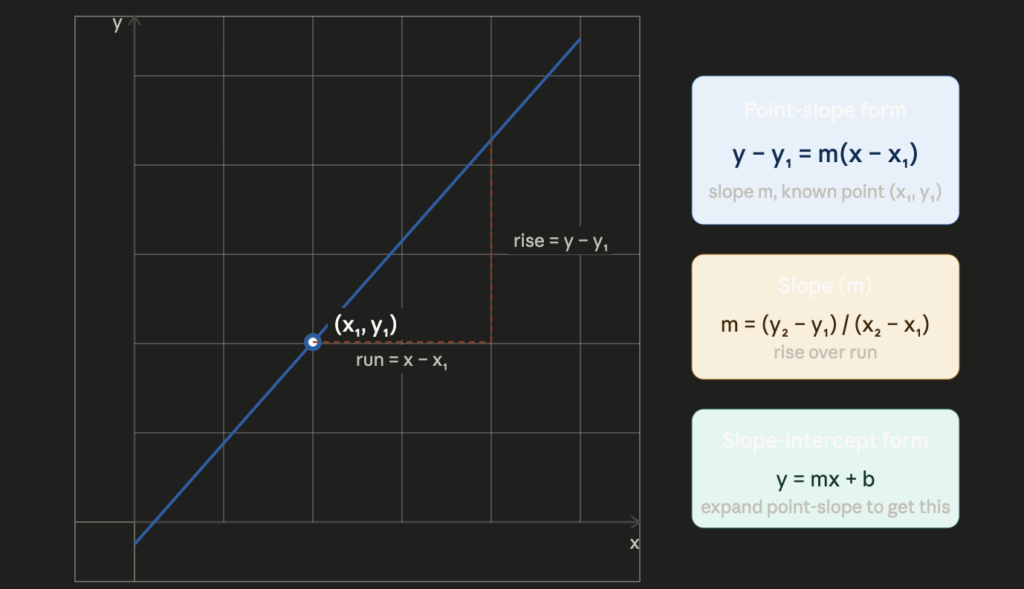
The point slope formula is a way of writing the equation of a straight line when you know:
- One point on the line, written as (x₁, y₁)
- The slope of the line, written as m
The formula is:
y − y₁ = m(x − x₁)
That’s it. Plug in your point and your slope, and you have the equation of the line.
This formula is one of three standard ways to write the equation of a straight line in Grade 9 math. The other two are:
| Form | Equation | When to use it |
|---|---|---|
| Point-slope form | y − y₁ = m(x − x₁) | When you have one point and the slope |
| Slope-intercept form | y = mx + b | When you have the slope and the y-intercept |
| Standard form | Ax + By = C | When the equation is written with integer coefficients |
All three describe the same line. They’re just different ways of writing it. Strong Grade 9 students can move between all three on demand.
The y-intercept in slope-intercept form is one of the most useful concepts in Grade 9 math. Once you know it, you can write the equation of any line, sketch the graph in seconds, and answer a huge class of EQAO Grade 9 questions almost automatically. For what the y-intercept actually means, how to find the y-intercept from a graph, two points, or an equation, and how to use it on EQAO-style problems, check out our guide Y-Intercept in Slope Intercept Form: How to Find It and Use It (Grade 9 Math).
The slope of a line formula
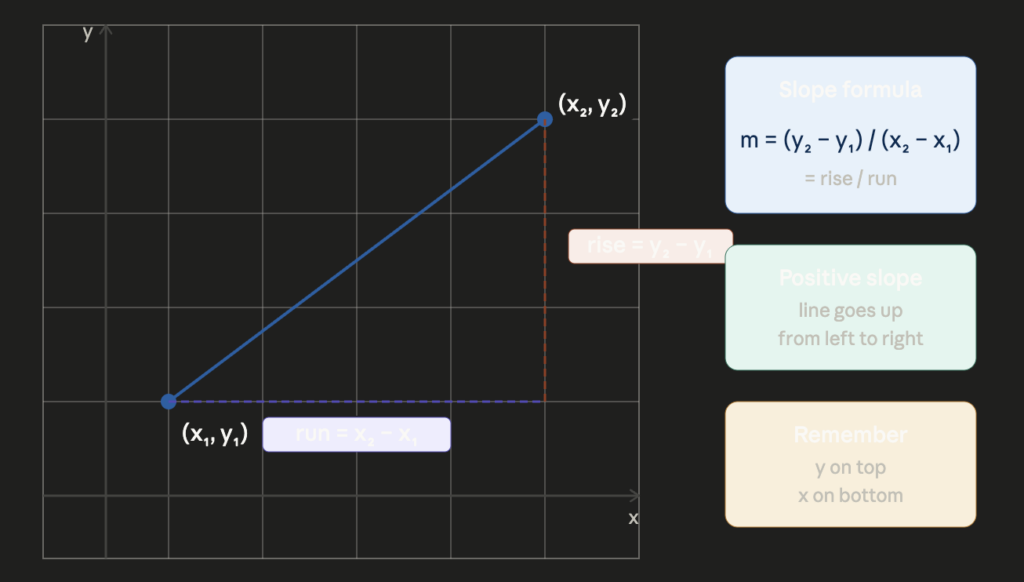
Before using the point slope formula, you need the slope (m). The slope of a line formula uses two points on the line:
m = (y₂ − y₁) / (x₂ − x₁)
Where (x₁, y₁) and (x₂, y₂) are any two points on the line.
What slope actually means
Slope measures how steep a line is. Specifically, it measures the rise over run: how much the line goes up (rise) for every unit it moves to the right (run).
- A positive slope means the line goes up from left to right
- A negative slope means the line goes down from left to right
- A slope of zero means the line is horizontal (flat)
- An undefined slope means the line is vertical (the formula would divide by zero)
Example 1 — finding slope from two points
Find the slope of the line passing through (2, 3) and (6, 11).
Pick (x₁, y₁) = (2, 3) and (x₂, y₂) = (6, 11).
m = (y₂ − y₁) / (x₂ − x₁) m = (11 − 3) / (6 − 2) m = 8 / 4 m = 2
The line has a slope of 2. For every 1 unit you move right, the line goes up 2 units.
Common mistake
Switching the order of x and y. The slope is rise over run, which means y on top and x on bottom — not the other way around. A surprisingly common error is to write m = (x₂ − x₁) / (y₂ − y₁), which gives the reciprocal of the actual slope. Sketch the two points on graph paper if you’re not sure; the formula always matches what your eyes see.
Where the point slope formula comes from
Understanding the derivation matters because students who memorise the point slope formula in isolation tend to forget it under pressure. Students who understand why it works can rebuild it in seconds.
Start with the slope of a line formula:
m = (y − y₁) / (x − x₁)
This says: for any point (x, y) on the line and any fixed point (x₁, y₁) on the line, the slope between them is m.
Now multiply both sides by (x − x₁):
m × (x − x₁) = y − y₁
Flip it around to put y − y₁ on the left:
y − y₁ = m(x − x₁)
That’s the point slope formula. It’s just the slope formula rearranged. Every time you use it, you’re really using the slope formula in disguise.
How to use the point slope formula — worked examples
Example 2 — straight application
Write the equation of the line that passes through (3, 5) with slope 4.
Plug into y − y₁ = m(x − x₁): y − 5 = 4(x − 3)
That’s the equation in point-slope form. Done.
If the question asks for the equation in slope-intercept form (y = mx + b), expand it:
y − 5 = 4(x − 3) y − 5 = 4x − 12 y = 4x − 12 + 5 y = 4x − 7
Same line, different form. The slope is still 4 and the y-intercept is −7.
Example 3 — when you only have two points
Find the equation of the line passing through (1, 2) and (5, 14).
Step 1: find the slope using the slope of a line formula.
m = (14 − 2) / (5 − 1) = 12 / 4 = 3
Step 2: pick one of the two points (it doesn’t matter which) and use the point slope formula. Let’s use (1, 2).
y − 2 = 3(x − 1)
Step 3 (optional): expand to slope-intercept form.
y − 2 = 3x − 3 y = 3x − 1
Both points should satisfy this equation. Check with (5, 14): 3(5) − 1 = 14. ✓
Example 4 — with negative slope and a negative coordinate
Write the equation of the line passing through (−2, 7) with slope −3.
Be careful with the signs:
y − 7 = −3(x − (−2)) y − 7 = −3(x + 2)
Expanding:
y − 7 = −3x − 6 y = −3x + 1
The double negative trips up students. (x − (−2)) becomes (x + 2). Always rewrite double negatives explicitly before expanding.
Slope formula intercept — converting between forms
The slope formula intercept form — y = mx + b — is the form most Grade 9 students are most comfortable with. Going between point-slope and slope-intercept is something you should be able to do without thinking.
From point-slope to slope-intercept
Start with: y − y₁ = m(x − x₁)
- Distribute m on the right
- Add y₁ to both sides
- Simplify
That’s the conversion. Example: y − 5 = 4(x − 3) becomes y = 4x − 12 + 5, which simplifies to y = 4x − 7.
From slope-intercept to point-slope
Start with: y = mx + b
The point (0, b) is on the line (it’s the y-intercept). So plug (0, b) into the point slope formula:
y − b = m(x − 0)
This simplifies to y = mx + b, which is back where we started. The two forms are mathematically equivalent.
In practice, the point-slope form is easier when you have any random point on the line. Slope-intercept form is easier when you specifically have the y-intercept.
When EQAO asks for one form vs the other
EQAO Grade 9 questions don’t always specify which form to use. Common phrasings:
- “Write the equation of the line” — usually expects slope-intercept form (y = mx + b)
- “Find an equation of the line” — either form is acceptable
- “Express in standard form” — convert to Ax + By = C with integer coefficients
- “Write in the form y = mx + b” — explicit, must use slope-intercept
When in doubt, write the answer in slope-intercept form. It’s the form most teachers and most automated answer-checkers expect.
Want to see whether you’d pass an EQAO test with your current knowledge? Try our free EQAO assessment and get free feedback and resources to study with!
The slope perpendicular formula
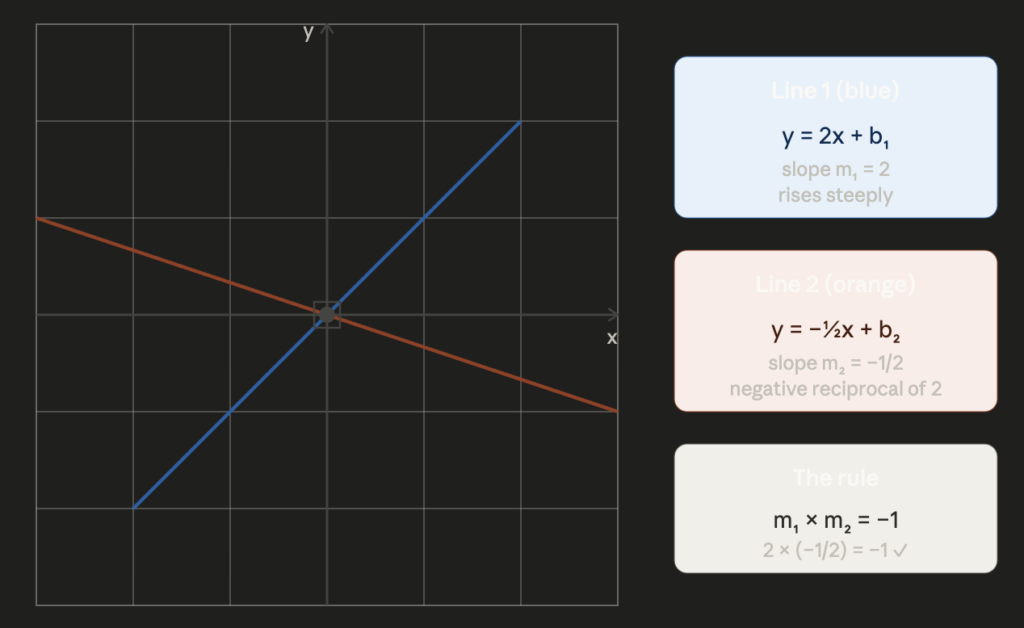
Two lines are perpendicular if they meet at a 90° angle. The relationship between their slopes is one of the most heavily tested concepts on EQAO Grade 9 and in Grade 10 math.
The rule
If line 1 has slope m₁ and line 2 has slope m₂, and the two lines are perpendicular, then:
m₁ × m₂ = −1
Or equivalently:
m₂ = −1 / m₁
The slope of a perpendicular line is the negative reciprocal of the original slope.
What “negative reciprocal” means
To find the negative reciprocal of a number:
- Flip the fraction (find the reciprocal)
- Change the sign (positive becomes negative, or vice versa)
| Original slope | Negative reciprocal |
|---|---|
| 2 | −1/2 |
| −3 | 1/3 |
| 1/4 | −4 |
| −2/5 | 5/2 |
| 1 | −1 |
A horizontal line (slope 0) is perpendicular to a vertical line (undefined slope). These are the edge cases where the formula breaks down, because dividing by 0 isn’t defined.
Parallel lines, for contrast
Two lines are parallel if they have the same slope and never intersect. So if line 1 has slope 3, any line with slope 3 is parallel to it.
| Relationship | Slope condition |
|---|---|
| Parallel | m₁ = m₂ |
| Perpendicular | m₁ × m₂ = −1 |
| Neither | All other cases |
Example 5 — perpendicular line problem (EQAO Level 3)
Find the equation of the line that passes through (4, −1) and is perpendicular to the line y = 2x + 5.
Step 1: identify the slope of the original line.
The line y = 2x + 5 has slope m₁ = 2.
Step 2: find the slope of the perpendicular line using the slope perpendicular formula.
m₂ = −1 / m₁ = −1 / 2
Step 3: use the point slope formula with the new slope and the given point (4, −1).
y − (−1) = (−1/2)(x − 4) y + 1 = (−1/2)(x − 4)
Step 4: expand to slope-intercept form.
y + 1 = (−1/2)x + 2 y = (−1/2)x + 2 − 1 y = (−1/2)x + 1
The perpendicular line is y = (−1/2)x + 1. You can check: its slope is −1/2, and 2 × (−1/2) = −1. ✓
This is a classic EQAO Grade 9 Level 3 question. Students who know the slope perpendicular formula cold can solve it in under two minutes.
Special cases — horizontal and vertical lines
Two slope situations break the standard formulas, and they appear regularly on EQAO.
Horizontal lines (slope = 0)
A horizontal line has slope 0. Its equation is always y = c, where c is the y-coordinate of any point on the line. For example, the line passing through (3, 7) horizontally is y = 7.
You can derive this from the point slope formula:
y − 7 = 0 × (x − 3) y − 7 = 0 y = 7
The x dropped out entirely because the slope is 0.
Vertical lines (undefined slope)
A vertical line has an undefined slope. Its equation is always x = c, where c is the x-coordinate of any point on the line. For example, the line passing through (3, 7) vertically is x = 3.
The point slope formula doesn’t work for vertical lines because the slope formula would divide by zero. For vertical lines, skip the formula entirely and just write x = (the x-coordinate).
A common trap
If EQAO asks for the equation of a line perpendicular to a horizontal line, the perpendicular is vertical. This catches students who try to use m₂ = −1 / m₁ with m₁ = 0, which divides by zero. The correct answer is just x = (something), no formula needed.

Common point slope formula mistakes
After marking thousands of Grade 9 papers, the same handful of mistakes come up over and over.
Sign errors with the subtraction. y − y₁ = m(x − x₁) involves subtracting the coordinates of the point. If the point is (−2, 7), then x − x₁ becomes x − (−2) = x + 2. Double negatives convert to positives, and students who don’t rewrite them explicitly often forget.
Mixing up x₁ and y₁. Some students put the x-coordinate on the y side or vice versa. Always label your point clearly: “x₁ = 3, y₁ = 5” before substituting.
Forgetting to distribute the slope. y − 5 = 4(x − 3) expands to y − 5 = 4x − 12, not y − 5 = 4x − 3. The 4 has to multiply both terms inside the bracket.
Using the slope formula incorrectly. m = (y₂ − y₁) / (x₂ − x₁), not the other way around. Always y on top.
Confusing parallel and perpendicular. Parallel = same slope. Perpendicular = negative reciprocal. They’re easy to mix up under exam pressure.
Forgetting that vertical lines have undefined slopes. If the slope formula gives you “divide by zero,” the line is vertical, and the equation is simply x = (the x-coordinate).
How the point slope formula connects to senior math
The point slope formula isn’t just a Grade 9 topic. It reappears constantly through senior math.
In Grade 10 Principles of Mathematics (MPM2D), linear equations expand into systems of equations, and the point-slope form remains the fastest way to write the equation of any single line.
In Grade 11 Functions (MCR3U), linear functions become a special case of the broader function families, and the slope concept generalises to the average rate of change between two points on any function.
In Grade 12 Advanced Functions and Calculus, slope becomes the derivative — the instantaneous rate of change at a single point. Calculus uses point-slope form constantly when writing equations of tangent lines. Students who never properly mastered the Grade 9 formula struggle with the very first chapter of MCV4U.
In Canadian math contests like the Pascal, Cayley, and Fermat, linear equations appear regularly in coordinate geometry problems. A Cayley Part B question might give two points and ask for the equation of a perpendicular line through a third point — exactly the workflow this blog covers.
How Think Academy Canada teaches slope and linear equations
Think Academy is the international arm of TAL Education Group, one of the largest education companies in the world. Our Canadian programs build linear equations the same way we build every other topic: derivation first, then memorisation, then application across increasing difficulty levels.
We teach the point slope formula as a rearrangement of the slope of a line formula, not as something to memorise from scratch. Students who understand why y − y₁ = m(x − x₁) is just the slope formula in disguise are far less likely to forget it under EQAO pressure.
Our curriculum runs ahead of the Ontario MTH1W timeline, so Grade 8 students at Think Academy meet linear equations before their Grade 9 school classmates do. By the time the topic comes up in school, it’s review.
Our practice problem library includes hundreds of problems on slope, point-slope, slope-intercept, parallel, and perpendicular lines, organised by difficulty from straightforward Grade 9 questions up to Fermat and AMC contest problems.
Our teachers mark every homework set personally, with written feedback on the types of mistakes a student is making. Auto-graded software can tell a student they got a question wrong; it can’t tell them whether the issue is sign errors, formula misuse, or a deeper conceptual gap.
We offer free MTH1W evaluations before any paid program, so parents can see exactly where their child stands on linear equations before committing.
Frequently asked questions
What is the point slope formula?
The point slope formula is y − y₁ = m(x − x₁), where m is the slope of the line and (x₁, y₁) is any known point on the line. It lets you write the equation of any line as soon as you know one point on it and its slope.
How is the point slope formula different from slope-intercept form?
Point-slope form uses any point on the line and the slope: y − y₁ = m(x − x₁). Slope-intercept form uses the y-intercept specifically and the slope: y = mx + b. They describe the same line in different forms. You can convert between them by expanding the brackets in the point-slope form.
What is the slope of a line formula?
The slope of a line formula is m = (y₂ − y₁) / (x₂ − x₁), where (x₁, y₁) and (x₂, y₂) are any two points on the line. It measures the rise (change in y) over the run (change in x).
What is the slope perpendicular formula?
If two lines are perpendicular, their slopes multiply to give −1: m₁ × m₂ = −1. Equivalently, the slope of a perpendicular line is the negative reciprocal of the original slope. For example, the slope perpendicular to 2 is −1/2.
How do I find the equation of a line given two points?
First, find the slope using the slope of a line formula: m = (y₂ − y₁) / (x₂ − x₁). Then plug the slope and either of the two points into the point slope formula: y − y₁ = m(x − x₁). Finally, expand to slope-intercept form if the question requires y = mx + b.
What’s the slope of a horizontal line?
A horizontal line has slope 0. Its equation is y = c, where c is the y-coordinate of any point on the line.
What’s the slope of a vertical line?
A vertical line has an undefined slope (the slope of a line formula would divide by zero). Its equation is x = c, where c is the x-coordinate of any point on the line.
How do I know if two lines are parallel?
Two lines are parallel if they have the same slope and different y-intercepts. If they have the same slope and the same y-intercept, they’re the same line.
Is the point slope formula on the EQAO Grade 9 formula sheet?
Yes. The point slope formula y − y₁ = m(x − x₁), along with the slope of a line formula and the slope-intercept form, all appear on the official EQAO Grade 9 formula sheet. Students should still know them by memory because the formula sheet doesn’t tell you which form to use in any given problem.
How heavily does EQAO Grade 9 test linear equations?
Heavily. Linear relationships (slope, point-slope form, slope-intercept form, parallel and perpendicular lines, graphing) account for roughly 15–20% of an average EQAO Grade 9 paper. It’s the single highest-leverage topic to master.