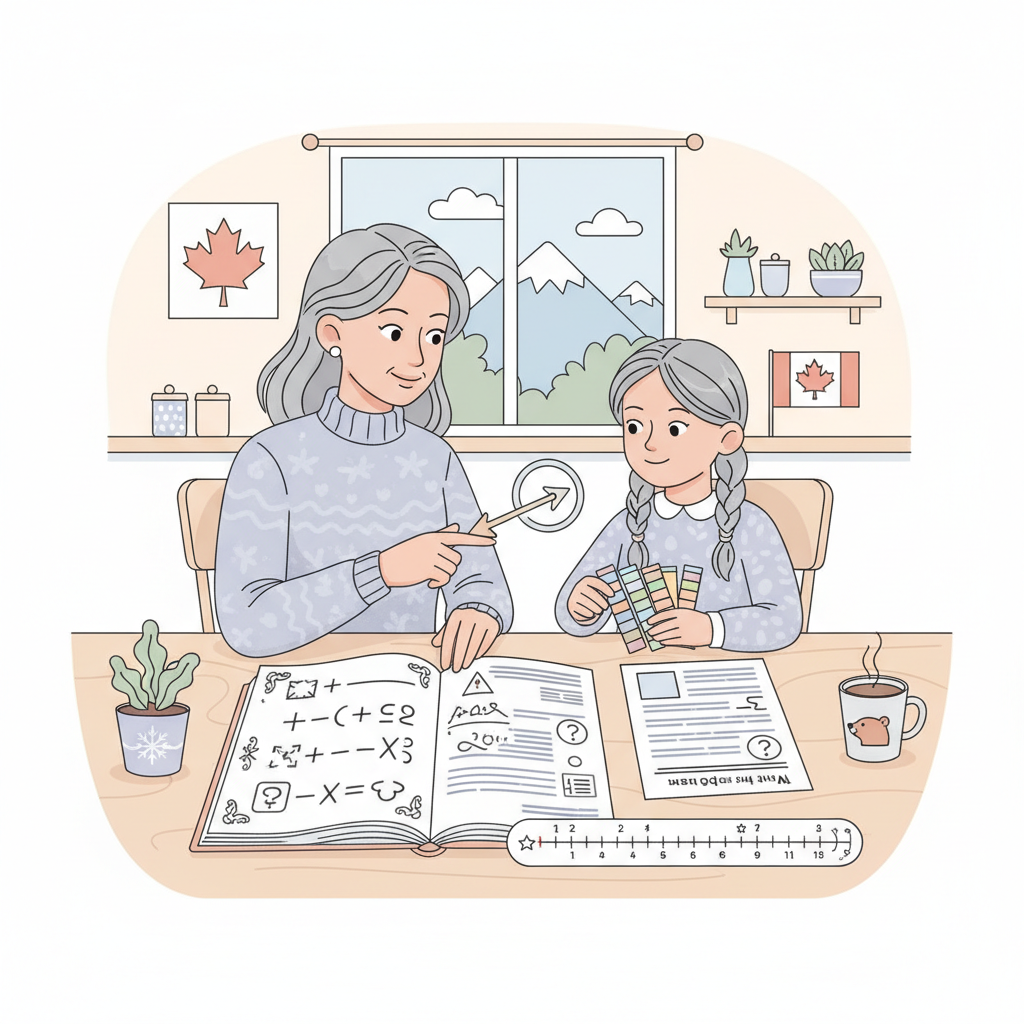
If homework suddenly takes longer, your child guesses more, or math confidence dips, the transition from Grade 5 to Grade 6 math may be the reason. Grade 6 typically asks students to explain their thinking more clearly, juggle more steps in a single question, and use fractions, decimals, and whole numbers together. This article breaks down what usually changes, why it feels harder, and what you can do this month to make math feel steady again.
Want to know exactly what to work on going in to Grade 6? Get a free feedback report and tailored resources here.
Intro: Why Grade 6 Math Can Feel Like a Leap
In many Canadian provinces, Grade 6 is a consolidation year: students still learn new content, however they also combine older skills in more complex ways. That often means fewer “one-skill” worksheets and more questions that require reading carefully, choosing a strategy, and showing reasoning (explaining why a solution works).
Because education is provincial, exact expectations vary. Still, you can confirm common strands such as number, algebra, data, and geometry in official curriculum documents like the Ontario elementary mathematics curriculum and Alberta’s K–6 curriculum.
transition from Grade 5 to Grade 6 math: The Biggest Skill Shifts
The most noticeable change is not always the topic—it is the demand for accuracy, clarity, and stamina. For example, a Grade 5 student might compute correctly, but a Grade 6 student also needs to justify choices and catch mistakes independently. Therefore, “doing math” becomes “doing math and explaining it.”
1) Fractions become a daily tool (not a unit)
By Grade 6, students use fractions across many topics, including measurement and problem solving. They often compare fractions, find equivalent forms, and operate with them more flexibly. If fraction sense is shaky, Grade 6 can feel frustrating quickly.
- Key idea: Equivalent fractions (different-looking fractions with the same value)
- Key habit: Estimating first (e.g., knowing 5/8 is a bit more than 1/2)
- Common snag: Treating numerator and denominator as separate whole numbers
If you want a simple reference for quick refreshers, Britannica’s overview of fractions can help you and your child use the same vocabulary.
2) Decimals and whole numbers mix more often
Grade 6 tends to use decimals in more “real-life math” contexts, such as money, measurement, and data. Students may be expected to align place values reliably and interpret decimal size correctly. However, many children still confuse tenths and hundredths when rushing.
- Practical check: Ask “Is your answer reasonable?” before finishing
- Home support: Use a ruler or measuring cup to connect decimals to length/volume
3) Early algebra thinking shows up more clearly
Grade 6 often introduces or strengthens patterns, relationships, and variables (letters that stand for numbers). This is not high-school algebra; instead, it is the start of generalizing rules, such as describing a pattern with words or a simple expression (a math sentence like 3n + 2). For a parent-friendly definition of a variable, Wikipedia can be a quick starting point, and you can then match terms to your province’s curriculum wording.
4) Multi-step word problems become the norm
Many Grade 6 questions combine reading comprehension with math operations. Therefore, students must identify relevant information, ignore distractors, and choose an efficient plan. This is where strong “math communication” matters: neat work, labelled units, and clear steps.
What Grade 6 Questions Look Like (With a Parent-Friendly Comparison)
Teachers often increase complexity by changing one feature at a time: more steps, more operations, or less direct wording. The table below shows how the same skill can “level up.”
| Skill | Typical Grade 5 Task | Typical Grade 6 Task |
|---|---|---|
| Fractions | Compare 3/4 and 2/3 | Decide which recipe uses more flour and justify using a model (diagram) and computation |
| Decimals | Add 2.4 + 1.35 | Estimate, add, then explain why your answer makes sense in a money scenario |
| Patterns | Find the next number in a pattern | Describe the rule and write an expression for term n (the nth term means “the term in position n”) |
| Problem solving | One-step word problem | Two- or three-step problem with extra information and a required written explanation |
Common Grade 5-to-6 Gaps (And How to Spot Them Early)
Many children “pass” Grade 5 while still relying on memorized steps. In Grade 6, that can break down because questions vary more. However, you can often spot the gap by listening to how your child explains an answer.
- If your child says “I just did it,” practise asking “How do you know?”
- If your child avoids fractions, rebuild confidence with visuals (fraction strips, number lines)
- If your child makes small errors, slow down and add a self-check step every time
A Simple 4-Week Home Plan (15 Minutes, 4 Days a Week)
You do not need long sessions to help. Instead, short practice with feedback builds consistency. Keep sessions calm, and stop before your child burns out.
Week 1: Rebuild fraction meaning
- Use a number line to place 1/2, 2/3, 3/4, 5/8
- Practise finding equivalent fractions (e.g., 1/2 = 2/4 = 3/6)
- Do 2 word problems that use fractions in context (recipes, sharing)
Week 2: Strengthen decimals and estimation
- Daily: estimate then calculate (e.g., 3.98 + 2.1 is about 6.1)
- Compare decimals using place value language (tenths, hundredths)
- Use money problems to connect to real amounts
Week 3: Add multi-step word problems
- Teach a routine: Read, Underline, Plan, Solve, Check
- Ask your child to write one sentence explaining the strategy
- Practise unit checks (cm, mL, $, minutes) to catch errors
Week 4: Introduce gentle pre-algebra thinking
- Find rules in patterns (add 3 each time, double then subtract 1)
- Use a box or letter for an unknown (e.g., □ + 7 = 19)
- Have your child explain what the symbol represents
Tools & Resources You Can Trust
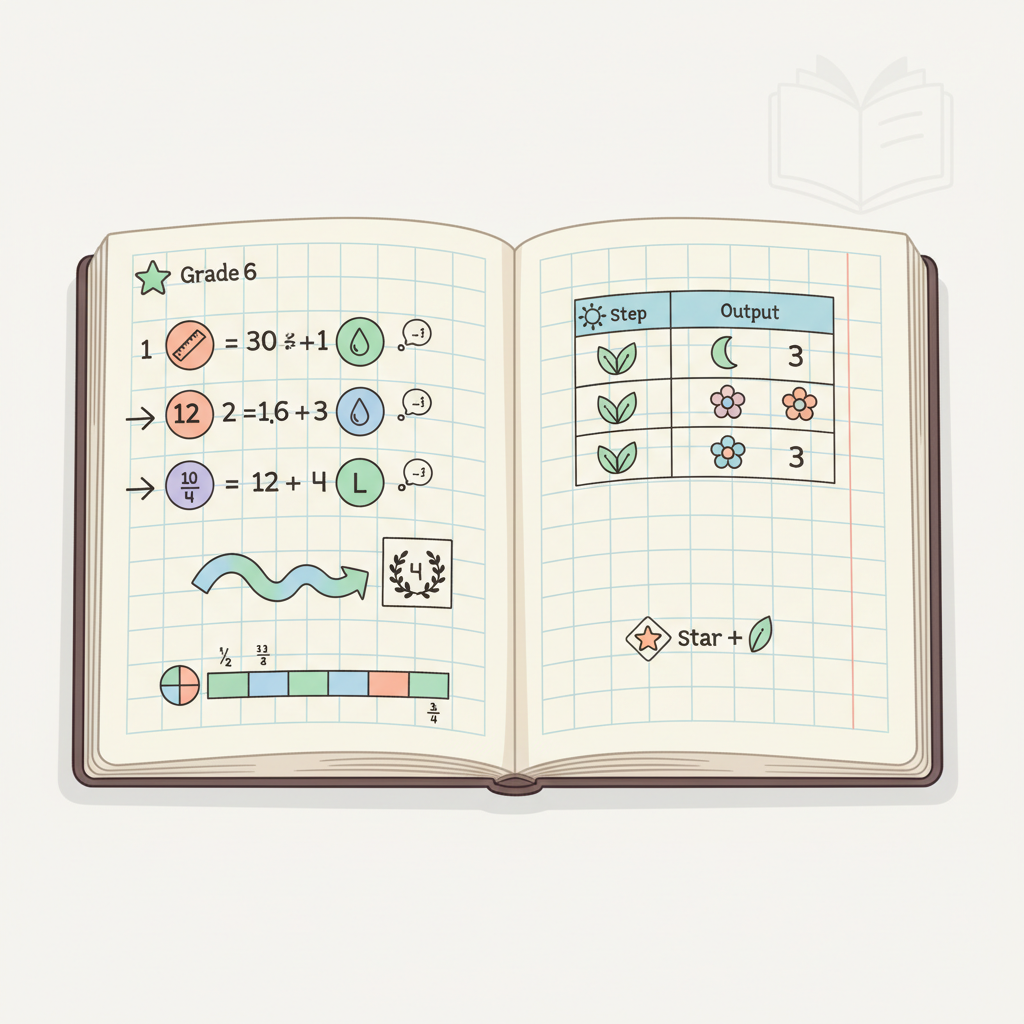
When you choose resources, prioritize official curriculum language and evidence-based practice. These options are widely used and easy to verify.
- Ontario Ministry of Education: Elementary Mathematics (official curriculum expectations)
- BC Ministry of Education and Child Care: Curriculum (official learning standards)
- Alberta Education: K–6 curriculum (official program information)
- Khan Academy Math (free practice with videos and immediate feedback)
- GeoGebra (free interactive tools for number lines, geometry, and graphs)
For clear definitions of terms that come up in homework, you can also use Britannica as a parent reference.
How to Talk to Your Child About Harder Math (Without Pressure)
Confidence often drops before skills do. Therefore, aim to normalize challenge and make effort visible. Instead of “You’re so smart,” try “Your strategy worked because you checked your units.”
- Use “yet” language: “You don’t see it yet, but we can figure it out.”
- Ask for reasoning: “What did you try first, and why?”
- Separate speed from understanding: “Let’s go slow and be accurate.”
Concluding Paragraph
The transition from Grade 5 to Grade 6 math is easier when you focus on a few core skills: fraction sense, place value with decimals, clear explanations, and steady multi-step problem solving. Start small, practise consistently, and watch for reasoning—not just answers. If your child feels stuck, a quick skills check can show exactly which building blocks need attention, so learning feels manageable again.
Take a free Math Evaluation to identify your child’s learning strengths and next steps.
About Think Academy
Think Academy, part of TAL Education Group, helps K–12 students succeed in school today by building strong math foundations and critical thinking skills. At the same time, we focus on the bigger picture—developing learning ability, curiosity, and healthy study habits that inspire a lifelong love of learning. With expert teachers, proven methods, and innovative AI tools, we support every child’s journey from classroom confidence to long-term growth.
Want more insights into math learning and parenting? Subscribe to our newsletter for weekly tips and the latest resources.