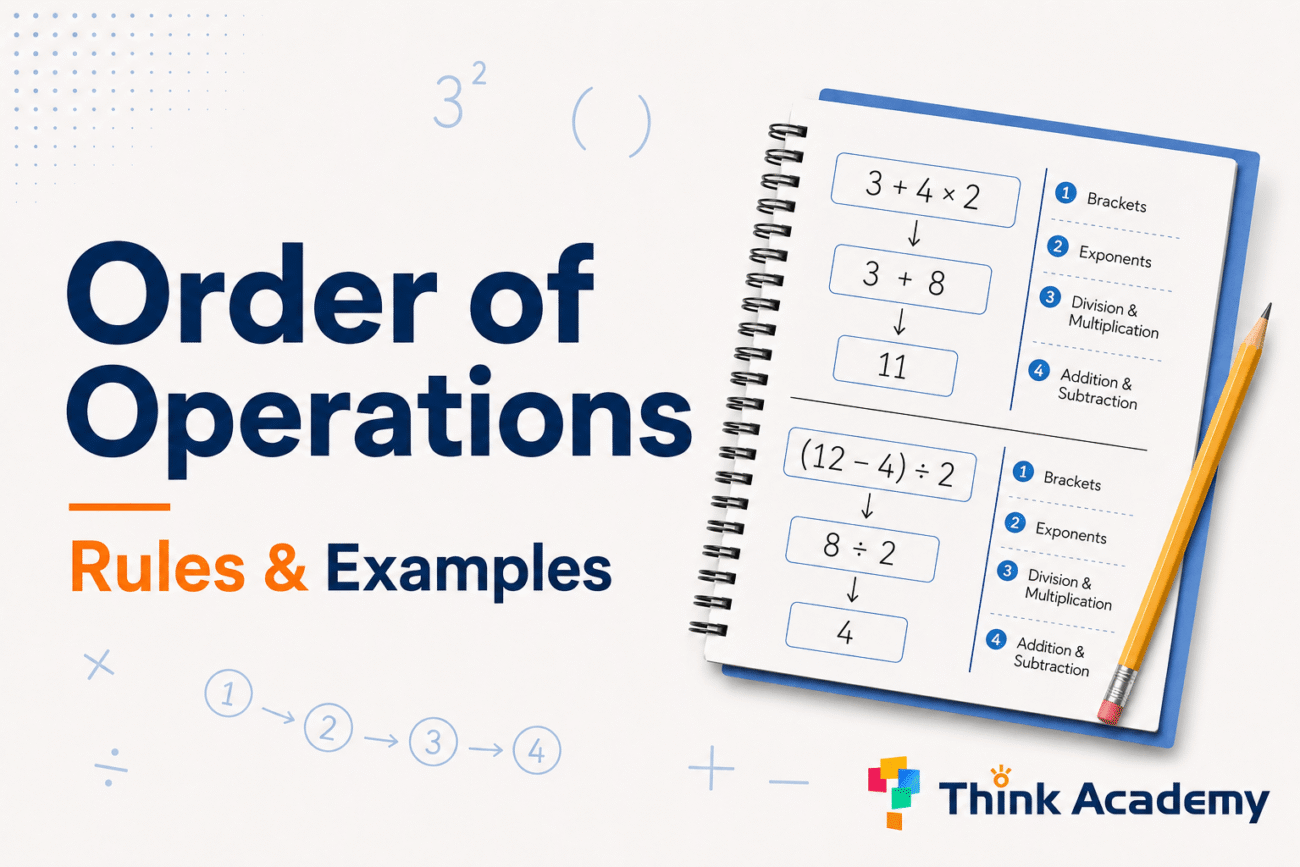
The math order of operations is one of the most important — and most misunderstood — concepts in elementary and middle school mathematics. It appears in Grades 5 through 9 across Canada, affects everything from basic arithmetic to algebra, and is the source of some of the most common errors students make when they start secondary school mathematics.
This guide explains the math order of operations clearly, with step-by-step examples, common mistakes, and practice problems at the end. If your child is confused by BEDMAS or keeps getting different answers to the same expression, this is the right place to start.
What Is the Math Order of Operations?
The math order of operations is a set of rules that tells you which part of a mathematical expression to calculate first when there are multiple operations involved.
Without a consistent order of operations, the same expression could produce different answers depending on which operation you did first. That would make mathematics unreliable — which is why mathematicians agreed on a universal rule.
In Canada, the math order of operations is taught using the acronym BEDMAS:
| Letter | Stands For | Example |
|---|---|---|
| B | Brackets | (3 + 4) |
| E | Exponents | 2³ |
| D | Division | 20 ÷ 4 |
| M | Multiplication | 5 × 3 |
| A | Addition | 8 + 6 |
| S | Subtraction | 12 − 5 |
The rule: Always work through a mathematical expression in this order — Brackets first, then Exponents, then Division and Multiplication (left to right), then Addition and Subtraction (left to right).
You may also see PEMDAS (used in the US, where P stands for Parentheses) or BODMAS (used in the UK, where O stands for Orders). These are all the same rule, just with different acronyms.
Why the Math Order of Operations Matters
Here is the classic example that shows why math order of operations rules exist:
What is 2 + 3 × 4?
If you go left to right without the math order of operations: 2 + 3 = 5, then 5 × 4 = 20 ✗
If you apply the math order of operations (multiplication before addition): 3 × 4 = 12, then 2 + 12 = 14 ✓
The correct answer is 14 — and anyone who learned the math order of operations will get the same answer every time.
This is not a trick question. It is the core reason the math order of operations was established: to ensure that mathematical expressions have exactly one correct interpretation, regardless of who is reading them.
BEDMAS Explained Step by Step
Step 1: Brackets First
Always calculate everything inside brackets before anything outside them.
Example: (5 + 3) × 4 → First: 5 + 3 = 8 → Then: 8 × 4 = 32
Compare to: 5 + 3 × 4 (no brackets) → First: 3 × 4 = 12 (multiplication before addition) → Then: 5 + 12 = 17
The brackets completely change the answer. This is exactly what they are designed to do — they override the default math order of operations.
Nested brackets: When brackets appear inside other brackets, always work from the innermost set outward.
Example: ((2 + 3) × 4) − 6 → Innermost: 2 + 3 = 5 → Next bracket: 5 × 4 = 20 → Final: 20 − 6 = 14
Step 2: Exponents
After brackets, evaluate any exponents (powers).
Example: 3 + 2³ × 4 → First: 2³ = 8 → Then: 8 × 4 = 32 (multiplication before addition) → Final: 3 + 32 = 35
Step 3: Division and Multiplication (Left to Right)
Division and multiplication have equal priority in the math order of operations. When both appear in an expression, work from left to right — whichever comes first gets done first.
Example: 20 ÷ 4 × 3 → Left to right: 20 ÷ 4 = 5, then 5 × 3 = 15 ✓
Common mistake: Doing multiplication before division because M comes before D in BEDMAS. → 20 ÷ (4 × 3) = 20 ÷ 12 ≈ 1.67 ✗
The left-to-right rule is critical. DM are equal partners — neither comes before the other. The one that appears first in the expression gets done first.
Step 4: Addition and Subtraction (Left to Right)
Exactly like multiplication and division, addition and subtraction have equal priority. Work left to right.
Example: 15 − 6 + 4 → Left to right: 15 − 6 = 9, then 9 + 4 = 13 ✓
Common mistake: Always adding before subtracting. → 15 − (6 + 4) = 15 − 10 = 5 ✗
Worked Examples: Math Order of Operations in Action
Example 1 (Grade 5 level): 4 + 6 ÷ 2
Step 1: Division first → 6 ÷ 2 = 3 Step 2: Addition → 4 + 3 = 7
Example 2 (Grade 6 level): 3 × (8 − 5) + 2²
Step 1: Brackets → 8 − 5 = 3 Step 2: Exponents → 2² = 4 Step 3: Multiplication → 3 × 3 = 9 Step 4: Addition → 9 + 4 = 13
Example 3 (Grade 7 level): 18 ÷ 3 + 4 × 2 − 5
Step 1: Division → 18 ÷ 3 = 6 Step 2: Multiplication → 4 × 2 = 8 Step 3: Left to right (addition then subtraction) → 6 + 8 = 14, then 14 − 5 = 9
Example 4 (Grade 8 level): (2³ + 4) ÷ 3 − 1
Step 1: Brackets (exponent inside) → 2³ = 8, then 8 + 4 = 12 Step 2: Division → 12 ÷ 3 = 4 Step 3: Subtraction → 4 − 1 = 3
Example 5 (Grade 9 challenge): 5 + 2 × (3² − 1) ÷ 4
Step 1: Brackets (exponent inside) → 3² = 9, then 9 − 1 = 8 Step 2: Left to right (multiplication before division, left to right) → 2 × 8 = 16, then 16 ÷ 4 = 4 Step 3: Addition → 5 + 4 = 9
The Most Common Math Order of Operations Mistakes
Students who understand BEDMAS in principle still make predictable errors. Knowing the common mistakes in advance helps avoid them.
Mistake 1: Ignoring left-to-right for division and multiplication. Thinking M always comes before D is the single most common math order of operations error at the Grade 6–7 level. Remember: D and M are equal. Work left to right.
Mistake 2: Ignoring left-to-right for addition and subtraction. Same principle as above. A and S are equal — left to right always.
Mistake 3: Forgetting to apply BEDMAS inside brackets. The math order of operations applies inside brackets too. (2 + 3 × 4) is not (2 + 3) × 4 — you still do multiplication before addition inside the brackets.
Mistake 4: Treating negative numbers carelessly. Expressions involving negative numbers and operations need particular care. −3² means −(3²) = −9, not (−3)² = 9. The exponent applies to 3, not to −3, unless there are brackets.
Mistake 5: Rushing through multi-step expressions. The math order of operations requires working through an expression in stages, rewriting after each step. Students who try to do it all mentally or skip rewriting intermediate steps make significantly more errors than those who work through it methodically, one step at a time.
Math Order of Operations Practice Problems
Work through these problems applying BEDMAS. Answers are at the bottom — try them before checking.
Set A — Grade 5/6 Level
- 5 + 3 × 2 = ___
- (7 + 3) × 4 = ___
- 24 ÷ 6 + 5 = ___
- 8 − 2 + 5 = ___
- 3 × 4 − 8 ÷ 2 = ___
- (9 − 3) ÷ 2 × 4 = ___
Set B — Grade 7/8 Level
- 2³ + 4 × 3 = ___
- (5 + 3) × (8 − 4) ÷ 4 = ___
- 36 ÷ 4 − 2 × 3 + 5 = ___
- 3 × (2 + 4²) − 6 = ___
- (8 − 3)² ÷ 5 + 7 = ___
- 4 + 6 × 2 − 3² ÷ 3 = ___
Set C — Grade 9 Challenge
- 2 + 3 × (4² − 10) ÷ 3 = ___
- (5² − 4 × 3) ÷ (7 − 2) × 2 = ___
- 6 × 2 − (3 + 1)² + 8 ÷ 2 = ___
Answers:
Set A: 1) 11 2) 40 3) 9 4) 11 5) 8 6) 12
Set B: 7) 20 8) 8 9) 8 10) 48 11) 12 12) 13
Set C: 13) 8 14) 26/5 = 5.2 15) 6
Math Order of Operations in the Ontario Curriculum
The math order of operations is first introduced formally in the Ontario curriculum in Grade 6, and is applied and extended through to Grade 9 and beyond. It underpins:
- All algebraic expressions in Grades 7–9
- The Ontario Grade 9 MTH1W curriculum, where students work with multi-step algebraic expressions
- EQAO Grade 6 assessment — where order of operations questions appear in the Number strand
- Every standardised mathematics assessment from Grade 6 onward, including EQAO and the AMC series
A student who has not fully internalised the math order of operations by the end of Grade 6 will make consistent errors in Grades 7, 8, and 9 — in algebra, in expressions, and in multi-step problem-solving — without necessarily understanding why their answers are wrong.
For the curriculum context around how math order of operations connects to the broader mathematics programme, see our Grade 6 math curriculum guide, Grade 7 math curriculum guide, and Ontario Grade 9 math curriculum guide.
Math Order of Operations in Mathematics Competitions
For students interested in mathematics competitions, the math order of operations is assumed knowledge at every level — from the Gauss Contest (Grades 7–8) through to the AMC 8 and AMC 10. Contest problems regularly include multi-step expressions where misapplying the math order of operations costs marks — and more importantly, where fluency with it frees up mental capacity for the harder parts of the problem.
A student who has to consciously think through BEDMAS while solving a multi-step contest problem is using cognitive resources that should be available for the mathematical reasoning the problem is actually testing. Fluency — not just accuracy — is the goal.
For students preparing for competitions, our math competitions in Canada guide and math enrichment guide cover the full landscape.
How to Help Your Child Master Math Order of Operations
Practice the steps out loud. Ask your child to talk through each step as they work — “brackets first, so I do this… then exponents… then left to right for division and multiplication.” Verbalising the process builds the habit more effectively than silent practice.
Use the rewrite method. After completing each step, write out the new expression with that step evaluated. This prevents the most common error — trying to track multiple changes mentally and losing the thread. A student who rewrites after every step makes far fewer errors than one who tries to hold everything in their head.
Start simple, add complexity gradually. Master two-operation expressions before moving to three, and three before moving to expressions with brackets and exponents. The math order of operations is a sequential skill — the foundation has to be solid before more complexity is added.
Connect it to algebra. The math order of operations becomes most important when students start working with algebraic expressions in Grade 7. If your child is heading into Grade 7 with shaky order of operations foundations, address it over the summer — it will affect their algebra performance from the first week of school.
For more on how number and algebra skills build across the elementary years, see our number sense parent guide and adding and subtracting integers guide.
How Think Academy Can Help
Think Academy Canada works with students from Grade 1 through Grade 12. For students in Grades 5–8, the math order of operations is one of a small number of foundational skills that our instructors assess in every diagnostic — because it appears so consistently in the errors students make across other topic areas.
When a student consistently gets wrong answers on multi-step problems without understanding why, the math order of operations is one of the first things our instructors check. Addressing it directly, in the context of the student’s specific error patterns, is faster and more effective than worksheets alone.
The free diagnostic assessment identifies exactly where your child’s current understanding of the math order of operations and other core skills sits — specific enough to act on, whether through Think Academy or through targeted home practice.
Frequently Asked Questions
What is the math order of operations? A set of rules that determines the sequence in which operations are performed in a mathematical expression. In Canada, it is taught using the acronym BEDMAS: Brackets, Exponents, Division, Multiplication, Addition, Subtraction.
What does BEDMAS stand for? Brackets, Exponents, Division, Multiplication, Addition, Subtraction. It is the Canadian equivalent of PEMDAS (US) and BODMAS (UK) — all three represent the same math order of operations rules.
Is it always left to right for division and multiplication? Yes. Division and multiplication have equal priority in the math order of operations. When both appear in the same expression, work from left to right — whichever appears first gets done first. The same applies to addition and subtraction.
What grade is math order of operations taught? Math order of operations is formally introduced in Grade 6 in Ontario and most Canadian provinces. It is applied throughout Grades 7, 8, and 9 in increasingly complex algebraic expressions.
Why does my child keep getting different answers to the same problem? Almost certainly because they are not consistently applying the math order of operations — specifically the left-to-right rule for division/multiplication or addition/subtraction, or forgetting to evaluate brackets first. This is the most common cause of inconsistent answers to multi-step expressions.
Does the math order of operations apply inside brackets? Yes. The full BEDMAS rule applies inside brackets as well. If a bracket contains multiple operations, evaluate them in BEDMAS order before using the result outside the bracket.
See our related guides: Grade 6 math curriculum Ontario · Grade 7 math curriculum Ontario · Grade 8 math curriculum Ontario · Ontario Grade 9 math curriculum · number sense parent guide · adding and subtracting integers · Gauss math contest guide · AMC 8 guide · math enrichment guide
The math order of operations is foundational. Make sure your child has it — properly.