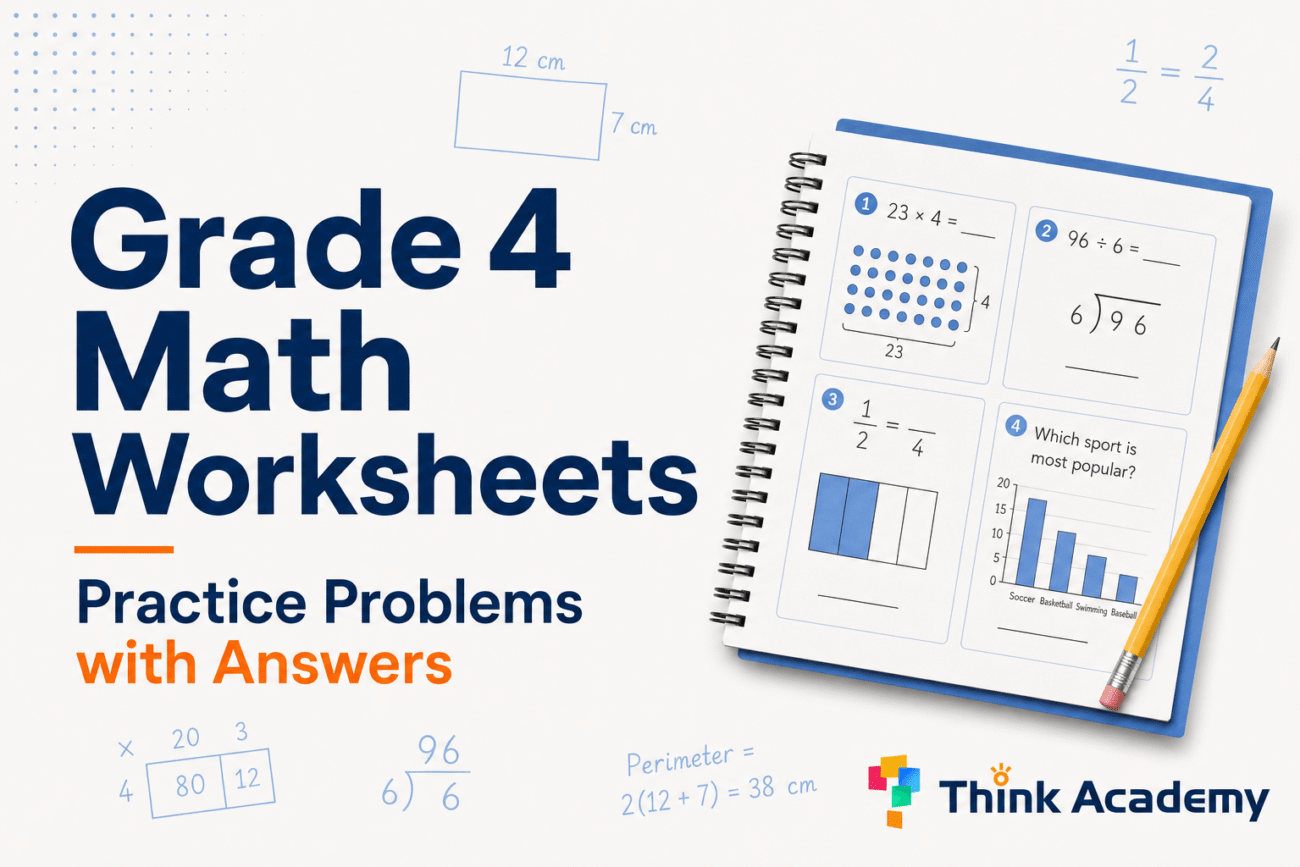
Grade 4 is when the mathematics curriculum makes its first significant jump in complexity. Multi-digit multiplication, long division, decimals, and equivalent fractions all arrive in the same year — and students who were comfortable in Grade 3 sometimes find Grade 4 harder than expected. Consistent practice at home using Grade 4 math worksheets targeted at the right skills, closes gaps before they compound.
This page provides free Grade 4 math practice problems across every major curriculum strand, with full answers. Use them for daily practice, test preparation, or to identify where your child needs more focused work.
What Grade 4 Math Covers in Canada
The Ontario Grade 4 mathematics curriculum — closely aligned with other Canadian provincial curricula — covers five main strands:
- Number — place value to 10,000, multiplication to 12×12, long division, fractions and equivalent fractions, decimals to tenths and hundredths
- Algebra — patterns with multiple attributes, introduction to variables, equations with unknowns
- Data — bar graphs, line plots, median, and basic data analysis
- Spatial Sense (Geometry) — lines, angles, quadrilaterals, transformations (flips, slides, turns)
- Measurement — perimeter, area, time, and unit conversions
For a complete breakdown of the Ontario Grade 4 curriculum by strand, see our Grade 4 math curriculum Ontario guide.
Grade 4 Math Worksheets: Number Practice Problems
Multi-Digit Multiplication
Practice Set 1 — Multiplying 2-digit × 1-digit
- 34 × 4 = ___
- 57 × 3 = ___
- 86 × 5 = ___
- 49 × 7 = ___
- 72 × 8 = ___
- 63 × 6 = ___
- A box has 48 crayons. How many crayons are in 5 boxes? ___
- Each shelf holds 37 books. There are 4 shelves. How many books are there altogether? ___
- A farmer plants 65 seeds in each row. She plants 3 rows. How many seeds does she plant? ___
- Each pack has 29 stickers. Lena buys 6 packs. How many stickers does she have? ___
Answers: 1) 136 2) 171 3) 430 4) 343 5) 576 6) 378 7) 240 8) 148 9) 195 10) 174
Practice Set 2 — Multiplying 3-digit × 1-digit
- 124 × 3 = ___
- 215 × 4 = ___
- 347 × 5 = ___
- 406 × 7 = ___
- 528 × 6 = ___
- A store receives 312 bottles in each shipment. It gets 4 shipments. How many bottles arrive in total? ___
- There are 256 pages in each book. How many pages are in 3 books? ___
Answers: 1) 372 2) 860 3) 1,735 4) 2,842 5) 3,168 6) 1,248 7) 768
Division
Practice Set 3 — Division with and without Remainders
- 56 ÷ 7 = ___
- 63 ÷ 9 = ___
- 84 ÷ 4 = ___
- 75 ÷ 5 = ___
- 97 ÷ 8 = ___ remainder ___
- 50 ÷ 6 = ___ remainder ___
- 83 ÷ 9 = ___ remainder ___
- 100 ÷ 7 = ___ remainder ___
- 36 students are split into groups of 4. How many groups are there? ___
- A baker makes 74 cookies and puts 6 in each bag. How many full bags can she make? How many cookies are left over? ___
Answers: 1) 8 2) 7 3) 21 4) 15 5) 12 r1 6) 8 r2 7) 9 r2 8) 14 r2 9) 9 groups 10) 12 bags, 2 left over
Fractions and Equivalent Fractions
Practice Set 4 — Fractions
- Write an equivalent fraction for 1/2 using tenths: ___
- Are 2/4 and 1/2 equivalent? ___
- Which is larger: 3/4 or 2/3? ___
- Simplify 4/8 to its lowest terms. ___
- Write 3/5 as an equivalent fraction with a denominator of 10. ___
- Order from smallest to largest: 1/4, 3/8, 1/2
- A pizza is cut into 8 slices. You eat 3 slices. What fraction have you eaten? Can you simplify it? ___
- Sam ran 3/4 of a kilometre. Maria ran 5/8 of a kilometre. Who ran further? ___
Answers: 1) 5/10 2) Yes 3) 3/4 4) 1/2 5) 6/10 6) 1/4, 3/8, 1/2 7) 3/8 (already simplified) 8) Sam (3/4 = 6/8 > 5/8)
Decimals
Practice Set 5 — Decimals to Hundredths
- Write 0.7 in words. ___
- Write 0.45 in words. ___
- Which is larger: 0.6 or 0.48? ___
- 0.3 + 0.5 = ___
- 1.4 + 0.7 = ___
- 2.6 − 0.9 = ___
- Write 47/100 as a decimal. ___
- Write 3/10 as a decimal. ___
- A ribbon is 1.35 m long. Another is 0.8 m long. What is their total length? ___
- A book costs $4.75 and a pen costs $1.30. How much do they cost together? ___
Answers: 1) Seven tenths 2) Forty-five hundredths 3) 0.6 4) 0.8 5) 2.1 6) 1.7 7) 0.47 8) 0.3 9) 2.15 m 10) $6.05
Place Value to 10,000
Practice Set 6 — Place Value
- What is the value of the digit 6 in 46,320? ___
- Write 8,000 + 400 + 70 + 3 as a single number. ___
- Round 4,567 to the nearest 1,000. ___
- Round 7,834 to the nearest 100. ___
- What number is 1,000 more than 6,450? ___
- What number is 100 less than 3,200? ___
- Order from largest to smallest: 4,823 / 4,283 / 4,382 / 4,832
- Write 9,706 in expanded form. ___
Answers: 1) 6,000 2) 8,473 3) 5,000 4) 7,800 5) 7,450 6) 3,100 7) 4,832, 4,823, 4,382, 4,283 8) 9,000 + 700 + 0 + 6
Grade 4 Algebra: Practice Problems
Practice Set 7 — Patterns and Variables
- Continue the pattern: 4, 8, 12, 16, ___, ___
- Find the rule and fill in the missing number: 3, 6, 12, 24, ___
- Find the missing value: ___ × 6 = 54
- Find the missing value: 72 ÷ ___ = 8
- If ▲ = 5, what is ▲ × 7? ___
- If ■ + 14 = 30, what is ■? ___
- Continue the pattern and describe the rule: 100, 95, 90, 85, ___, ___ Rule: ___
- A machine adds 7 to every number. If the input is 43, what is the output? ___
Answers: 1) 20, 24 2) 48 (rule: ×2) 3) 9 4) 9 5) 35 6) 16 7) 80, 75; rule: subtract 5 8) 50
Grade 4 Math Worksheets: Data Practice Problems
Practice Set 8 — Data and Graphs
Use this data for questions 1–5:
Favourite sports in a Grade 4 class:
- Soccer: 8 students
- Basketball: 5 students
- Swimming: 6 students
- Hockey: 9 students
- Tennis: 2 students
- How many students were surveyed in total? ___
- What is the most popular sport? ___
- What is the least popular sport? ___
- How many more students prefer Hockey than Basketball? ___
- What fraction of students chose Swimming? ___
- If you drew a bar graph, which bar would be tallest? ___
- What is the median of these numbers? 3, 7, 5, 9, 1 ___
- What is the range of: 12, 8, 15, 4, 20? ___
Answers: 1) 30 2) Hockey 3) Tennis 4) 4 5) 6/30 = 1/5 6) Hockey 7) 5 (ordered: 1,3,5,7,9) 8) 16
Grade 4 Math Worksheets: Geometry Practice Problems
Practice Set 9 — Lines, Angles and Shapes
- What type of angle is exactly 90°? ___
- Is an angle of 120° acute, right, or obtuse? ___
- Name a quadrilateral with exactly one pair of parallel sides. ___
- How many lines of symmetry does a rectangle have? ___
- A shape is translated 3 units right and 2 units up. Has its size or shape changed? ___
- What do you call a flip of a shape over a line? ___
- How many right angles does a square have? ___
- Name two quadrilaterals that have all sides equal. ___
Answers: 1) Right angle 2) Obtuse 3) Trapezoid 4) 2 5) No — only position changes 6) Reflection 7) 4 8) Square and rhombus
Grade 4 Math Worksheets: Measurement Practice Problems
Practice Set 10 — Perimeter, Area and Time
- Find the perimeter of a rectangle with length 8 cm and width 5 cm. ___
- Find the area of a rectangle with length 6 cm and width 4 cm. ___
- A square has a perimeter of 28 cm. What is the length of one side? ___
- How many minutes are in 3 hours and 15 minutes? ___
- A film starts at 6:45 pm and lasts 1 hour 50 minutes. When does it end? ___
- Find the area of a shape made of two rectangles: one 3 × 4 cm and one 2 × 5 cm. ___
- A park has a perimeter of 360 m. If three sides measure 80 m, 100 m, and 90 m, how long is the fourth side? ___
- How many centimetres are in 2.5 metres? ___
Answers: 1) 26 cm 2) 24 cm² 3) 7 cm 4) 195 minutes 5) 8:35 pm 6) 22 cm² 7) 90 m 8) 250 cm
How to Get the Most from These Worksheets
Grade 4 math worksheets build procedural fluency. Getting the most out of them requires a few deliberate habits beyond filling in answers.
Time each practice set. A Grade 4 student who is genuinely fluent in the content should complete a set of 8–10 problems in 10–15 minutes. If it consistently takes much longer, the skill is not yet automatic — the content needs more work, not more of the same practice at the same pace.
Review errors immediately, not at the end. When your child gets a problem wrong, work through it together straight away. Understanding the error in the moment is significantly more effective than reviewing a marked sheet later.
Watch the error patterns. Consistent errors in one area — say, every division-with-remainder problem, or every word problem regardless of the operation — point to a specific gap. A child who always makes the same type of error needs targeted instruction on that concept, not more general practice.
Check for understanding, not just accuracy. Ask your child to explain how they solved a problem. A student who can explain their reasoning understands the concept. One who got the right answer but cannot explain it has a procedure without understanding — which will fail when the same concept appears in a new context.
Alternate strands. Rather than completing all number problems in one sitting, mix strands across a practice session. This builds the flexibility to switch between different types of mathematical thinking — which is what tests and real-life problems require. For more on how to structure home maths practice effectively, see our number sense parent guide and active recall guide.

Signs Your Grade 4 Child May Need More Than Worksheets
Grade 4 is the year mathematical gaps most commonly open up and quietly persist. The following signs suggest a child needs structured support beyond home practice.
Multiplication facts are not yet automatic. By Grade 4, students should retrieve all facts to 12×12 in under 3 seconds. Students who are still counting on fingers or using repeated addition are not fluent — and every subsequent calculation that involves multiplication will be slower and more error-prone. This is the single most common and most consequential Grade 4 gap.
Fractions are confusing rather than manageable. Grade 4 introduces equivalent fractions and comparing fractions with different denominators. Students who do not have a conceptual understanding of what a fraction represents — not just the notation — consistently struggle with these problems and carry that confusion into Grade 5 and 6.
Decimals feel like a new language. The connection between fractions and decimals (3/10 = 0.3, 7/100 = 0.07) requires a clear mental model of place value that some students have not yet solidly built. Students who treat decimals as a separate topic from fractions, rather than a different representation of the same quantity, will struggle throughout the upper elementary years.
Word problems trigger avoidance. A child who can complete calculation problems but consistently gives up on word problems is showing that the mathematics is not yet connected to real-world meaning — a gap that grows in severity as mathematics becomes more applied in Grades 5–8.
Performance is inconsistent. A child who does well on some days and poorly on others is often one with gaps in specific strands that surface unpredictably depending on what the worksheet or test happens to emphasise. Inconsistency is a signal, not a personality trait.
For a clearer picture of what Grade 4 mastery looks like relative to provincial standards, see our EQAO Grade 3 guide (as a benchmark for entry to Grade 4) and the Grade 5 math curriculum guide (for where Grade 4 is heading).
How Think Academy Helps Grade 4 Students
Think Academy Canada works with students from Grade 1 through Grade 12. At the Grade 4 level, our focus is building the genuine mathematical fluency — in multiplication, fractions, and decimals especially — that determines how a student performs in every year of mathematics that follows.
Our Grade 4 programme is structured around diagnostic-led placement: every student starts with an assessment that identifies their actual current level, not their grade, and the programme builds from there. Students working below grade level close specific gaps efficiently. Students working at grade level accelerate. Students who are ahead of grade level are extended into Grade 5 and competition mathematics content.
The free assessment takes 20 minutes and produces a written feedback report showing exactly which Grade 4 strands are secure and which need work — specific enough to act on, whether through Think Academy or independently. There is no obligation to sign up for anything.
Frequently Asked Questions
What maths should a Grade 4 student know? By the end of Grade 4, students should know all multiplication facts to 12×12 automatically, be able to multiply 3-digit numbers by 1-digit numbers, perform division with remainders, identify and create equivalent fractions, understand decimals to hundredths, calculate perimeter and area of rectangles, and read and interpret bar graphs and line plots.
How much daily maths practice does a Grade 4 student need? 15–20 minutes of focused practice, four or five times per week, is more effective than a single long session. The key word is focused — distracted practice produces less learning than the same amount of time spent with full attention on the problems.
My child gets most problems right but is very slow. Is that a problem? Yes — particularly for multiplication facts. Speed matters because fluency with basic facts frees up cognitive capacity for more complex problems. A student who has to calculate 7 × 8 rather than retrieve it instantly is using mental resources that should be available for the harder part of the problem. Timed practice that builds retrieval speed — not just accuracy — is the right intervention.
Are these worksheets aligned to what Grade 4 students are tested on in Ontario? Yes. The problems on this page are aligned to the Ontario Grade 4 mathematics curriculum. EQAO does not test Grade 4 directly (it tests Grade 3 and Grade 6), but the Grade 4 curriculum content feeds directly into the Grade 6 EQAO assessment. See our EQAO Grade 6 complete guide for more on that connection.
My child has already mastered these — what’s next? For students who are working above Grade 4 level, the right next step is Grade 5 content — specifically multi-digit multiplication, long division, and fraction operations. See our Grade 5 math curriculum guide for what that looks like.
See our related guides: Grade 4 math curriculum Ontario · Grade 3 math worksheets · Grade 5 math curriculum · EQAO Grade 6 complete guide · number sense parent guide · Grade 2 math worksheets · active recall guide · Ontario math curriculum overview
Worksheets show you what your child practises. A free trial lesson shows you what they actually know.