


Grade 8 is one of the most important years in a student’s math education. It is the final year before high school mathematics begins. Students move beyond basic arithmetic and start developing the algebraic thinking, data analysis skills, and problem-solving abilities that will be expected in Grade 9 and beyond. For many families, Grade 8 is also when questions about enrichment begin to emerge. Is your child prepared for Grade 9 math? Are they working above grade level? Would they benefit from challenge beyond the classroom? This guide explains exactly what students learn in the Grade 8 math curriculum in Ontario, the skills they should master by the end of the year, and how parents can help them prepare for future success.
What Is the Grade 8 Math Curriculum in Ontario?
The Ontario Grade 8 math curriculum builds on concepts introduced in Grade 7 while preparing students for the transition to high school mathematics.
Students develop skills across six strands:
| Strand | What Students Learn |
|---|---|
| Number | Rational numbers, operations, percentages, rates |
| Algebra | Expressions, equations, patterns, linear relationships |
| Data | Data collection, analysis, graphs, probability |
| Financial Literacy | Budgeting, taxes, financial decision-making |
| Measurement | Surface area, volume, geometric reasoning |
| Coding | Creating and modifying algorithms |
By the end of Grade 8, students should be comfortable solving multi-step problems and explaining their mathematical reasoning.
Number Sense and Operations
Working with Rational Numbers
Students learn to:
- Add and subtract integers
- Multiply and divide rational numbers
- Convert between fractions, decimals, and percentages
- Solve percentage problems
- Compare positive and negative values
Examples include:
- Calculating discounts and taxes
- Comparing rates
- Working with proportional relationships
Ratios, Rates and Proportions
Students continue developing proportional reasoning skills.
Topics include:
- Unit rates
- Scale drawings
- Percent increase and decrease
- Real-world comparisons
These concepts become essential in Grade 9 algebra and EQAO preparation. Read more about the Grade 9 EQAO here at EQAO Grade 9: A Complete Guide for Ontario Students and Parents.
Algebra in Grade 8
Algebra becomes a major focus of the Ontario Grade 8 math curriculum.
Students learn to:
- Evaluate algebraic expressions
- Simplify expressions
- Solve one-step and two-step equations
- Identify patterns
- Represent relationships using tables and graphs
Linear Relationships
Students begin exploring concepts that later form the foundation of Grade 9 linear equations.
They learn to:
- Create tables of values
- Identify relationships between variables
- Recognise patterns
- Predict future values
Strong algebra skills are often the biggest predictor of success in Grade 9 mathematics.
Data Management and Probability
Students work with larger and more complex data sets.
Topics include:
| Topic | Examples |
| Graphs | Scatter plots, line graphs, bar graphs |
| Data Analysis | Mean, median, mode, range |
| Probability | Experimental and theoretical probability |
| Interpretation | Drawing conclusions from data |
Students are expected to explain what data shows rather than simply calculate answers.
Financial Literacy
Financial literacy is now integrated throughout the Ontario math curriculum.
Grade 8 students learn about:
- Budgeting
- Banking basics
- Saving and spending decisions
- Sales tax
- Consumer choices
Parents often find this strand especially useful because students can connect mathematics directly to everyday life.
Measurement and Geometry
Students continue developing spatial reasoning skills.
Key topics include:
Surface Area
Students calculate the surface area of:
- Prisms
- Cylinders
- Composite figures
Volume
Students learn to calculate:
- Volume of prisms
- Volume of cylinders
- Real-world applications involving capacity
Geometric Relationships
Students explore:
- Angle relationships
- Transformations
- Similarity
- Geometric reasoning
These concepts become increasingly important in high school mathematics.
Coding in the Grade 8 Ontario Math Curriculum
Coding remains part of Ontario mathematics.
Students learn to:
- Create algorithms
- Use variables
- Identify patterns
- Debug simple programs
Coding helps reinforce logical thinking and problem-solving.
The goal is not to become a programmer. The goal is to strengthen mathematical reasoning.
How Grade 8 Prepares Students for Grade 9 Math
Many parents underestimate how important Grade 8 is.
Grade 9 mathematics assumes students already understand:
| Grade 8 Skill | Grade 9 Application |
| Integers | Algebraic operations |
| Linear patterns | Linear equations |
| Ratios and rates | Slope and proportional reasoning |
| Surface area and volume | Measurement problems |
| Data analysis | Statistics and modelling |
Students with gaps in Grade 8 often struggle when the pace increases in Grade 9.
Common Areas Where Students Fall Behind
Algebra
Many students can follow procedures but struggle to understand why equations work.
Multi-Step Problem Solving
Students may know the individual skills but have difficulty applying several concepts in one problem.
Mathematical Communication
Ontario increasingly emphasises reasoning and explanation, not just answers.
Advanced Problem Solving
School curriculum focuses on grade-level expectations. Students aiming for enrichment opportunities often need additional challenge beyond classroom work.
Should Grade 8 Students Explore Math Competitions?
For students who enjoy mathematics, Grade 8 is an excellent time to begin exploring enrichment opportunities.
Popular options include:
| Contest | Typical Grade Levels |
| Gauss Contest | Grades 7-8 |
| AMC 8 | Grades 8 and below |
| Math Kangaroo | Grades 1-12 |
These contests develop:
- Problem-solving skills
- Logical reasoning
- Mathematical creativity
- Confidence
Many strong Grade 8 students discover that competition mathematics introduces a different style of thinking from school mathematics.
How Parents Can Support Grade 8 Math Success
Parents do not need to be math experts.
Instead, focus on:
- Building consistent study habits
- Encouraging problem-solving
- Reviewing mistakes
- Practising mental math
- Connecting mathematics to everyday situations
Small, regular practice is usually more effective than occasional intensive sessions.
How Think Academy Canada Supports Grade 8 Students
At Think Academy Canada, we work with ambitious students who want to go beyond basic curriculum expectations.
Our programmes help students:
- Master the Ontario curriculum
- Strengthen algebra and problem-solving skills
- Prepare for Grade 9 mathematics
- Build confidence in advanced concepts
- Explore contest mathematics through competitions such as Gauss and AMC 8
Students receive structured instruction designed to challenge strong learners while building a deep understanding of mathematical concepts.

Frequently Asked Questions
What is taught in Grade 8 math in Ontario?
Students study number sense, algebra, data, financial literacy, geometry, measurement, and coding.
Is Grade 8 math difficult?
Grade 8 introduces more abstract thinking than earlier grades, particularly in algebra and problem-solving.
What algebra is taught in Grade 8?
Students work with expressions, equations, patterns, variables, and linear relationships.
Does Grade 8 math prepare students for Grade 9?
Yes. Grade 8 provides the foundation for success in Grade 9 mathematics.
What is the most important Grade 8 math skill?
Algebraic reasoning is often the most important skill for future success.
Are percentages taught in Grade 8?
Yes. Students learn percentages, rates, and proportional reasoning.
Is coding part of the Ontario Grade 8 math curriculum?
Yes. Coding and algorithmic thinking are included in the curriculum.
What geometry topics are taught in Grade 8?
Students study surface area, volume, transformations, angles, and geometric reasoning.
Should Grade 8 students participate in math competitions?
Students who enjoy mathematics often benefit from competitions such as Gauss, AMC 8, and Math Kangaroo.
How can I tell if my child is ready for Grade 9 math?
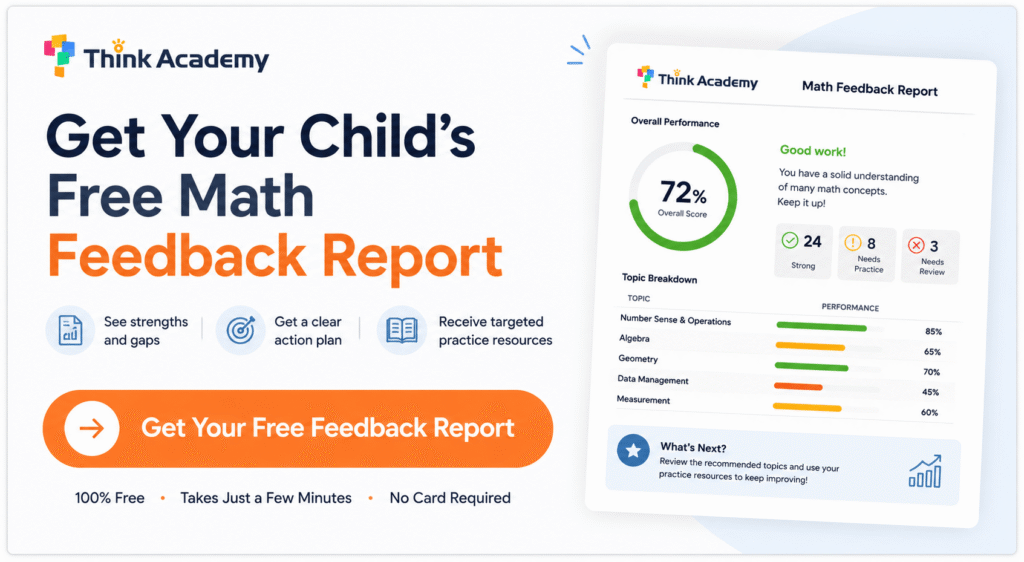
A diagnostic assessment can identify strengths, weaknesses, and areas that need improvement before high school.
What is the difference between Grade 7 and Grade 8 math?
Grade 8 places greater emphasis on algebra, linear relationships, and multi-step problem solving.
How much math practice should Grade 8 students do?
Consistent practice several times per week is generally more effective than occasional intensive sessions.
About Think Academy Canada
Think Academy Canada helps ambitious students build strong mathematical foundations and advanced problem-solving skills. Our programmes support students from elementary school through high school and include curriculum enrichment, contest preparation, and structured learning pathways.

