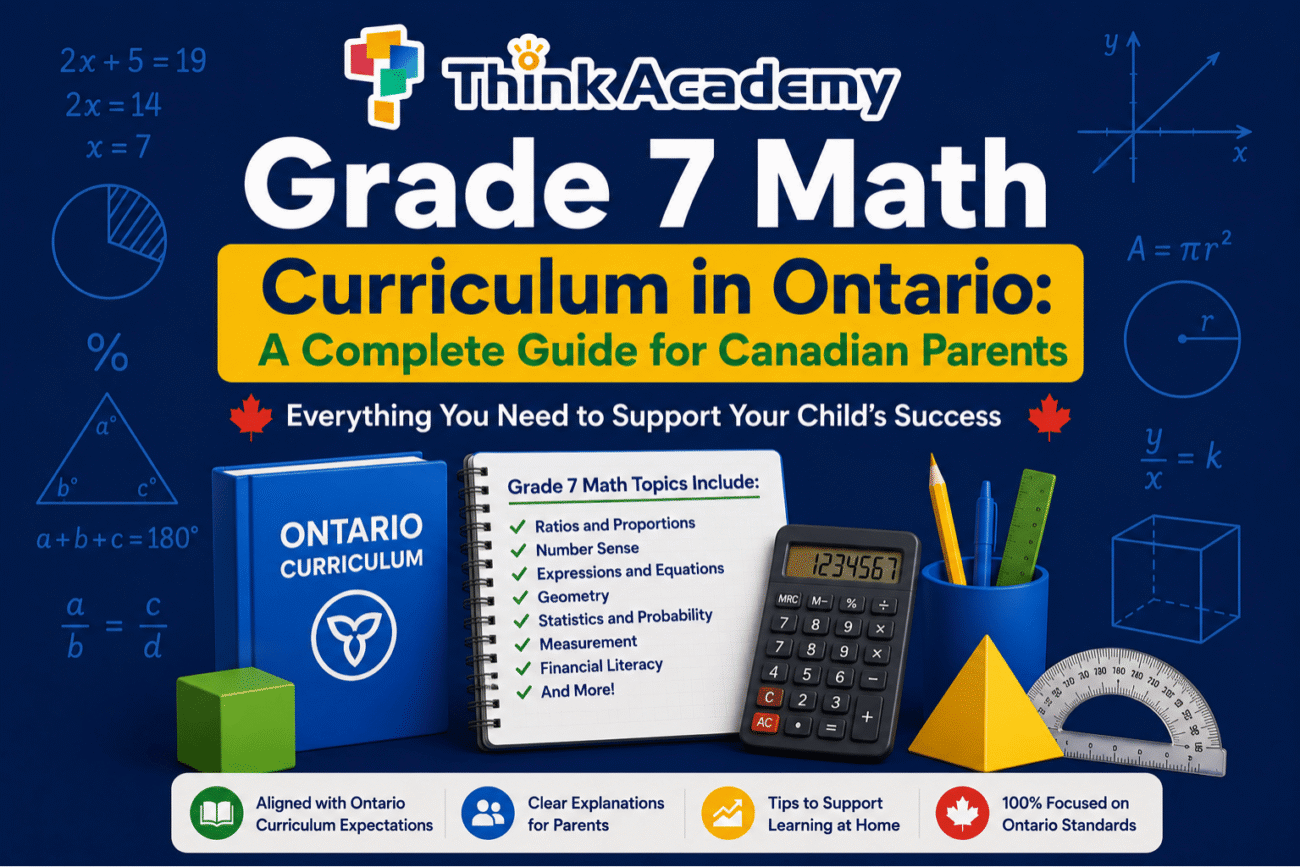
Grade 7 is a major turning point in mathematics. Students move beyond basic arithmetic and begin working with more abstract concepts such as algebraic expressions, proportional reasoning, and probability. For many children, Grade 7 is where math starts to feel less like calculation and more like problem-solving. It is also an important year for students who enjoy mathematics and may be ready for additional challenge through enrichment programmes or competitions such as the Gauss Math Contest. This guide explains exactly what students learn in the Ontario Grade 7 math curriculum, the skills they should master by the end of the year, and how parents can support long-term success.
What Is the Grade 7 Math Curriculum in Ontario?
The Ontario Grade 7 math curriculum is organised into six strands:
| Strand | What Students Learn |
|---|---|
| Number | Integers, fractions, decimals, percentages |
| Algebra | Expressions, equations, coding, patterns |
| Data | Data analysis, graphs, probability |
| Financial Literacy | Budgeting and financial decision-making |
| Measurement | Geometry, area, volume, circumference |
| Coding | Algorithms and computational thinking |
Compared with Grade 6, students encounter more multi-step problems and are expected to explain their reasoning more clearly. If your child has recently completed Grade 6, our guide to the Grade 6 math curriculum explains the skills students are expected to bring into Grade 7.
If your child is moving into Grade 7, you may also want to read our guide to the Grade 6 curriculum.
Number Sense and Operations
The number strand develops fluency with rational numbers.
Students learn to:
- Add and subtract integers
- Multiply and divide fractions
- Convert between fractions, decimals, and percentages
- Solve problems involving ratios and rates
- Apply proportional reasoning
Why This Matters
Many Grade 8 and Grade 9 topics rely on strong number sense.
Students who struggle with fractions and percentages often find algebra significantly more difficult later on.
Algebra in Grade 7
Algebra becomes much more important in Grade 7.
Students learn to:
- Identify variables
- Write algebraic expressions
- Evaluate expressions
- Solve simple equations
- Analyse patterns and relationships
Example
Students may be asked:
“If x = 4, what is the value of 3x + 2?”
This is often the first time students work extensively with variables.
Algebra Is the Foundation for Future Success
Algebra skills introduced in Grade 7 support:
- Grade 8 linear relationships
- Grade 9 mathematics
- EQAO Grade 9
- Contest mathematics
Parents interested in long-term preparation may also find our Grade 9 Math Curriculum Guide helpful.
Ratios, Rates and Proportional Reasoning
One of the most important Grade 7 topics is proportional reasoning.
Students learn:
- Unit rates
- Equivalent ratios
- Percent increase and decrease
- Scale drawings
- Real-world applications
These skills appear frequently in both school assessments and math competitions.
Data Management and Probability
Students learn how to interpret and analyse information.
Topics include:
| Topic | Examples |
| Data Collection | Surveys and experiments |
| Graphs | Bar graphs, line graphs, circle graphs |
| Probability | Likelihood of events |
| Data Interpretation | Drawing conclusions from data |
Students are expected to justify conclusions using evidence rather than simply calculate answers.
Geometry and Measurement
The Ontario Grade 7 math curriculum introduces more advanced geometric reasoning.
Students learn:
Circumference and Area
- Area of composite figures
- Circumference of circles
- Applications involving real-world measurement
Volume
Students calculate volume for:
- Rectangular prisms
- Composite shapes
Geometric Relationships
Topics include:
- Angles
- Transformations
- Tessellations
- Geometric problem-solving
Financial Literacy
Financial literacy is integrated into mathematics learning.
Students may explore:
- Budgeting
- Saving and spending
- Comparing financial options
- Taxes and discounts
This helps students connect mathematics with everyday decisions.
Coding in the Ontario Grade 7 Math Curriculum
Coding supports logical thinking and problem-solving.
Students learn to:
- Build simple algorithms
- Use variables
- Recognise patterns
- Debug code
Coding is used as a tool for mathematical reasoning rather than software development.
How Grade 7 Prepares Students for Grade 8
Many parents think Grade 8 is the most important middle-school year.
In reality, Grade 7 lays much of the groundwork.
| Grade 7 Skill | Grade 8 Application |
| Fractions and percentages | Advanced proportional reasoning |
| Expressions | Algebraic equations |
| Ratios | Linear relationships |
| Geometry | Surface area and volume |
| Probability | Data analysis |
Strong Grade 7 foundations make Grade 8 significantly easier.
Is Your Child Working Above Grade 7 Level?
Many students earn good classroom grades but still have untapped potential.
Signs your child may benefit from additional challenge include:
- Completing math homework quickly
- Enjoying logic puzzles
- Solving problems in multiple ways
- Showing curiosity about advanced concepts
- Performing well on standardised assessments
These students often enjoy enrichment opportunities that go beyond the school curriculum.
Should Grade 7 Students Participate in Math Competitions?
Grade 7 is an excellent age to begin exploring competition mathematics.
Popular options include:
| Competition | Typical Grades |
| Gauss Contest | Grades 7–8 |
| Math Kangaroo | Grades 1–12 |
| AMC 8 | Grade 8 and below |
Competition math develops:
- Problem-solving ability
- Mathematical creativity
- Logical reasoning
- Confidence
Parents interested in contests may find these guides helpful:
- Gauss Math Contest: The Complete Guide for Canadian Students and Parents
- Math Kangaroo Canada: The Complete Guide for Canadian Parents and Students
- AMC 8 Math Competition: The Complete Guide for Canadian Students and Parents
Common Areas Where Grade 7 Students Struggle
Fractions
Fraction operations remain one of the most common sources of difficulty.
Algebra
Students may understand procedures but struggle with concepts.
Multi-Step Problems
Many students can perform calculations but find it difficult to combine several ideas within a single question.
Mathematical Communication
Ontario increasingly expects students to explain their reasoning, not simply provide answers.
How Parents Can Support Grade 7 Math Success
Parents can help by:
- Encouraging regular practice
- Reviewing mistakes together
- Building confidence around problem-solving
- Connecting math to everyday situations
- Providing additional challenge when appropriate
Consistent exposure is more effective than last-minute studying.
How Think Academy Canada Supports Grade 7 Students
At Think Academy Canada, we help ambitious students build strong mathematical foundations while developing advanced problem-solving skills.
Our programmes support students through:
- Ontario curriculum enrichment
- Algebra development
- Contest preparation
- Logical reasoning
- Advanced mathematical thinking
Many Grade 7 students use this year to strengthen foundations before Grade 8, the Gauss Contest, and future high school mathematics.
Follow us on Instagram: @thinkacademyca
Frequently Asked Questions
What is taught in Grade 7 math in Ontario?
Students study integers, fractions, percentages, algebra, geometry, probability, financial literacy, and coding.
Is Grade 7 math difficult?
Grade 7 introduces more abstract thinking and algebraic concepts than previous grades.
What algebra is taught in Grade 7?
Students learn variables, expressions, equations, and pattern relationships.
What is the most important Grade 7 math skill?
Algebraic reasoning and proportional thinking are particularly important.
Are integers taught in Grade 7?
Yes. Students learn to add, subtract, multiply, and divide integers.
Is coding included in Grade 7 math?
Yes. Coding and computational thinking are integrated into the curriculum.
How does Grade 7 prepare students for Grade 8?
Grade 7 introduces many concepts that are expanded up on in Grade 8, particularly algebra and proportional reasoning.
Should Grade 7 students enter math competitions?
Many students enjoy competitions such as Gauss and Math Kangaroo because they develop problem-solving skills beyond the classroom.
How can parents support Grade 7 math?
Regular practice, reviewing mistakes, and encouraging problem-solving are effective strategies.
How do I know if my child is ahead in math?
A diagnostic assessment can help identify whether a student is performing at, above, or below grade-level expectations.
What percentage topics are taught in Grade 7?
Students learn percentages, discounts, proportional relationships, and percent increase or decrease.
What geometry is covered in Grade 7?
Students learn circumference, area, volume, angles, and geometric reasoning.
About Think Academy Canada
Think Academy Canada helps students develop strong mathematical foundations, advanced problem-solving skills, and confidence in mathematics. Our programmes support ambitious learners through curriculum enrichment, contest preparation, and structured learning pathways.