


When your child seems unchallenged, it can feel like you are failing to “keep up” with their curiosity. However, many families face the same question: how do you choose enrichment and advanced programs in a way that supports learning without burning out a child aged 4–12? This article breaks down the main options available in Canada, how schools and districts typically define advanced learning, and a practical checklist to help you decide what fits your family.
Intro When “More Challenge” Becomes a Real Need
Some kids ask for harder books, invent number puzzles, or pick up concepts quickly, and then get frustrated with repetition. Others do well academically but crave faster pace, deeper projects, or more meaningful feedback. Therefore, the goal is not to label a child, but to match learning level with the right environment and support.
In Canada, the K–12 landscape varies by province and even by school board. Because education is provincial, there is no single national model for advanced learning. You can start by understanding what your local public system offers, then compare it with community and private options.

How Canadian Schools Typically Define Advanced Learning
Canadian public schools generally focus on meeting provincial curriculum expectations. “Advanced” opportunities often mean one of three things: learning the same curriculum at a faster pace, going deeper into the same topics, or accessing enriched learning experiences beyond the classroom.
You may also see terms like assessment (a way to measure current skills), placement (matching a student to a learning level), and differentiation (adjusting instruction to meet different needs in one classroom). If a term feels unclear, ask your school to explain how it looks in day-to-day learning, not just on paper.
For province-specific curriculum expectations, you can review official curriculum hubs such as the Ontario government education pages and BC’s curriculum portal. These help you see what “on grade level” means before you decide what “beyond” should look like.
enrichment and advanced programs: The Main Pathways for Ages 4–12
Most families consider a mix of school-based and outside-of-school options. However, the best fit depends on your child’s personality, your weekly schedule, and how your local system is structured.
1) In-class enrichment in public schools
This is the most common pathway, especially in elementary years. A teacher may provide extension tasks, higher-level reading groups, math problem-solving, or independent projects.
Because in-class enrichment depends on classroom resources and time, it can vary widely. Therefore, it helps to ask for concrete examples, such as what your child will do when they finish work early.
2) School- or board-run advanced learning options
Some schools or districts offer cluster groups, enriched classes, or special opportunities like math clubs and science fairs. Access can depend on local policy, space, and identified need.
Start with your school’s main office and your school board’s website. Many boards publish program descriptions and registration steps, although details differ across Canada.
3) Private schools and independent programs
Independent schools may advertise smaller classes or enriched academics. However, “advanced” is not a regulated label, so you should ask what curriculum they follow, how they assess progress, and how they support students who are ahead in one subject but not another.
In Canada, many independent schools belong to provincial associations. For example, families can explore Canadian Accredited Independent Schools (CAIS) to understand accreditation (a formal process that reviews school standards) and school profiles.
4) Community-based enrichment (libraries, museums, STEM groups)
Public libraries, science centres, and community organizations often run low-cost programs that build skills through interest-led learning. This can be a great fit for kids who resist “more school” but love hands-on challenges.
As a starting point, the Science World site shows the kind of STEM programming many Canadian science centres provide, and your local library website often lists children’s learning events.
5) Structured outside-of-school learning (online or in-person)
Some families add structured math or reading programs to create steady challenge and confidence. This route can work well if your child needs clearer pacing, more practice with harder problems, or a different teaching style.
However, time limits matter. A good program should protect play, sleep, and family time, especially for ages 4–12.
What to Ask Before You Commit (A Parent Checklist)
Program brochures often sound similar. Therefore, your questions should focus on how your child will actually experience the learning.
- What is the goal: faster pace, deeper thinking, or broader exposure?
- How will my child be placed: observation, teacher input, or formal assessment?
- What does a typical lesson look like for a child who is already ahead?
- How often will I receive progress updates, and what do they include?
- What happens if the level is too easy or too hard after a few weeks?
- How much homework is expected, and how is stress monitored?
- What is the total cost, including materials and transportation?
If your child is very young, also ask how the program balances academic challenge with play-based learning (learning through guided play and exploration). For ages 4–7, the right challenge often looks like richer questions and better conversation, not longer worksheets.
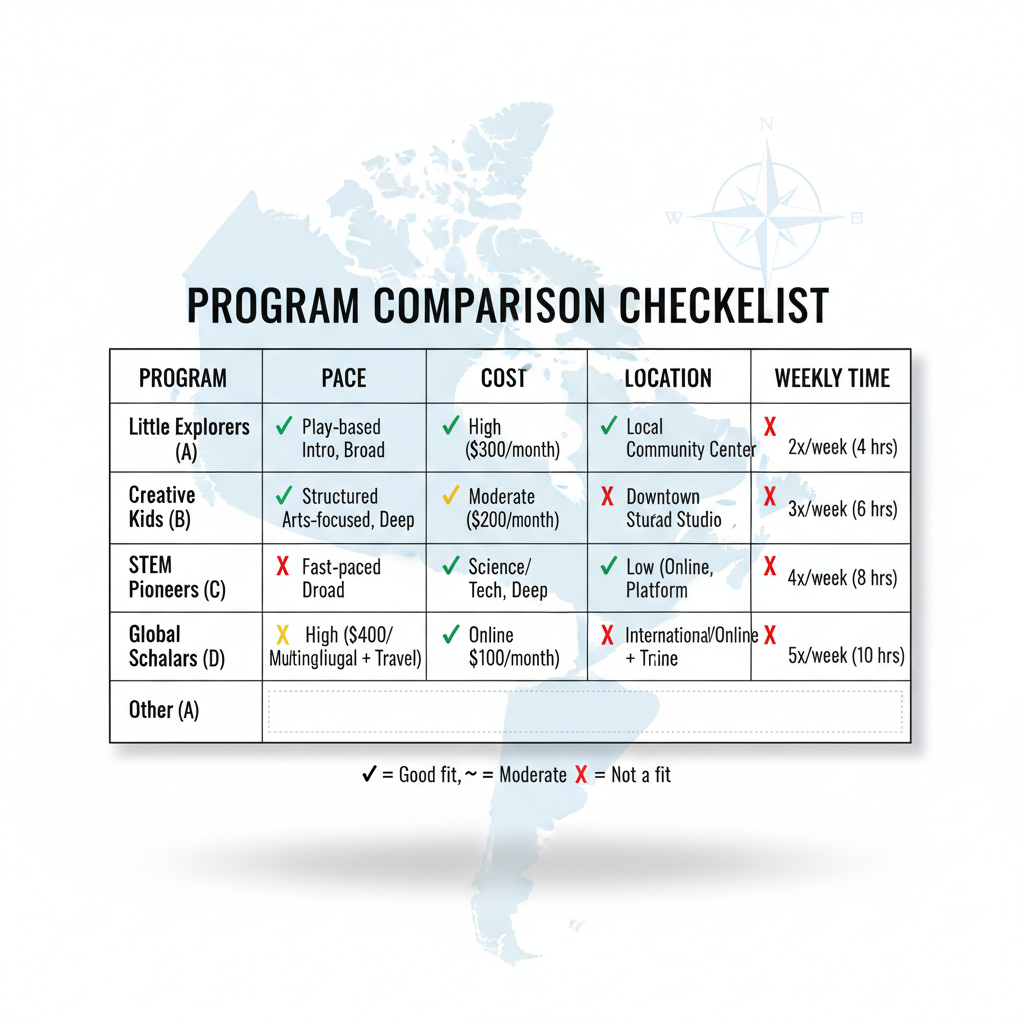
A Simple Comparison Table for Common Options
Use this as a quick way to compare choices. However, always confirm details with your local school or provider, since Canada’s education system is decentralized.
| Option | Best for | Typical cost | Key trade-off |
|---|---|---|---|
| In-class enrichment | Kids who need modest extra challenge | Free | Quality varies by classroom resources |
| Board/school advanced options | Kids who benefit from peers at similar pace | Usually free | Availability and entry process vary locally |
| Community programs | Interest-driven learners (STEM, arts, reading) | Low to moderate | May be shorter-term and not sequential |
| Structured outside-of-school programs | Families wanting consistent level and pacing | Moderate to high | Requires careful scheduling to avoid overload |
| Independent schools | Families seeking a full-time enriched setting | High | “Advanced” claims require verification |
How to Tell If It Is Working (Without Waiting a Whole Year)
Parents often wait too long because they want to avoid switching paths mid-year. However, you can look for early signals in the first four to six weeks.
- Your child shows healthier effort: they try, pause, and try again.
- Mistakes feel “safe,” not embarrassing or scary.
- They can explain their thinking (not just give answers).
- They still have energy for play and sleep stays steady.
On the other hand, frequent stomach aches, bedtime battles, or daily tears are signals to slow down. Therefore, prioritize the right level of challenge over the fastest possible acceleration.
Tools & Resources (Official and Reputable)
These tools help you understand curriculum, ask better questions, and track learning in a simple way.
- Ontario government education information (provincial schooling structure and resources)
- BC Curriculum (official curriculum expectations by subject and grade)
- Canadian Accredited Independent Schools (CAIS) (accreditation information for participating independent schools)
- Common Sense Media (reviews of learning apps and digital tools for kids)
- Khan Academy (free practice and lessons; useful for checking comfort level and gaps)
If you want background definitions, Encyclopaedia Britannica and Wikipedia can be helpful for quick overviews of education terms. However, use them to learn vocabulary, then confirm program rules with official Canadian sources.
Concluding Paragraph
Choosing well often comes down to one question: does this option create steady, healthy challenge while protecting your child’s confidence? When you compare enrichment and advanced programs, focus on what your child will do each week, how progress is measured, and how stress is prevented. Therefore, start small, review after a month, and adjust based on real observations at home.
About Think Academy
Think Academy Canada is a K-12 mathematics tutoring programme, part of TAL Education Group. We work with motivated students across Canada from Grade 1 through Grade 12, with a focus on Ontario curriculum, EQAO preparation, and competition mathematics including CEMC contests (Pascal, Cayley, Fermat, Euclid) and AMC. All lessons are delivered online. Follow us on Instagram at @thinkacademyca.

