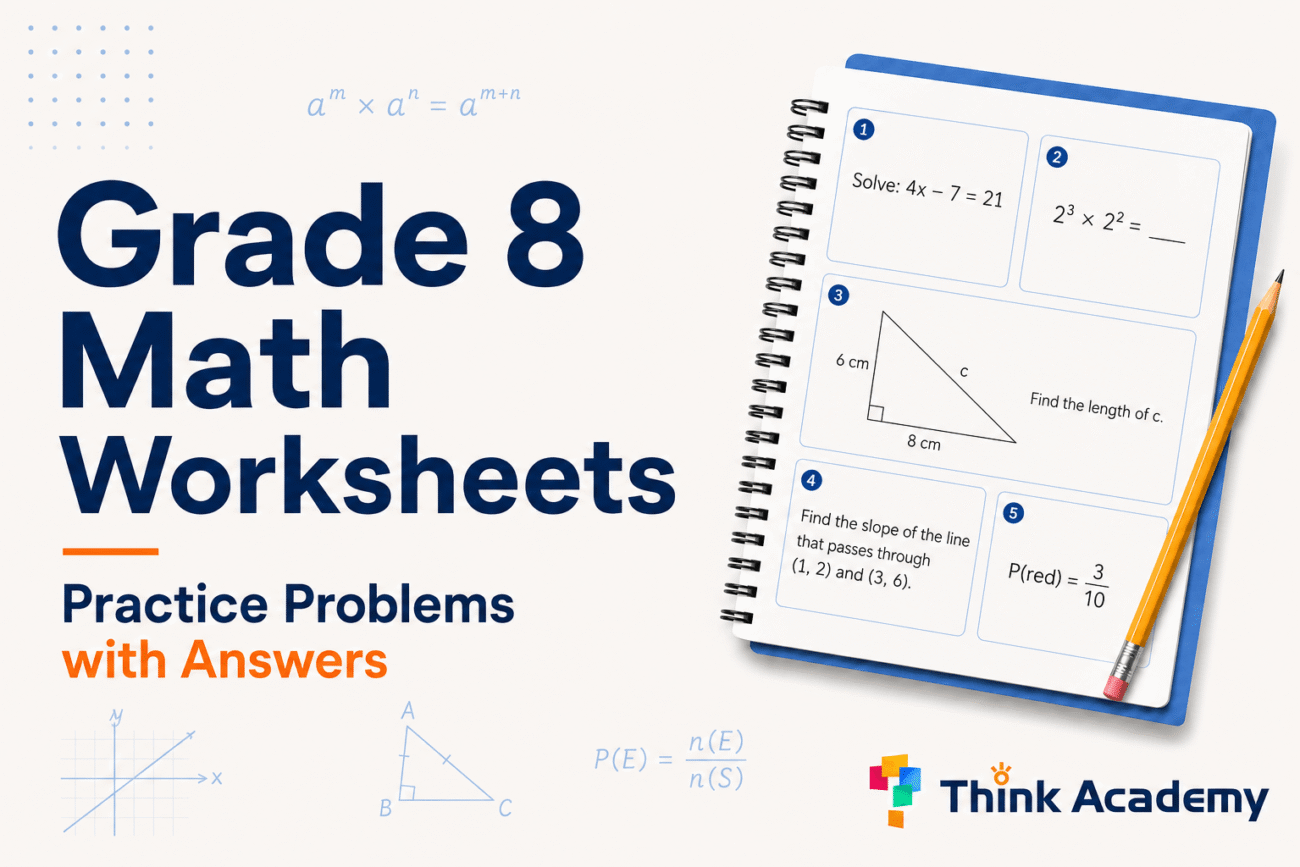
Grade 8 is the most consequential year of elementary school mathematics. Everything your child learns this year — algebra, the Pythagorean theorem, linear relations, integers, and geometry — is exactly what Grade 9 mathematics (MTH1W) builds on directly. A student who finishes Grade 8 with strong foundations arrives in high school ready. One who finishes with gaps finds those gaps immediately in September. This page provides free Grade 8 math worksheets and practice problems across every major curriculum strand, with full answers. Use them for test preparation, homework support, or to identify where your child needs focused work before the transition to Grade 9.
What Grade 8 Math Covers in Ontario
The Ontario Grade 8 mathematics curriculum covers five main strands:
- Number — fractions, decimals, integers, percentages, ratio and rate, perfect squares and square roots
- Algebra — evaluating expressions with integers, solving multi-step equations, linear relations
- Data — probability (theoretical and experimental), data collection, scatter plots, trends
- Spatial Sense (Geometry) — Pythagorean theorem, surface area and volume, geometric transformations
- Measurement — volume of cylinders, spheres, and cones; unit rates and conversions
For a complete breakdown of the Ontario Grade 8 curriculum by strand, see our Grade 8 math curriculum Ontario guide.
Grade 8 Math Worksheets: Number Practice Problems
Fractions and Percentages
Practice Set 1 — Operations with Fractions
- 3/4 + 2/5 = ___
- 5/6 − 3/8 = ___
- 2 2/3 + 1 3/4 = ___
- 3 1/2 − 1 5/6 = ___
- 3/4 × 8/9 = ___
- 2/3 ÷ 4/5 = ___
- 1 3/4 × 2 2/5 = ___
- 3 1/3 ÷ 1 2/3 = ___
- A tank is 3/4 full. It holds 240 L when full. How much water is in it? ___
- A piece of wood is 5 1/2 m long. It is cut into pieces of 3/4 m each. How many pieces can be cut? ___
Answers: 1) 23/20 = 1 3/20 2) 11/24 3) 4 5/12 4) 1 2/3 5) 2/3 6) 5/6 7) 4 1/5 8) 2 9) 180 L 10) 7 pieces (with 1/4 m left over)
Practice Set 2 — Percentages and Proportions
- What is 35% of 120? ___
- 48 is what percent of 160? ___
- A price increases from $80 to $96. What is the percent increase? ___
- A jacket is $240. It is discounted by 30%. What is the sale price? ___
- A student scored 54/72 on a test. What percent is this? ___
- A population of 4,500 decreases by 12%. What is the new population? ___
- The price of a phone drops from $650 to $520. What is the percent decrease? ___
- A store marks up an item by 25% and sells it for $75. What was the original price? ___
Answers: 1) 42 2) 30% 3) 20% 4) $168 5) 75% 6) 3,960 7) 20% 8) $60
Integers
Practice Set 3 — Integer Operations
- (−8) × (−7) = ___
- −144 ÷ (−12) = ___
- (−6)² = ___
- −6² = ___
- (−3)³ = ___
- −5 × (−4) ÷ (−2) = ___
- (−2)⁴ = ___
- −(−3)² = ___
- Evaluate: −4 × 3 + (−6) ÷ 2 − (−5) = ___
- The temperature is −8°C. It falls by 5°C each hour for 3 hours, then rises 12°C. What is the final temperature? ___
Answers: 1) 56 2) 12 3) 36 4) −36 5) −27 6) −10 7) 16 8) −9 9) −10 10) −11°C
Square Roots and Perfect Squares
Practice Set 4 — Perfect Squares and Square Roots
- What is √64? ___
- What is √144? ___
- Is 75 a perfect square? ___
- What is the smallest perfect square greater than 50? ___
- Between which two whole numbers does √50 lie? ___
- Estimate √30 to one decimal place. ___
- A square has an area of 169 cm². What is the side length? ___
- Simplify: √(36 × 4) = ___
- Is √2 rational or irrational? ___
- Order from smallest to largest: √25, √10, √36, √18 ___
Answers: 1) 8 2) 12 3) No 4) 64 5) 7 and 8 6) 5.5 7) 13 cm 8) 12 9) Irrational 10) √10, √18, √25, √36
Grade 8 Math Worksheets: Algebra Practice Problems
Evaluating and Simplifying Expressions
Practice Set 5 — Algebraic Expressions
- If x = −3, evaluate 4x² − 2x + 1. ___
- If a = 2 and b = −4, evaluate 3a − b². ___
- Simplify: 5x − 3y + 2x + 7y. ___
- Simplify: 3(2x − 4) + 5x. ___
- Simplify: 4(x + 3) − 2(x − 1). ___
- Expand and simplify: (2x + 3)(x − 1). Extension for strong students.
- Factor: 6x + 9. ___
- Factor: 12a − 8b. ___
Answers: 1) 43 2) −10 3) 7x + 4y 4) 11x − 12 5) 2x + 14 6) 2x² + x − 3 7) 3(2x + 3) 8) 4(3a − 2b)
Solving Equations
Practice Set 6 — Multi-Step Equations
- 3x + 7 = 22 → x = ___
- 5n − 8 = 27 → n = ___
- 2(x + 4) = 18 → x = ___
- 4x − 3 = 2x + 9 → x = ___
- 3(2n − 1) = 5n + 4 → n = ___
- x/3 + 5 = 11 → x = ___
- (2x + 6)/4 = 5 → x = ___
- 2(3x − 4) = 4(x + 1) → x = ___
- A number is doubled and then 7 is subtracted. The result is 19. What is the number? ___
- Three consecutive integers add up to 54. What are they? ___
Answers: 1) 5 2) 7 3) 5 4) 6 5) 7 6) 18 7) 7 8) 6 9) 13 10) 17, 18, 19
Grade 8 Math Worksheets: Linear Relations
Practice Set 7 — Linear Relations
- Complete the table of values for y = 2x + 3:
| x | −2 | −1 | 0 | 1 | 2 |
|---|---|---|---|---|---|
| y | ___ | ___ | ___ | ___ | ___ |
- What is the slope of the line through (2, 5) and (6, 13)? ___
- What is the y-intercept of y = 3x − 4? ___
- Write the equation of a line with slope 2 and y-intercept −5. ___
- Does the point (3, 7) lie on the line y = 2x + 1? ___
- What is the x-intercept of y = 2x − 8? ___
- Two lines: y = 3x + 1 and y = 3x − 4. Are they parallel, perpendicular, or neither? ___
- A plumber charges $50 plus $30 per hour. Write an equation for the total cost C after h hours. ___
Answers: 1) −1, 1, 3, 5, 7 2) 2 3) −4 4) y = 2x − 5 5) Yes (2×3 + 1 = 7) 6) x = 4 7) Parallel (same slope) 8) C = 30h + 50
Grade 8 Math Worksheets: Geometry Practice Problems
The Pythagorean Theorem
Practice Set 8 — Pythagorean Theorem
Use c² = a² + b² where c is the hypotenuse.
- A right triangle has legs of 6 cm and 8 cm. Find the hypotenuse. ___
- A right triangle has a hypotenuse of 13 cm and one leg of 5 cm. Find the other leg. ___
- Is a triangle with sides 9, 40, and 41 a right triangle? ___
- A ladder 10 m long leans against a wall. The base is 6 m from the wall. How high up the wall does it reach? ___
- A rectangular park is 24 m long and 7 m wide. How long is the diagonal path? ___
- Find the distance between points (1, 2) and (4, 6). ___
- A right triangle has legs x and (x + 1), and hypotenuse (x + 2). Find x. ___
- A television screen is 40 cm wide and 30 cm tall. What is the diagonal measurement? ___
Answers: 1) 10 cm 2) 12 cm 3) Yes (9² + 40² = 81 + 1600 = 1681 = 41²) 4) 8 m 5) 25 m 6) 5 7) 3 8) 50 cm
Surface Area and Volume
Practice Set 9 — Surface Area and Volume
Use π ≈ 3.14
- Find the volume of a cylinder with radius 4 cm and height 10 cm. ___
- Find the surface area of a rectangular prism: 5 cm × 3 cm × 2 cm. ___
- Find the volume of a cone with radius 3 cm and height 8 cm. (V = 1/3 πr²h) ___
- Find the surface area of a cylinder with radius 5 cm and height 12 cm. ___
- A sphere has radius 6 cm. Find its volume. (V = 4/3 πr³) ___
- A rectangular prism has volume 120 cm³, length 5 cm, and width 4 cm. Find the height. ___
- Find the volume of a triangular prism with base area 15 cm² and height 8 cm. ___
- A can has a diameter of 10 cm and height of 15 cm. How much liquid does it hold? ___
Answers: 1) 502.4 cm³ 2) 62 cm² 3) 75.36 cm³ 4) 534.07 cm² 5) 904.32 cm³ 6) 6 cm 7) 120 cm³ 8) 1,177.5 cm³
Grade 8 Math Worksheets: Data and Probability Practice Problems
Practice Set 10 — Probability and Data
- A bag has 3 red, 5 blue, and 2 green marbles. What is the probability of picking a blue marble? ___
- A die is rolled. What is the probability of getting an even number? ___
- Two coins are flipped. List all possible outcomes. How many are there? ___
- A spinner has 4 equal sections: red, blue, green, yellow. What is the probability of landing on red or blue? ___
- In 80 coin flips, heads came up 38 times. What is the experimental probability of heads? ___
- How does this compare to the theoretical probability? ___
- A scatter plot shows as hours studying increase, test scores increase. Is this a positive or negative correlation? ___
- Data set: 4, 7, 2, 9, 3, 8, 1, 6. Find the median. ___
Answers: 1) 5/10 = 1/2 2) 1/2 3) HH, HT, TH, TT — 4 outcomes 4) 1/2 5) 38/80 = 19/40 6) Slightly below theoretical probability of 1/2 7) Positive 8) 5.5 (ordered: 1,2,3,4,6,7,8,9 — average of 4 and 6)
Why Grade 8 Is the Last Chance Before High School
If there is one message this guide should leave every Grade 8 parent with, it is this: gaps in Grade 8 mathematics do not close on their own when high school starts. They compound.
The Ontario Grade 9 mathematics course (MTH1W) builds directly on Grade 8 content. Specifically:
- Grade 8 algebra feeds directly into MTH1W’s linear relations and equations units — the two units most students find hardest in Grade 9
- Grade 8 linear relations is the exact prerequisite for slope, y-intercept, and equation of a line in Grade 9
- Grade 8 Pythagorean theorem recurs in Grade 9 and 10 geometry
- Grade 8 integers and fractions are assumed as automatic in every strand of Grade 9 mathematics
A student with Grade 8 gaps will not have a fresh start in September. They will have the same gaps, now being asked to apply them in more complex contexts, at a faster pace, with less individual teacher support.
The summer before Grade 9 is the single best preparation window available. Six to eight weeks of targeted work — addressing the specific Grade 8 strands that are weakest — produces a meaningfully different September than doing nothing. For what that preparation looks like in practice, see our Grade 9 math September preparation guide.
Signs Your Grade 8 Child Has Gaps That Need Addressing Before Grade 9
Algebra is procedural, not understood. A student who can follow the steps of equation solving but cannot explain what “solving for x” means — that they are finding the value that makes the equation true — has a procedure without understanding. This will surface immediately in Grade 9 when equations become more complex.
Linear relations feel arbitrary. Students who can fill in a table of values but cannot explain why the slope is constant, or what the y-intercept represents in context, do not have genuine understanding of linear relations. They have a calculation procedure. Grade 9 requires the conceptual understanding.
The Pythagorean theorem is a formula, not a concept. A student who knows c² = a² + b² but cannot recognise which side is the hypotenuse in a non-standard diagram, or cannot apply the theorem in a word problem, has memorised a formula without understanding it. This is a specific and common Grade 8 gap.
Word problems are avoided or rushed. Grade 9 mathematics is significantly more applied than Grade 8. Students who have avoided word problems, or who rush through them and make consistent errors, are not prepared for the problem types that MTH1W regularly includes.
EQAO Grade 9 preparation feels overwhelming. Most Ontario Grade 9 students sit the EQAO mathematics assessment. A student who feels overwhelmed by the idea of this assessment, or whose Grade 8 teacher has expressed concern, is showing a clear signal that support is needed. For guidance on what the assessment involves, see our EQAO Grade 9 complete guide.
How Think Academy Helps Grade 8 Students
Think Academy Canada works with Grade 8 students across Ontario to build the algebraic fluency, geometric reasoning, and problem-solving skills that Grade 9 mathematics demands.
Our Grade 8 programme is diagnostic-led: every student starts with a targeted assessment that identifies specifically which strands are secure and which have gaps. The programme then addresses those gaps directly — not through generic Grade 8 curriculum review, but through targeted work on the concepts most consequential for the Grade 9 transition.
For students using the summer before Grade 9, we offer a focused transition programme specifically designed to close Grade 8 gaps and build Grade 9 readiness before September. The students who begin Grade 9 with this preparation consistently outperform those who rely on catching up during the school year.
The free diagnostic assessment is 20 minutes, produces a written feedback report, and requires no commitment. It is the most useful thing a Grade 8 parent can do before September.
Frequently Asked Questions
What maths should a Grade 8 student know before starting Grade 9? Grade 8 students entering Grade 9 should be fluent in: integer operations (including negative exponents), multi-step equation solving, basic linear relations (tables of values, slope, y-intercept), the Pythagorean theorem and its applications, surface area and volume of basic 3D shapes, and operations with fractions including multiplication and division.
My child got 75% in Grade 8 math — are they ready for Grade 9? Possibly, but a course mark alone is not the most reliable indicator. A 75% averaged across multiple strands can mask genuine weakness in one strand — and if that strand is algebra or linear relations, it will surface immediately in MTH1W. A strand-level diagnostic is more informative than an overall mark.
How hard is the jump from Grade 8 to Grade 9 math? Significant — and consistently underestimated by students and parents. The pace is faster, the content is more abstract, the assessment structure is more demanding, and there is less hand-holding. Students who arrive prepared find the jump manageable. Students who arrive with gaps find it genuinely difficult within the first month.
Are these Grade 8 math worksheets aligned to EQAO? These worksheets are aligned to the Ontario Grade 8 mathematics curriculum. The EQAO assesses Ontario students at Grade 3, Grade 6, and Grade 9. Grade 8 content directly feeds into the Grade 9 EQAO assessment. See our EQAO Grade 9 complete guide for more on that assessment.
My child is strong in Grade 8 — what should they do next? For mathematically strong Grade 8 students, two paths are worth considering: mathematics competitions (the Gauss Contest and AMC 8 are both appropriate) and early enrichment in Grade 9 content. For more on enrichment options, see our math enrichment guide.
See our related guides: Grade 8 math curriculum Ontario · Grade 7 math worksheets · Ontario Grade 9 math curriculum · Grade 9 math September preparation · EQAO Grade 9 complete guide · EQAO Grade 9 practice test guide · math order of operations guide · adding and subtracting integers · Gauss math contest guide · math enrichment guide
Grade 8 is the last chance to prepare. Don’t leave it to September.