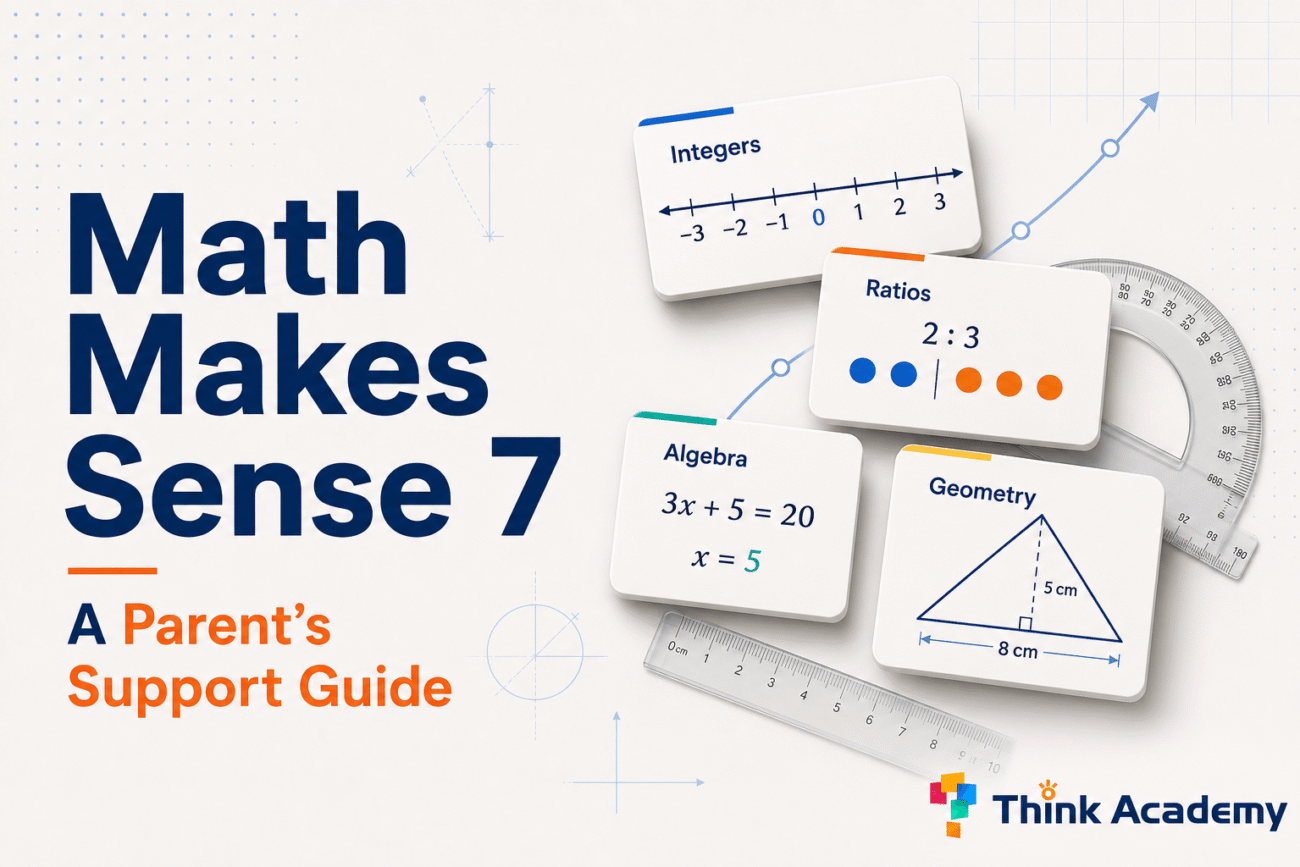
Grade 7 is the year the mathematics curriculum makes its first real shift toward abstraction. Integers, algebraic expressions, proportional reasoning, and two-step equations arrive in the same year — and for many students, Math Makes Sense 7 is the first textbook that feels genuinely difficult rather than just more of what they have already learned.
This guide is written for parents. It covers what Math Makes Sense 7 actually contains, which chapters are most likely to cause difficulty, and what you can do to support your child through Grade 7 mathematics — and set them up for Grade 8 and beyond.
What Is Math Makes Sense 7?
Math Makes Sense 7 (MMS 7) is a Canadian mathematics textbook published by Pearson Education and widely used in Ontario and other Canadian provinces for Grade 7 mathematics. It is designed to cover the Ontario Grade 7 mathematics curriculum and is one of the most commonly assigned textbooks in Ontario Grade 7 classrooms.
Like the other books in the Math Makes Sense series, MMS 7 uses a spiral approach — concepts introduced early in the book return later at greater depth and complexity. A student who does not consolidate Chapter 2 content, for example, will encounter it again, harder, in Chapter 6. This compounding structure is precisely why addressing gaps early in the year matters more than many parents realise.
MMS 7 is not the only textbook used for Ontario Grade 7 mathematics. Some schools use Nelson Mathematics 7 or board-developed resources. But if your child is using MMS 7, this guide covers exactly what they are working through.
For a complete breakdown of the Ontario Grade 7 curriculum regardless of textbook, see our Grade 7 math curriculum Ontario guide.
What Does Math Makes Sense 7 Cover?
Math Makes Sense 7 is structured around the Ontario Grade 7 mathematics curriculum strands. Here is what each chapter covers and why it matters for your child’s long-term mathematical development.
Chapter 1: Patterns and Relations
Extending patterns, writing pattern rules using variables, and an introduction to algebraic thinking. This chapter is often treated as a warm-up — and underestimated as a result. The shift from thinking about patterns as sequences of numbers to expressing them as algebraic rules is the first real step into abstract mathematical thinking. Students who do not make this conceptual shift in Chapter 1 find the formal algebra in Chapter 6 significantly harder.
Chapter 2: Integers
Positive and negative integers — adding, subtracting, multiplying, and dividing. This is the chapter that most frequently catches Grade 7 students off guard. Negative numbers require a conceptual reorientation: suddenly subtraction can produce a larger number (−3 − (−7) = 4), and multiplication of two negatives gives a positive. Students who treat these as arbitrary rules to memorise rather than logical relationships to understand make inconsistent errors throughout the year.
The integer rules introduced in Chapter 2 recur in every algebra chapter that follows. A student who is shaky on integers will be shaky on all subsequent algebraic work — which makes Chapter 2 the highest-priority chapter to get right.
Chapter 3: Fractions, Decimals and Percents
Operations with fractions including unlike denominators, converting between fractions, decimals, and percentages, and applying all three in word problems. Students who did not fully consolidate fraction operations in Grades 5 and 6 find this chapter significantly harder than those who did. The most common gap: multiplying and dividing fractions is understood procedurally but not conceptually, which fails when the same operations appear in proportional reasoning problems later in the book.
Chapter 4: Circles and Area
Circumference and area of circles, and area of composite shapes. This chapter introduces π and requires students to select and apply the correct formula in context — not just calculate, but set up the right calculation from a word problem or diagram. It is more accessible than the algebra chapters for most students, but the skill of working from a diagram or word description rather than a labelled formula sheet is important practice for later content.
Chapter 5: Operations with Fractions
Adding, subtracting, multiplying, and dividing fractions including mixed numbers. This extends Chapter 3 content and is often the chapter where fraction gaps — if not addressed earlier — become fully visible. A student who scraped through Chapter 3 will find Chapter 5 noticeably harder.
Chapter 6: Equations
Writing and solving one- and two-step equations, and using equations to solve word problems. This is the most algebraically significant chapter in Math Makes Sense 7 and the one parents should pay closest attention to. Equation solving requires understanding balance — what you do to one side of an equation, you do to the other — which is a logical principle, not a procedure to follow blindly. Students who treat it as procedure rather than principle make systematic errors when equations become more complex.
The equation-solving skills introduced in Chapter 6 of MMS 7 are the direct prerequisites for Chapter 7 of Math Makes Sense 8 — which in turn feeds into the first month of Grade 9 mathematics. Getting Chapter 6 right is not just about this year’s grade.
Chapter 7: Data Analysis
Collecting and organising data, creating and interpreting various types of graphs, and understanding misleading graphs. This chapter is often treated as the “easy” part of Grade 7 by students, which means it receives less preparation than it deserves. Misleading graphs in particular require critical reading of data — a skill that appears in standardised assessments and is less practised than computational skills.
Chapter 8: Geometry
Transformations (rotations, reflections, translations), similar figures, and coordinate geometry. This chapter draws on spatial reasoning skills some students have developed strongly and others less so. The transformation content connects to Grade 8 geometry and is worth taking seriously even for students who are otherwise strong mathematically.
Where Students Struggle Most in Math Makes Sense 7
Chapter 2: Integers
This is the single most common source of difficulty in Math Makes Sense 7, and it matters disproportionately because integers appear in every subsequent algebra chapter. A student who is inconsistent with integer operations — sometimes getting the sign right, sometimes not — is carrying that uncertainty into Chapter 6 equations and then into Grade 8 algebra.
The specific errors to watch for: subtracting a negative (should increase the value, often reduced instead), multiplying two negatives (students expect a negative result, not positive), and applying integer rules inconsistently depending on the format of the problem.
Chapter 6: Equations
The algebra chapter that MMS 7 builds toward across the whole year. Students who have genuinely understood Chapters 1, 2, and 5 find Chapter 6 challenging but manageable. Students who have gaps in patterns, integers, or fractions find that all three gaps surface at once in Chapter 6 — because equations combine all of them.
The most common failure mode is treating equation solving as a series of steps to follow rather than a logical process to understand. This works for simple one-step equations and breaks down immediately when equations involve brackets, negative coefficients, or fractions.
Chapter 5: Fractions (Second Round)
Students who got through Chapter 3 without genuinely consolidating fraction operations hit the wall in Chapter 5, where the operations become more complex. The most consequential gap: fraction division. Many students can multiply fractions mechanically but cannot explain what dividing by a fraction means — which is fine for Grade 7 tests and a problem for Grade 8 proportional reasoning.
Word Problems Throughout
Math Makes Sense 7 integrates applied word problems across every chapter. Students who can answer calculation problems correctly but cannot set up the calculation from a written scenario lose marks across every strand. This is a specific, addressable skill — but it requires deliberate practice with word problems as the primary format, not as an afterthought after completing calculation practice.
How to Support Your Child Through Math Makes Sense 7
Make Chapter 2 a priority from the start. The integer chapter is the foundation for everything algebraic that follows in MMS 7 and MMS 8. If your child comes home from Chapter 2 uncertain about why two negatives multiply to a positive, address that uncertainty immediately — not after the chapter test, when the class has already moved on.
Ask for explanations, not just answers. After your child completes a homework problem, ask them to explain what they did and why — without looking at the textbook. A child who can explain it understands it. A child who completed the problem correctly but cannot explain it has a procedure without understanding — which will fail when the format changes or the complexity increases.
Watch the Chapter 6 test closely. Chapter 6 is the algebraic heart of Math Makes Sense 7. A mark below 70% on the Chapter 6 assessment is a signal worth acting on immediately — both because of its implications for the rest of Grade 7 and because of what it signals for Grade 8 readiness.
Connect the chapters explicitly. When your child reaches Chapter 6, point out that the integers from Chapter 2 are appearing in the equations — this is not a coincidence, it is the design of the textbook. Helping your child see how the chapters connect builds the kind of mathematical coherence that strong students have and struggling students often lack.
Address fractions before they appear in algebra. If your child is uncertain about fraction multiplication or division at any point in the year, address it before Chapter 5 arrives — because Chapter 5 assumes Chapter 3 was understood, and Chapter 6 equations sometimes involve fractional coefficients that compound both gaps at once.
Understand the Grade 8 implications. The equation-solving skills in Chapter 6 of MMS 7 connect directly to the linear relations and equation-solving content in Math Makes Sense 8 Chapters 6 and 7, which in turn connect to Grade 9 MTH1W. A student who leaves Grade 7 with genuine algebraic fluency is well positioned for everything that follows. For what Grade 8 expects, see our Math Makes Sense 8 parent guide.
What a Strong Math Makes Sense 7 Result Leads To
Most parents think of Grade 7 as the year before Grade 8 — not as something with longer consequences. But the algebra introduced in Math Makes Sense 7 is the beginning of a chain that runs directly to university admissions.
MMS 7 Chapter 6 (equations) → MMS 8 Chapters 6–7 (linear relations and equations) → MTH1W Grade 9 (algebra and linear relations) → MPM2D Grade 10 → MCR3U Grade 11 → MHF4U Grade 12 → university admissions average.
Every link in that chain assumes the previous one is solid. A student who leaves Grade 7 with genuine algebraic understanding — not just completed homework — arrives at every subsequent level better positioned than one who scraped through.
This is not an argument for pressure. It is an argument for paying attention to Chapter 6 now, when the content is at its most accessible, rather than trying to address the gap in Grade 9 when the stakes are higher and the pace is faster.
For a full picture of the Ontario secondary mathematics pathway, see our choosing high school math courses guide and Grade 8 math curriculum Ontario guide.
How Think Academy Helps Grade 7 Students with Math Makes Sense 7
Think Academy Canada works with Grade 7 students across Ontario who are using Math Makes Sense 7 and finding specific chapters difficult — particularly the integer and algebra chapters. Our approach is diagnostic: every student starts with an assessment that identifies specifically which chapters and concepts have gaps, and the programme addresses those gaps directly rather than reviewing the full Grade 7 curriculum.
Our Grade 7 programme:
- Aligns to the Ontario Grade 7 curriculum covered in Math Makes Sense 7
- Starts with a diagnostic that pinpoints integer, fraction, and algebra gaps specifically
- Builds genuine algebraic understanding in Chapter 6 content — not just procedural equation-solving, but the conceptual understanding that carries into Grade 8 and beyond
- Includes a Grade 8 readiness component for students approaching the end of Grade 7
The free diagnostic assessment takes 20 minutes and produces a written feedback report identifying exactly which MMS 7 chapters need work and what targeted support looks like. No commitment required.
Frequently Asked Questions
What is Math Makes Sense 7? A Canadian Grade 7 mathematics textbook published by Pearson Education, widely used in Ontario schools. It covers the Ontario Grade 7 curriculum across eight chapters including integers, fractions, circles, and one- and two-step equation solving.
Is Math Makes Sense 7 hard? Harder than Grade 6 for most students — particularly the integer chapter (Chapter 2) and the algebra chapter (Chapter 6). The content becomes genuinely abstract for the first time in Grade 7, and the pace in MMS 7 is faster than most students experienced in elementary school.
Where can I find Math Makes Sense 7 answers? Answers to odd-numbered questions are typically included at the back of the student textbook. Complete answer keys are in the teacher’s edition, which is not publicly available. For worked practice problems across every Grade 7 strand, see our Grade 7 math worksheets.
My child does the homework fine but fails the tests. Why? The most common reason: homework is done with the textbook open, at a comfortable pace, with examples visible. Tests are closed-book, timed, and combine concepts from multiple chapters in a single problem. Building test-condition fluency — practising independently, without notes, with varied problem types — is different from completing homework, and needs to be practised separately. See our active recall guide for effective study techniques.
What is the most important chapter in Math Makes Sense 7? Chapter 6 (equations) — because it is the most algebraically significant chapter and the most consequential for Grade 8 readiness. Chapter 2 (integers) is a close second because integer fluency underpins everything algebraic in the book.
What comes after Math Makes Sense 7? Grade 8 mathematics — covered in Math Makes Sense 8, which builds directly on MMS 7’s algebra content. Chapters 6 and 7 of MMS 8 (linear relations and equations) are the direct continuation of Chapter 6 of MMS 7.
Does Think Academy align to Math Makes Sense 7? Yes. Our Grade 7 programme is built around the Ontario Grade 7 curriculum that Math Makes Sense 7 covers. We can work with a student on the specific chapter they are struggling with, or support them across the full year.
See our related guides: Grade 7 math curriculum Ontario · Grade 7 math worksheets · Math Makes Sense 8 parent guide · Math Makes Sense 9 parent guide · Grade 8 math curriculum Ontario · Ontario Grade 9 math curriculum · adding and subtracting integers · math order of operations guide · MHF4U Advanced Functions guide · active recall guide · choosing high school math courses