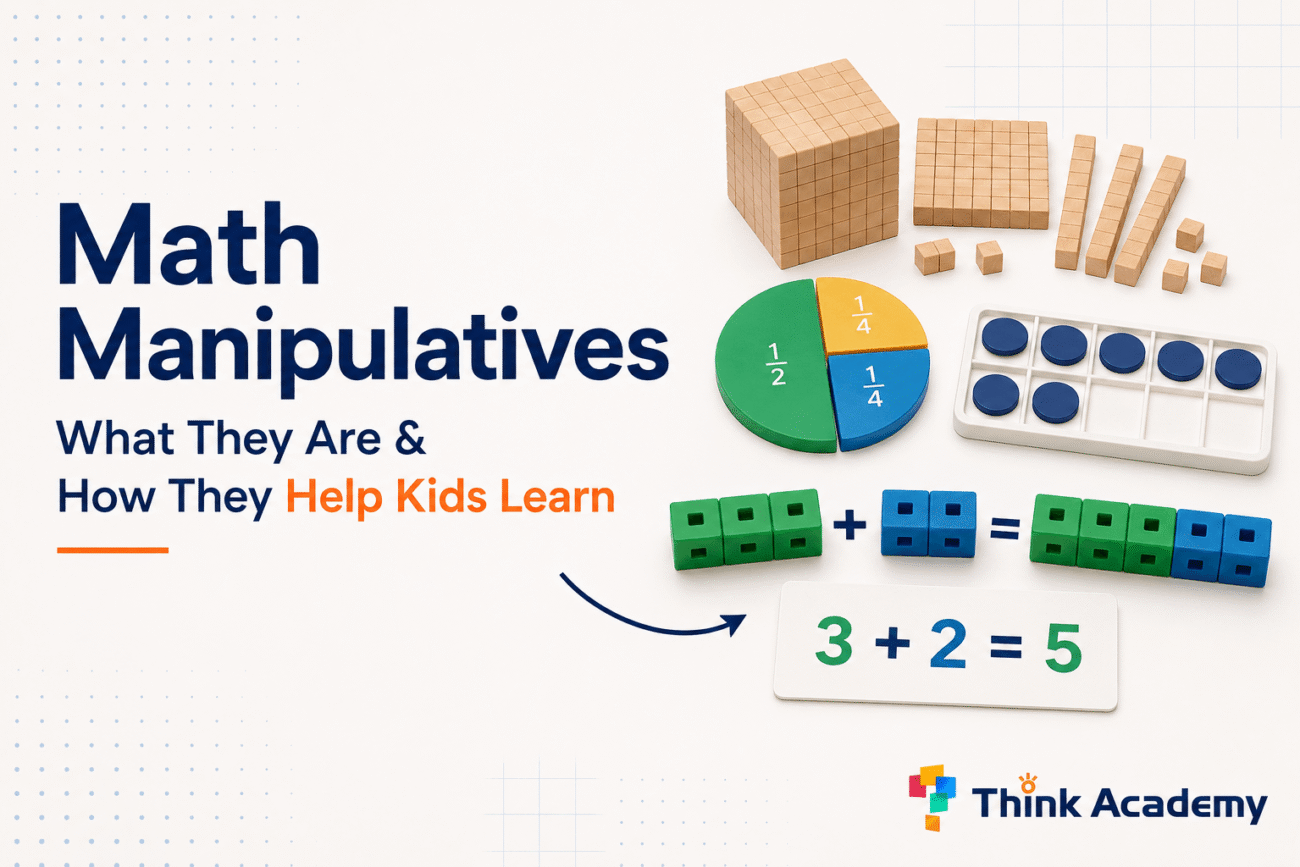
Math manipulatives are physical or digital tools that allow children to see, touch, and move mathematical objects — making abstract concepts concrete. They are used widely in Canadian elementary schools and increasingly at home, and when used well they genuinely accelerate mathematical understanding.
But manipulatives are a means, not an end. A child who can arrange fraction tiles into equivalent fractions has demonstrated something — but whether they understand what those arrangements mean, and whether that understanding transfers to paper problems, is a separate and more important question. This guide covers what manipulatives are, which ones actually help, how to use them effectively at home, and when your child needs more than hands-on tools alone.
What Are Math Manipulatives?
Math manipulatives are physical objects used to represent mathematical ideas concretely. They bridge the gap between the abstract language of mathematics — numbers, symbols, equations — and the tangible world children already understand intuitively.
The underlying principle is from educational research: children learn mathematical concepts most durably when they progress through three stages of understanding — concrete (physical objects), pictorial (diagrams and representations), and abstract (symbols and equations). Manipulatives are the concrete stage. They are not a shortcut or a crutch — they are the starting point from which abstract mathematical understanding is built.
In the Ontario curriculum, manipulatives are explicitly endorsed as learning tools across the elementary years. Canadian teachers use them widely in Kindergarten through Grade 6, and increasingly in Grades 7 and 8 for concepts like algebraic expressions and geometric reasoning.
The Most Useful Math Manipulatives by Concept
Not all manipulatives serve every purpose. The following are the tools most commonly used in Canadian classrooms and most worth having at home, organised by the mathematical concept they develop best.
Counting and Number Sense (Kindergarten–Grade 2)
Counting bears, cubes, or tiles The most basic manipulative — physical objects that can be counted, grouped, and compared. Counting with objects builds one-to-one correspondence (each object gets exactly one count) which is the foundation of number sense. For more on what strong number sense looks like at each grade level, see our number sense parent guide.
Ten frames A ten frame is a simple 2×5 grid that helps children visualise numbers in relation to ten — the most important number in our base-ten system. Filling a ten frame with counters makes “8 is 2 less than 10” and “8 + 5 = 13” visually obvious in a way that naked numbers rarely are for young children.
Number lines A number line — even a simple drawn one — is one of the most powerful tools for developing number sense because it shows numbers as positions in a continuous sequence rather than discrete labels. Children who have a well-developed mental number line make significantly fewer calculation errors than those who have not.
Hundred charts A 10×10 grid showing numbers 1–100. Useful for skip counting, identifying multiples, and building the number pattern intuitions that underpin multiplication. For structured skip counting practice, see our skip counting worksheets.
Place Value (Grades 1–4)
Base-ten blocks The most important place value manipulative. Base-ten blocks use three different physical sizes — unit cubes (ones), rods (tens), and flats (hundreds) — to represent the structure of our number system concretely. A child who arranges base-ten blocks to represent 347 understands place value in a way that circling digits on a page does not develop.
They are directly useful for teaching addition and subtraction with regrouping — the physical act of trading 10 unit cubes for 1 rod makes “carrying” and “borrowing” conceptually clear rather than procedurally arbitrary.
Place value discs or mats Similar purpose to base-ten blocks but flatter and easier to use in a limited workspace. Coloured discs labelled 1, 10, 100, 1000 can be arranged on a place value mat to represent any number and manipulated to show addition and subtraction operations.
Fractions (Grades 3–6)
Fraction tiles or circles Physical pieces representing halves, thirds, quarters, eighths, and so on. Children can physically compare 1/2 and 3/4, find equivalent fractions by matching pieces, and see that 3/6 = 1/2 by placing pieces side by side. This is enormously more intuitive than trying to understand equivalence through cross-multiplication on paper.
Fraction strips Paper or card strips of equal length divided into different fractional parts. Similar purpose to fraction tiles but easier to make at home — just fold paper strips into different numbers of equal sections.
Pattern blocks Hexagons, trapezoids, rhombuses, and triangles that fit together in specific ways. Used for both geometry and fraction exploration — if a hexagon represents one whole, a trapezoid is 1/2, a rhombus is 1/3, and a triangle is 1/6.
Multiplication and Division (Grades 3–5)
Arrays and area models Not a physical object but a diagrammatic tool worth treating as a manipulative — arranging objects into rows and columns to represent multiplication. 4 rows of 6 objects = 24 objects total = 4 × 6. This visual representation makes the commutative property (4 × 6 = 6 × 4) intuitively obvious and connects multiplication to area in a way that underpins Grade 4 and 5 geometry.
Multiplication tiles or grids Physical tiles that can be arranged into rectangular arrays. Useful for visualising multi-digit multiplication using the area model — a key conceptual bridge to algebraic area models in Grade 8 and 9.
Geometry (Grades 4–8)
Geometric solids Three-dimensional models of prisms, pyramids, cylinders, cones, and spheres. Handling physical 3D shapes makes surface area and volume calculations meaningful — students can see which faces are being added up and understand why the formulas have the structure they do.
Geoboards A board with an array of pegs on which rubber bands can be stretched to form shapes. Excellent for exploring area, perimeter, angles, and the properties of polygons in a hands-on way that paper diagrams cannot match.
Protractors and compasses Classical geometry tools that are manipulatives in the truest sense — students learn angle measurement and circle construction by physically using the tools, not by watching a demonstration.
Algebra and Equations (Grades 6–9)
Algebra tiles Tiles representing x², x, and 1 in different sizes and colours (positive and negative). Used to model algebraic expressions, combine like terms, and solve equations concretely before the abstract notation is introduced. A student who uses algebra tiles to represent 2x + 3 = 9 and physically isolates the x tiles has a concrete experience of what equation solving means — not just a sequence of steps.
Balance scales A physical or diagrammatic balance scale makes the fundamental principle of equation solving — whatever you do to one side, you do to the other — intuitively obvious. A child who can balance a scale by adding and removing weights has internalised the logic of algebraic balance before seeing a single equation.
How to Use Math Manipulatives Effectively at Home
Having the right tools is less important than using them in the right way. These principles consistently distinguish effective manipulative use from ineffective:
Let the child do the arranging, not you. The learning happens in the physical manipulation, not in watching. A parent who arranges the fraction tiles to show equivalence and then asks “can you see that?” is doing the mathematical work themselves. The child who arranges the tiles with guidance internalises the concept.
Name the mathematics as you go. Physical manipulation without mathematical language builds intuition but not vocabulary. As your child arranges base-ten blocks, say “you have 3 hundreds, 4 tens, and 7 ones — that’s 347.” Connecting the concrete representation to the abstract number and word simultaneously is what moves learning forward.
Connect to the abstract after the concrete is understood. Manipulatives are the starting point, not the destination. Once your child can reliably show a concept with physical objects, ask them to draw it, then ask them to write it with numbers. The progression from concrete to pictorial to abstract is how durable mathematical understanding is built — rushing to the abstract before the concrete is solid produces surface knowledge that breaks down under test conditions.
Use them when a concept is new, not just when it’s hard. Parents often reach for manipulatives when a child is struggling — which is right, but incomplete. The most effective use is introducing a concept with manipulatives before the abstract notation is taught. This gives children a mental model to attach the symbols to, rather than symbols arriving first with no referent.
Don’t make every session formal. Counting bears, sorting pattern blocks, and building with connecting cubes are mathematically productive activities that feel like play. The line between mathematical play and mathematical learning is not sharp for young children, and it doesn’t need to be. Informal mathematical activity outside dedicated practice sessions compounds over time.
When Manipulatives Are Not Enough
Manipulatives are genuinely useful — but they have a ceiling, and it is important to understand where it is.
When the concrete-to-abstract transfer is not happening. A child who can correctly complete a task with physical fraction tiles but consistently gets the equivalent fraction wrong on paper has not yet made the transfer from concrete to abstract. This is not a manipulative problem — it is a teaching problem. The same concept needs to be presented in a different way, with an explicit bridge between the physical arrangement and the mathematical notation.
When the concept has been misunderstood concretely. Manipulatives can build correct understanding — and they can also build incorrect understanding if the activity is set up wrongly or the child has drawn a wrong conclusion from it. A child who has developed a misunderstanding about fractions through fraction tiles will have a firmly held, concrete, wrong belief that is harder to dislodge than one built only on paper.
When the pace of the curriculum has moved past the manipulative stage. By Grade 6 and 7, most curriculum content requires abstract algebraic reasoning that manipulatives alone cannot fully develop. A Grade 7 student who needs fraction tiles to answer fraction questions is not ready for the Grade 7 curriculum — they need a different kind of support.
When a child needs to build speed as well as understanding. Manipulatives build conceptual understanding but not computational fluency — the fast, automatic retrieval of number facts that allows a student to work efficiently on multi-step problems. A student who understands multiplication through arrays but cannot retrieve 7 × 8 in under 3 seconds will be slow on every problem that involves multiplication as a sub-step.
This is where structured, expert-led instruction complements what manipulatives achieve at home. Think Academy Canada works with students from Grade 1 through Grade 12, building both the conceptual understanding that manipulatives develop and the mathematical fluency and problem-solving skills that go beyond them.
Digital Math Manipulatives: Are They as Good as Physical Ones?
Digital manipulatives — virtual fraction bars, online base-ten blocks, interactive geoboards — have become widely used, particularly since 2020. The research suggests they are broadly comparable in effectiveness to physical manipulatives for most concepts, with a few caveats worth knowing.
What digital manipulatives do well: Immediacy (no setup), variety (one app can contain dozens of tools), and feedback (some platforms immediately confirm whether an arrangement is correct).
What physical manipulatives do better: The tactile, physical experience of moving objects in space engages spatial reasoning in a way that dragging items on a screen does not fully replicate. For young children especially (Kindergarten through Grade 2), physical objects are generally more effective than digital equivalents for building foundational number sense.
The practical recommendation: Use physical manipulatives for foundational number sense with young children. For older children (Grade 3 and up), digital and physical are broadly interchangeable, and the best tool is whichever one the child engages with more consistently. The NCTM’s virtual manipulatives library and platforms like Mathigon’s Polypad are well-regarded free digital options worth exploring.
Math Manipulatives by Grade Level: A Quick Reference
| Grade | Most Useful Manipulatives | Key Concept |
|---|---|---|
| Kindergarten–1 | Counting bears, ten frames, number lines | Counting, number sense, comparison |
| Grades 2–3 | Base-ten blocks, hundred charts, number lines | Place value, addition, subtraction |
| Grades 3–4 | Fraction tiles, pattern blocks, arrays | Fractions, multiplication |
| Grades 4–5 | Fraction strips, geometric solids, geoboards | Fraction operations, geometry |
| Grades 6–7 | Algebra tiles, balance scales, protractors | Algebraic expressions, equations |
| Grades 7–8 | Algebra tiles, 3D solids, coordinate grids | Equation solving, geometry, linear relations |
How Think Academy Builds on What Math Manipulatives Start
Think Academy Canada works with students from Grade 1 through Grade 12 across Canada, fully online. Our approach to early mathematics builds on the same concrete-to-abstract progression that effective manipulative use follows — starting with visual and concrete representations before moving to abstract notation, and ensuring that the transfer from hands-on to abstract has actually happened before moving forward.
For young learners, our instructors use visual models and interactive digital tools that replicate the benefits of physical manipulatives in an online environment. For older students, our diagnostic-led approach identifies exactly where the concrete-to-abstract transfer has not happened — whether that is a fraction concept, an algebraic principle, or a geometric relationship — and addresses it at the right level.
The free assessment is the right starting point. It takes 20 minutes and produces a written feedback report showing exactly where your child’s current mathematical understanding sits — concrete, developing, or fully abstract — across every major strand. Whether your child is in Kindergarten or Grade 8, that information is more useful than any manipulative alone can provide.
Frequently Asked Questions
What are math manipulatives? Physical or digital tools that represent mathematical ideas concretely — counting bears, base-ten blocks, fraction tiles, algebra tiles, and geoboards are common examples. They allow children to see and touch mathematical concepts before working with them abstractly.
Do math manipulatives actually work? Yes, when used correctly. Research consistently shows that concrete manipulation of objects accelerates mathematical understanding, particularly for young children and for concepts that are inherently spatial or relational (fractions, geometry, algebra). The key is ensuring the concrete understanding transfers to abstract representation — manipulatives are the starting point, not the destination.
At what age should children stop using manipulatives? There is no fixed age — it depends on the concept being learned. Even adults use manipulatives (diagrams, models, physical prototypes) when learning genuinely new concepts. The question is not “when to stop” but “when has the concrete understanding been sufficiently developed to support abstract work?” For most students, manipulative use tapers naturally through Grades 5 and 6 for number concepts, but continues into Grade 7 and 8 for algebraic and geometric concepts.
Are digital manipulatives as good as physical ones? Broadly comparable for most concepts, with physical manipulatives having a slight advantage for very young children (Kindergarten–Grade 2) where tactile experience matters most. For Grade 3 and older, the best manipulative is whichever one the child uses most consistently.
What math manipulatives should I buy for home use? For a basic home set: counting bears or linking cubes (Kindergarten–Grade 2), base-ten blocks (Grades 1–4), fraction tiles (Grades 3–6), and a geoboard (Grades 4–7). These four cover the highest-priority concepts across the elementary years. Beyond this, many schools will send manipulatives home or have them available to borrow.
My child’s school uses manipulatives but they still struggle. Why? Manipulative use in a classroom is often limited by time and group size — a child may have less hands-on time with a concept than they need to fully internalise it. Individual or small-group instruction, where the pace and focus can be adjusted to the specific child’s developing understanding, is more effective than whole-class manipulative activities for children who need more time.
See our related guides: number sense parent guide · Grade 1 math curriculum Ontario · Grade 2 math curriculum Ontario · Grade 3 math worksheets · Grade 4 math worksheets · skip counting worksheets · Ontario math curriculum overview · math enrichment guide · online math tutor Canada guide
Manipulatives build the foundation. Find out how solid your child’s foundation actually is.