


If you are noticing more homework frustration or “I used to be good at math” worries, you are not alone. The transition from Grade 5 to Grade 6 math often brings a real shift: less memorization, more reasoning, and more multi-step problems. However, with a clear picture of what changes and a simple home plan, you can help your child feel prepared without turning evenings into battles.
Intro: What really changes in Grade 6 (and why it feels harder)
In many Canadian curricula, Grade 6 math expects students to connect ideas across topics rather than treat each unit as separate. For example, a question may combine fractions, measurement, and data into one problem. Therefore, children who relied on quick tricks in Grade 5 sometimes feel stuck when problems look unfamiliar.
Another common change is explanation. Your child may need to show thinking using words, diagrams, or equations. This is mathematical reasoning (explaining how you know), and it matters as much as the final answer.
transition from Grade 5 to Grade 6 math: Key skill shifts to expect
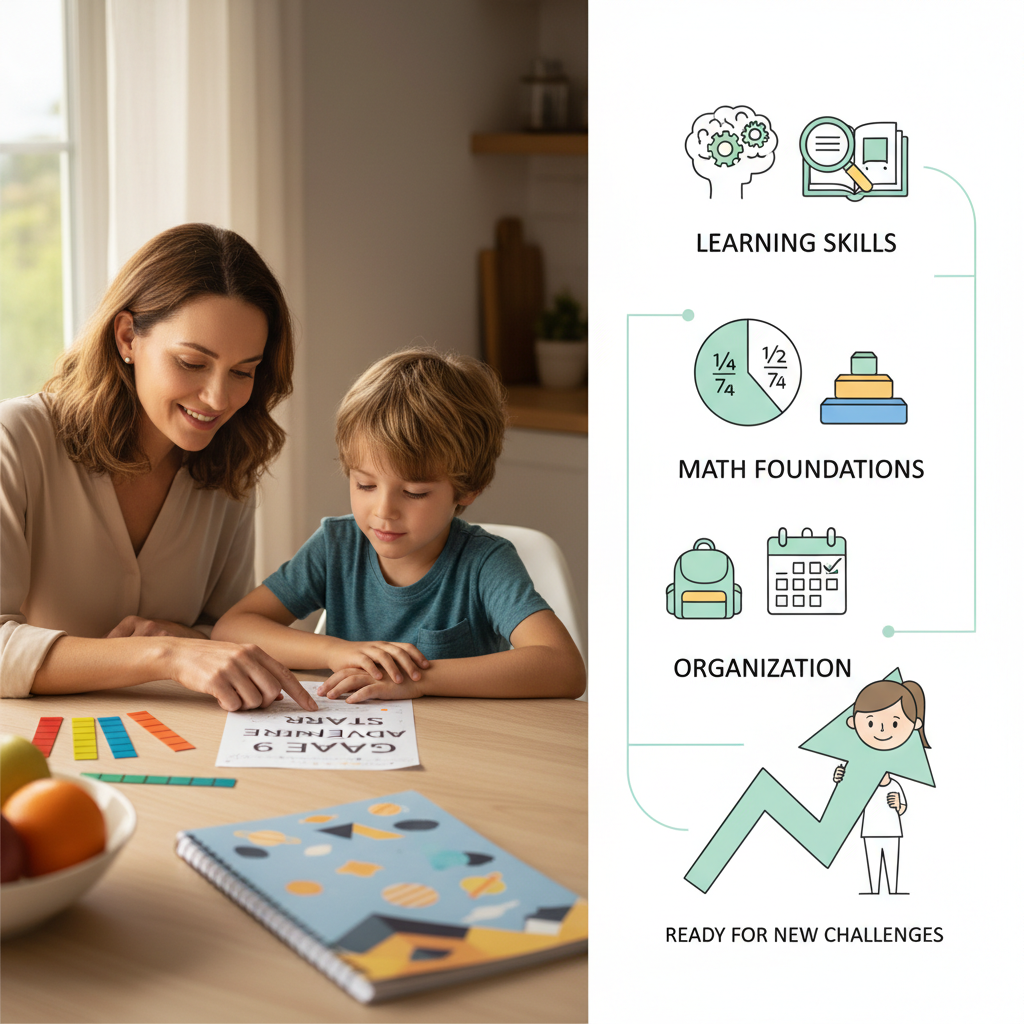
Grade 6 usually builds directly on Grade 5 topics, but the difficulty increases because students apply skills in new ways. Instead of “do this type of question,” they often see “choose a strategy and justify it.” As a result, fluency (speed and accuracy) and understanding (why it works) both matter.
Because Canada is provincially organized, exact expectations vary. However, you can confirm your province’s strands and examples through official curriculum pages such as the Ontario mathematics curriculum and the BC curriculum portal.
A quick “what changes” table
| Area | Often seen in Grade 5 | More common in Grade 6 |
|---|---|---|
| Fractions & decimals | Compute with like denominators and basic conversions | Compare, estimate, and solve multi-step fraction/decimal problems |
| Percent | Intro and simple percent-of problems | Percent as rates; discounts, tax, and real-life contexts |
| Ratios | Early proportional thinking | Ratios and unit rates (per 1) used to compare scenarios |
| Algebra | Patterns and missing numbers | Expressions and equations (math sentences with variables) |
| Problem solving | One-step or guided steps | Plan, choose strategy, show reasoning, check reasonableness |
Core Grade 6 readiness skills to review at home
You do not need to reteach a full year. Instead, focus on a few foundations that unlock many Grade 6 units. For example, strong fraction sense supports ratios, percent, and algebra.
1) Fractions: beyond procedures
In Grade 6, students often need to explain fraction size and operations using models. Therefore, it helps to practise with number lines and area models, not only worksheets.
- Compare and order fractions using benchmarks like 0, 1/2, and 1.
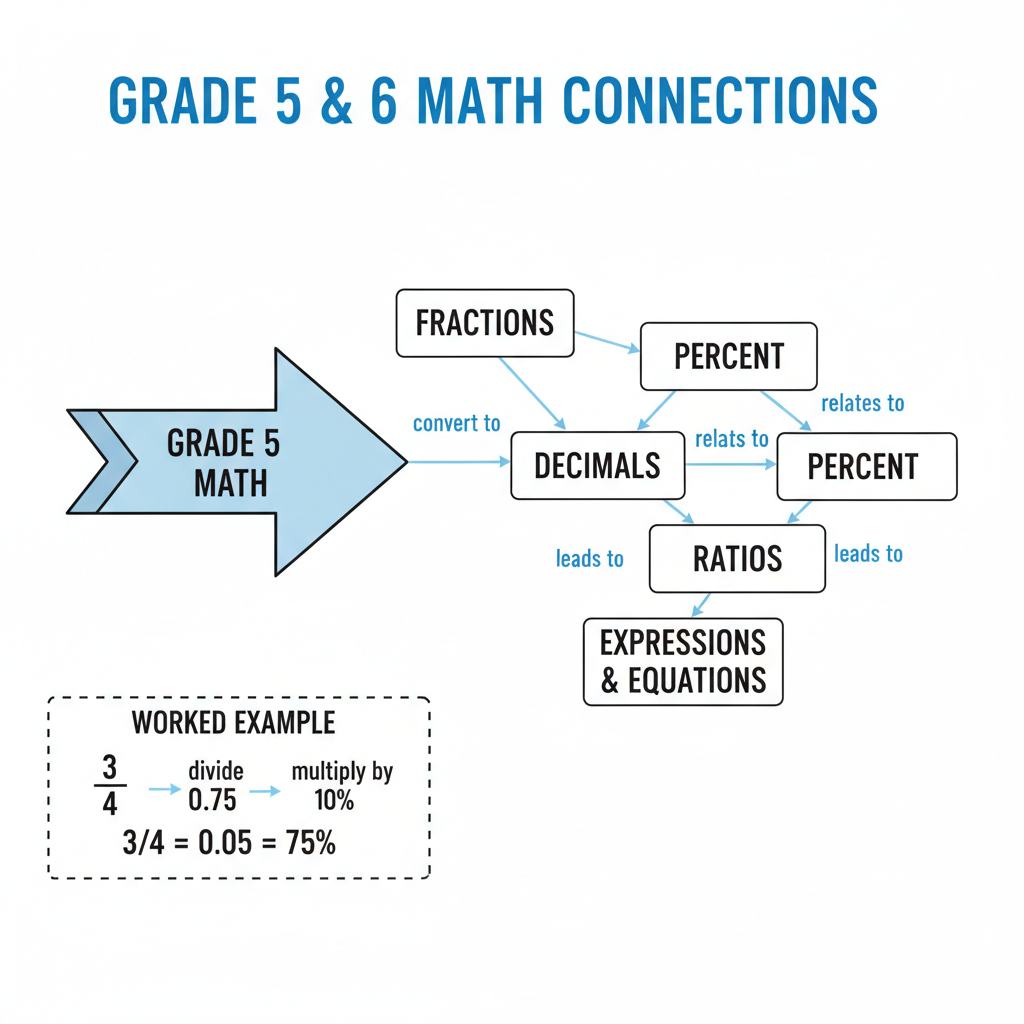
- Recognize equivalent fractions quickly (for example, 3/4 = 75/100).
- Add and subtract fractions and connect the steps to a picture model.
If you want a quick concept refresher, Britannica’s overview of fractions can help you review the language clearly.
2) Decimals: place value confidence
Many kids can “do” decimal questions but still feel uncertain about what decimals mean. However, Grade 6 problems often require estimation and reasonableness checks (asking, “Does this answer make sense?”).
- Read and write decimals to thousandths, connecting digits to place value.
- Compare decimals using place value, not just “more digits means bigger.”
- Round and estimate to check an answer quickly.
3) Percent: connecting fractions, decimals, and money
Percent becomes more practical in Grade 6, especially in financial literacy units. Therefore, children benefit from mental math anchors like 10% and 50%.
- Know that percent means “out of 100.”
- Convert between 1/2, 0.5, and 50% (and similar common equivalents).
- Practise real-life questions: sale prices, tips, and simple tax scenarios.
For parent-friendly background, Wikipedia can be useful for quick definitions, especially for terms like percent and ratio, although you should still rely on your province’s curriculum for expectations.
4) Ratios and unit rates: the “new” Grade 6 hurdle
Ratios sound advanced, but they often start with simple comparisons. For example, “2 red blocks for every 3 blue blocks” is a ratio. A unit rate means “per 1,” such as kilometres per hour, and it helps children compare options fairly.
- Write ratios in different forms (2:3, 2 to 3, 2/3) and explain what they mean.
- Find unit rates using division (for example, $12 for 3 items is $4 per item).
- Solve “best deal” problems using unit rate logic.
5) Early algebra: from patterns to equations
Grade 6 often formalizes patterns into expressions (math phrases like 3n + 2) and equations (math sentences like 3n + 2 = 17). However, the goal is not advanced algebra. Instead, it is learning how symbols represent numbers and relationships.
- Use a variable (a letter) to stand for an unknown number.
- Translate words into a simple expression (for example, “five more than x” becomes x + 5).
- Check a solution by substituting (plugging in) a value and verifying the equation.
Common Grade 6 math misunderstandings (and quick fixes)
Some mistakes look like carelessness, but they usually reflect a concept gap. Therefore, correcting the idea often solves the “accuracy” problem too.
- Misunderstanding: “0.35 is bigger than 0.5 because 35 is bigger than 5.” Quick fix: Compare using place value and money (35 cents vs 50 cents).
- Misunderstanding: “A bigger denominator means a bigger fraction.” Quick fix: Use pizza slices or fraction strips to show 1/8 is smaller than 1/4.
- Misunderstanding: “Percent is a separate topic.” Quick fix: Always connect percent to fractions and decimals (out of 100).
- Misunderstanding: “Ratio problems are guesswork.” Quick fix: Use tables (for example, 2:3 becomes 4:6, 6:9) to scale up.
A simple 3-week home plan (10–15 minutes a day)
You do not need long sessions to make progress. In fact, short, frequent practice builds retention (remembering over time). However, keep it calm and predictable so your child does not associate math with tension.
Week 1: Rebuild number sense
- 3 days: fraction comparison and equivalence using visuals
- 2 days: decimal place value and rounding
- Weekend: one mixed set + talk through two mistakes
Week 2: Connect percent and real life
- 2 days: fraction–decimal–percent conversions
- 2 days: sale price problems using 10% and 50% anchors
- 1 day: make-your-own word problem (your child writes it, then solves it)
Week 3: Ratio + early algebra, lightly
- 2 days: ratio tables and unit rate comparisons
- 2 days: expressions from word phrases
- 1 day: multi-step mixed problems with a “show your thinking” rule
How to support confidence without doing the work for them
When children move into harder content, they often need different support. Instead of correcting immediately, try prompts that build independence. For example, ask, “What do you notice?” before asking, “What is the answer?”
- Use “therefore” talk: “Therefore, if 10% is 4, then 20% is 8.”
- Ask for a model: number line, picture, or a quick table.
- Encourage checking: estimate first, then calculate, then compare.
If stress is rising, it can help to normalize struggle as part of learning. The goal is steady progress, not perfect pages.
Tools & Resources (official, parent-friendly)
These tools help you verify expectations and add practice without guessing. However, use them selectively so your child does not feel overwhelmed.
- Ontario Ministry of Education math curriculum (official strands and expectations)
- BC Curriculum (official learning standards and examples)
- EQAO (Ontario’s assessment agency; useful for understanding question styles and math language)
- Khan Academy (free practice; choose targeted skills like fractions, decimals, and ratios)
- Desmos (visual math tool; helpful for exploring patterns and graphs as kids advance)
Concluding Paragraph
The transition from Grade 5 to Grade 6 math becomes much smoother when your child has strong fraction sense, confident decimal place value, and a clear way to explain thinking. Therefore, focus on a few high-impact skills, practise in short bursts, and make “show your reasoning” feel normal at home. With that approach, your child can enter Grade 6 feeling capable, curious, and ready for the next level of math.
About Think Academy
About Think Academy Canada Think Academy Canada is a K-12 mathematics tutoring programme, part of TAL Education Group. We work with motivated students across Canada from Grade 1 through Grade 12, with a focus on Ontario curriculum, EQAO, and competition mathematics including CEMC and AMC. All lessons are delivered online. Follow us on Instagram at @thinkacademyca.

