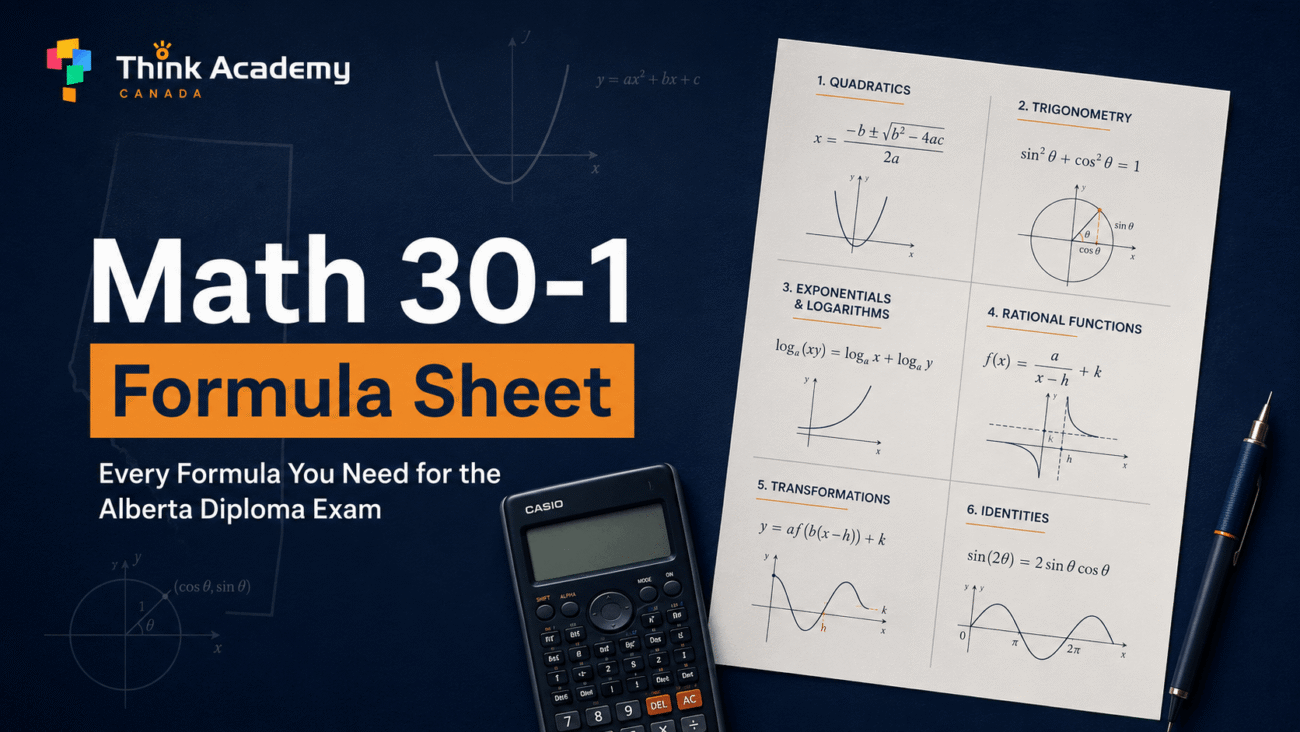
This page contains the Math 30-1 formula sheet that Alberta students need for Math 30-1 and the Alberta Diploma Examination — organised by unit, explained where the formula requires context, and annotated with common exam mistakes to avoid.
A formula sheet tells you what to use. It does not tell you when, how, or why. The difference between students who score well on the diploma exam and those who don’t is not which formulas they have memorised — it is whether they understand what those formulas mean and how to apply them in unfamiliar contexts. That understanding is what this guide is built to support, alongside the reference itself.
For a full breakdown of the Math 30-1 curriculum, prerequisites, and diploma exam structure, see our Math 30-1 complete guide.
What the Alberta Diploma Exam Provides vs What You Must Know
One of the most important things to understand before studying Math 30-1 formulas: the diploma exam does not provide a formula sheet. Students are expected to know every formula from memory.
This is different from many school-based assessments where a reference sheet is permitted. On the diploma exam, if you cannot recall the double angle formula or the combination formula, you cannot use it. This makes deliberate memorisation — not just understanding — a necessary part of preparation.
The formulas below are organised by unit. For each formula, the notation is standard Alberta curriculum notation. Where a formula has a common misapplication on the diploma exam, that is noted explicitly.
Math 30-1 Formula Sheet: Trigonometry Formulas
Trigonometry is the most heavily tested unit on the Math 30-1 diploma exam and contains the greatest number of formulas to know.
Math 30-1 Formula Sheet: Fundamental Identities
Pythagorean Identitiessin2θ+cos2θ=1 1+tan2θ=sec2θ 1+cot2θ=csc2θ
From the first identity, derive the other two by dividing through by cos²θ and sin²θ respectively. Knowing the derivation means you never need to memorise all three separately.
Reciprocal Identitiescscθ=sinθ1secθ=cosθ1cotθ=tanθ1
Quotient Identitiestanθ=cosθsinθcotθ=sinθcosθ
Common mistake: confusing cot with the reciprocal of tan vs the quotient of cos and sin — they are the same thing, but students who don’t see this connection make errors when substituting.
Math 30-1 Formula Sheet: Sum and Difference Formulas
sin(A±B)=sinAcosB±cosAsinB cos(A±B)=cosAcosB∓sinAsinB tan(A±B)=1∓tanAtanBtanA±tanB
Note the sign reversal in the cosine formula (± on the left becomes ∓ on the right). This is the most commonly misremembered formula in this set — cos(A + B) expands with subtraction.
Double Angle Formulas
sin2A=2sinAcosA cos2A=cos2A−sin2A=2cos2A−1=1−2sin2A tan2A=1−tan2A2tanA
The three forms of cos 2A are all equivalent — each is derived by substituting the Pythagorean identity into the cos²A − sin²A form. On the diploma exam, choosing the right form can simplify a proof significantly.
Radian and Degree Conversion
Radians=Degrees×180π Degrees=Radians×π180
**Arc length formula:** a=rθ
*(where a = arc length, r = radius, θ = angle in radians)*
Special angle values to know from memory:
| Degrees | Radians | sin | cos | tan |
|---|---|---|---|---|
| 0° | 0 | 0 | 1 | 0 |
| 30° | π/6 | 1/2 | √3/2 | 1/√3 |
| 45° | π/4 | √2/2 | √2/2 | 1 |
| 60° | π/3 | √3/2 | 1/2 | √3 |
| 90° | π/2 | 1 | 0 | undefined |
These must be committed to memory — the diploma exam will test them in radian form without a calculator permitted for Part A.
General Form of Sinusoidal Functions
y=asin(b(x−c))+dy=acos(b(x−c))+d
| Parameter | Effect |
|---|---|
| |a| | Amplitude |
| b | Period = 2π/|b| (for sin/cos) |
| c | Phase shift (horizontal translation) |
| d | Vertical displacement (midline) |
Common mistake: students confuse the period formula — period = 2π/b, not 2πb. A larger b gives a shorter period.
Math 30-1 Formula Sheet: Functions Formulas
Transformations: General Form
For any function f(x): y=af(b(x−c))+d
| Parameter | Transformation |
|---|---|
| a > 1 | Vertical stretch by factor a |
| 0 < a < 1 | Vertical compression by factor a |
| a < 0 | Reflection over x-axis |
| b > 1 | Horizontal compression by factor 1/b |
| 0 < b < 1 | Horizontal stretch by factor 1/b |
| b < 0 | Reflection over y-axis |
| c > 0 | Shift right c units |
| c < 0 | Shift left |c| units |
| d > 0 | Shift up d units |
| d < 0 | Shift down |d| units |
Common mistake: students reverse the direction of horizontal transformations. The shift is c units in the direction of the sign inside the bracket — so f(x − 3) shifts right 3, not left.
Inverse Functions
If f and f⁻¹ are inverse functions: f(f−1(x))=xf−1(f(x))=x
To find an inverse algebraically: swap x and y, then solve for y.
The graph of f⁻¹ is the reflection of f over the line y = x.
Domain restriction for inverses: An inverse is only a function if the original function is one-to-one (passes the horizontal line test). When restricting domain, the most common convention is to restrict to the interval where the function is increasing.
Absolute Value
∣x∣={x−xif x≥0if x<0
For solving |f(x)| = a (where a > 0): f(x)=aorf(x)=−a
For solving |f(x)| < a: −a<f(x)<a
For solving |f(x)| > a: f(x)<−aorf(x)>a
Rational Functions: Asymptotes
For a rational function f(x) = P(x)/Q(x):
Vertical asymptotes: occur where Q(x) = 0 and P(x) ≠ 0 (if both equal zero, there may be a hole instead)
Horizontal asymptotes:
- If degree of P < degree of Q: y = 0
- If degree of P = degree of Q: y = leading coefficient of P / leading coefficient of Q
- If degree of P > degree of Q: no horizontal asymptote (oblique asymptote instead)
Math 30-1 Formula Sheet: Exponents and Logarithms Formulas
Exponent Laws
am⋅an=am+n anam=am−n (am)n=amn (ab)n=anbn a0=1(a=0) a−n=an1 am/n=nam=(na)m
Logarithm Laws
logb(MN)=logbM+logbN logb(NM)=logbM−logbN logb(Mp)=plogbM logbb=1 logb1=0 blogbx=x logbx=logblogx=lnblnx(change of base)
The change of base formula is essential for evaluating logarithms with non-standard bases on a calculator.
Relationship between exponential and logarithmic forms:y=bx⟺x=logby
Common mistake: confusing which side the exponent and base go when converting. The base of the logarithm is always the base of the exponential.
Math 30-1 Formula Sheet: Permutations and Combinations Formulas
Fundamental Counting Principle
If one event can occur in m ways and a second event can occur in n ways, they can occur together in m × n ways.
Factorial
n!=n×(n−1)×(n−2)×⋯×2×1 0!=1
Permutations
Permutation of n objects taken r at a time (no repetition):nPr=(n−r)!n!
**Permutation of n objects where some are identical:** a!b!c!⋯n!
*(divide by the factorial of each group of identical items)*
Combinations
Combination of n objects taken r at a time:nCr=(rn)=r!(n−r)!n!
Key distinction: use permutations when order matters, combinations when it doesn’t. If the question asks for arrangements, lineups, or sequences — permutations. If it asks for selections, groups, or committees — combinations.
Binomial Theorem
(a+b)n=k=0∑n(kn)an−kbk
General term (t_{k+1}):tk+1=(kn)an−kbk
Common diploma exam question type: “find the term containing x⁴ in the expansion of (2x + 3)⁶.” Set up the general term, match the power of x, solve for k.
Pascal’s Triangle
Row n of Pascal’s Triangle gives the coefficients for the expansion of (a + b)ⁿ. The entry in row n, position r (starting from r = 0) equals ₙCᵣ.
Math 30-1 Formula Sheet: Polynomial Functions (Factor and Remainder Theorems)
Remainder Theorem: When f(x) is divided by (x − a), the remainder is f(a).
Factor Theorem: (x − a) is a factor of f(x) if and only if f(a) = 0.
Rational Root Theorem: If f(x) has integer coefficients, any rational root p/q (in lowest terms) must have p as a factor of the constant term and q as a factor of the leading coefficient.
How to Use The Math 30-1 Formula Sheet Effectively
Memorise, then practise application. Formula memorisation is necessary but not sufficient. A formula that lives only in your memory produces errors when a diploma exam question applies it in an unfamiliar context. After memorising each formula, solve at least five varied problems using it — including problems where the formula is one step in a multi-step solution.
Know the derivations for the trig identities. The Pythagorean identity sin²θ + cos²θ = 1 can be derived from the unit circle. The double angle formulas follow from the sum formulas. Knowing where formulas come from means you can reconstruct them if memory fails — and it means you understand them well enough to apply them flexibly.
Practise without a reference sheet. The diploma exam provides no formula sheet. Every practice session that allows formula-checking is only partial preparation. At least some of your practice — particularly in the final weeks before the diploma exam — should be done without any reference material, under timed conditions.
Identify your weak formula areas specifically. Most students have a few formulas they consistently misremember or misapply. Identifying these specifically — rather than resolving to “review all trig formulas” — allows focused preparation. If the sum formula for cosine is your weak point, practise ten cosine sum problems until the sign pattern is automatic.
Common Diploma Exam Mistakes by Unit
Trigonometry
- Misremembering the sign pattern in cos(A + B) — it expands with subtraction, not addition
- Confusing period with frequency — period = 2π/b, not b or 2πb
- Applying identities in the wrong direction when proving — start from the more complex side
- Forgetting to state restrictions on trigonometric equations (θ ∈ [0, 2π] vs general solutions)
Functions
- Reversing horizontal transformation directions — f(x − 3) shifts right, not left
- Forgetting to state domain restrictions for radical and rational functions
- Incorrectly identifying asymptotes — a vertical asymptote requires the denominator to be zero AND the numerator to be non-zero at that point
Exponents and Logarithms
- Applying log laws to sums — log(M + N) ≠ log M + log N
- Confusing the change of base formula direction
- Forgetting that log is only defined for positive arguments
Permutations and Combinations
- Using permutations when order doesn’t matter (or combinations when it does)
- Forgetting that 0! = 1
- Setting up the general term of a binomial expansion with the wrong value of k
Frequently Asked Questions
Does the Math 30-1 diploma exam provide a formula sheet? No. Unlike some school-based assessments, the Alberta Diploma Examination for Math 30-1 does not provide a formula sheet. All formulas must be memorised. This makes deliberate formula study — not just understanding — a necessary part of diploma preparation.
Which formulas are most important to know for the diploma exam? Trigonometry formulas are the most heavily weighted — particularly the Pythagorean identities, sum and difference formulas, double angle formulas, and the general sinusoidal form. The combination formula and binomial theorem general term are also consistently tested. Logarithm laws and the asymptote rules for rational functions are important for the functions and logarithms units.
How many formulas do I need to memorise for Math 30-1? There is no official count, but the formulas on this page cover the full scope of what the diploma exam tests. The trigonometry section contains the most formulas; the permutations and combinations section contains the fewest but most distinctly formatted.
How do I memorise the trig identities without just repeating them? Understand derivations rather than memorising each identity in isolation. The Pythagorean identity follows from the unit circle. The sum formulas are foundational — the double angle formulas follow from them. Knowing the logical chain means you can reconstruct any identity you have partially forgotten. Supplement derivation-based understanding with timed practice — retrieve each identity from memory, then check.
What is the hardest part of Math 30-1 for most students? Trigonometry — specifically identity proofs, which require both algebraic flexibility and trigonometric fluency simultaneously. The rational functions section (asymptotes, holes, sketching) is the second most commonly cited difficulty. Logarithms are conceptually challenging for students who did not build strong exponential function understanding in Math 20-1.
See our related guides: Math 30-1 complete guide · trigonometric identities sheet · special triangles in trigonometry · MHF4U Advanced Functions guide · proof by contradiction guide · math enrichment guide
Memorising formulas gets you started. Understanding them gets you through the diploma exam.