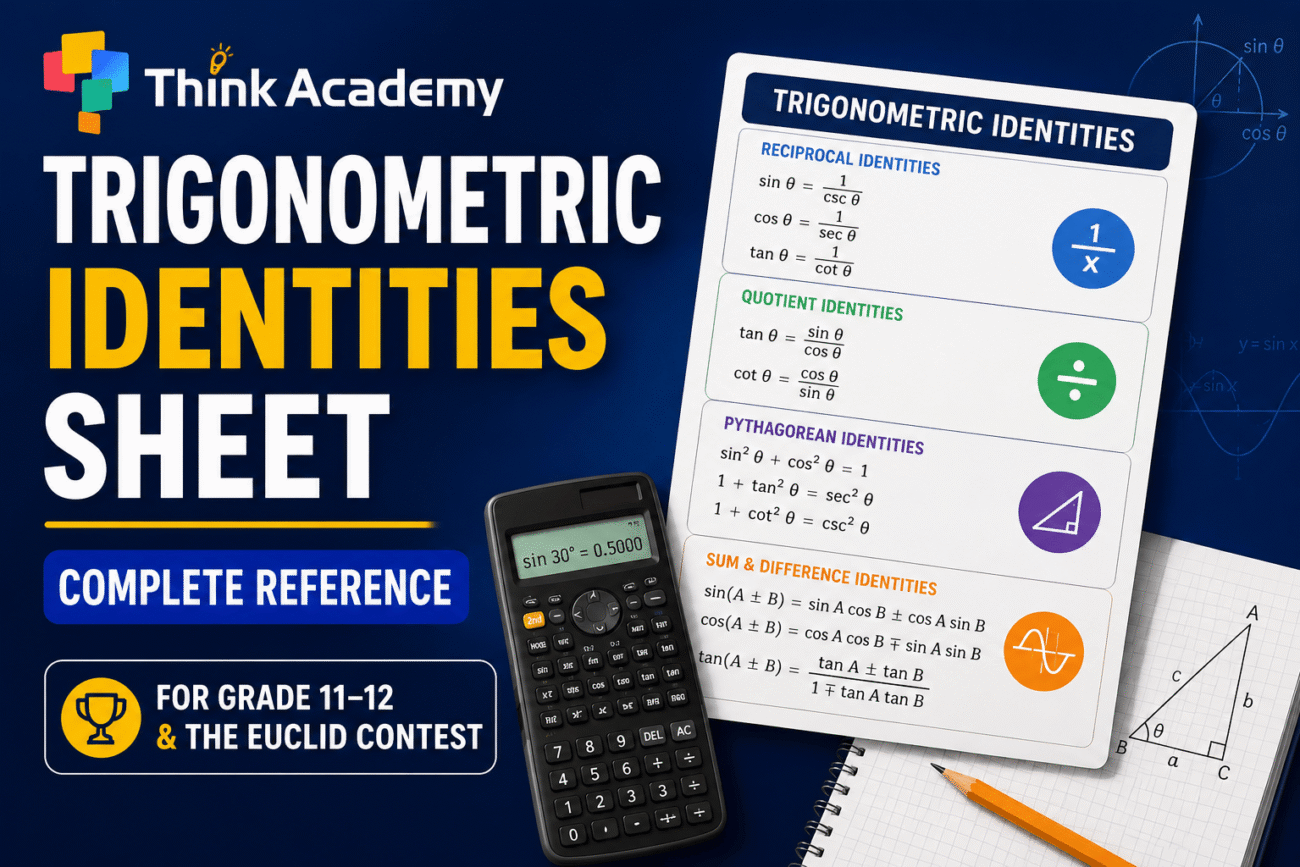
Trigonometric identities are one of the topics that separate strong Grade 11–12 math students from exceptional ones. The identities themselves are not difficult to state — the challenge is knowing which one to reach for, how to manipulate expressions efficiently, and how to construct a proof under time pressure. This guide gives you a complete trigonometric identities sheet covering every identity from MCR3U through to Euclid Contest level, with clear explanations, worked examples for each family, and practice problems with solutions.
What are trigonometric identities? Why trigonometric identities sheet?
A trigonometric identity is an equation involving trigonometric functions that is true for all values of the variable for which both sides are defined. Unlike a trigonometric equation (which is true for specific values of the angle), an identity holds universally.
The main use of identities is to rewrite trigonometric expressions in equivalent forms — simplifying them, combining them, or transforming them into something easier to work with in a proof or equation.
In Ontario, trigonometric identities are introduced in MCR3U (Grade 11 Functions) and extended significantly in MHF4U (Grade 12 Advanced Functions). They appear on the Euclid Math Contest, typically in problems that require proving an identity or using one to simplify an expression within a larger problem.
The complete trigonometric identities sheet
Our trigonometric identities sheet has everything you need to know about trigonometric identities for Grades 11-12.
1. Reciprocal identities
These define the three secondary trigonometric functions in terms of sine, cosine, and tangent.
| Identity | Notes |
|---|---|
| csc θ = 1 / sin θ | Cosecant is the reciprocal of sine |
| sec θ = 1 / cos θ | Secant is the reciprocal of cosine |
| cot θ = 1 / tan θ | Cotangent is the reciprocal of tangent |
These are the first identities to learn because they are used constantly as substitution tools in proofs and simplifications. When you see csc, sec, or cot in an expression, the first move is almost always to convert to sin and cos.
2. Quotient identities
| Identity | Notes |
|---|---|
| tan θ = sin θ / cos θ | Definition of tangent in terms of sin and cos |
| cot θ = cos θ / sin θ | Definition of cotangent in terms of sin and cos |
Combined with the reciprocal identities, these mean every trigonometric expression can be rewritten entirely in terms of sin and cos. This is the most reliable proof strategy for students who are not sure where to start.
3. Pythagorean identities
These are the most important identities in all of trigonometry. They come directly from the unit circle (x² + y² = 1, where x = cos θ and y = sin θ).
| Identity | Rearrangements |
|---|---|
| sin²θ + cos²θ = 1 | sin²θ = 1 − cos²θ; cos²θ = 1 − sin²θ |
| 1 + tan²θ = sec²θ | tan²θ = sec²θ − 1; 1 = sec²θ − tan²θ |
| 1 + cot²θ = csc²θ | cot²θ = csc²θ − 1; 1 = csc²θ − cot²θ |
The second and third Pythagorean identities are derived by dividing the first by cos²θ and sin²θ respectively.
The most used rearrangement: sin²θ = 1 − cos²θ and cos²θ = 1 − sin²θ. In a proof, whenever you see a squared trig function that doesn’t fit the expression, substitute using the Pythagorean identity to change it to the other function.
4. Cofunction identities
These relate each trig function to its complement (the co-function). In Ontario MCR3U and MHF4U, these appear in transformation contexts and occasionally in proofs.
| Identity |
|---|
| sin(90° − θ) = cos θ |
| cos(90° − θ) = sin θ |
| tan(90° − θ) = cot θ |
| csc(90° − θ) = sec θ |
| sec(90° − θ) = csc θ |
| cot(90° − θ) = tan θ |
5. Compound angle identities
These are the identities that most students first encounter in MHF4U (Grade 12). They express the trig functions of a sum or difference of two angles in terms of the trig functions of the individual angles.
| Identity |
|---|
| sin(A + B) = sin A cos B + cos A sin B |
| sin(A − B) = sin A cos B − cos A sin B |
| cos(A + B) = cos A cos B − sin A sin B |
| cos(A − B) = cos A cos B + sin A sin B |
| tan(A + B) = (tan A + tan B) / (1 − tan A tan B) |
| tan(A − B) = (tan A − tan B) / (1 + tan A tan B) |
Memory device for cos compound angles: the signs flip. cos(A + B) has a minus; cos(A − B) has a plus. This is the most commonly confused pair.
Key application: finding exact values of angles like 75° or 15° that are not in the standard table. For example, sin 75° = sin(45° + 30°) = sin 45° cos 30° + cos 45° sin 30°.
6. Double angle identities
These follow directly from the compound angle identities by setting B = A.
| Identity | Notes |
|---|---|
| sin 2A = 2 sin A cos A | From sin(A + A) |
| cos 2A = cos²A − sin²A | From cos(A + A) |
| cos 2A = 1 − 2sin²A | Substituting cos²A = 1 − sin²A |
| cos 2A = 2cos²A − 1 | Substituting sin²A = 1 − cos²A |
| tan 2A = 2 tan A / (1 − tan²A) | From tan(A + A) |
The three forms of cos 2A are all correct. The choice of which to use depends on the context — if the expression contains sin², use cos 2A = 1 − 2sin²A; if it contains cos², use cos 2A = 2cos²A − 1. This flexibility is what makes double angle identities useful in proofs.
Trigonometric Identities Sheet: How to prove a trigonometric identity
Proving a trig identity means showing that the left-hand side and right-hand side are equivalent. The key rule: work on one side only (usually the more complex side), and transform it into the other side. Do not move terms across the equals sign.
General strategy:
- Convert everything to sin and cos using reciprocal and quotient identities
- Look for opportunities to apply a Pythagorean identity (especially sin² + cos² = 1)
- Factor where possible
- Simplify fractions by finding common denominators or cancelling
- If stuck, try the other side
Worked example 1: Pythagorean identity proof
Prove that (1 − sin²θ) / cos θ = cos θ.
Left side: (1 − sin²θ) / cos θ
Apply the Pythagorean identity: 1 − sin²θ = cos²θ
= cos²θ / cos θ = cos θ ✓
Worked example 2: Reciprocal and quotient identity proof
Prove that sin θ × cot θ = cos θ.
Left side: sin θ × cot θ
Apply the quotient identity: cot θ = cos θ / sin θ
= sin θ × (cos θ / sin θ) = cos θ ✓
Worked example 3: Multi-step proof
Prove that (sec θ − cos θ) / sin θ = tan θ × sin θ.
Left side: (sec θ − cos θ) / sin θ
Convert sec θ to 1/cos θ: = (1/cos θ − cos θ) / sin θ
Common denominator: = ((1 − cos²θ) / cos θ) / sin θ
Apply Pythagorean identity: 1 − cos²θ = sin²θ = (sin²θ / cos θ) / sin θ = sin²θ / (cos θ × sin θ) = sin θ / cos θ = tan θ
Right side: tan θ × sin θ
Wait — re-read the identity. Right side = tan θ × sin θ, not tan θ. Let’s recheck.
Right side: tan θ × sin θ = (sin θ / cos θ) × sin θ = sin²θ / cos θ
Left side reached: sin²θ / cos θ ✓ Both sides equal sin²θ / cos θ.
Worked example 4: Compound angle application
Find the exact value of cos 15°.
cos 15° = cos(45° − 30°) = cos 45° cos 30° + sin 45° sin 30° = (√2/2)(√3/2) + (√2/2)(1/2) = √6/4 + √2/4 = (√6 + √2) / 4
Worked example 5: Double angle identity
Given sin θ = 3/5 and θ is in the first quadrant, find sin 2θ and cos 2θ.
First find cos θ: cos θ = √(1 − 9/25) = √(16/25) = 4/5
sin 2θ = 2 sin θ cos θ = 2 × (3/5) × (4/5) = 24/25
cos 2θ = cos²θ − sin²θ = 16/25 − 9/25 = 7/25
Trigonometric identities sheet: Practice problems
Try these before checking the solutions.
Q1. Prove: tan θ + cot θ = sec θ × csc θ
Q2. Prove: (sin θ + cos θ)² = 1 + 2 sin θ cos θ
Q3. Find the exact value of sin 75°.
Q4. Given cos 2θ = 7/25, find cos θ if θ is acute.
Q5. Simplify: (1 − cos²θ)(1 + cot²θ)
Solutions
Q1. Left side: tan θ + cot θ = sin θ/cos θ + cos θ/sin θ = (sin²θ + cos²θ) / (sin θ cos θ) = 1 / (sin θ cos θ) = (1/cos θ)(1/sin θ) = sec θ × csc θ ✓
Q2. Left side: (sin θ + cos θ)² = sin²θ + 2 sin θ cos θ + cos²θ = 1 + 2 sin θ cos θ ✓ (using sin²θ + cos²θ = 1)
Q3. sin 75° = sin(45° + 30°) = sin 45° cos 30° + cos 45° sin 30° = (√2/2)(√3/2) + (√2/2)(1/2) = √6/4 + √2/4 = (√6 + √2) / 4
Q4. cos 2θ = 2cos²θ − 1 = 7/25 2cos²θ = 7/25 + 1 = 32/25 cos²θ = 16/25 cos θ = 4/5 (positive since θ is acute)
Q5. (1 − cos²θ)(1 + cot²θ) = sin²θ × csc²θ (using Pythagorean identities) = sin²θ × (1/sin²θ) = 1
Trigonometric identities sheet and the Euclid Contest
The Euclid Mathematics Contest, written by Grade 12 students in April each year, tests mathematical reasoning and proof at a level significantly beyond the curriculum. Trigonometric identities appear in two main ways:
Direct proof problems: Students are asked to prove an identity, typically using compound angle or double angle formulas alongside the foundational identities. These problems require a clean, complete argument — partial or circular proofs receive partial credit at best.
Embedded identity use: More commonly, an identity is required as a tool within a larger problem. A student who recognises that an expression simplifies using the double angle formula for sin 2A, or that a fraction reduces using 1 − cos²A = sin²A, can unlock a problem that would otherwise be intractable.
The key Euclid skill that identity practice builds is pattern recognition — seeing sin²θ + cos²θ hiding in an expression, noticing a sum-of-angles structure, or spotting that a complex expression is just sin 2θ in disguise. This pattern recognition only comes from repeated practice with a wide range of identity types.
Trigonometric identities sheet: which identities to know for MCR3U vs MHF4U vs Euclid
| Level | Required identities |
|---|---|
| MCR3U (Grade 11) | Reciprocal, quotient, Pythagorean identities; basic proof by substitution |
| MHF4U (Grade 12) | All of the above + compound angle, double angle, cofunction identities; proving identities; solving trig equations using identities |
| Euclid Contest | All of the above + fluent application in multi-step proofs; pattern recognition in unfamiliar forms |
A student who has only studied MCR3U content will find the compound angle problems on the Euclid very difficult. The most effective preparation for the Euclid trigonometry section starts with complete fluency in MHF4U identities, then moves to practising Euclid past paper problems.
Common mistakes when working with trigonometric identities
| Mistake | What to do instead |
|---|---|
| Moving terms across the equals sign | Work on one side only — never rearrange across the equals sign in a proof |
| Confusing cos(A + B) and cos A + cos B | cos(A + B) ≠ cos A + cos B — always expand using the compound angle formula |
| Using the wrong form of cos 2A | Match the form to the expression — if you see sin², use cos 2A = 1 − 2sin²A |
| Forgetting to square when applying Pythagorean identities | sin²θ + cos²θ = 1, not sin θ + cos θ = 1 |
| Starting from the simpler side of a proof | Start from the more complex side and simplify toward the simpler one |
How Think Academy Canada supports Grade 11–12 math and Euclid preparation
Think Academy Canada works with high-performing Ontario students from Grade 1 through Grade 12. For students in MCR3U, MHF4U, or preparing for the Euclid Contest, our programme covers trigonometric identities in full — from the foundational Pythagorean identities through to compound angle proof problems at Euclid level.
Our approach starts with a free diagnostic. Every new student completes a short assessment and receives a personalised feedback report identifying where their skills stand. For Grade 11 and 12 students, the report shows whether the difficulty is in the foundational identities, in proof strategy, or in the higher-level pattern recognition the Euclid requires — three distinct problems that need three different approaches.
The Euclid Contest is written in April each year. Students who begin serious preparation in the autumn — building MHF4U identity fluency before moving to Euclid-level proof practice — have the strongest results.
FAQ
What are the main trigonometric identities I need to know?
The core families are: reciprocal identities (csc, sec, cot in terms of sin, cos, tan), quotient identities (tan and cot as ratios of sin and cos), Pythagorean identities (sin²θ + cos²θ = 1 and its derivatives), compound angle identities (sin and cos of A ± B), and double angle identities (sin 2A, cos 2A, tan 2A).
What is the most important trigonometric identity?
The Pythagorean identity sin²θ + cos²θ = 1 is the most fundamental. Its rearrangements (sin²θ = 1 − cos²θ and cos²θ = 1 − sin²θ) appear in virtually every trigonometric proof and simplification.
How do you prove a trigonometric identity?
Work on one side only — usually the more complex side. Convert everything to sin and cos using reciprocal and quotient identities. Apply Pythagorean identities to replace squared trig functions. Factor and simplify. The goal is to transform one side into the other without moving terms across the equals sign.
What is the compound angle formula for sin?
sin(A + B) = sin A cos B + cos A sin B, and sin(A − B) = sin A cos B − cos A sin B. These are used to find exact values of angles like 75° and 15°, and to prove identities involving sums of angles.
What is the double angle formula?
The double angle formulas are: sin 2A = 2 sin A cos A; cos 2A = cos²A − sin²A (also written as 1 − 2sin²A or 2cos²A − 1); and tan 2A = 2 tan A / (1 − tan²A). They are derived from the compound angle formulas by setting B = A.
Do trigonometric identities appear on the Euclid Contest?
Yes. Trigonometric identities appear in the Euclid both as direct proof problems and as tools embedded within larger problems. Compound angle and double angle identities are most commonly tested. Fluency with the full identity sheet is necessary for students targeting strong Euclid results.
What trigonometric identities are in MCR3U?
MCR3U (Grade 11 Functions) covers the reciprocal, quotient, and Pythagorean identities. Students prove identities by substitution and simplification. Compound angle and double angle identities are introduced in MHF4U (Grade 12).
What is the best strategy for proving a trigonometric identity?
Start from the more complex side. Convert everything to sin and cos. Apply the Pythagorean identity wherever you see sin² or cos² and the expression can be simplified. Factor before expanding where possible. If stuck, try starting from the other side or writing both sides in terms of sin and cos and working toward the middle.
How is csc different from sin?
csc θ (cosecant) is the reciprocal of sin θ: csc θ = 1/sin θ. Similarly, sec θ = 1/cos θ and cot θ = 1/tan θ. These three reciprocal functions appear frequently in advanced trig identities and in the Euclid Contest.
What is the difference between a trigonometric identity and a trigonometric equation?
A trigonometric identity is true for all values of the variable (where both sides are defined). A trigonometric equation is true only for specific values. Proving an identity requires showing it is universally true; solving an equation requires finding which specific angles satisfy it.
How can Think Academy Canada help with trigonometric identities?
Think Academy Canada offers a free diagnostic assessment for Ontario students in Grades 1 to 12. The assessment identifies where a student’s trigonometric skills stand — including whether gaps are in the foundational identities, in proof strategy, or in the higher-level pattern recognition the Euclid requires. A personalised feedback report is provided after the assessment as well as free resources to practice with, so this trigonometric identities sheet isn’t the only resource you’ll have.
About Think Academy Canada Think Academy Canada is a K-12 mathematics tutoring programme, part of TAL Education Group. We work with motivated students across Canada from Grade 1 through Grade 12, with a focus on Ontario curriculum, EQAO preparation, and competition mathematics including CEMC contests (Pascal, Cayley, Fermat, Euclid) and AMC. All lessons are delivered online. Follow us on Instagram at @thinkacademyca.