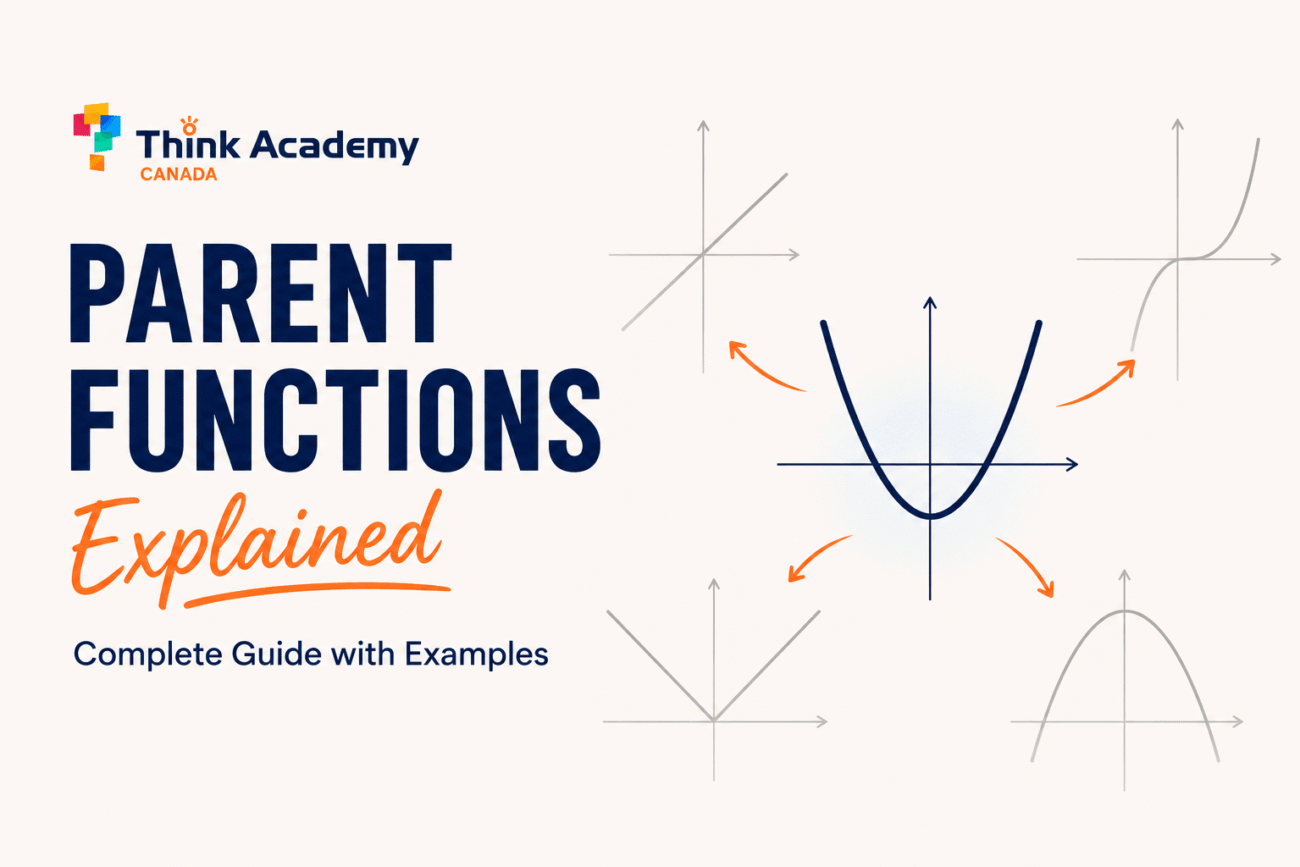
Parent functions math is one of the most important concepts in Ontario’s Grade 11 and 12 mathematics curriculum — and one of the most underestimated. A parent function is the simplest, most basic version of a family of functions. Every other function in that family is created by applying transformations to the parent. Once a student genuinely understands parent functions math, transformations become logical rather than arbitrary — and the entire functions strand of MCR3U and MHF4U becomes significantly more manageable.
This guide covers what parent functions are, the eight key parent functions every Ontario student needs to know, their graphs and key properties, and how they connect to the transformations your child will encounter throughout Grade 11 and 12.
What Are Parent Functions in Math?
A parent function is the simplest form of a function family — the version with no transformations applied. It has no shifts, stretches, reflections, or compressions. It is the base from which all other functions in the family are built.
Why parent functions math matters:
Every function your child encounters in MCR3U and MHF4U is a transformed version of a parent function. When a student sees f(x) = 2(x − 3)² + 1, they are looking at the quadratic parent function y = x² with three transformations applied: a vertical stretch by factor 2, a horizontal shift 3 right, and a vertical shift 1 up.
A student who knows the parent functions math well can:
- Sketch any transformed function quickly by starting from the parent
- Identify transformations from an equation without memorising them as separate rules
- Understand domain and range for any function in the family
- Connect different function types to each other through the transformation framework
A student who does not know parent functions math is essentially memorising each function in each unit as a separate new topic — a much harder and less efficient approach.
For the full functions curriculum context, see our MCR3U complete guide and types of function in math guide.
The General Transformation Formula
Before covering each parent function, it is worth understanding the transformation formula that applies to all of them:y=af(b(x−c))+d
| Parameter | Effect on graph |
|---|---|
| a (vertical) | |a| > 1: vertical stretch; 0 < |a| < 1: vertical compression; a < 0: reflection over x-axis |
| b (horizontal) | |b| > 1: horizontal compression by 1/b; 0 < |b| < 1: horizontal stretch by 1/b; b < 0: reflection over y-axis |
| c (horizontal shift) | c > 0: shift right c units; c < 0: shift left |c| units |
| d (vertical shift) | d > 0: shift up d units; d < 0: shift down |d| units |
Key point for students: Horizontal transformations are counterintuitive. f(x − 3) shifts the graph RIGHT 3 (not left). f(2x) compresses the graph horizontally by factor 1/2 (not stretches). This reversal is one of the most common sources of errors in parent functions math.
This formula applies identically to every parent function — learn it once, apply it everywhere.
The 8 Key Parent Functions in Math
1. Linear Parent Function
Equation: f(x) = x
Graph: A straight line through the origin with slope 1
Key features:
- Domain: all real numbers
- Range: all real numbers
- x-intercept and y-intercept both at (0, 0)
- Slope = 1
Transformed form: f(x) = mx + b (or y = a(x − c) + d in transformation notation)
What transformations do:
- Changing slope m is a vertical stretch/compression
- Adding b shifts the line vertically
Where it appears: Grade 9 MTH1W, reviewed in MCR3U as the baseline function type.
2. Quadratic Parent Function
Equation: f(x) = x²
Graph: A parabola opening upward with vertex at the origin
Key features:
- Domain: all real numbers
- Range: y ≥ 0
- Vertex at (0, 0)
- Axis of symmetry: x = 0
- Even function: f(−x) = f(x)
Transformed form: f(x) = a(x − h)² + k
What transformations do:
- a > 0: opens up; a < 0: opens down (reflection)
- |a| > 1: narrower parabola; 0 < |a| < 1: wider parabola
- h shifts the vertex horizontally; k shifts it vertically
Where it appears: Grade 10 MPM2D (central topic), reviewed in MCR3U. See our Grade 10 math Ontario guide.
Common parent functions math mistake: Students think |a| > 1 makes the parabola “wider” and |a| < 1 makes it “narrower.” It is the reverse — a larger |a| means a steeper, narrower parabola.
3. Cubic Parent Function
Equation: f(x) = x³
Graph: An S-shaped curve through the origin
Key features:
- Domain: all real numbers
- Range: all real numbers
- Passes through (0, 0), (1, 1), (−1, −1)
- Odd function: f(−x) = −f(x)
- Point of inflection at the origin
Transformed form: f(x) = a(x − h)³ + k
Where it appears: MCR3U Unit 2 (polynomial functions) and MHF4U. The cubic is the simplest odd-degree polynomial — its end behaviour (left down, right up) is the model for all odd-degree polynomial functions with a positive leading coefficient.
4. Exponential Parent Function
Equation: f(x) = bˣ (where b > 0, b ≠ 1)
Most common forms: f(x) = 2ˣ or f(x) = eˣ
Graph: A rapid growth curve (b > 1) or decay curve (0 < b < 1) always above the x-axis
Key features:
- Domain: all real numbers
- Range: y > 0
- y-intercept at (0, 1) — always, for any base
- Horizontal asymptote at y = 0
- Never touches the x-axis
Transformed form: f(x) = a · b^(k(x−c)) + d
What transformations do:
- d shifts the horizontal asymptote vertically from y = 0 to y = d
- a reflects or stretches the curve
- c shifts the y-intercept horizontally
Where it appears: MCR3U Unit 3. The exponential parent function is one of the most important in parent functions math because its inverse — the logarithmic function — is defined directly in terms of it.
5. Logarithmic Parent Function
Equation: f(x) = logᵦ(x) (where b > 0, b ≠ 1)
Most common form: f(x) = log(x) (base 10) or f(x) = ln(x) (base e)
Graph: A slowly increasing curve crossing the x-axis at (1, 0), with a vertical asymptote at x = 0
Key features:
- Domain: x > 0 (critical domain restriction)
- Range: all real numbers
- x-intercept at (1, 0) — always, for any base
- Vertical asymptote at x = 0
- Passes through (b, 1) — since logᵦ(b) = 1
Relationship to exponential: The logarithmic parent function is the inverse of the exponential parent function. Their graphs are reflections of each other over the line y = x.
Transformed form: f(x) = a · logᵦ(k(x − c)) + d
What transformations do to the logarithm:
- c shifts the vertical asymptote from x = 0 to x = c
- d shifts the x-intercept vertically
- a reflects the curve over the x-axis (a < 0)
Where it appears: MCR3U Unit 4 and MHF4U. The domain restriction (x > 0) is the most commonly forgotten detail in parent functions math for the logarithmic function.
6. Square Root (Radical) Parent Function
Equation: f(x) = √x
Graph: The upper half of a sideways parabola, starting at the origin and curving right
Key features:
- Domain: x ≥ 0 (cannot take the square root of a negative number)
- Range: y ≥ 0
- Starts at (0, 0)
- Passes through (1, 1) and (4, 2) and (9, 3)
Transformed form: f(x) = a√(b(x − c)) + d
What transformations do:
- c shifts the starting point (vertex) horizontally
- d shifts it vertically
- a < 0 reflects the curve below the x-axis
Relationship to quadratic: The radical parent function is the inverse of the quadratic parent function (restricted to x ≥ 0). Their graphs are reflections over y = x.
Where it appears: MHF4U. Domain restriction is particularly important for transformed radical functions — when the expression under the radical is shifted, the domain restriction shifts with it.
7. Absolute Value Parent Function
Equation: f(x) = |x|
Graph: A V-shape with vertex at the origin, both arms rising at 45° angles
Key features:
- Domain: all real numbers
- Range: y ≥ 0
- Vertex at (0, 0)
- Slope is 1 for x > 0 and −1 for x < 0
- Even function: f(−x) = f(x)
Transformed form: f(x) = a|b(x − c)| + d
What transformations do:
- c shifts the vertex horizontally
- d shifts it vertically
- a < 0 flips the V into an inverted ∧ shape
Where it appears: MHF4U. The absolute value parent function is useful for modelling quantities that cannot be negative — distance, speed, magnitude.
8. Trigonometric Parent Functions
Primary parent functions:
- f(x) = sin(x)
- f(x) = cos(x)
- f(x) = tan(x)
Sine parent function key features:
- Domain: all real numbers
- Range: −1 ≤ y ≤ 1
- Period: 2π
- Passes through (0, 0)
- Maximum value 1 at x = π/2; minimum −1 at x = 3π/2
Cosine parent function key features:
- Domain: all real numbers
- Range: −1 ≤ y ≤ 1
- Period: 2π
- Passes through (0, 1) — the key difference from sine
- Maximum value 1 at x = 0; minimum −1 at x = π
Transformed form: f(x) = a sin(b(x − c)) + d
| Parameter | Effect |
|---|---|
| a | Amplitude = |a| |
| b | Period = 2π/|b| |
| c | Phase shift (horizontal) |
| d | Vertical displacement (midline shifts from y=0 to y=d) |
Where it appears: MCR3U Unit 5 (the largest and hardest unit) and MHF4U. Trigonometric parent functions are the most complex in parent functions math because they introduce two new parameters (amplitude and period) that have no equivalent in the other function families. See our special triangles in trigonometry guide and trigonometric identities sheet.
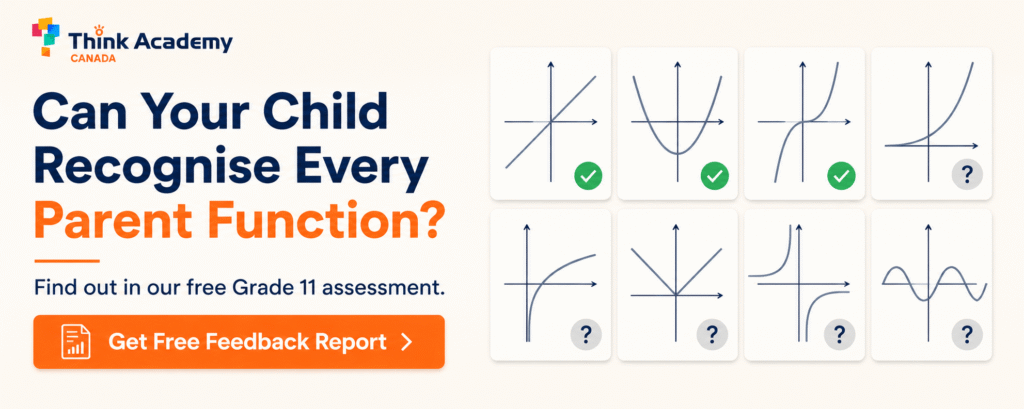
Can your child recognise all eight parent functions from memory?
Most Grade 11 students can identify two or three confidently—but struggle once transformations are introduced.
How to Sketch a Transformed Function from Its Parent
The parent functions math approach to sketching any transformed function follows the same four-step process regardless of function type.
Step 1: Identify the parent function. What is the base shape? y = x, y = x², y = bˣ, y = logᵦ(x), etc.
Step 2: Identify the parameters a, b, c, d. Write the function in the form y = af(b(x − c)) + d and read off each parameter.
Step 3: List the transformations in order. Apply horizontal transformations (b and c) before vertical transformations (a and d). This order matters — applying them in the wrong order produces incorrect results.
Correct order:
- Horizontal stretch/compression (b)
- Horizontal shift (c)
- Vertical stretch/compression/reflection (a)
- Vertical shift (d)
Step 4: Apply each transformation to the key points of the parent function. Every parent function has 3–5 key points that define its shape. Apply the transformations to those key points, then sketch the transformed curve through the new points.
Example: Sketch f(x) = −2(x + 1)² + 3
- Parent function: y = x² — key points: (0,0), (1,1), (−1,1), (2,4), (−2,4)
- Parameters: a = −2, b = 1, c = −1, d = 3
- Transformations: reflect over x-axis (a < 0), stretch vertically by 2, shift left 1, shift up 3
- New vertex: (0,0) → shift left 1, up 3 → (−1, 3)
- New point from (1,1): apply transformations → (0, −2+3) = (0, 1)
- Sketch: inverted parabola, vertex at (−1, 3)
Parent Functions Math: Key Points Summary
| Parent Function | Equation | Key Point 1 | Key Point 2 | Key Point 3 | Domain | Range |
|---|---|---|---|---|---|---|
| Linear | y = x | (0,0) | (1,1) | (−1,−1) | All reals | All reals |
| Quadratic | y = x² | (0,0) | (1,1) | (−1,1) | All reals | y ≥ 0 |
| Cubic | y = x³ | (0,0) | (1,1) | (−1,−1) | All reals | All reals |
| Exponential | y = bˣ | (0,1) | (1,b) | (−1,1/b) | All reals | y > 0 |
| Logarithmic | y = logᵦ(x) | (1,0) | (b,1) | (1/b,−1) | x > 0 | All reals |
| Radical | y = √x | (0,0) | (1,1) | (4,2) | x ≥ 0 | y ≥ 0 |
| Absolute Value | y = |x| | (0,0) | (1,1) | (−1,1) | All reals | y ≥ 0 |
| Sine | y = sin(x) | (0,0) | (π/2,1) | (π,0) | All reals | −1 ≤ y ≤ 1 |
| Cosine | y = cos(x) | (0,1) | (π/2,0) | (π,−1) | All reals | −1 ≤ y ≤ 1 |
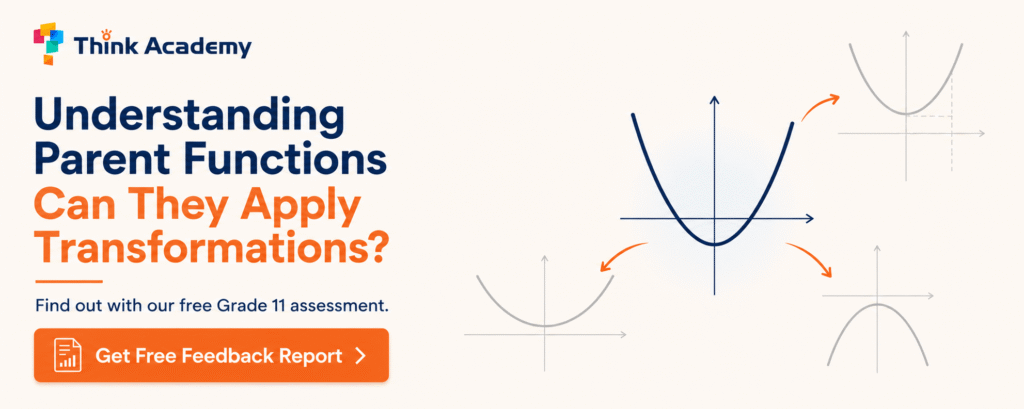
Many students can identify a parent function when they see one.
The challenge begins when transformations are introduced.
Our free assessment measures whether your child can apply function concepts—not just memorise them—and provides personalised feedback highlighting strengths and gaps.
→ Get your free feedback report
Common Mistakes in Parent Functions Math
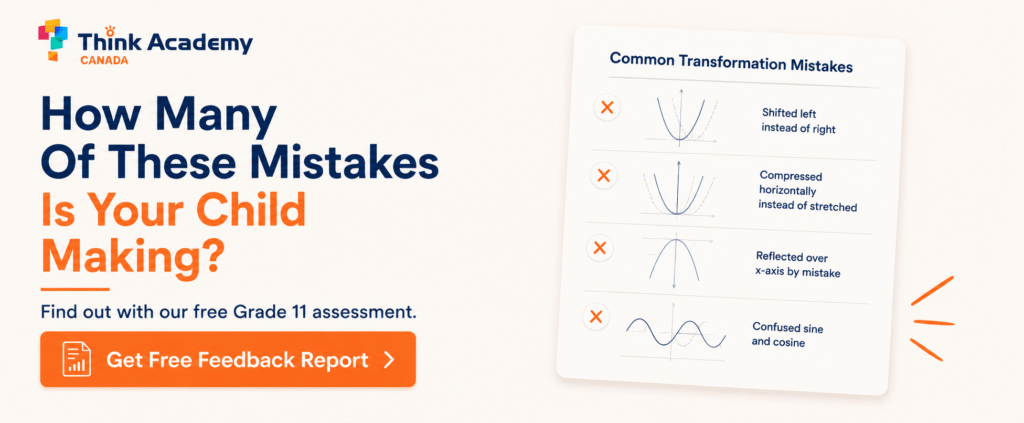
Confusing horizontal transformation directions. f(x − 3) shifts RIGHT 3, not left. f(2x) compresses horizontally, not stretches. These reversals are the single most common source of errors when students apply transformations to parent functions. The reason: x − 3 = 0 when x = 3, so the graph reaches its “zero point” at x = 3 rather than x = 0 — it has moved right.
Not knowing the key points of each parent function. Transformations are applied to key points. A student who does not know that the exponential parent function passes through (0, 1) — always — cannot accurately sketch a transformed exponential. Memorising 3–5 key points for each parent function is necessary preparation.
Forgetting domain restrictions on radical and logarithmic parent functions. When transformations are applied to y = √x or y = log(x), the domain restriction shifts too. f(x) = √(x − 4) has domain x ≥ 4, not x ≥ 0. f(x) = log(x + 2) has domain x > −2, not x > 0. Missing domain shifts is a consistent source of lost marks in MHF4U.
Applying transformations in the wrong order. Horizontal transformations (b and c) should be applied before vertical ones (a and d). A student who shifts vertically before stretching horizontally will sketch the wrong curve.
Confusing sine and cosine starting values. sin(0) = 0 — the sine wave starts at the midline. cos(0) = 1 — the cosine wave starts at its maximum. Students who confuse these will sketch sinusoidal transformations incorrectly.
Parent Functions Math in the Ontario Curriculum
Parent functions math underpins the entire functions strand across Grade 9 through Grade 12:
- Grade 9 MTH1W: Linear function introduced (y = x as the parent)
- Grade 10 MPM2D: Quadratic parent function — vertex form, transformations of y = x²
- Grade 11 MCR3U Unit 1: Formal introduction of transformations framework applied to all function types — this is where parent functions math is explicitly taught as a unifying concept
- Grade 11 MCR3U Units 3–5: Exponential, logarithmic, and trigonometric parent functions introduced and transformed
- Grade 12 MHF4U: Radical, absolute value, and rational parent functions; all transformations extended
For a full picture of the MCR3U curriculum and how parent functions math connects across all six units, see our MCR3U complete guide. For MHF4U, see our MHF4U Advanced Functions guide.
Practice Problems
Set A — Identifying parent functions
Identify the parent function for each:
- f(x) = 3(x − 2)² + 5 → parent: ___
- f(x) = −2ˣ⁺¹ → parent: ___
- f(x) = √(x + 4) − 1 → parent: ___
- f(x) = 4 sin(2x − π) + 3 → parent: ___
- f(x) = log₃(x − 1) → parent: ___
- f(x) = −|2x + 6| + 4 → parent: ___
Set B — Identifying transformations
State all transformations applied to the parent function:
- f(x) = (x + 3)² − 7
- f(x) = 2 · 3ˣ⁻¹ + 4
- f(x) = −√(x − 2) + 1
- f(x) = 3 sin(2(x − π/4)) − 1
Set C — Key points after transformation
The parent function y = x² has key point (2, 4). Find the image of this point after the transformation f(x) = −(x + 1)² + 3:
- Image of (2, 4): ___
- Image of (0, 0) (vertex): ___
Answers:
Set A: 1) y = x² 2) y = bˣ (exponential) 3) y = √x 4) y = sin(x) 5) y = logᵦ(x) 6) y = |x|
Set B: 7) Shift left 3, shift down 7 (no stretch or reflection) 8) Vertical stretch by 2, shift right 1, shift up 4 9) Shift right 2, reflect over x-axis (a = −1), shift up 1 10) Vertical stretch by 3, horizontal compression (period = π), phase shift right π/4, shift down 1
Set C: 11) Apply c = −1 (shift left 1): x → 2 − 1 = 1. Apply a = −1 (reflect): y → −4. Apply d = 3 (shift up 3): y → −4 + 3 = −1. Image: (1, −1) 12) Vertex shifts from (0,0) to (−1, 3)
Frequently Asked Questions
What are parent functions in math? Parent functions math refers to the basic, untransformed versions of each function family. The parent function is the simplest member of its family — it has no shifts, stretches, reflections, or compressions applied. Every other function in the family is a transformation of the parent.
Why are parent functions important in math? Because the transformation framework y = af(b(x−c)) + d applies identically to every parent function. A student who understands parent functions math can sketch any transformed function by starting from the parent and applying systematic changes to key points, rather than memorising each function type separately.
What are the 8 parent functions in high school math? Linear (y = x), quadratic (y = x²), cubic (y = x³), exponential (y = bˣ), logarithmic (y = logᵦ(x)), radical (y = √x), absolute value (y = |x|), and trigonometric (y = sin(x), y = cos(x)). These are the parent functions that appear across the Ontario Grade 9 through Grade 12 mathematics curriculum.
What is the parent function of a parabola? The parent function of a parabola is y = x² — a parabola with vertex at the origin, opening upward with no stretch or compression. Every other parabola is a transformation of this parent function.
Do parent functions always pass through the origin? No. The linear, quadratic, cubic, radical, absolute value, and sine parent functions all pass through the origin. However, the exponential parent function passes through (0, 1), the cosine parent function passes through (0, 1), and the logarithmic parent function passes through (1, 0). Knowing these starting points for each parent function is essential for accurately sketching transformations.
Where does parent functions math appear in EQAO? Parent functions math concepts — particularly transformations of quadratic functions — appear in the EQAO Grade 9 assessment (MTH1W). The full range of parent function transformations is tested throughout MCR3U and MHF4U assessments. See our EQAO Grade 9 complete guide.
See our related guides: MCR3U complete guide · types of function in math guide · composite functions maths guide · MHF4U Advanced Functions guide · Grade 11 Functions Ontario guide · special triangles in trigonometry · trigonometric identities sheet · Grade 10 math Ontario guide · choosing high school math courses
Parent functions math is the foundation of everything in Grade 11 and 12. Make sure it’s solid.

Understanding parent functions makes every transformations unit easier.
During a free online trial lesson, one of our teachers will show your child how to recognise parent functions, apply transformations confidently, and approach exam questions step by step.
Book a free lesson to see whether Think Academy is the right fit.