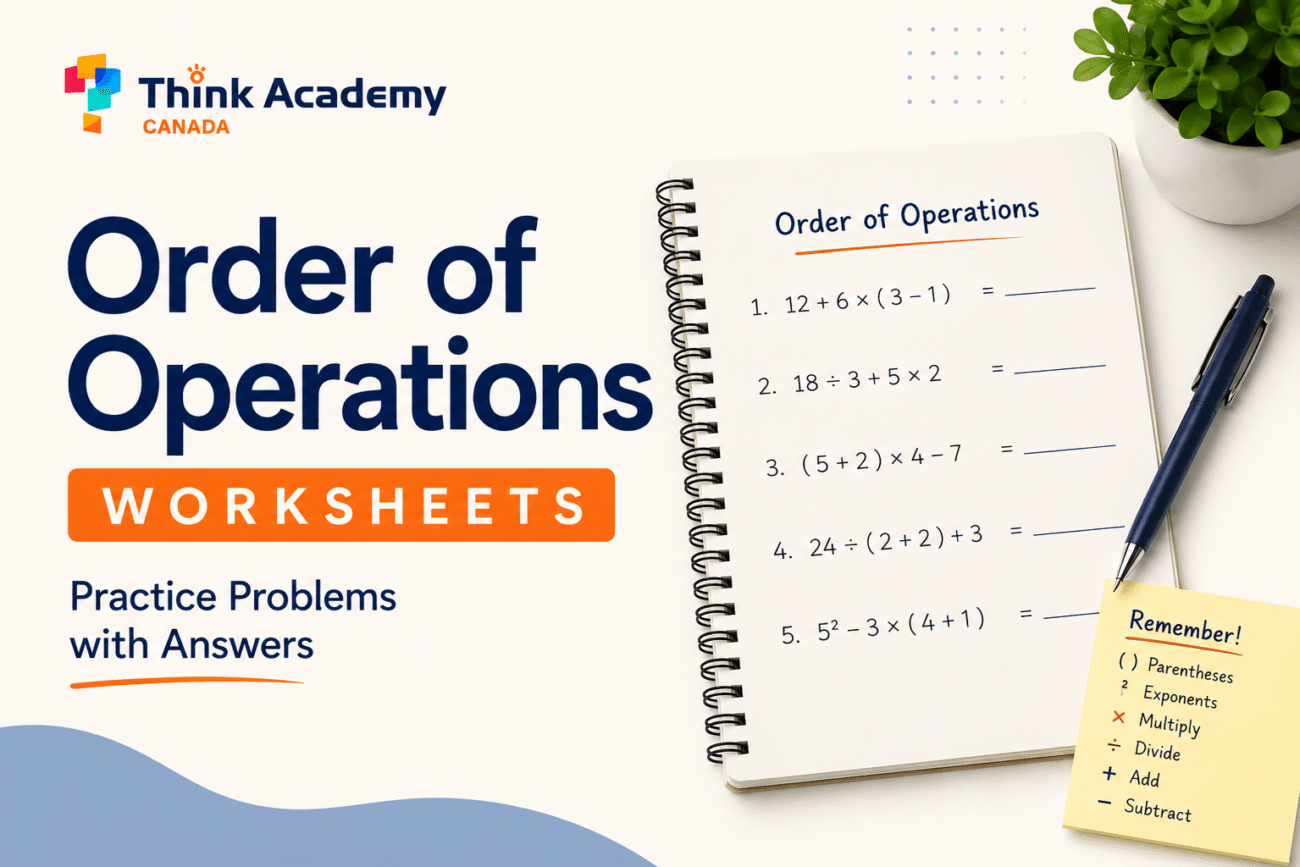
These order of operations math worksheets cover every level of BEDMAS from basic two-operation problems through to multi-step expressions with integers, exponents, and nested brackets — organised by grade level and difficulty. Each set includes full worked answers. Use them for daily practice, test preparation, or to identify the specific step where your child’s order of operations understanding breaks down.
For the complete explanation of BEDMAS rules, common mistakes, and how to remember the order, see our math order of operations guide.
How to Use These Worksheets Effectively
Before jumping into the problems, three principles make order of operations math worksheets significantly more effective:
Rewrite after every step. The most reliable way to avoid errors in multi-step expressions is to rewrite the expression after each operation is performed. Students who try to track multiple changes mentally make significantly more errors than those who write out each intermediate step. If the answer is wrong, the rewrite makes it easy to find exactly where the error occurred.
Time the practice. A student who is genuinely fluent with order of operations should complete a set of 10 problems in under 10 minutes. Consistent slowness signals that the order is not yet automatic — the student is thinking about which operation comes next rather than applying it instinctively.
Diagnose by error type. When reviewing incorrect answers, categorise each error: wrong operation order (e.g. adding before multiplying), wrong direction for equal-priority operations (e.g. doing addition before subtraction when subtraction came first in the expression), or arithmetic error within a correctly identified step. Each error type points to a different gap.
Working through worksheets is helpful—but only if your child is practising the right skills.
Our free assessment identifies exactly which BEDMAS concepts they understand and where mistakes are happening, so practice becomes much more effective.
→ Get your free personalised feedback report
Order of Operations Math Worksheets: Worksheet 1: Basic BEDMAS — Grade 5/6 Level
Two operations per expression. No exponents. No negative numbers.
Set A — Multiplication and Addition
- 3 + 4 × 2 = ___
- 10 + 5 × 3 = ___
- 2 × 6 + 4 = ___
- 8 + 3 × 4 = ___
- 5 × 3 + 2 × 4 = ___
- 7 + 2 × 9 = ___
- 4 × 5 + 3 × 2 = ___
- 12 + 4 × 3 = ___
- 6 × 2 + 5 × 3 = ___
- 20 + 3 × 5 = ___
Answers — Set A:
- 11 2) 25 3) 16 4) 20 5) 23 6) 25 7) 26 8) 24 9) 27 10) 35
Set B — Division and Subtraction
- 20 − 8 ÷ 4 = ___
- 36 ÷ 6 − 2 = ___
- 18 − 15 ÷ 5 = ___
- 30 ÷ 5 − 1 = ___
- 24 − 12 ÷ 3 = ___
- 45 ÷ 9 + 8 = ___
- 14 − 6 ÷ 2 = ___
- 28 ÷ 4 − 3 = ___
- 32 − 24 ÷ 8 = ___
- 50 ÷ 10 + 6 = ___
Answers — Set B:
- 18 2) 4 3) 15 4) 5 5) 20 6) 13 7) 11 8) 4 9) 29 10) 11
Set C — Brackets First
- (3 + 4) × 2 = ___
- (10 − 4) ÷ 3 = ___
- 5 × (6 + 2) = ___
- (15 − 6) ÷ 9 = ___
- (4 + 3) × (8 − 5) = ___
- 24 ÷ (3 + 5) = ___
- (12 − 4) × 3 = ___
- 6 × (7 − 4) = ___
- (9 + 6) ÷ (8 − 3) = ___
- (2 + 8) × (3 + 2) = ___
Answers — Set C:
- 14 2) 2 3) 40 4) 1 5) 21 6) 3 7) 24 8) 18 9) 3 10) 50
Order of Operations Math Worksheets: Worksheet 2: Three and Four Operations — Grade 6/7 Level
Three or four operations per expression. Brackets and mixed operations. No exponents yet.
Set D — Three Operations
- 3 + 4 × 2 − 1 = ___
- 20 ÷ 4 + 3 × 2 = ___
- (5 + 3) × 2 − 4 = ___
- 18 ÷ 6 + 4 × 3 = ___
- 15 − 2 × 4 + 6 = ___
- 4 × (3 + 2) − 7 = ___
- 36 ÷ (4 + 2) + 5 = ___
- 5 + 8 × 3 − 10 ÷ 2 = ___
- (7 − 3) × 5 + 12 ÷ 4 = ___
- 24 ÷ 8 × 3 + 2 = ___
Answers — Set D:
- 10 2) 11 3) 12 4) 15 5) 13 6) 13 7) 11 8) 24 9) 23 10) 11
Set E — Nested Brackets
- (2 + (3 × 4)) = ___
- ((8 − 3) × 2) + 4 = ___
- 3 × (2 + (10 − 6)) = ___
- ((4 + 6) ÷ 2) × 3 = ___
- 5 × ((3 + 7) ÷ 2) = ___
- (20 − (4 × 3)) ÷ 2 = ___
- ((9 − 3) × (4 + 1)) − 10 = ___
- 4 + (3 × (8 − (2 + 1))) = ___
Answers — Set E:
- 14 2) 14 3) 18 4) 15 5) 25 6) 4 7) 20 8) 19
Order of Operations Math Worksheets: Worksheet 3: Exponents — Grade 7/8 Level
Introducing the E in BEDMAS. Remember: exponents are evaluated after brackets, before division, multiplication, addition, and subtraction.
Set F — Exponents with Other Operations
- 2³ + 4 = ___
- 3² × 4 = ___
- 5 + 2² × 3 = ___
- (3 + 1)² − 5 = ___
- 2³ − 3 × 2 = ___
- 4² ÷ 8 + 3 = ___
- (2 + 3)² − 4 × 3 = ___
- 3 × 2³ − 10 = ___
- (5 − 2)² × (4 + 1) = ___
- 2 + 3² ÷ 3 × 4 = ___
- 5² − (3 + 2)² = ___
- (1 + 2)³ ÷ 9 = ___
Answers — Set F:
- 12 2) 36 3) 17 4) 11 5) 2 6) 5 7) 13 8) 14 9) 45 10) 14 11) 0 12) 3
Set G — Negative Exponents and Tricky Cases
Watch carefully: −3² ≠ (−3)²
- −3² = ___
- (−3)² = ___
- −2³ = ___
- (−2)³ = ___
- −4² + 20 = ___
- (−4)² + 20 = ___
- 5 − 2² × 3 = ___
- (5 − 2)² × 3 = ___
Answers — Set G:
- −9 2) 9 3) −8 4) −8 5) 4 6) 36 7) −7 8) 27
Note: −3² means −(3²) = −9. The exponent applies to 3 only. (−3)² means (−3) × (−3) = 9. The brackets make the exponent apply to the entire −3.
Worksheet 4: Integers — Grade 7/8 Level
Order of operations math worksheets must include integers, since BEDMAS applies equally to expressions with negative numbers.
Set H — Integers with All Four Operations
- −3 + 4 × 2 = ___
- (−5 + 3) × 4 = ___
- −18 ÷ (−3) + 5 × 2 = ___
- −4 × 3 + (−6) ÷ 2 = ___
- (−3 + 7) × (5 − 8) = ___
- −2 × (−3)² + 5 = ___
- (−4)² − 3 × 5 = ___
- −(3 + 2) × (4 − 7) = ___
- 15 ÷ (−3) + (−4) × 2 = ___
- (−6 + 2) × (−3)² ÷ (−4) = ___
- −2³ + (−2)³ = ___
- (−5) × (−3) − 4² ÷ 2 = ___
Answers — Set H:
- 5 2) −8 3) 16 4) −15 5) −12 6) −13 7) 1 8) 15 9) −13 10) 9 11) −16 12) 7
Worksheet 5: Multi-Step Challenges — Grade 8/9 Level
These order of operations math worksheets problems require four or more steps and combine all BEDMAS elements. These are the problem types that appear on EQAO Grade 9 and competition mathematics at the Grade 7–8 level.
Set I — Full BEDMAS Challenge
- 3 + 4 × (2³ − 5) ÷ 2 = ___
- (5² − 3 × 4) ÷ (7 − 2) × 2 = ___
- −2 × (3 + 1)² + 6 × 5 = ___
- ((−3)² − 4) × 2 − (8 ÷ 4)³ = ___
- 4 × (3 + 2)² ÷ (5 × 4) + 1 = ___
- (2³ − 4 + 1) × (−3)² ÷ 3 − 7 = ___
- 5 × 3² − (4 + 6)÷ 2 + (−2)³ = ___
- (−4)² ÷ (3 + 1) − 2³ × (−1) = ___
- 3 × ((−2 + 5)² − (4 − 7)) ÷ 3 = ___
- (5² − 4²) ÷ (5 − 4) × (2 + 3)² − 100 = ___
Answers — Set I:
- 3 + 4 × 3 ÷ 2 = 3 + 6 = 9
- (25 − 12) ÷ 5 × 2 = 13 ÷ 5 × 2 = 2.6 × 2 = 5.2
- −2 × 16 + 30 = −32 + 30 = −2
- (9 − 4) × 2 − 8 = 10 − 8 = 2
- 4 × 25 ÷ 20 + 1 = 100 ÷ 20 + 1 = 5 + 1 = 6
- (8 − 4 + 1) × 9 ÷ 3 − 7 = 5 × 9 ÷ 3 − 7 = 15 − 7 = 8
- 45 − 5 + (−8) = 32
- 16 ÷ 4 − (−8) = 4 + 8 = 12
- 3 × ((9) − (−3)) ÷ 3 = 3 × 12 ÷ 3 = 12
- (25 − 16) ÷ 1 × 25 − 100 = 9 × 25 − 100 = 225 − 100 = 125
Worksheet 6: Word Problems — Grade 8/9 Level
Order of operations math worksheets that include word problems test whether students can translate a real context into a correctly structured expression.
Set J — Applied Problems
- A teacher buys 4 packs of pencils with 12 pencils each, and 3 packs of pens with 8 pens each. She already had 5 pencils. Write an expression for the total number of pencils she has now, and evaluate it. ___
- A cinema sells tickets for $12 each and popcorn for $7 each. A family of 4 buys tickets and 2 popcorns. Write an expression for the total cost and evaluate it. ___
- Evaluate: the sum of 3 squared and 4 squared, divided by the difference of 5 and 2. ___
- A number is tripled, then 8 is subtracted, then the result is divided by the square of 2. The starting number is 6. Write an expression and evaluate it. ___
- Ahmed earns $15 per hour. He works 8 hours on Monday, 6 hours on Tuesday, and has $45 in expenses. Write an expression for his net earnings and evaluate it. ___
Answers — Set J:
- 4 × 12 + 5 = 48 + 5 = 53 pencils
- 4 × 12 + 2 × 7 = 48 + 14 = $62
- (3² + 4²) ÷ (5 − 2) = (9 + 16) ÷ 3 = 25 ÷ 3 ≈ 8.33
- (3 × 6 − 8) ÷ 2² = (18 − 8) ÷ 4 = 10 ÷ 4 = 2.5
- 15 × (8 + 6) − 45 = 15 × 14 − 45 = 210 − 45 = $165
Not every wrong answer comes from the same misunderstanding.
Some students struggle with brackets. Others forget left-to-right rules or apply exponents incorrectly.
Our free assessment pinpoints the exact misconception so your child can focus on what will make the biggest difference.
→ Get your free feedback report
The Most Common Errors on Order of Operations Math Worksheets
Reviewing these against your child’s work identifies exactly which gap to address:
Error type 1: Addition before multiplication (no brackets) 3 + 4 × 2 calculated as 7 × 2 = 14 instead of 3 + 8 = 11. Fix: Multiplication and division always before addition and subtraction — no exceptions, no brackets needed.
Error type 2: Left-to-right rule ignored for equal-priority operations 18 − 6 + 4 calculated as 18 − 10 = 8 instead of 12 + 4 = 16. Fix: When addition and subtraction appear together (or multiplication and division appear together), work strictly left to right — whichever comes first is done first.
Error type 3: Exponent not applied before multiplication 3 × 2³ calculated as 6³ = 216 instead of 3 × 8 = 24. Fix: Exponents are evaluated before multiplication, immediately after brackets.
Error type 4: −3² confused with (−3)² −3² written as 9 instead of −9. Fix: Without brackets, the exponent applies only to 3. −3² = −(3²) = −9. Brackets are needed to make the negative part of the base: (−3)² = 9.
Error type 5: Nested brackets worked outside-in 3 × (2 + (10 − 6)) worked as 3 × (2 + 10) − 6 instead of 3 × (2 + 4) = 18. Fix: Always work from the innermost bracket outward.
For a complete explanation of all BEDMAS rules and why each one exists, see our math order of operations guide.
Order of Operations Math Worksheets by Grade Level: Quick Reference
| Grade Level | Worksheet Focus | Sets to Use |
|---|---|---|
| Grade 5 | Multiplication/addition, brackets intro | Sets A, B, C |
| Grade 6 | Three operations, mixed | Sets D, E |
| Grade 7 | Exponents, integers introduced | Sets F, G, H |
| Grade 8 | Full BEDMAS, integers, exponents | Sets F, G, H, I |
| Grade 9 | Multi-step, word problems, exam prep | Sets I, J |
These worksheets are organised by grade—but every child progresses differently.
A free assessment shows whether your child is working at, above, or below the expected level, with clear next steps tailored to their results.
→ Get your free personalised report
Order of Operations in the Ontario Curriculum and EQAO
Order of operations is introduced formally in Grade 6 in Ontario and remains a foundational skill through Grade 9. It appears on:
- EQAO Grade 6 — in the Number strand; students are expected to apply order of operations with whole numbers and decimals
- EQAO Grade 9 (MTH1W) — order of operations with integers, rational numbers, and algebraic expressions is assumed knowledge tested across multiple strands
- Grade 7–8 Gauss Contest — multi-step expressions are a standard question type
For EQAO-specific preparation, see our EQAO Grade 6 complete guide and EQAO Grade 9 complete guide.
How Think Academy Helps Students Master Order of Operations
Think Academy Canada works with students from Grade 1 through Grade 12. For students in Grades 5–9, the order of operations is one of the foundational skills assessed in every diagnostic — because errors here compound across algebra, equation solving, and every multi-step problem that follows.
When a student’s order of operations understanding has a specific gap — the left-to-right rule, the exponent rule, or integer sign errors — our instructors identify it precisely and address it directly. The free diagnostic assessment takes 20 minutes and produces a written feedback report covering all major curriculum strands, including a clear indication of where BEDMAS understanding breaks down. No obligation — just specific, actionable information.
Frequently Asked Questions
What does BEDMAS stand for? Brackets, Exponents, Division, Multiplication, Addition, Subtraction — the Canadian acronym for the order of operations rules. Equivalent to PEMDAS (US) and BODMAS (UK).
At what grade are order of operations math worksheets appropriate? Order of operations is introduced in Grade 6 and remains relevant through Grade 9. Grade 5 students who are advanced can begin with two-operation problems. The worksheets on this page are organised by difficulty, from Grade 5/6 level through Grade 8/9 level.
Why do division and multiplication have equal priority? Because multiplication and division are inverse operations — mathematically equivalent in priority. The same is true of addition and subtraction. When two equal-priority operations appear in the same expression, work left to right.
Is the order of operations the same in Canada as in the US? Yes — the rules are identical. The acronym differs: BEDMAS in Canada, PEMDAS in the US (Parentheses instead of Brackets, Orders instead of Exponents). The mathematical rules are the same.
How many problems should my child practise each day? Ten to fifteen problems in a focused 10–15 minute session, three to four times per week, is more effective than a single long session. Consistency matters more than volume — the goal is making BEDMAS automatic, which requires repeated short practice over time.
See our related guides: math order of operations guide · Grade 7 math worksheets · Grade 8 math worksheets · Grade 6 math curriculum Ontario · Grade 7 math curriculum Ontario · EQAO Grade 6 complete guide · EQAO Grade 9 complete guide · adding and subtracting integers · Gauss math contest guide
Order of operations errors compound across every topic that follows. Fix the gap now.

Strong order of operations skills make algebra, equations, fractions, and later high school maths much easier.
In a free online trial lesson, one of our teachers will identify your child’s biggest gaps and show them strategies to solve multi-step problems with confidence.
Book a free lesson and see how Think Academy can help.