Grade 1 is when formal mathematics begins — and the foundations built this year matter far more than most parents realise. The counting, number sense, addition, and subtraction skills a child develops in Grade 1 are the direct prerequisites for every year of mathematics that follows. Regular practice at home, with the right problems at the right level, makes a genuine difference to how confidently a child progresses through Grades 2 and beyond. This page provides free Grade 1 math worksheets across every major curriculum strand, with full answers included. Use them for daily practice, homework support, or to find out specifically where your child needs more focused attention.
What Grade 1 Math Covers in Ontario
The Ontario Grade 1 mathematics curriculum covers five main strands. The activities on this page are aligned to these expectations.
- Number — counting to 50, reading and writing numerals to 20, comparing quantities, addition and subtraction to 20, introduction to place value (tens and ones)
- Algebra — repeating patterns, extending and creating patterns, equality and balance concepts
- Data — sorting objects, reading simple graphs and tally charts
- Spatial Sense (Geometry) — 2D and 3D shapes, positional language, sorting shapes
- Measurement — comparing length, mass, and capacity; ordering objects by size; introduction to time
For a complete breakdown of what Grade 1 students are expected to learn this year, see our Grade 1 math curriculum Ontario guide.
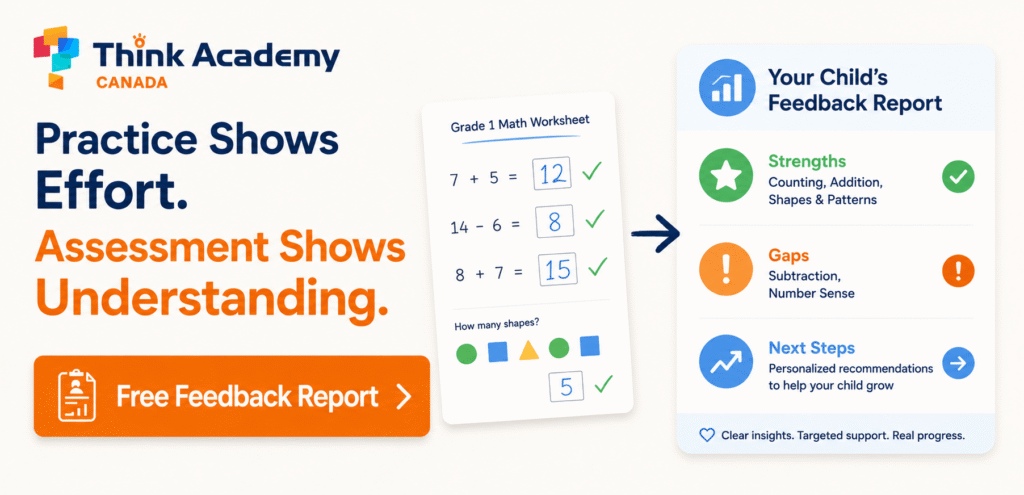
These worksheets provide practice—but they don’t show whether your child is meeting Grade 1 expectations.
Our free assessment evaluates every key strand of the Ontario Grade 1 curriculum and provides a personalised feedback report showing exactly where your child is thriving and where they may need extra support.
→ Get your free personalised feedback report
Grade 1 Math Worksheets: Counting and Number Recognition
Counting to 50
Practice Set 1 — Forward and Backward Counting
Fill in the missing numbers:
- 1, 2, ___, 4, 5
- 7, 8, 9, ___, 11
- 13, 14, ___, 16, 17
- 18, ___, 20, 21, ___
- ___, 25, 26, ___, 28
- 30, 31, ___, 33, ___
- Count backward: 10, 9, ___, 7, ___
- Count backward: 20, ___, 18, ___, 16
- What number comes just before 15? ___
- What number comes just after 29? ___
- Count on 3 from 17: ___
- Count back 2 from 22: ___
Answers — Set 1:
- 3 2) 10 3) 15 4) 19, 22 5) 24, 27 6) 32, 34 7) 8, 6 8) 19, 17 9) 14 10) 30 11) 20 12) 20
Practice Set 2 — Number Recognition to 20
- Circle the number that is bigger: 7 or 4
- Circle the number that is smaller: 12 or 9
- Put these in order from smallest to largest: 8, 3, 15, 6, 11
- Put these in order from largest to smallest: 17, 4, 12, 9, 20
- Which number is between 8 and 10? ___
- Which two numbers are between 14 and 17? ___
- Write the number that is 1 more than 13: ___
- Write the number that is 1 less than 20: ___
- Write the number that is 2 more than 16: ___
- Is 15 closer to 10 or 20? ___
Answers — Set 2:
- 7 2) 9 3) 3, 6, 8, 11, 15 4) 20, 17, 12, 9, 4 5) 9 6) 15 and 16 7) 14 8) 19 9) 18 10) 20
Place Value: Tens and Ones
Practice Set 3 — Tens and Ones
Note: Grade 1 introduces tens and ones as a beginning concept, typically with numbers to 20.
- 14 = ___ ten and ___ ones
- 17 = ___ ten and ___ ones
- 12 = ___ ten and ___ ones
- 1 ten and 5 ones = ___
- 1 ten and 9 ones = ___
- 1 ten and 0 ones = ___
- Which number has 1 ten and 8 ones? ___
- Draw a group of 10 blocks and 3 single blocks. What number does this show? ___
Answers — Set 3:
- 1 ten, 4 ones 2) 1 ten, 7 ones 3) 1 ten, 2 ones 4) 15 5) 19 6) 10 7) 18 8) 13
Grade 1 Math Worksheets: Addition Practice
Adding to 10
Practice Set 4 — Addition Facts to 10
- 3 + 4 = ___
- 6 + 2 = ___
- 5 + 5 = ___
- 1 + 8 = ___
- 4 + 4 = ___
- 7 + 3 = ___
- 2 + 6 = ___
- 9 + 1 = ___
- 0 + 7 = ___
- 5 + 4 = ___
- There are 3 red apples and 5 green apples. How many apples are there altogether? ___
- 4 birds are on a branch. 3 more birds land. How many birds are there now? ___
Answers — Set 4:
- 7 2) 8 3) 10 4) 9 5) 8 6) 10 7) 8 8) 10 9) 7 10) 9 11) 8 12) 7
Adding to 20
Practice Set 5 — Addition Facts to 20
- 8 + 5 = ___
- 7 + 6 = ___
- 9 + 4 = ___
- 6 + 8 = ___
- 5 + 9 = ___
- 7 + 7 = ___
- 10 + 8 = ___
- 9 + 9 = ___
- 6 + 7 = ___
- 8 + 8 = ___
- Maria has 7 stickers. Her friend gives her 6 more. How many stickers does Maria have? ___
- There are 9 children on the playground. 8 more come out. How many children are there now? ___
- A bag has 10 grapes and 7 berries. How many pieces of fruit are there? ___
Answers — Set 5:
- 13 2) 13 3) 13 4) 14 5) 14 6) 14 7) 18 8) 18 9) 13 10) 16 11) 13 12) 17 13) 17
Adding Three Numbers
Practice Set 6 — Three Addends
- 2 + 3 + 4 = ___
- 5 + 1 + 3 = ___
- 4 + 4 + 2 = ___
- 3 + 5 + 5 = ___
- 6 + 2 + 4 = ___
- 1 + 7 + 3 = ___
- 5 + 5 + 5 = ___
- 4 + 3 + 6 = ___
Answers — Set 6:
- 9 2) 9 3) 10 4) 13 5) 12 6) 11 7) 15 8) 13
Grade 1 Math Worksheets: Subtraction Practice
Subtracting from 10
Practice Set 7 — Subtraction Facts to 10
- 8 − 3 = ___
- 10 − 4 = ___
- 7 − 5 = ___
- 9 − 6 = ___
- 6 − 2 = ___
- 10 − 7 = ___
- 5 − 5 = ___
- 8 − 0 = ___
- 9 − 9 = ___
- 10 − 1 = ___
- There were 8 cookies. Sam ate 3. How many are left? ___
- 10 birds were in a tree. 6 flew away. How many stayed? ___
Answers — Set 7:
- 5 2) 6 3) 2 4) 3 5) 4 6) 3 7) 0 8) 8 9) 0 10) 9 11) 5 12) 4
Subtracting from 20
Practice Set 8 — Subtraction Facts to 20
- 15 − 7 = ___
- 13 − 6 = ___
- 18 − 9 = ___
- 14 − 8 = ___
- 16 − 7 = ___
- 20 − 8 = ___
- 12 − 5 = ___
- 17 − 9 = ___
- 11 − 6 = ___
- 19 − 7 = ___
- There are 16 children. 8 go inside. How many are still outside? ___
- A bookshelf had 14 books. 6 were borrowed. How many books remain? ___
Answers — Set 8:
- 8 2) 7 3) 9 4) 6 5) 9 6) 12 7) 7 8) 8 9) 5 10) 12 11) 8 12) 8
Addition and Subtraction Mixed
Practice Set 9 — Mixed Operations to 20
- 9 + 4 = ___
- 15 − 8 = ___
- 7 + 8 = ___
- 20 − 9 = ___
- 6 + 6 = ___
- 13 − 7 = ___
- If 5 + ___ = 12, what is the missing number? ___
- If ___ − 4 = 9, what is the missing number? ___
- If 8 + ___ = 15, what is the missing number? ___
- If ___ + 6 = 14, what is the missing number? ___
Answers — Set 9:
- 13 2) 7 3) 15 4) 11 5) 12 6) 6 7) 7 8) 13 9) 7 10) 8
Grade 1 Patterns: Practice Problems
Practice Set 10 — Repeating Patterns
- Continue the pattern: red, blue, red, blue, red, ___
- Continue: circle, square, circle, square, ___
- Continue: 1, 2, 1, 2, 1, ___
- What is the rule? A, B, B, A, B, B, A, ___
- Continue: big, small, big, small, ___
- Create your own AB pattern using two colours. Draw or describe it. ___
- Continue: 2, 4, 2, 4, 2, ___
- What comes next? ★ ● ● ★ ● ● ★ ___
Answers — Set 10:
- blue 2) circle 3) 2 4) B, B 5) big 6) any valid AB pattern 7) 4 8) ● ●
Grade 1 Geometry: Practice Problems
Practice Set 11 — 2D Shapes
- How many sides does a triangle have? ___
- How many corners does a square have? ___
- What shape has no corners? ___
- How many sides does a rectangle have? ___
- Name a shape that has 4 equal sides. ___
- True or false: A circle has straight sides. ___
- How many sides does a hexagon have? ___
- Look around the room. Name one thing shaped like a rectangle. ___
- Name one thing shaped like a circle. ___
- How many corners does a triangle have? ___
Answers — Set 11:
- 3 2) 4 3) Circle 4) 4 5) Square 6) False 7) 6 8) any valid answer (door, book, window) 9) any valid answer (clock, coin, wheel) 10) 3
Practice Set 12 — 3D Shapes
Use real objects from around your home.
- A box of cereal is shaped like a ___
- A ball is shaped like a ___
- A can of soup is shaped like a ___
- How many flat faces does a cube have? ___
- Can a sphere roll? ___
- Can a cube roll? ___
- Name something shaped like a cone. ___
- Which shape has no flat faces — a cube or a sphere? ___
Answers — Set 12:
- Rectangular prism 2) Sphere 3) Cylinder 4) 6 5) Yes 6) No 7) Ice cream cone, party hat, traffic cone 8) Sphere
Grade 1 Measurement: Practice Problems
Practice Set 13 — Comparing and Ordering
These activities work best with real objects.
- Find two pencils. Which one is longer? ___
- Find two books. Which one is heavier? ___
- Order these from shortest to tallest: a marker, a pencil, a crayon. ___
- True or false: A longer object is always heavier. ___
- Fill a cup with water and a glass with less water. Which has more? ___
- Use your hand to measure your desk. How many hands wide is it? ___
- Is a dog heavier or lighter than a cat? ___
- Which holds more — a bathtub or a glass? ___
Answers — Set 13:
- child measures and answers 2) child answers from observation 3) depends on real objects — child orders by looking 4) False (a long feather is lighter than a short rock) 5) the cup 6) child measures and records 7) usually heavier (accept any reasonable answer) 8) a bathtub
Practice Set 14 — Time
- Morning or afternoon — when do you eat breakfast? ___
- Morning or afternoon — when do you eat dinner? ___
- Which comes first in the day: lunch or bedtime? ___
- How many days are in a week? ___
- Name the days of the week in order. ___
- What day comes after Monday? ___
- What day comes before Friday? ___
- How many months are in a year? ___
Answers — Set 14:
- morning 2) afternoon/evening 3) lunch 4) 7 5) Sunday, Monday, Tuesday, Wednesday, Thursday, Friday, Saturday 6) Tuesday 7) Thursday 8) 12
Grade 1 Data: Practice Problems
Practice Set 15 — Reading Simple Graphs
Use the following data for questions 1–5:
A class voted for their favourite pet:
- Dog: 7 students
- Cat: 5 students
- Fish: 3 students
- Rabbit: 2 students
- How many students voted in total? ___
- Which pet got the most votes? ___
- Which pet got the fewest votes? ___
- How many more students like dogs than cats? ___
- Did more students prefer cats or fish? ___
Bonus: If you drew a tally chart for this data, how many tally marks would you make for dogs? ___
Answers — Set 15:
- 17 2) Dog 3) Rabbit 4) 2 more 5) Cats Bonus: 7 tally marks (IIII II)
Finished the worksheets?
A score alone doesn’t tell you whether your child truly understands the concepts—or has simply memorised the answers.
Take our free Grade 1 assessment →
How to Use Grade 1 Math Worksheets Effectively
Grade 1 mathematics is best learned through a combination of hands-on activity and structured practice. Worksheets are useful — but they work best when used alongside conversation and real objects, not instead of them.
Do the activity problems together. Several sets on this page (measurement, time, 3D shapes) are designed for shared parent-child activity rather than independent seat work. A Grade 1 child who measures their desk, orders their pencils, and discusses which objects are heavier builds more durable understanding than one who fills in blanks on a page without the physical experience.
Keep sessions short and positive. Ten to fifteen minutes of focused, engaged practice is significantly more effective than thirty minutes of distracted completion. Stop while your child is still engaged — the goal is a child who returns to mathematics tomorrow, not one who has finished today’s sheet.
Watch for specific patterns in errors. If your child consistently reverses the order of subtraction (writing 8 − 15 = 7 instead of recognising that 15 − 8 = 7), that is a specific gap — they do not yet understand that the smaller number is subtracted from the larger. If they consistently add when asked to subtract, they may not yet have a firm understanding of what subtraction means. These patterns are informative; random errors are less so.
Celebrate what is correct before addressing errors. A Grade 1 child who gets 8 out of 10 right has done well. Acknowledge that before working through what went wrong. Mathematical confidence at this age is as important as accuracy — and a child who is afraid of being wrong will begin to avoid mathematics.
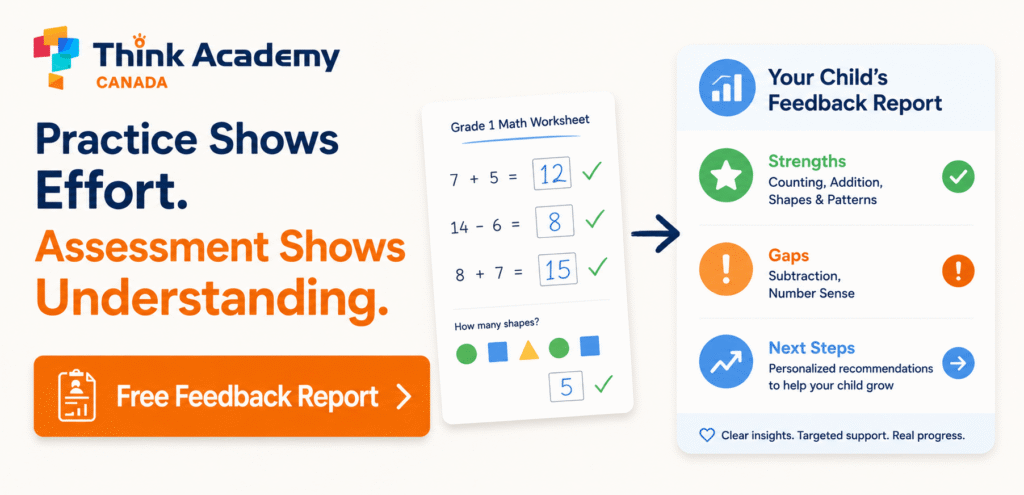
Completing worksheets is an excellent start—but knowing why mistakes happen is what helps children improve.
Our free assessment identifies the skills your child has mastered, the concepts they still find challenging, and the next steps to support their progress.
→ Get your free personalised feedback report
Signs Your Grade 1 Child May Need More Than Worksheets
They count by touching each object multiple times. One-to-one correspondence — each object counted exactly once — should be reliable by the end of Grade 1. A child who recounts the same object or skips objects while counting has a foundational gap that needs direct attention.
They cannot recall basic addition facts to 10 quickly. By the end of Grade 1, 3 + 4 and 5 + 5 should be retrievable in a few seconds, not recalculated by counting on fingers every time. Slow retrieval at the end of Grade 1 typically means slow retrieval for the more complex addition facts introduced in Grade 2.
They confuse addition and subtraction. A child who is asked “how many are left?” and adds instead of subtracts does not yet have a conceptual understanding of what the two operations mean. This is common in Grade 1 and addressable — but it needs to be addressed, not assumed to resolve itself.
They cannot identify simple shapes reliably. Confusing squares and rectangles (all squares are rectangles, but not all rectangles are squares) is a normal Grade 1 learning point. Consistently being unable to identify circles, triangles, or squares is worth noticing.
Patterns activity produces anxiety rather than interest. Pattern recognition is foundational to algebraic thinking. A child who finds pattern activities confusing or frustrating in Grade 1 may need more concrete, physical pattern work — sorting real objects, making patterns with blocks — before tackling them on paper.
For a fuller picture of what strong mathematical development looks like at this age, see our number sense parent guide and kindergarten math worksheets.
How Think Academy Helps Grade 1 Students
Think Academy Canada works with students from Grade 1 through Grade 12. At the Grade 1 level, our focus is on building genuine number sense — not just the ability to complete worksheets correctly, but the flexible, intuitive understanding of numbers that makes every subsequent year of mathematics easier.
Our Grade 1 programme is diagnostic-led: every student starts with an assessment that identifies their actual current level — which may be ahead of, at, or behind the Grade 1 curriculum — and the programme builds from there. Sessions are structured and expert-led, short enough to maintain a young child’s focus, and designed to build mathematical habits alongside mathematical content.
The free assessment is the right starting point. It takes 20 minutes and produces a written feedback report identifying specifically which Grade 1 strands are secure and which need work. No obligation — just a clear, specific picture of where your child stands.
Frequently Asked Questions
What maths should a Grade 1 student know? By the end of Grade 1, students should count reliably to 50, read and write numerals to 20, add and subtract fluently to 20, understand basic place value (tens and ones to 20), identify and sort 2D and 3D shapes, extend repeating patterns, and compare objects by length, mass, and capacity.
How much daily maths practice does a Grade 1 student need? Ten to fifteen minutes of focused, engaged practice three to four times per week is more effective than longer less-frequent sessions. At this age, consistency and positivity matter as much as volume.
My child can count to 100 but struggles with addition to 10. Is that a problem? Yes — rote counting to large numbers is a different skill from understanding quantity and performing operations. A child who can count to 100 but struggles with 6 + 4 has memorised a sequence without building the number sense that makes addition meaningful. Both skills are important; the addition and number sense foundations need direct attention.
Are these grade 1 math worksheets aligned to the Ontario curriculum? Yes. All practice problems on this page are aligned to the Ontario Grade 1 mathematics curriculum expectations. These grade 1 math worksheets are also appropriate for students in other Canadian provinces where the curriculum is closely aligned.
What comes after Grade 1 math? Grade 2 mathematics builds directly on Grade 1 foundations — extending addition and subtraction, introducing multiplication concepts, and building on place value and geometry. See our Grade 2 math curriculum Ontario guide for what that looks like.
My child is ahead — are these worksheets too easy? Possibly. For students working above the Grade 1 curriculum, Grade 2 content — particularly double-digit addition, number patterns to 100, and more complex data problems — is the right next step. See our Grade 2 math worksheets for what that looks like.
See our related guides: Grade 1 math curriculum Ontario · kindergarten math worksheets · Grade 2 math worksheets · Grade 2 math curriculum Ontario · Grade 3 math worksheets · number sense parent guide · math manipulatives guide · skip counting worksheets · Ontario math curriculum overview
Grade 1 is where mathematical confidence is built — or lost. Make sure it’s being built.
The habits children build in Grade 1 shape their confidence for years to come.
In a free online trial lesson, one of our experienced teachers will assess your child’s current level, introduce engaging activities, and show you how Think Academy helps students develop strong mathematical foundations.
Book a free lesson to see if we’re the right fit for your family.