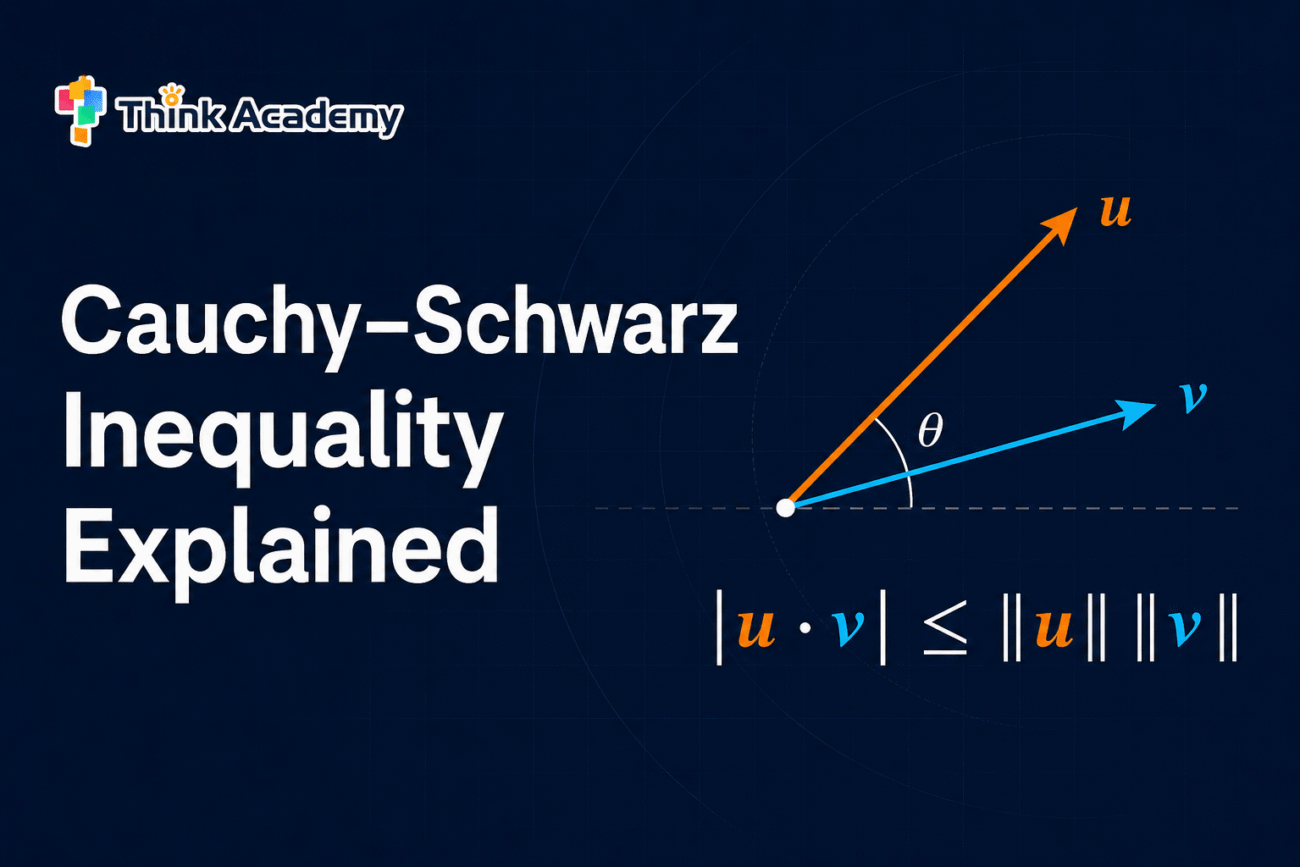
The Cauchy-Schwarz inequality is one of the most widely used and most versatile inequalities in mathematics. It appears in linear algebra, analysis, probability, statistics, and — most relevantly for Canadian competition students — in olympiad mathematics at the Euclid, COMC, and CMO level. Understanding it, being able to apply it quickly, and knowing its most useful forms are essential skills for any student seriously preparing for senior competition mathematics.
This guide explains what the Cauchy-Schwarz inequality states, proves it in several ways, works through applications at increasing difficulty, and covers the Engel form (also called the Titu form or Sedrakyan’s inequality) — the most competition-useful variant.
What Is the Cauchy-Schwarz Inequality?
The Cauchy-Schwarz inequality states:
For real numbers a1,a2,…,an and b1,b2,…,bn:(i=1∑naibi)2≤(i=1∑nai2)(i=1∑nbi2)
In expanded form for n = 2 and n = 3:
n = 2: (a1b1+a2b2)2≤(a12+a22)(b12+b22)
n = 3: (a1b1+a2b2+a3b3)2≤(a12+a22+a32)(b12+b22+b32)
Equality condition: Equality holds if and only if the sequences (a1,…,an) and (b1,…,bn) are proportional — that is, there exists a constant k such that ai=kbi for all i (or all bi=0).
The equality condition is as important as the inequality itself — in competition problems, finding when equality holds is often the key step.
Three Proofs of the Cauchy-Schwarz Inequality
Proof 1: The Lagrange Identity (Most Elementary)
For n = 2, the Lagrange identity gives:(a12+a22)(b12+b22)−(a1b1+a2b2)2=(a1b2−a2b1)2
Since (a1b2−a2b1)2≥0 always, the left side is non-negative:(a12+a22)(b12+b22)≥(a1b1+a2b2)2□
Equality holds when a1b2−a2b1=0, i.e., a1/b1=a2/b2 — when the pairs are proportional.
Why this proof matters for competition students: It shows explicitly what the “gap” is between the two sides — (a1b2−a2b1)2. This expression is useful in some competition problems.
Proof 2: The Discriminant Approach (Most Elegant for Competition Use)
Consider the quadratic in t:f(t)=i=1∑n(ait−bi)2≥0for all real t
Expanding:f(t)=(∑ai2)t2−2(∑aibi)t+∑bi2≥0
Since this quadratic in t is always non-negative, its discriminant must be ≤0:Δ=4(∑aibi)2−4(∑ai2)(∑bi2)≤0
Rearranging:(∑aibi)2≤(∑ai2)(∑bi2)□
Why this proof matters: It connects the Cauchy-Schwarz inequality to the discriminant of a quadratic — a technique familiar from MCR3U and MHF4U. Students who know this proof can re-derive the inequality instantly if they forget the statement.
Proof 3: AM-GM Approach (Connects Inequality Techniques)
Normalise: let A=∑ai2 and B=∑bi2 (assuming both are non-zero).
By AM-GM: A2ai2+B2bi2≥AB2∣aibi∣
Summing over all i:∑A2ai2+∑B2bi2≥AB2∑∣aibi∣ 1+1≥AB2∑∣aibi∣ AB≥∑∣aibi∣≥∑aibi ∑ai2⋅∑bi2≥∑aibi
Squaring gives Cauchy-Schwarz. □
The Engel Form (Titu’s Lemma / Sedrakyan’s Inequality)
The Engel form (also called Titu’s Lemma or Sedrakyan’s inequality) is the most frequently used variant of the Cauchy-Schwarz inequality in competition mathematics. It states:b1a12+b2a22+⋯+bnan2≥b1+b2+⋯+bn(a1+a2+⋯+an)2
where all bi>0.
Derivation: Set ai′=ai/bi and bi′=bi in the standard Cauchy-Schwarz inequality. The Engel form follows immediately.
Why the Engel form is so useful:
It transforms a sum of fractions into a single fraction, often simplifying complex expressions dramatically. Recognising when an expression matches the Engel form pattern — a sum of fractions where the numerators are squares and the denominators are positive — is the key skill.
Competition success depends on recognising the right technique before the algebra becomes overwhelming. Our free assessment reveals how confidently your child handles unfamiliar problems and identifies the skills they should develop next.
Get your child’s free feedback report →
Cauchy Schwartz Inequality Worked Examples
Example 1 — Direct Application (n = 2)
Show that for positive reals a, b: (a+b)2≤2(a2+b2)(a + b)^2 \leq 2(a^2 + b^2) (a+b)2≤2(a2+b2)
By Cauchy-Schwarz with (a1,a2)=(1,1) and (b1,b2)=(a,b):
(1⋅a+1⋅b)2≤(12+12)(a2+b2)=2(a2+b2)
(a+b)2≤2(a2+b2) □
Equality when: a/1=b/1, i.e., a=b.
Example 2 — Classic Competition Form
Prove that for positive reals a, b, c: a2b+c+b2c+a+c2a+b≥a+b+c2\frac{a^2}{b+c} + \frac{b^2}{c+a} + \frac{c^2}{a+b} \geq \frac{a+b+c}{2} b+ca2+c+ab2+a+bc2≥2a+b+c
By the Engel form (Titu’s Lemma):b+ca2+c+ab2+a+bc2≥(b+c)+(c+a)+(a+b)(a+b+c)2=2(a+b+c)(a+b+c)2=2a+b+c
□
Equality when: a/(b+c)=b/(c+a)=c/(a+b), which holds when a=b=c.
This is the Nesbitt’s inequality — one of the most classic competition inequality problems, solved in two lines using the Engel form.
Example 3 — Geometric Application
In triangle ABC with sides a, b, c and area S, prove that a2+b2+c2≥43Sa^2 + b^2 + c^2 \geq 4\sqrt{3} S a2+b2+c2≥43S
This is a known result (Weitzenböck’s inequality). One approach uses Cauchy-Schwarz alongside Heron’s formula. The setup is more involved, but the Cauchy-Schwarz step appears when establishing that the area satisfies S≤43a2+b2+c2.
At competition level, this is a Part C type problem — recognising that Cauchy-Schwarz applies requires geometric insight alongside algebraic technique.
Example 4 — Finding the Maximum
For real numbers x, y with x2+y2=1x^2 + y^2 = 1 x2+y2=1, find the maximum value of 3x+4y3x + 4y 3x+4y.
By Cauchy-Schwarz with (a1,a2)=(3,4) and (b1,b2)=(x,y):
(3x+4y)2≤(32+42)(x2+y2)=25⋅1=25
So 3x+4y≤5.
Maximum value is 5, achieved when (x,y)=(3/5,4/5) (proportionality condition).
Why this matters: This “maximum of a linear expression on a sphere/circle” problem type appears repeatedly in competitions and has a clean Cauchy-Schwarz solution. The equality condition tells you exactly where the maximum is achieved.
Example 5 — Engel Form in a Competition Setting
For positive reals x, y, z with x+y+z=1x + y + z = 1 x+y+z=1, prove that x21−x+y21−y+z21−z≥12\frac{x^2}{1-x} + \frac{y^2}{1-y} + \frac{z^2}{1-z} \geq \frac{1}{2} 1−xx2+1−yy2+1−zz2≥21.
Since x+y+z=1: we have 1−x=y+z, 1−y=x+z, 1−z=x+y.
By the Engel form:y+zx2+x+zy2+x+yz2≥(y+z)+(x+z)+(x+y)(x+y+z)2=2(x+y+z)1=21
□
Equality when: x=y=z=1/3.
Example 6 — Euclid / CMO Level
For positive reals a1,a2,…,ana_1, a_2, \ldots, a_n a1,a2,…,an with ∑ai=1\sum a_i = 1 ∑ai=1, prove that ∑ai2ai+ai+1≥12\sum \frac{a_i^2}{a_i + a_{i+1}} \geq \frac{1}{2} ∑ai+ai+1ai2≥21 (indices mod n).
By the Engel form:i=1∑nai+ai+1ai2≥∑(ai+ai+1)(∑ai)2=∑ai+∑ai+11=2∑ai1=21
□
Note: ∑ai+1=∑ai=1 since the indices cycle.
The AM-GM and Cauchy-Schwarz: How They Relate
Cauchy-Schwarz and the AM-GM inequality are the two workhorses of competition inequality problems. Understanding how they relate — and when to use each — is a key strategic skill.
AM-GM: For non-negative reals, na1+a2+⋯+an≥na1a2⋯an
Best for: Problems involving products, or where the sum is given and you want a bound on a product (or vice versa).
Cauchy-Schwarz: Best for problems involving sums of products or sums of squared terms.
Engel form: Best for problems involving sums of fractions with squared numerators and positive denominators.
General strategy for competition inequality problems:
- Identify the structure: is the expression a sum of products (Cauchy-Schwarz), a sum of fractions (Engel), or a product/sum comparison (AM-GM)?
- Try the most natural tool first.
- Check the equality condition — it should match the constraint of the problem.
- If one tool doesn’t work cleanly, try the other.
Where the Cauchy-Schwarz Inequality Appears in Contests
The Cauchy-Schwarz inequality is a tool at the highest levels of the Canadian competition mathematics pathway.
Euclid Contest (CEMC, Grade 12): Inequality problems appear occasionally in Euclid Part B and Part C. The Cauchy-Schwarz inequality provides clean, short proofs for problems that would be very difficult to solve by other means. A student who recognises the Engel form pattern and applies it correctly can produce a 2-line proof where other students write pages of algebra. See our Euclid math contest guide.
COMC Part C: The COMC frequently includes inequality problems in Part C. The Cauchy-Schwarz inequality — particularly the Engel form — is one of the most reliable tools for these problems. See our COMC math contest guide.
Canadian Mathematical Olympiad:The CMO tests inequality proof at the deepest level. Cauchy-Schwarz problems at CMO level require creative application — setting up the sequences ai and bi cleverly, combining Cauchy-Schwarz with other inequality techniques, or proving that equality holds at the right point. Students who have thoroughly understood Cauchy-Schwarz arrive at the CMO with a powerful tool. See our Canadian Mathematical Olympiad guide.
AMC 10 and 12: The Cauchy-Schwarz inequality appears in the AMC 12 in problems asking for the maximum value of a linear expression subject to a quadratic constraint (like Example 4 above). Recognising this as a Cauchy-Schwarz problem saves significant time over the calculus or geometric approach a student might otherwise attempt.
For the full competition landscape, see our math competitions in Canada guide.

Part C problems test more than mathematical knowledge. Students must choose an effective strategy, construct a rigorous argument and verify when equality holds. A free assessment shows where your child currently stands—and what could help them progress.
Assess their competition math skills →
Common Mistakes with the Cauchy-Schwarz Inequality
Mistake 1: Applying Cauchy-Schwarz in the wrong direction.Cauchy-Schwarz gives an upper bound on (∑aibi)2. If a problem asks you to prove a lower bound, you are proving the wrong direction. Check: does the inequality you need point the same way as Cauchy-Schwarz?
Mistake 2: Forgetting the equality condition. In problems where you need to show a maximum or minimum is achieved, the equality condition tells you where. A proof that finds the bound but does not verify equality is achieved is incomplete.
Mistake 3: Applying the Engel form with non-positive denominators.The Engel form requires bi>0. Applying it when a denominator might be zero or negative produces incorrect results.
Mistake 4: Wrong choice of sequences aia_i ai and bib_i bi. The power of Cauchy-Schwarz comes from choosing the right sequences. A poor choice gives a true but useless inequality. The right choice gives exactly what the problem needs. This is the skill that develops through solving many problems — there is no formula for choosing correctly.
Mistake 5: Confusing Cauchy-Schwarz with AM-GM. Both are inequality tools, but they apply to different structures. AM-GM works with products and geometric means; Cauchy-Schwarz works with sums of products and sums of squares. Applying the wrong tool produces the wrong inequality.
Practice Problems
Set A — Direct Cauchy-Schwarz
- Prove that for real a, b, c: (a+b+c)2≤3(a2+b2+c2)
- For x2+y2+z2=1, find the maximum value of 2x+3y+6z.
- Prove that (a1b1+a2b2+a3b3)2≤(a12+a22+a32)(b12+b22+b32) (directly from the discriminant proof).
Set B — Engel Form
- For positive reals a, b, c: prove ba2+cb2+ac2≥a+b+c
- For positive reals with x+y=1: find the minimum of 1−xx2+1−yy2
- Prove Nesbitt’s inequality: b+ca+c+ab+a+bc≥23 for positive a, b, c.
Set C — Competition Level
- For positive reals a, b, c with a+b+c=3: prove a2+b2+c2≥3.
- For positive reals: prove a(b+c)1+b(c+a)1+c(a+b)1≥2(ab+bc+ca)9
Answers/outlines:
- Cauchy-Schwarz with ai=1 and bi=a,b,c: (1⋅a+1⋅b+1⋅c)2≤(1+1+1)(a2+b2+c2). Done.
- By C-S: (2x+3y+6z)2≤(4+9+36)(x2+y2+z2)=49. Maximum = 7, at (x,y,z)=(2/7,3/7,6/7).
- See Proof 2 in the guide above.
- Engel: ba2+cb2+ac2≥a+b+c(a+b+c)2=a+b+c.
- Engel: yx2+xy2≥x+y(x+y)2=x+y=1. With 1−x=y and 1−y=x: minimum = 1/2 at x=y=1/2.
- Write as b+ca+c+ab+a+bc=a(b+c)a2+b(c+a)b2+c(a+b)c2. By Engel: ≥a(b+c)+b(c+a)+c(a+b)(a+b+c)2=2(ab+bc+ca)(a+b+c)2. Then use (a+b+c)2≥3(ab+bc+ca) to get ≥23.
- By C-S (or Cauchy directly): (a+b+c)2≤3(a2+b2+c2), so a2+b2+c2≥3(a+b+c)2=39=3.
- Apply Engel with ai=a(b+c)1 etc. — setup is more involved; this is a CMO-level problem.
Frequently Asked Questions
What is the Cauchy-Schwarz inequality?For real numbers a1,…,an and b1,…,bn: (∑aibi)2≤(∑ai2)(∑bi2). Equality holds if and only if the sequences are proportional.
What is the Engel form of the Cauchy-Schwarz inequality?Also called Titu’s Lemma: ∑biai2≥∑bi(∑ai)2 for positive bi. It transforms a sum of fractions into a single fraction and is the most frequently used Cauchy-Schwarz variant in competition mathematics.
When should I use Cauchy-Schwarz instead of AM-GM? When the expression involves sums of products, sums of squared terms, or fractions with squared numerators (Engel form). AM-GM is better when the expression involves products or geometric means.
How do I find the right sequences aia_i ai and bib_i bi to apply?This is the core skill and cannot be reduced to a formula. General guidance: if the inequality involves ∑gifi2, use Engel directly with ai=fi and bi=gi. If it involves (∑fi)2, try setting one sequence to constants. The equality condition should match the symmetry of the problem.
Does the Cauchy-Schwarz inequality appear on the Euclid Contest? Yes — occasionally in Part B and Part C inequality problems. The Engel form in particular provides short, clean proofs for problems that would be difficult by other means.
What is the equality condition and why does it matter?Equality holds when the sequences ai and bi are proportional (ai=kbi for all i). In competition problems, identifying when equality holds is essential for: (a) verifying the bound is tight, (b) finding where a maximum or minimum is achieved, and (c) completing a proof that requires equality at a specific point.
See our related guides: Canadian Mathematical Olympiad guide · Euclid math contest guide · Euclid past contests guide · COMC math contest guide · math induction proof guide · proof by contradiction guide · contrapositive math guide · pigeonhole principle guide · math competitions in Canada
The Cauchy-Schwarz inequality is a one-page tool with competition-level reach. Master it before you need it.

Cauchy–Schwarz becomes powerful when students learn to recognise its hidden forms and choose the right setup independently. In a free online trial lesson, your child can experience how Think Academy develops competition-level reasoning through guided problem solving.