


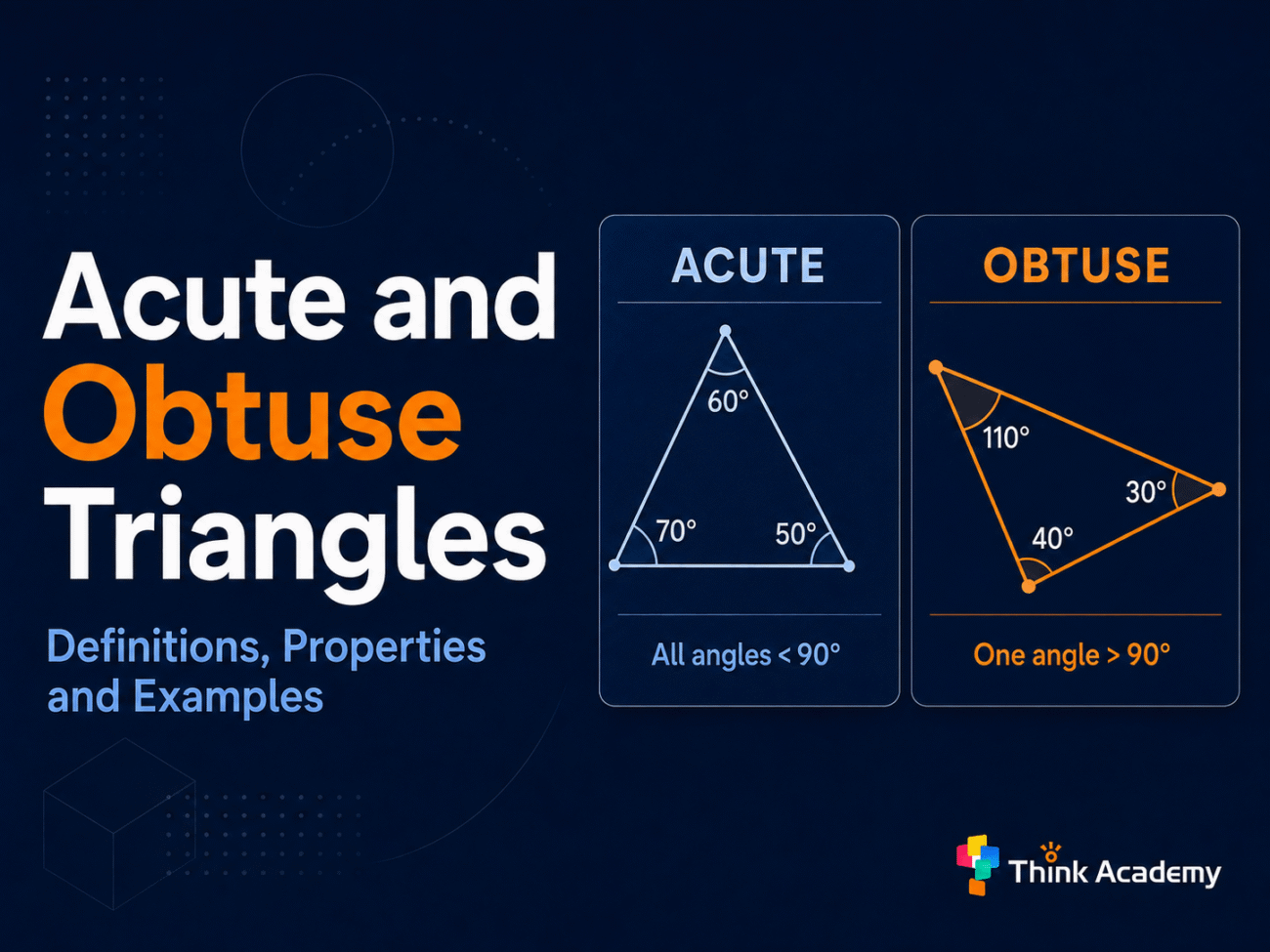
Every triangle belongs to one of three categories based on its angles: acute, right, or obtuse. Knowing which category a triangle belongs to — and why — is foundational geometry knowledge that appears in school assessments from Grade 5 through Grade 9, in EQAO, and in every major Canadian mathematics competition including the Gauss Contest and AMC 8. This guide covers the definitions clearly, explains how to identify each type from angles and side lengths, and works through the types of problems where these concepts are tested.
The Three Types of Triangles by Angle
Triangles are classified by their largest angle:
| Type | Condition | Largest angle |
|---|---|---|
| Acute triangle | All three angles are less than 90° | < 90° |
| Right triangle | One angle equals exactly 90° | = 90° |
| Obtuse triangle | One angle is greater than 90° | > 90° |
Every triangle fits exactly one of these categories. A triangle cannot be both acute and obtuse, and a triangle can have at most one right angle or one obtuse angle (since all three angles must sum to 180°).
Acute Triangle and Obtuse Triangle Guide: What Is an Acute Triangle?
An acute triangle is a triangle in which all three angles are less than 90°.
Every angle in an acute triangle is acute — no right angles, no obtuse angles.
Examples of acute triangles:
- Equilateral triangle (all angles = 60°) — always acute
- A triangle with angles 50°, 60°, and 70° — all less than 90°, so acute
- A triangle with angles 45°, 75°, and 60° — all less than 90°, so acute
Key properties of acute triangles:
- All three altitudes (perpendicular lines from each vertex to the opposite side) fall inside the triangle
- The circumcentre (centre of the circumscribed circle) falls inside the triangle
- The orthocentre (intersection of the altitudes) falls inside the triangle
- For sides a ≤ b ≤ c: a² + b² > c² (the Pythagorean theorem inequality for acute triangles)
How to recognise an acute triangle from its angles:
If you know all three angles: check that each is less than 90°.
If you know only the side lengths: use the inequality a² + b² > c² where c is the longest side.
Acute Triangle and Obtuse Triangle Guide: What Is an Obtuse Triangle?
An obtuse triangle is a triangle in which one angle is greater than 90°.
Only one angle can be obtuse — if one angle is greater than 90°, the other two must sum to less than 90°, making them both acute.
Examples of obtuse triangles:
- A triangle with angles 120°, 35°, and 25° — 120° > 90°, so obtuse
- A triangle with angles 100°, 50°, and 30° — 100° > 90°, so obtuse
- A triangle with angles 91°, 60°, and 29° — 91° > 90°, so obtuse (barely)
Key properties of obtuse triangles:
- The altitude from the vertex with the obtuse angle falls inside the triangle, but the altitudes from the other two vertices fall outside (requiring the sides to be extended)
- The circumcentre falls outside the triangle
- The orthocentre falls outside the triangle
- For sides a ≤ b ≤ c: a² + b² < c² (the Pythagorean theorem inequality for obtuse triangles)
How to recognise an obtuse triangle from its angles:
If you know all three angles: check that one exceeds 90°.
If you know only the side lengths: check a² + b² vs c² where c is the longest side.
- If a² + b² > c²: acute
- If a² + b² = c²: right
- If a² + b² < c²: obtuse
The Angle-Side Relationship: Identifying Triangle Type from Side Lengths
This is the most practically useful skill for geometry problems: identifying whether a triangle is acute, right, or obtuse without being given the angles directly.
The rule:
For a triangle with sides a, b, c where c is the longest side:a2+b2≷c2
- If a² + b² > c²: acute triangle
- If a² + b² = c²: right triangle
- If a² + b² < c²: obtuse triangle
Why this works:
This follows from the law of cosines: c² = a² + b² − 2ab cos(C), where C is the angle opposite the longest side c.
- If C < 90°: cos(C) > 0, so c² < a² + b² → acute
- If C = 90°: cos(C) = 0, so c² = a² + b² → right
- If C > 90°: cos(C) < 0, so c² > a² + b² → obtuse
Recognising triangle types is only the beginning. Our free online assessment shows how confidently your child applies math concepts to unfamiliar problems—and identifies the areas that need more work.
Get your child’s free feedback report →
Acute Triangle and Obtuse Triangle Guide: Worked Examples
Example 1 — Identifying from angles
Classify each triangle:
a) Angles: 40°, 75°, 65° All less than 90°. Acute triangle.
b) Angles: 90°, 45°, 45° One angle equals 90°. Right triangle.
c) Angles: 110°, 40°, 30° One angle exceeds 90°. Obtuse triangle.
d) Angles: 60°, 60°, 60° All equal 60°. Acute triangle (equilateral).
Example 2 — Identifying from side lengths
Classify each triangle with the given side lengths:
a) Sides: 5, 7, 9 Longest side: c = 9. Check: 5² + 7² = 25 + 49 = 74 vs 9² = 81. 74 < 81, so a² + b² < c². Obtuse triangle.
b) Sides: 5, 12, 13 Longest side: c = 13. Check: 5² + 12² = 25 + 144 = 169 = 13². Equal. Right triangle. (This is the (5, 12, 13) Pythagorean triple.)
c) Sides: 6, 7, 8 Longest side: c = 8. Check: 6² + 7² = 36 + 49 = 85 vs 8² = 64. 85 > 64, so a² + b² > c². Acute triangle.
d) Sides: 3, 4, 6 Longest side: c = 6. Check: 3² + 4² = 9 + 16 = 25 vs 6² = 36. 25 < 36. Obtuse triangle.
Example 3 — Finding a missing angle
A triangle has angles x, 2x, and 3x. Classify it.
Sum of angles = 180°: x + 2x + 3x = 180° → 6x = 180° → x = 30°.
Angles: 30°, 60°, 90°. One angle equals 90°. Right triangle.
Example 4 — Word problem
The three sides of a triangle are 8 cm, 15 cm, and 17 cm. Is the triangle acute, right, or obtuse? What is its area?
Longest side: 17. Check: 8² + 15² = 64 + 225 = 289 = 17².
This is the (8, 15, 17) Pythagorean triple — a right triangle.
Area = (1/2) × base × height = (1/2) × 8 × 15 = 60 cm².
(In a right triangle, the two legs are the base and height.)
Special Cases and Common Misconceptions
Can an equilateral triangle be obtuse? No. An equilateral triangle has all angles equal to 60°, which are all acute. Every equilateral triangle is acute.
Can an isosceles triangle be obtuse? Yes. An isosceles triangle has two equal angles. If those two equal angles are each 30° (summing to 60°), the third angle is 120° — obtuse. Example: a triangle with angles 30°, 30°, 120° is both isosceles and obtuse.
Can a triangle have two obtuse angles? No. Two angles greater than 90° would sum to more than 180°, making a third positive angle impossible. Every triangle has at most one obtuse angle.
Is a right triangle acute or obtuse? Neither. Right triangles form their own category. The definitions of acute and obtuse triangles specifically exclude the case where an angle equals exactly 90°.
A very “flat” triangle — is it obtuse? Usually yes. A triangle with angles 170°, 5°, 5° is obtuse. Very flat triangles typically have one very large obtuse angle.
Acute Triangle and Obtuse Triangle Guide: EQAO and Canadian Mathematics Competitions
EQAO Grade 3 and Grade 6: Triangle classification — acute, right, obtuse — is explicitly tested in EQAO’s spatial sense strand. Students are expected to identify triangle types by looking at angles and to understand that the properties of each type are distinct. See our EQAO Grade 6 complete guide and EQAO Grade 3 complete guide.
Gauss Contest (CEMC, Grades 7–8): Triangle geometry — including classification and area calculations — appears in Part A and Part B of the Gauss Contest. A common problem type: given side lengths or angle relationships, determine the triangle type and use its properties to find an unknown measurement. Students who know the a² + b² comparison rule can solve these much faster than those who work from angle sums alone. See our Gauss math contest guide.
AMC 8: Triangle type problems appear regularly in the AMC 8 geometry section. They often combine classification with area calculations, the Pythagorean theorem, or coordinate geometry. Recognising a Pythagorean triple in the side lengths — and therefore knowing the triangle is right — is one of the most common time-saving shortcuts in AMC 8 geometry. See our AMC 8 guide.
Cayley and Pascal Contests (Grades 9–10): At this level, acute and obtuse triangle classification appears as a component in larger geometry problems — often combined with the law of cosines, area calculations using different formulas, or coordinate geometry applications. The a² + b² comparison rule is assumed knowledge.
For more on the Pythagorean triples that make many of these problems faster to solve, see our Pythagorean triples guide. For the triangle inequality theorem — the result governing which side lengths can form any triangle at all — see our triangle inequality theorem guide.
Triangle classification appears in EQAO, Gauss and AMC 8—but stronger questions combine it with side lengths, area and logical reasoning. Your child can take a free online assessment and receive a personalised report showing their strengths and learning gaps.
Practice Problems
Set A — Identifying triangle type from angles
- Angles: 55°, 65°, 60° → ___
- Angles: 90°, 30°, 60° → ___
- Angles: 120°, 35°, 25° → ___
- Angles: 45°, 45°, 90° → ___
- Angles: 80°, 80°, 20° → ___
- Angles: 89°, 89°, 2° → ___
Set B — Identifying triangle type from side lengths
- Sides: 3, 4, 5 → ___
- Sides: 6, 8, 11 → ___
- Sides: 5, 6, 7 → ___
- Sides: 8, 15, 17 → ___
- Sides: 7, 7, 7 → ___
- Sides: 4, 4, 6 → ___
- Sides: 2, 3, 4 → ___
- Sides: 9, 12, 15 → ___
Set C — Mixed problems
- A triangle has angles x, x + 10°, and x + 20°. What type is it?
- A triangle has two angles of 70° each. Is it acute, right, or obtuse? What is the third angle?
- A right triangle has one leg of 9 and a hypotenuse of 15. What is the other leg? Is the original triangle with sides 9, 15, and this leg acute, right, or obtuse?
- Can a triangle with sides 5, 5, and 10 exist? If not, why not?
- A triangle has angles in the ratio 1:2:3. What type is it?
- The longest side of a triangle is 10. The other two sides are equal. What is the range of the equal side lengths for which the triangle is acute?
Answers:
Set A:
- Acute 2) Right 3) Obtuse 4) Right 5) Acute 6) Acute (all angles < 90°, even though two are close to 90°)
Set B: 7) 3² + 4² = 25 = 5² → Right 8) 6² + 8² = 100 vs 11² = 121. 100 < 121 → Obtuse 9) 5² + 6² = 61 vs 7² = 49. 61 > 49 → Acute 10) 8² + 15² = 289 = 17² → Right (Pythagorean triple) 11) 7² + 7² = 98 vs 7² = 49. 98 > 49 → Acute (equilateral) 12) 4² + 4² = 32 vs 6² = 36. 32 < 36 → Obtuse 13) 2² + 3² = 13 vs 4² = 16. 13 < 16 → Obtuse 14) 9² + 12² = 225 = 15². Right (3 × (3,4,5) Pythagorean triple)
Set C: 15) x + (x+10) + (x+20) = 180 → 3x + 30 = 180 → x = 50. Angles: 50°, 60°, 70°. All < 90° → Acute 16) 70° + 70° + third = 180° → third = 40°. All angles < 90° → Acute 17) 9² + b² = 15² → b² = 225 − 81 = 144 → b = 12. Triangle (9, 12, 15) = 3 × (3,4,5) → Right 18) Triangle inequality: 5 + 5 = 10, not strictly greater than 10. Does not exist — degenerate (collinear points) 19) Angles in ratio 1:2:3 sum to 180°. Parts: 30°, 60°, 90°. One angle = 90° → Right 20) For acute with longest side 10 and equal sides s: need s² + s² > 10² → 2s² > 100 → s > 5√2 ≈ 7.07. Also triangle inequality: s + s > 10 → s > 5. And each s < 10 (otherwise s > 10 becomes longest side). Combined: 5√2 < s < 10
Frequently Asked Questions
What is an acute triangle? A triangle in which all three interior angles are less than 90°. Every angle is acute — there are no right or obtuse angles.
What is an obtuse triangle? A triangle in which one interior angle is greater than 90°. Only one angle can be obtuse (since the three angles must sum to 180°).
How do you tell if a triangle is acute or obtuse from its sides? Let c be the longest side. Compare a² + b² with c²: if a² + b² > c², the triangle is acute; if equal, right; if a² + b² < c², obtuse.
Can a triangle be both acute and isosceles? Yes. An equilateral triangle (all sides equal, all angles 60°) is both equilateral and acute. Any isosceles triangle with angles 70°, 70°, 40° is both isosceles and acute.
Can a triangle be both obtuse and isosceles? Yes. A triangle with angles 100°, 40°, 40° is both obtuse and isosceles.
What is the difference between an acute angle and an acute triangle? An acute angle is a single angle less than 90°. An acute triangle is a triangle in which all three of its angles are acute (all less than 90°).
Do acute and obtuse triangles appear in mathematics competitions? Yes — in the Gauss Contest and AMC 8 regularly, and in more advanced form in the Cayley, Pascal, and Euclid Contests. The a² + b² comparison rule for identifying triangle type from side lengths is one of the most practical shortcuts in competition geometry.
See our related guides: triangle inequality theorem guide · Pythagorean triples guide · special triangles in trigonometry · AMC 8 guide · Gauss math contest guide · EQAO Grade 6 complete guide · EQAO Grade 3 complete guide · Grade 7 math curriculum Ontario · math enrichment guide
Geometry fundamentals unlock everything that comes after. Build them properly.

If your child understands the definitions but gets stuck when problems combine several concepts, a guided lesson can help. Book a free online trial and see how Think Academy develops deeper mathematical reasoning.

