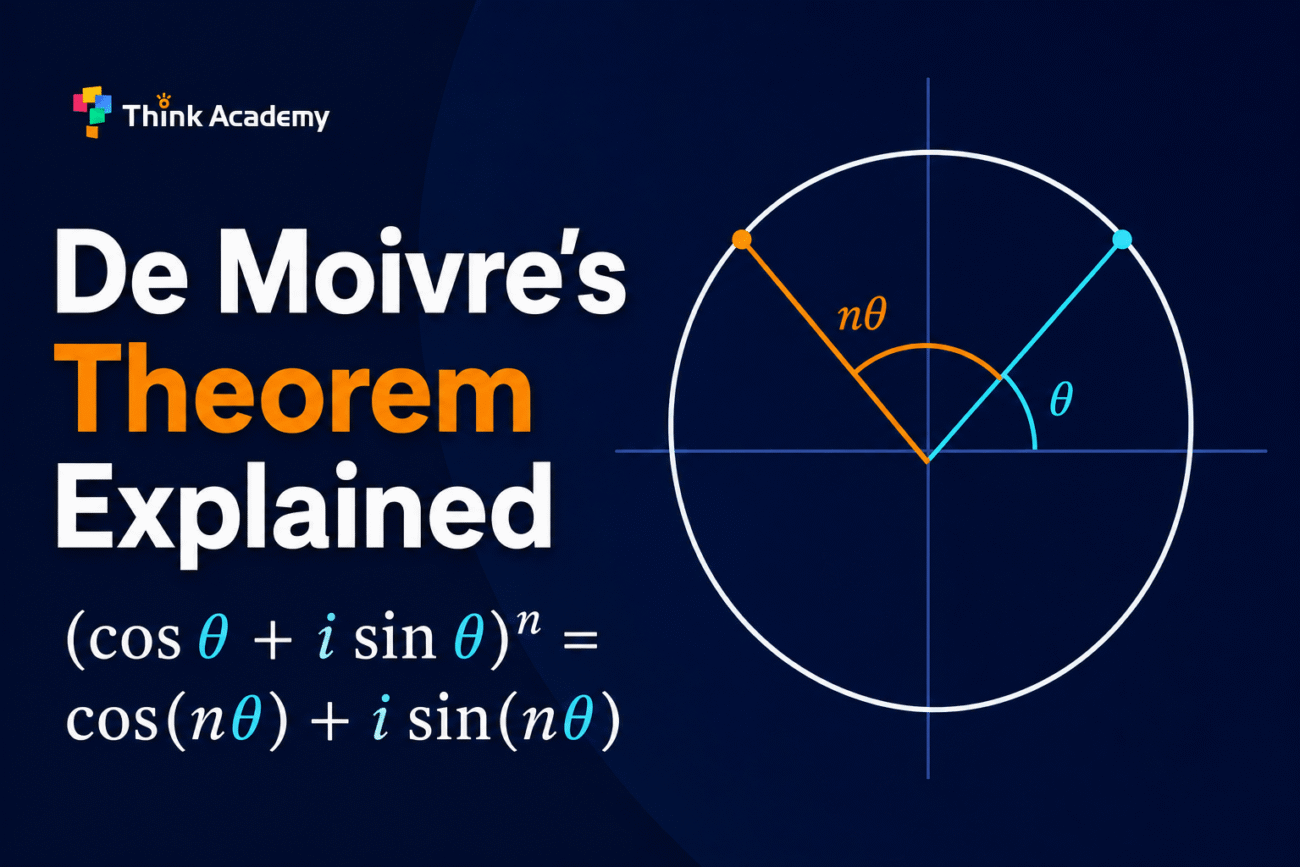
De Moivre’s theorem is one of the most elegant results in mathematics — a single compact formula that connects complex numbers, trigonometry, and exponentiation in a way that makes computing powers and roots of complex numbers remarkably clean. It appears in MHF4U, in university-level complex analysis, and in senior mathematics competitions including the Euclid Contest and AMC 12. Understanding it deeply — not just as a formula to apply, but as a result that makes sense — is the mark of strong senior mathematics preparation.
Prerequisites: Complex Numbers and Polar Form
Complex numbers:
A complex number has the form z=a+bi where a is the real part, b is the imaginary part, and i=−1 (so i2=−1).
Polar form:
Every complex number z=a+bi can be written in polar form:z=r(cosθ+isinθ)
where:
- r=∣z∣=a2+b2 is the modulus (distance from the origin in the complex plane)
- θ=arg(z)=arctan(b/a) is the argument (angle from the positive real axis)
Conversion:
- a=rcosθ, b=rsinθ
- r=a2+b2, θ=arctan(b/a) (with quadrant adjustment)
Example: Write z=1+i in polar form.
r=12+12=2
θ=arctan(1/1)=π/4 (first quadrant)
z=2(cos(π/4)+isin(π/4)) ✓
What Is De Moivre’s Theorem?
For any real number θ and integer n:(cosθ+isinθ)n=cos(nθ)+isin(nθ)
More generally, for any complex number z=r(cosθ+isinθ):zn=rn(cos(nθ)+isin(nθ))
In plain English:
To raise a complex number to the power n:
- Raise the modulus to the power n
- Multiply the argument by n
That’s it. A potentially complex multi-step calculation becomes two operations.
A first example:
Compute (1+i)8.
Polar form: 2(cos(π/4)+isin(π/4))
By De Moivre’s theorem:
(1+i)8=(2)8(cos(8⋅π/4)+isin(8⋅π/4))
=16(cos(2π)+isin(2π))
=16(1+0)=16
(1+i)8=16(1+i)^8 = 16 (1+i)8=16 — a real number, computed in seconds.
Compare this to expanding (1+i)8 by hand: eight rounds of complex multiplication, tracking real and imaginary parts throughout. The theorem makes the calculation almost trivial.

Proof of De Moivre’s Theorem
The standard proof is by mathematical induction on n (for positive integers), with separate arguments for n=0, negative integers, and rational exponents.
Proof for Positive Integers (by Induction)
Base case (n=1n = 1 n=1):
(cosθ+isinθ)1=cos(1⋅θ)+isin(1⋅θ) ✓ (trivially true)
Inductive hypothesis: Assume the theorem holds for some k≥1:(cosθ+isinθ)k=cos(kθ)+isin(kθ)
Inductive step: Show it holds for k+1:(cosθ+isinθ)k+1=(cosθ+isinθ)k⋅(cosθ+isinθ)
By the inductive hypothesis:=(cos(kθ)+isin(kθ))(cosθ+isinθ)
Expand using the distributive property (and i2=−1):=cos(kθ)cosθ−sin(kθ)sinθ+i(cos(kθ)sinθ+sin(kθ)cosθ)
By the angle addition formulas:=cos(kθ+θ)+isin(kθ+θ)=cos((k+1)θ)+isin((k+1)θ)
This is exactly the theorem for n=k+1. ✓
Conclusion: By induction, De Moivre’s theorem holds for all positive integers n. □
Extension to n=0
(cosθ+isinθ)0=1=cos(0)+isin(0) ✓
Extension to Negative Integers
For n<0, write n=−m with m>0:(cosθ+isinθ)−m=(cosθ+isinθ)m1=cos(mθ)+isin(mθ)1
Multiplying numerator and denominator by the conjugate:=cos(mθ)−isin(mθ)=cos(−mθ)+isin(−mθ)=cos(nθ)+isin(nθ)□
Euler’s Formula: The Deep Connection
De Moivre’s theorem becomes even more transparent when viewed through Euler’s formula:eiθ=cosθ+isinθ
This is one of the most remarkable formulas in mathematics. It expresses the complex exponential in terms of trigonometric functions.
With Euler’s formula, De Moivre’s theorem is simply:(eiθ)n=einθ=cos(nθ)+isin(nθ)
The theorem follows immediately from the basic exponent rule (ex)n=enx.
Euler’s identity, a special case: setting θ=π gives eiπ+1=0 — often called the most beautiful equation in mathematics, connecting e, i, π, 1, and 0 in a single identity.
At the MHF4U and Euclid level, Euler’s formula is noted but not deeply developed. At university level, it becomes foundational to complex analysis.
Applications of De Moivre’s Theorem
Application 1: Computing Powers of Complex Numbers
Example 1: Find (3+i)12.
Convert to polar: r=3+1=2, θ=arctan(1/3)=π/6.
z=2(cos(π/6)+isin(π/6))
By De Moivre’s theorem:
z12=212(cos(12⋅π/6)+isin(12⋅π/6))=4096(cos(2π)+isin(2π))=4096
(3+i)12=4096(\sqrt{3}+i)^{12} = 4096 (3+i)12=4096
Example 2: Find (1−i)10.
r=1+1=2, θ=arctan(−1/1)=−π/4 (fourth quadrant).
z=2(cos(−π/4)+isin(−π/4))
z10=(2)10(cos(−10π/4)+isin(−10π/4))=32(cos(−5π/2)+isin(−5π/2))
−5π/2≡−π/2(mod2π)
z10=32(cos(−π/2)+isin(−π/2))=32(0+i(−1))=−32i
(1−i)10=−32i(1-i)^{10} = -32i (1−i)10=−32i
Application 2: Finding nth Roots of Complex Numbers
The theorem is also used to find all nth roots of a complex number — a calculation that would be very difficult without it.
The nth root formula:
If z=r(cosθ+isinθ), the n distinct nth roots of z are:zk=r1/n(cosnθ+2πk+isinnθ+2πk),k=0,1,2,…,n−1
Example 3: Find all cube roots of 8.
8=8(cos(0)+isin(0)), so r=8, θ=0.
Cube roots (n=3):
k=0: 81/3(cos(0)+isin(0))=2
k=1: 2(cos(2π/3)+isin(2π/3))=2(−1/2+i3/2)=−1+i3
k=2: 2(cos(4π/3)+isin(4π/3))=2(−1/2−i3/2)=−1−i3
Cube roots of 8: 22 2, −1+i3-1 + i\sqrt{3} −1+i3, −1−i3-1 – i\sqrt{3} −1−i3
Note: the real cube root (2) is the one you know; De Moivre’s theorem reveals the two complex ones.
Example 4: Find the 4th roots of −16.
−16=16(cosπ+isinπ), so r=16, θ=π.
4th roots (n=4):
k=0: 161/4(cos(π/4)+isin(π/4))=2(22+i22)=2+i2
k=1: 2(cos(3π/4)+isin(3π/4))=−2+i2
k=2: 2(cos(5π/4)+isin(5π/4))=−2−i2
k=3: 2(cos(7π/4)+isin(7π/4))=2−i2
4th roots of −16-16 −16: ±2±i2\pm\sqrt{2} \pm i\sqrt{2} ±2±i2
Application 3: Deriving Trigonometric Identities
The theorem provides a powerful method for deriving multiple-angle formulas.
Example 5: Derive the triple angle formula for cosine.
By De Moivre’s theorem:
cos(3θ)+isin(3θ)=(cosθ+isinθ)3
Expand the right side:
=cos3θ+3icos2θsinθ+3i2cosθsin2θ+i3sin3θ
=cos3θ−3cosθsin2θ+i(3cos2θsinθ−sin3θ)
Equating real parts:cos(3θ)=cos3θ−3cosθsin2θ=4cos3θ−3cosθ
(using sin2θ=1−cos2θ)
Equating imaginary parts:sin(3θ)=3cos2θsinθ−sin3θ=3sinθ−4sin3θ
This is far faster than deriving these formulas from sum identities directly.
Where De Moivre’s Theorem Appears
MHF4U (Ontario Grade 12 Advanced Functions): Complex numbers are introduced in MHF4U, including polar form and basic operations. De Moivre’s theorem is covered as part of this unit and is tested on school assessments and the final exam. Powers of complex numbers and the connection to trigonometry are standard MHF4U applications. See our MHF4U Advanced Functions guide.
Euclid Contest (CEMC, Grade 12): De Moivre’s theorem appears in Euclid problems involving powers or roots of complex numbers, or in problems where expressing a complex number in polar form enables a clean solution. Students who know De Moivre’s theorem can solve these problems directly; those who do not may attempt expansion by hand — feasible for small powers but very slow. See our Euclid math contest guide and our Euclid past contests guide.
AMC 12: Complex number problems appear in the AMC 12, and De Moivre’s theorem is one of the key tools — particularly for problems asking for the real or imaginary part of a large power of a complex number, or for the number of distinct roots.
Canadian Mathematical Olympiad: At the CMO level, De Moivre’s theorem appears as a tool within larger problems — particularly in trigonometric identities (derived using the method of Example 5), roots of unity, and elegant evaluations of trigonometric sums. See our Canadian Mathematical Olympiad guide.
For the full competition landscape, see our math competitions in Canada guide.

Roots of Unity: A Beautiful Application
The nth roots of unity are the n complex numbers z satisfying zn=1. By De Moivre’s theorem, these are:zk=cosn2πk+isinn2πk,k=0,1,…,n−1
These n points are equally spaced around the unit circle in the complex plane, forming a regular n-gon.
The cube roots of unity (n=3n = 3 n=3):
k=0: 1
k=1: cos(2π/3)+isin(2π/3)=−21+i23=ω
k=2: cos(4π/3)+isin(4π/3)=−21−i23=ω2
Key properties of cube roots of unity:
- 1+ω+ω2=0 (sum of all roots)
- ω3=1 (definition)
- ω2=ωˉ (conjugate pair)
These properties — particularly 1+ω+ω2=0 — appear constantly in competition problems involving third roots of unity.
General property: The sum of all nth roots of unity is always 0 (for n≥2). This elegant result, provable from De Moivre’s theorem, is a standard tool in competition combinatorics and number theory.
Common Mistakes
Mistake 1: Forgetting to convert to polar form first. De Moivre’s theorem requires the complex number in the form r(cosθ+isinθ) — not a+bi. Applying the theorem directly to a+bi without converting produces meaningless results.
Mistake 2: Applying only to the angle, forgetting the modulus.zn=rn(cos(nθ)+isin(nθ)) — both r raised to n and θ multiplied by n. Students who only multiply the angle by n and forget to raise r get the argument right but the modulus wrong.
Mistake 3: Using degrees without converting to radians. Most formulations of De Moivre’s theorem use radians. Mixing degrees and radians in the same calculation produces incorrect results.
Mistake 4: Missing roots when finding nth roots.There are always n distinct nth roots of a non-zero complex number. Students who find only one root (the “obvious” one) miss the others. Always use k=0,1,…,n−1 to generate all roots.
Mistake 5: Not reducing the angle modulo 2π2\pi 2π.After multiplying by n, the resulting angle may be larger than 2π. Always reduce modulo 2π to find the standard angle for the result.
Practice Problems
Set A — Powers of complex numbers
- Find (1+i)10 using De Moivre’s theorem.
- Find (3+i)6.
- Find (−1+i)8.
- Find (1−i3)12.
- Find the real and imaginary parts of (cos(π/5)+isin(π/5))10.
Set B — Roots
- Find all square roots of i.
- Find all cube roots of −8.
- Find all 4th roots of 1, and sketch them in the complex plane.
- Find all 6th roots of −64.
Set C — Applications
- Show that cos(2θ)=cos2θ−sin2θ using De Moivre’s theorem.
- Derive the formula for sin(4θ) in terms of sinθ and cosθ.
- If ω=cos(2π/3)+isin(2π/3), show that 1+ω+ω2=0.
Answers:
Set A:
- 2(cosπ/4+isinπ/4); (√2)10=32; angle =10π/4=5π/2≡π/2; 32(0+i)=32i. (1+i)¹⁰ = 32i
- r=2, θ=π/6; 26=64; angle =π; 64(−1+0i)=−64. (3+i)6=−64(\sqrt{3}+i)^6 = -64 (3+i)6=−64
- r=2, θ=3π/4; (2)8=16; angle =6π≡0; 16(1)=16. (−1+i)8=16(-1+i)^8 = 16 (−1+i)8=16
- r=2, θ=−π/3; 212=4096; angle =−4π≡0; 4096. (1−i3)12=4096(1-i\sqrt{3})^{12} = 4096 (1−i3)12=4096
- r=1, θ=π/5; 110=1; angle =2π≡0; real part = 1, imaginary part = 0.
Set B: 6. i=cos(π/2)+isin(π/2); square roots: k=0: cos(π/4)+isin(π/4)=22+i22; k=1: cos(5π/4)+isin(5π/4)=−22−i22. ±22(1+i)\pm\frac{\sqrt{2}}{2}(1+i) ±22(1+i)7. −8=8(cosπ+isinπ); cube roots: k=0: 2(cosπ/3+isinπ/3)=1+i3; k=1: 2(cosπ+isinπ)=−2; k=2: 2(cos5π/3+isin5π/3)=1−i3. −2-2 −2, 1±i31\pm i\sqrt{3} 1±i38. 1=cos0+isin0; 4th roots at k=0,1,2,3: 1,i,−1,−i1, i, -1, -i 1,i,−1,−i — vertices of a square. 9. −64=64(cosπ+isinπ); 6th roots: r=2; angles (π+2πk)/6 for k=0,…,5: 3+i\sqrt{3}+i 3+i, 2i2i 2i, −3+i-\sqrt{3}+i −3+i, −3−i-\sqrt{3}-i −3−i, −2i-2i −2i, 3−i\sqrt{3}-i 3−i
Set C: 10. (cosθ+isinθ)2=cos2θ+isin2θ. Expanding left: cos2θ−sin2θ+2icosθsinθ. Equating real parts: cos2θ=cos2θ−sin2θ. □ 11. (cosθ+isinθ)4=cos4θ+isin4θ. Expand left side and equate imaginary parts (exercise). Result: sin4θ=4cos3θsinθ−4cosθsin3θ. 12. ω3=(cos2π/3+isin2π/3)3=cos2π+isin2π=1. So ω3−1=0, meaning (ω−1)(1+ω+ω2)=0. Since ω=1: 1+ω+ω2=0. □
Frequently Asked Questions
What is De Moivre’s theorem? For any real θ and integer n: (cosθ+isinθ)n=cos(nθ)+isin(nθ). More generally, for z=r(cosθ+isinθ): zn=rn(cos(nθ)+isin(nθ)). It makes computing powers and roots of complex numbers straightforward.
Why is De Moivre’s theorem useful? It reduces computing zn from a multi-step complex multiplication problem to two operations: raise the modulus to n and multiply the argument by n. For large powers this is dramatically faster than direct expansion.
How is De Moivre’s theorem proved? The standard proof is by mathematical induction on n for positive integers, using the angle addition formulas in the inductive step. The result extends to n=0, negative integers, and rational exponents. See our math induction proof guide for the induction technique.
What are roots of unity? The nth roots of unity are the n complex solutions to zn=1. By De Moivre’s theorem they are evenly spaced around the unit circle at angles 2πk/n for k=0,1,…,n−1. Their sum is always 0, a property with many applications in competition mathematics.
Does De Moivre’s theorem appear in MHF4U? Yes. Complex numbers in polar form and De Moivre’s theorem are part of the Ontario Grade 12 Advanced Functions curriculum. Powers of complex numbers and the derivation of trigonometric identities are standard MHF4U applications.
What is the connection between De Moivre’s theorem and Euler’s formula? Euler’s formula eiθ=cosθ+isinθ makes De Moivre’s theorem immediate: (eiθ)n=einθ=cos(nθ)+isin(nθ). The theorem follows from the basic exponent rule.
See our related guides: MHF4U Advanced Functions guide · fundamental theorem of algebra guide · Euclid math contest guide · Euclid past contests guide · Canadian Mathematical Olympiad guide · math induction proof guide · trigonometric identities sheet · MCR3U complete guide · math competitions in Canada