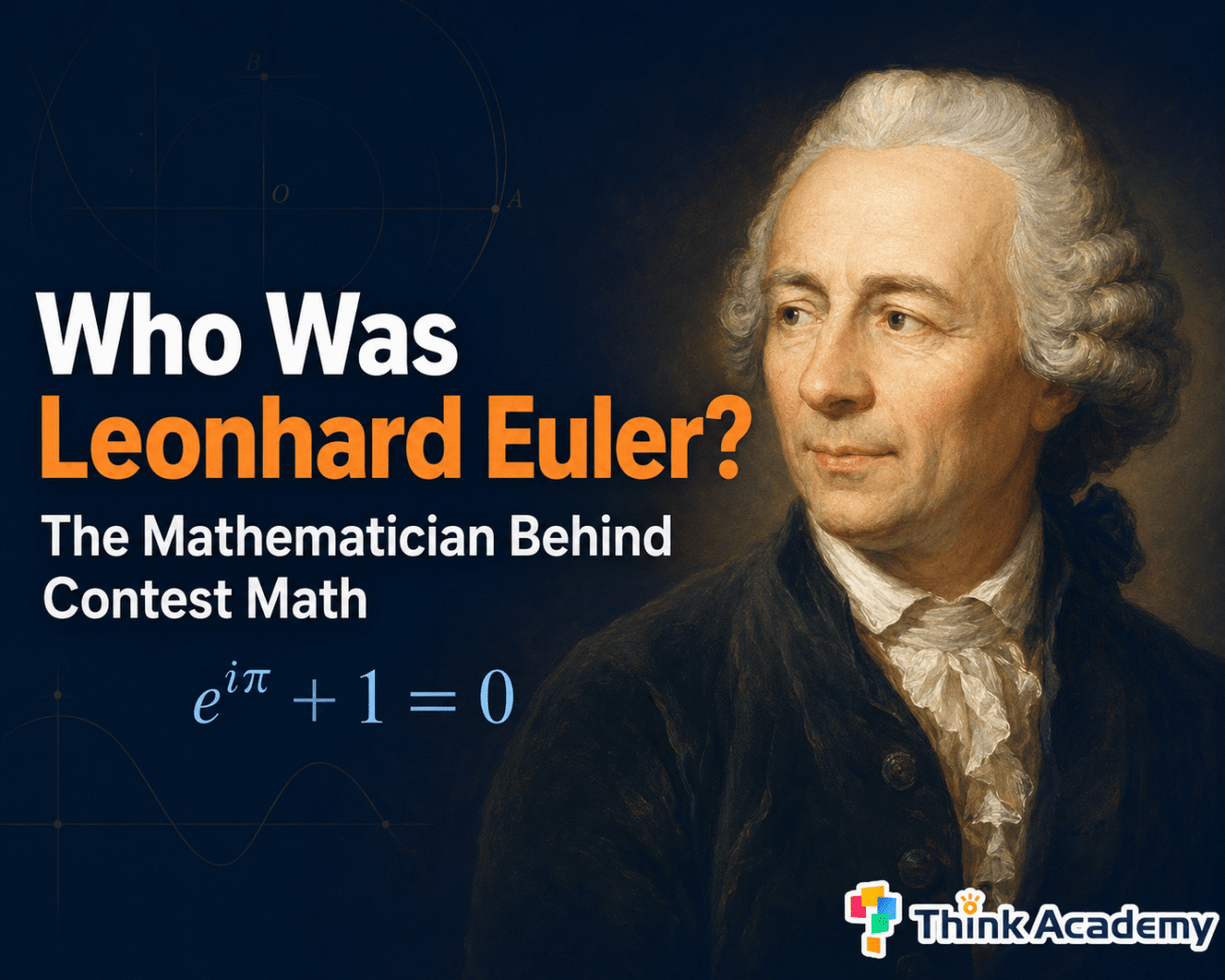
In 1988, Mathematical Intelligencer asked its readers to name the most beautiful theorem in mathematics. The winner was eiπ+1=0 — Euler’s identity. The runner-up was eiθ=cosθ+isinθ — also Euler’s. Third place went to the infinitude of primes — proved by Euclid, but the Leonhard Euler mathematician gave a far more elegant proof using infinite series. Four of the top five theorems were either discovered by Leonhard Euler or substantially advanced by him.
Leonhard Euler (1707–1783) was the most prolific mathematician in the history of mathematics. Understanding who he was, what he discovered, and how his work connects to the mathematics competition students encounter today is more than historical curiosity — it is context that makes the mathematics itself more interesting.
Who Was Leonhard Euler? A Mathematician Like No Other
Leonhard Euler mathematician (1707–1783) was a Swiss mathematician and physicist who spent most of his working life in Berlin and St Petersburg. He made foundational contributions to calculus, number theory, graph theory, mechanics, optics, and astronomy — in some cases effectively creating the fields from scratch.
Basic facts:
| Detail | Information |
|---|---|
| Born | 15 April 1707, Basel, Switzerland |
| Died | 18 September 1783, St Petersburg, Russia |
| Education | University of Basel (studied under Johann Bernoulli) |
| Career | St Petersburg Academy (1727–1741, 1766–1783); Berlin Academy (1741–1766) |
| Published works | Over 800 papers and books |
| Pages of mathematics | Estimated 30,000+ pages |
Euler lost sight in his right eye in his late 20s and became almost entirely blind in his final years — yet he continued producing mathematics at a remarkable rate, dictating to assistants and performing extraordinary calculations in his head.
The mathematical notation you use every day was largely standardised by the Leonhard Euler mathematician:
- f(x) for function notation
- e for the base of the natural logarithm
- i for −1
- π for the ratio of circumference to diameter
- Σ for summation
- Δ for finite differences
When you write f(x) or use π, you are using Euler’s notation.
Leonhard Euler Mathematician: His Most Important Results
1. Euler’s Identity: eiπ+1=0
The most celebrated equation in mathematics connects five of the most important constants:
- e — the base of the natural logarithm
- i — the imaginary unit (−1)
- π — the ratio of circumference to diameter
- 1 — the multiplicative identity
- 0 — the additive identity
It follows from Euler’s formula eiθ=cosθ+isinθ by setting θ=π. The formula itself — Euler’s formula — is the deepest connection between complex exponentials and trigonometry, and is the foundation of De Moivre’s theorem. For more on that, see our De Moivre’s theorem guide.
2. The Solution to the Basel Problem
In 1734, Euler solved a problem that had stumped mathematicians for nearly a century:n=1∑∞n21=6π2
The sum of the reciprocals of all perfect squares equals π2/6 — a result that seems almost impossible. The appearance of π in a sum involving only integers and their squares is startling, and Euler’s proof (using the power series expansion of sinx compared to its factored form over its roots) is one of the most creative mathematical arguments ever produced.
This result opened the door to the Riemann zeta function ζ(s)=∑n=1∞ns1, which Euler studied extensively. The Riemann Hypothesis — the most famous unsolved problem in mathematics — is about this function, and Euler’s work is the starting point.
3. Euler’s Formula for Polyhedra
For any convex polyhedron with V vertices, E edges, and F faces:V−E+F=2
A cube: 8−12+6=2 ✓. An octahedron: 6−12+8=2 ✓.
This is the foundation of topology — the study of properties that are preserved under continuous deformation. The quantity V−E+F is now called the Euler characteristic, and it generalises to surfaces and higher-dimensional spaces in ways that Euler could not have anticipated.
4. Graph Theory: The Königsberg Bridge Problem
In 1736, Euler solved the Königsberg Bridge Problem — could you walk through the city of Königsberg crossing each of its seven bridges exactly once? His answer (no) and his method of proving it founded graph theory — the mathematics of networks.
Euler showed that such a path (now called an Eulerian path) exists if and only if the graph has exactly zero or two vertices of odd degree. This is a theorem that every competition student who has encountered graph problems has encountered, whether they knew it or not.
5. Euler’s Theorem in Number Theory
Euler proved the theorem that bears his name in number theory: for any a and n with gcd(a,n)=1:aϕ(n)≡1(modn)
where ϕ(n) is Euler’s totient function — the count of integers from 1 to n that are coprime to n.
When n=p (prime), ϕ(p)=p−1, and Euler’s theorem reduces to Fermat’s Little Theorem — the result Fermat stated without proof in 1640, which Euler proved in 1736. For more on that result, see our Fermat’s Little Theorem guide.
6. The Product Formula for the Zeta Function
Euler proved the remarkable identity connecting the zeta function to prime numbers:n=1∑∞ns1=p prime∏1−p−s1
The left side is a sum over all positive integers; the right side is a product over all primes. This Euler product formula is one of the deepest connections between analysis and number theory, and it lies at the heart of the Riemann Hypothesis and all of modern analytic number theory.
Euler used this formula to prove that the sum of reciprocals of primes diverges — showing that primes, though sparse, are not too sparse. This is a result about the distribution of primes that had never been proved before.
7. Euler’s Number e and Calculus
Euler defined e as the base of the natural logarithm, established its connection to compound interest:e=n→∞lim(1+n1)n≈2.71828…
and developed the exponential function ex as a foundational object of calculus. He showed that ex is its own derivative — a property that makes the exponential function central to every differential equation in physics and engineering.e exponential function central to every differential equation in physics and engineering.
Euler and the Euler Contest
The Euler Contest — a CEMC competition aimed at Grade 7 and 8 students — is named after Leonhard Euler. It is one of the entry points into the CEMC competition series. Students who compete in the Euler Contest are working in the tradition of the mathematician who founded graph theory, solved the Basel problem, and proved Fermat’s Little Theorem.
For more on the CEMC competition series, see our math competitions in Canada guide and Waterloo math competitions guide.

The Euler Contest rewards flexible thinking—not just classroom calculation. A free math assessment can help you understand your child’s current foundations and includes a personalised written feedback report.
Start the free math assessment →
How the Leonhard Euler Mathematician Appears Throughout Competition Mathematics
The results Euler proved appear constantly throughout the competition mathematics curriculum — from the Gauss Contest through to the Canadian Mathematical Olympiad. Here is where his work surfaces most directly:
Graph theory (Gauss, AMC 8, AMC 10): Eulerian paths and circuits, vertex degree, and network problems all trace directly to Euler’s 1736 paper on the Königsberg bridges. When a competition problem asks about traversing a graph without repeating an edge, the answer method is Euler’s.
Number theory (Euclid, COMC, CMO):Euler’s totient function, Euler’s theorem, and the proof of Fermat’s Little Theorem are core tools at the senior competition level. Any competition problem involving an(modp) for large n connects to Euler’s work. See our Fermat’s Little Theorem guide.
Complex numbers and De Moivre’s theorem (MHF4U, Euclid, AMC 12):Euler’s formula eiθ=cosθ+isinθ is the foundation of De Moivre’s theorem. Every complex number power and root calculation at competition level traces back to Euler. See our De Moivre’s theorem guide.
Infinite series and analysis (university entrance): The Basel problem, the Euler product formula, and Euler’s work on series and convergence are standard university-level mathematics. Students who encounter them in competition mathematics are seeing research-level ideas from the 18th century that remain active areas of investigation.
Polyhedra and topology (competition geometry):Euler’s formula V−E+F=2 appears occasionally in competition geometry problems involving three-dimensional figures. It is also a conceptual touchstone in combinatorics problems involving planar graphs.
If your child finds these ideas genuinely interesting — the way a beautiful result from 1734 is still relevant to competition mathematics today, the way Euler’s notation shapes everything a student writes — that kind of mathematical curiosity is the foundation of genuine mathematical talent. Think Academy’s competition programmes are built around developing exactly this depth. Find out what that looks like →
Leonhard Euler’s Character: A Mathematician Who Loved Mathematics
What distinguished the Leonhard Euler mathematician was not just his output — though 800 papers is staggering — but the quality and range of his thinking. He solved problems across every branch of mathematics known in his time, introduced new notation that made mathematics clearer for everyone who followed, and proved results that have remained foundational for 300 years.
He was also, by all accounts, a warm and generous person — a devoted family man who fathered 13 children, many of whom died young, and who continued working through personal loss and physical difficulty. He is said to have done mathematics with a child on his knee.
One story: when Euler went blind in his left eye (having already lost the right), he reportedly said it would give him fewer distractions. He continued producing mathematics at the same rate.
The mathematical culture that competition mathematics inhabits — the love of elegant proofs, the pleasure of a clever argument, the satisfaction of a result that seems impossible until you see why it must be true — is the culture Euler embodied more completely than almost anyone.

Competition mathematics develops from strong foundations into deeper reasoning across graph theory, number theory and geometry. Find out where your child’s current skills stand and what they could work on next.
Get a free assessment and feedback report →
Key Leonhard Euler Results at a Glance
| Result | Area | Significance |
|---|---|---|
| eiπ+1=0 | Complex analysis | The most beautiful equation in mathematics |
| ∑1/n2=π2/6 | Analysis / number theory | Solution to the Basel problem |
| V−E+F=2 | Topology / geometry | Foundation of topological invariants |
| Königsberg bridge proof | Graph theory | Founded the entire field |
| Euler’s theorem: aϕ(n)≡1 | Number theory | Generalises Fermat’s Little Theorem |
| Euler product formula | Analytic number theory | Links zeta function to primes |
| eiθ=cosθ+isinθ | Complex analysis | Foundation of De Moivre’s theorem |
| Notation: f(x), e, i, π, Σ | All of mathematics | Mathematical language we still use today |
Frequently Asked Questions
Who was Leonhard Euler? Leonhard Euler mathematician (1707–1783) was a Swiss mathematician and physicist widely regarded as the most prolific mathematician in history. He made foundational contributions to calculus, number theory, graph theory, topology, and mechanics, and standardised much of the mathematical notation still used today. He produced over 800 papers and books, including after losing his sight.
What is Euler most famous for?Euler is most famous for Euler’s identity (eiπ+1=0), solving the Basel problem (∑1/n2=π2/6), founding graph theory with the Königsberg bridge problem, and Euler’s formula for polyhedra (V−E+F=2). He also proved Fermat’s Little Theorem and developed the exponential function.
What notation did Euler introduce?Euler standardised: f(x) for function notation, e for the natural logarithm base, i for −1, π for pi, Σ for summation, and several other symbols now universally used in mathematics.
Why is there an Euler Contest named after him? The CEMC (Centre for Education in Mathematics and Computing, University of Waterloo) named several of its competitions after distinguished mathematicians. The Euler Contest (Grade 7–8) honours Euler’s foundational contributions to the mathematics competition students encounter throughout their careers.
What is Euler’s formula?eiθ=cosθ+isinθ — the equation connecting the complex exponential to trigonometric functions. Setting θ=π gives Euler’s identity. The formula is the foundation of De Moivre’s theorem and complex number theory.
How does Euler’s work connect to competition mathematics? Directly and substantially. Graph theory (Gauss, AMC 8, AMC 10), number theory (Euclid, COMC, CMO), complex numbers and De Moivre’s theorem (MHF4U, Euclid, AMC 12), and infinite series all connect to results Euler proved. He is arguably the single most important figure behind the mathematical content of senior competition mathematics.
See our related guides: De Moivre’s theorem guide · Fermat’s Little Theorem guide · Goldbach conjecture guide · fundamental theorem of algebra guide · pigeonhole principle guide · Canadian Mathematical Olympiad guide · Euclid math contest guide · math competitions in Canada guide · math enrichment guide

Curious students thrive when they can explore why mathematics works—not simply memorise methods. Experience how Think Academy develops deeper reasoning and confident problem-solving in a free online trial class.