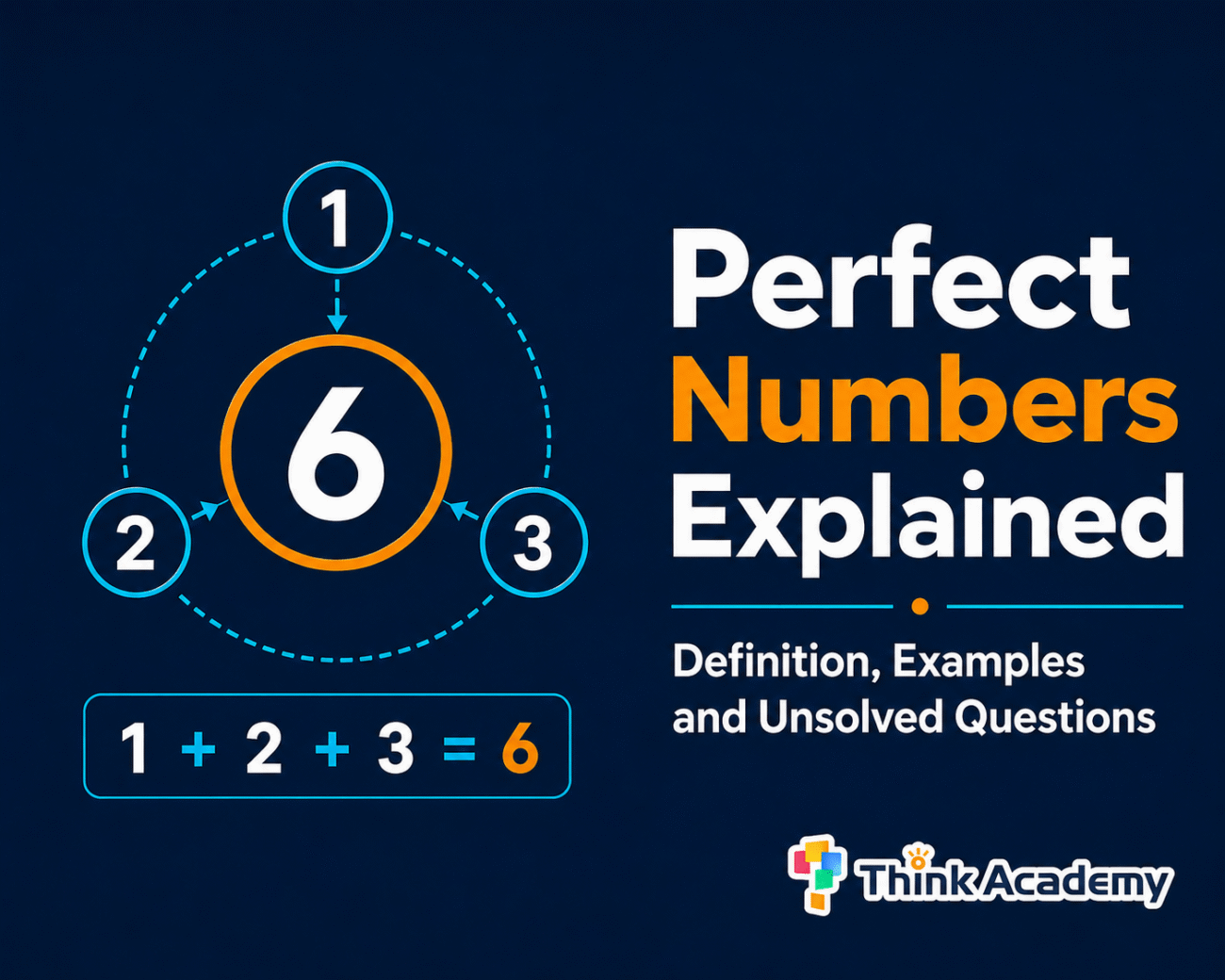
6 is the smallest perfect number. Its proper divisors — the positive divisors other than itself — are 1, 2, and 3. And 1 + 2 + 3 = 6.
28 is the next one. Its proper divisors are 1, 2, 4, 7, and 14. And 1 + 2 + 4 + 7 + 14 = 28.
A perfect number is a positive integer that equals the sum of its proper divisors. It is, in some sense, a number that is perfectly balanced — neither more nor less than the sum of all its parts.
Mathematicians have known about perfect numbers since ancient Greece. They have found only 51 of them in 2,500 years. They do not know if there are infinitely many. They do not know if any odd perfect number exists. Both questions are completely open.
What Is a Perfect Number?
A perfect number is a positive integer n that equals the sum of its proper divisors — that is, all positive divisors of n other than n itself.
Formally: Let σ(n) denote the sum of all positive divisors of n (including n itself). Then n is perfect if and only if σ(n)=2n.
Equivalently, n is perfect if the sum of its proper divisors equals n.
The first four perfect numbers:
| n | Proper divisors | Sum |
|---|---|---|
| 6 | 1, 2, 3 | 6 ✓ |
| 28 | 1, 2, 4, 7, 14 | 28 ✓ |
| 496 | 1, 2, 4, 8, 16, 31, 62, 124, 248 | 496 ✓ |
| 8128 | 1, 2, 4, 8, 16, 32, 64, 127, 254, 508, 1016, 2032, 4064 | 8128 ✓ |
The fifth perfect number is 33,550,336. The sixth is 8,589,869,056. The numbers grow very quickly.
Non-examples:
- 12: proper divisors 1, 2, 3, 4, 6 — sum = 16 > 12. Abundant (sum exceeds the number)
- 10: proper divisors 1, 2, 5 — sum = 8 < 10. Deficient (sum is less than the number)
Every positive integer is either perfect, abundant, or deficient. Most are deficient. Perfect numbers are extraordinarily rare.

Ancient History: Why Perfect Numbers Were Considered Sacred
The ancient Greeks — particularly the Pythagoreans — believed that certain numbers had mystical significance, and perfect numbers were among the most revered.
Euclid (around 300 BCE) proved the first major theorem about perfect numbers: if 2p−1(2p−1) is an expression where (2p−1) is prime, then 2p−1(2p−1) is a perfect number. This is still the only known formula for generating even perfect numbers.
Nicomachus (around 100 CE) wrote that perfect numbers were rare and beautiful, and that their study was connected to virtue and moral philosophy. He also made several incorrect claims — that there is exactly one perfect number for each number of digits, that they alternate between ending in 6 and 8 — that turned out to be accidentally true for the first few but false in general.
Early theologians found theological significance in 6 (the number of days of creation in Genesis) and 28 (the length of the lunar cycle). Augustine of Hippo wrote that “six is a number perfect in itself, and not because God created all things in six days; rather the contrary is true — God created all things in six days because this number is perfect.”
This is unusual in the history of mathematics: a purely number-theoretic property being absorbed into philosophical and religious thought because the numbers themselves seem to carry meaning.
Perfect Number Connection to Mersenne Primes
Every known perfect number is even, and every even perfect number has a very specific form.
Euclid-Euler Theorem:
An even number is perfect if and only if it has the form:n=2p−1(2p−1)
where p is a prime and (2p−1) is also prime.
The numbers of the form 2p−1 (where the result is prime) are called Mersenne primes, named after the French mathematician Marin Mersenne.
The connection:
| Prime p | 2p−1 | Is 2p−1 prime? | Perfect number 2p−1(2p−1) |
|---|---|---|---|
| 2 | 3 | Yes ✓ | 6 |
| 3 | 7 | Yes ✓ | 28 |
| 5 | 31 | Yes ✓ | 496 |
| 7 | 127 | Yes ✓ | 8,128 |
| 11 | 2,047 = 23 × 89 | No ✗ | — |
| 13 | 8,191 | Yes ✓ | 33,550,336 |
So the search for even perfect numbers reduces entirely to the search for Mersenne primes. Every time a new Mersenne prime is discovered, a new perfect number comes with it.
How many Mersenne primes are known?
As of 2025, 51 Mersenne primes are known — meaning 51 even perfect numbers are known. The largest known, discovered in 2024, has over 40 million digits.
Finding new Mersenne primes requires enormous computational power. The GIMPS project (Great Internet Mersenne Prime Search) is a collaborative distributed computing project that has found many of the largest known Mersenne primes using volunteer computers worldwide.
The Perfect Number Two Great Open Questions
Question 1: Are there infinitely many perfect numbers?
Since every even perfect number corresponds to a Mersenne prime, this is equivalent to asking: are there infinitely many Mersenne primes?
Answer: Nobody knows.
We have found 51 Mersenne primes, and they seem to keep appearing as we search further — but “they seem to keep appearing” is not a proof. The distribution of Mersenne primes is not well understood theoretically. There could be infinitely many, or the list could eventually terminate.
This is one of the simplest-sounding open questions in number theory.
Question 2: Does an odd perfect number exist?
This is perhaps the most famous question in the entire theory of perfect numbers. In 2,500 years of mathematical history, no odd perfect number has ever been found. Most mathematicians believe none exist. Yet no proof has been given.
What is known about odd perfect numbers:
If an odd perfect number exists, it must be:
- Greater than 101500 (a number with 1,500 digits)
- Divisible by at least 9 distinct prime factors
- Of the form qkm2 where q is a prime with q≡k≡1(mod4)
- Not divisible by 105 = 3 × 5 × 7
These constraints have been refined over centuries of work. Each new result tightens the cage around where an odd perfect number could hide. But the cage is never empty — a potential odd perfect number has never been ruled out entirely.
The situation is similar to the Goldbach conjecture: strong numerical evidence and many partial results, but no proof. For more on that comparison, see our Goldbach conjecture guide.
Near-Perfect Numbers and Related Concepts
The idea of a perfect number has inspired related concepts worth knowing:
Amicable numbers: Two numbers where each is the sum of the proper divisors of the other. The smallest pair is (220, 284): the proper divisors of 220 sum to 284, and the proper divisors of 284 sum to 220. Pythagoras reportedly knew this pair.
Sociable numbers: A chain of numbers where the sum of proper divisors of each leads to the next, eventually cycling back to the start. Amicable numbers are the special case of chain length 2.
Multiperfect numbers: Numbers where σ(n)=kn for some integer k>2. When k=2 this is the standard perfect number definition. When k=3, the number is called “triperfect” — only six are known.
Quasiperfect numbers: Numbers where the sum of proper divisors is n+1 (one more than perfect). None are known — whether any exist is open.
Hemiperfect numbers: Numbers where σ(n)/n=k/2 for some odd integer k. These exist (120 is an example with σ(120)/120=3) and connect to the broader theory of multiply-perfect numbers.
The richness of these related concepts illustrates how a single simple idea — a number equalling the sum of its parts — opens into a landscape of questions, most of them unsolved.
Perfect Numbers in History: A Timeline
~300 BCE: Euclid proves the formula 2p−1(2p−1) for even perfect numbers in Elements, Book IX.
~100 CE: Nicomachus in Introductio Arithmetica discusses perfect numbers and makes several incorrect claims about their properties.
1638: René Descartes proves several properties that an odd perfect number would need to satisfy — if one exists. He believes none exist.
1849: Leonhard Euler (posthumous publication) proves the converse of Euclid’s theorem: every even perfect number has the form 2p−1(2p−1) where 2p−1 is prime. The Euclid-Euler theorem is now complete.
1952: The first five Mersenne primes beyond the initial known four are discovered using early computers — the beginning of machine-assisted prime discovery.
1996: GIMPS (Great Internet Mersenne Prime Search) launches, using distributed computing to search for Mersenne primes.
2024: The 51st known Mersenne prime is discovered — a number with over 40 million digits.
Present: 51 known perfect numbers. No odd perfect number found. No proof that no odd perfect number exists. No proof that there are infinitely many perfect numbers.

Where Perfect Numbers Connect to Competition Mathematics
Perfect numbers themselves appear occasionally in competition problems — but the mathematical ideas surrounding them are foundational to competition number theory.
Divisor sums and sigma notation — the function σ(n) (sum of all divisors) is a standard tool in competition number theory. Problems involving the number of divisors, the sum of divisors, or divisibility properties of divisor sums appear regularly at the Gauss Contest, AMC 8, and AMC 10 level.
Mersenne primes and primality — the question of whether 2p−1 is prime connects to modular arithmetic and the Fermat’s Little Theorem toolkit that is standard at the senior competition level.
The Euclid-Euler theorem — this is a beautiful two-step proof combining Euclid’s construction and Euler’s converse. The proof technique — showing that a certain formula generates perfect numbers, and that no other even perfect numbers exist — is the kind of structured argument tested in Euclid Contest and COMC proof problems.
The unsolved questions — the open problems about perfect numbers (infinitely many? any odd ones?) connect to the same mathematical culture as the Goldbach conjecture and Millennium Prize Problems — a culture of genuine curiosity about hard questions.
If your child finds it interesting that a number can be “perfect” — that its divisors can sum back to itself exactly — and wants to know what else is hidden in the number system, that curiosity is the right instinct for mathematics. Think Academy’s competition programmes develop exactly this kind of number sense into genuine mathematical skill. Find out what structured competition training looks like →
Try It Yourself
Perfect numbers are one of the easiest topics in number theory to explore with nothing more than paper and arithmetic.
Find the divisors of numbers from 1 to 50. Which ones are abundant (divisor sum > number)? Which are deficient? Are any perfect? You will find 6 and 28 — and everything else will be abundant or deficient.
Check whether 496 is perfect. Find all divisors of 496 and sum them. (Hint: 496 = 16 × 31, and 31 is prime. Use this to list divisors systematically.)
Verify the Euclid-Euler formula for p=5p = 5 p=5: compute 24×(25−1)=16×31=496. Check that 31 is prime. Confirm that 496 is perfect by summing its divisors.
Explore amicable numbers. Check that 220 and 284 are amicable: find all proper divisors of each and verify the sums.
None of this exploration will answer whether odd perfect numbers exist. But it will give you a genuine feel for what number theory involves — the pleasure of discovering structure in the integers, and the surprise of how many questions remain open.
Frequently Asked Questions
What is a perfect number? A positive integer that equals the sum of its proper divisors (all positive divisors except itself). The first four are 6, 28, 496, and 8128.
How many perfect numbers are known? 51 are known as of 2025. Each corresponds to a known Mersenne prime.
Are there infinitely many perfect numbers? Unknown — one of the most famous open questions in number theory. Proving it is equivalent to proving there are infinitely many Mersenne primes.
Does any odd perfect number exist?None has ever been found, and most mathematicians believe none exist. However, no proof has been given in 2,500 years of trying. Any odd perfect number would have to be larger than 101500.
What is a Mersenne prime?A prime number of the form 2p−1 where p is prime. Every even perfect number corresponds to exactly one Mersenne prime, by the Euclid-Euler theorem.
Why are perfect numbers called “perfect”? The ancient Greeks used “perfect” to describe numbers that are completely balanced — neither more nor less than the sum of all their parts. The philosophical resonance of this idea, combined with the beauty of the small examples (6 and 28), made the name stick.
Do perfect numbers appear in competition mathematics? Occasionally — problems involving divisor sums, proper divisors, and number classifications (abundant/deficient/perfect) appear in AMC 8, AMC 10, and Gauss Contest problems. The Euclid-Euler theorem is relevant at the senior competition level.
See our related guides: Goldbach conjecture guide · Collatz conjecture guide · Millennium Prize Problems guide · Fermat’s Little Theorem guide · Leonhard Euler mathematician guide · Gauss math contest guide · AMC 8 guide · Euclid math contest guide · math enrichment guide