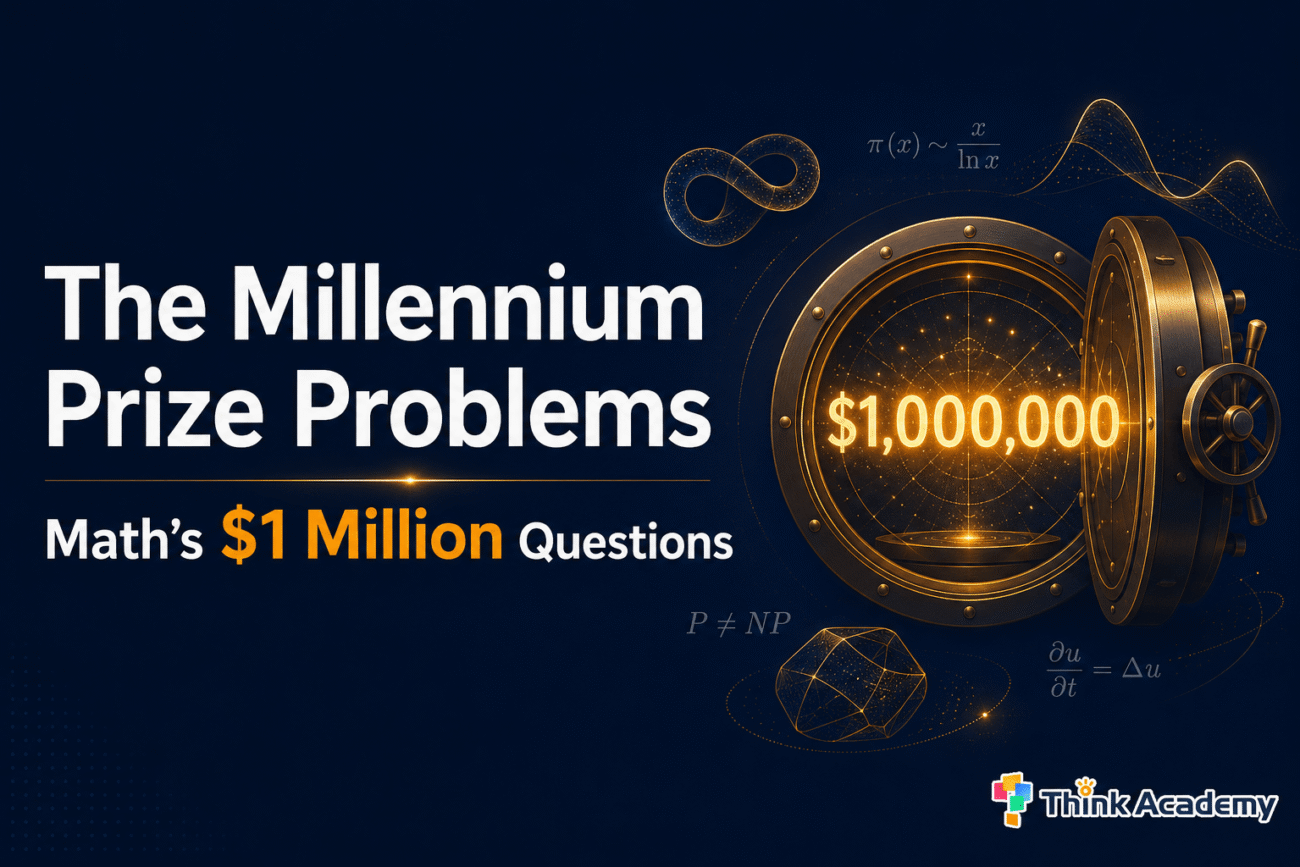
In the year 2000, the Clay Mathematics Institute in Cambridge, Massachusetts, announced seven mathematical problems and offered $1,000,000 for a complete solution to each. These are the Millennium Prize Problems — the most important unsolved questions in mathematics, selected by a panel of the world’s leading mathematicians. Each one represents a frontier of human understanding: a question that the combined mathematical community has been unable to answer despite decades or centuries of effort.
Twenty-five years later, one has been solved. The other six remain open.
This guide explains all seven Millennium Prize Problems — what each one asks, why it matters, what progress has been made, and what solving it would mean. You do not need advanced mathematics to appreciate what these problems are about and why they matter.
What Are the Millennium Prize Problems?
The Millennium Prize Problems were selected by the Clay Mathematics Institute (CMI) in 2000 to mark the new millennium and to identify the deepest open problems in mathematics at the turn of the century. The selection committee included some of the most eminent mathematicians alive.
The criteria for selection: problems that were (1) well-defined and precise, (2) widely recognised as important by the mathematical community, and (3) apparently very difficult — problems that had resisted serious attempts for many years.
The prize: $1,000,000 (USD) for each problem, awarded to whoever first presents a complete, correct solution that survives peer review and is published in a recognised journal.
The seven problems:
- P vs NP
- The Riemann Hypothesis
- Yang-Mills Existence and Mass Gap
- Navier-Stokes Existence and Smoothness
- The Hodge Conjecture
- The Birch and Swinnerton-Dyer Conjecture
- The Poincaré Conjecture ✓ (Solved, 2003)

1. P vs NP: Millennium Prize Problems That Affect Everything
The question: Is every problem whose solution can be quickly verified also one that can be quickly solved?
What this means:
In computer science, P is the class of problems that can be solved quickly (in polynomial time). NP is the class of problems whose solutions can be verified quickly — even if finding the solution takes much longer.
A classic NP problem: given a list of cities and the distances between them, is there a route shorter than 1,000 km that visits all of them? Checking whether a proposed route satisfies the condition is fast. Finding the shortest route among all possibilities is, for large numbers of cities, computationally intractable with any known method.
The P vs NP question asks: are these two classes the same? Is every problem that can be verified quickly also solvable quickly?
Why it matters:
Most cryptographers and computer scientists believe P ≠ NP — that some problems are genuinely harder to solve than to verify. If this is true, modern encryption (which relies on the difficulty of certain computational problems) is provably secure.
If P = NP, the consequences would be revolutionary — and largely alarming. Every password, every encrypted message, every secure financial transaction depends on certain problems being computationally hard. P = NP would mean they are not.
The P vs NP problem is the most practically important of the Millennium Prize Problems. Its resolution would reshape computing, cryptography, and artificial intelligence.
Status: Open. Most researchers believe P ≠ NP but no proof exists in either direction.
2. The Riemann Hypothesis: The Holy Grail of Number Theory
The question: Do all non-trivial zeros of the Riemann zeta function have real part equal to 1/2?
What this means:
The Riemann zeta function is defined for complex numbers s as:ζ(s)=n=1∑∞ns1=1+2s1+3s1+4s1+⋯
This function has “zeros” — values of s where ζ(s)=0. Some zeros are trivial (at negative even integers: −2,−4,−6,…). The non-trivial zeros lie in the “critical strip” 0<Re(s)<1.
The Riemann Hypothesis conjectures that all non-trivial zeros lie on the “critical line” Re(s)=1/2.
Why it matters:
The distribution of prime numbers is deeply connected to the zeros of the zeta function — a connection discovered by Bernhard Riemann in 1859 (and anticipated by Leonhard Euler’s earlier work, as covered in our Leonhard Euler mathematician guide). Proving the Riemann Hypothesis would give mathematicians precise control over questions about how primes are distributed among the integers.
Hundreds of results in number theory are currently conditional on the Riemann Hypothesis being true — proved as “if RH, then…” These results would all become unconditional theorems if RH were proved.
What has been verified: The first 1013 (ten trillion) non-trivial zeros all lie on the critical line. No counterexample has ever been found.
Status: Open — and has been since 1859. It is the most celebrated open problem in all of mathematics.
3. Yang-Mills Existence and Mass Gap
The question: Does Yang-Mills theory (a fundamental physical theory) have mathematically rigorous solutions? And is there a positive mass gap?
What this means:
Yang-Mills theory is the mathematical framework underlying the Standard Model of particle physics — the most successful physical theory ever developed, describing three of the four fundamental forces: electromagnetism, the weak force, and the strong force.
The problem asks two related questions: (1) does the Yang-Mills theory actually have a mathematically rigorous formulation in four-dimensional spacetime (a question about the foundations of mathematical physics), and (2) does it predict a “mass gap” — a minimum energy required to create any particle, which explains why the strong nuclear force is short-range?
Why it matters:
The existence of a mass gap is physically crucial for understanding why protons and neutrons hold together and why the strong force does not extend over large distances. Physicists accept that the mass gap exists (based on experimental evidence), but no mathematical proof has been given.
This problem sits at the interface of mathematical physics and pure mathematics — proving it requires new mathematics as much as new physics.
Status: Open. This is the least accessible of the seven problems to a non-specialist.
4. Navier-Stokes Existence and Smoothness
The question: Do smooth solutions to the Navier-Stokes equations always exist, or can they develop singularities (breakdowns) in finite time?
What this means:
The Navier-Stokes equations describe the motion of fluids — water, air, blood, ocean currents. They are used in weather forecasting, aircraft design, climate modelling, and medical physics. Despite being over 150 years old and used daily in engineering, the basic mathematical question about whether their solutions always behave smoothly (without developing infinite values or breakdowns) remains open.
In 3D: does a smooth fluid flow always remain smooth? Or can it become turbulent in a way that produces a mathematical singularity — a point where the equations break down entirely?
Why it matters:
Turbulence is one of the most important unsolved problems in physics. Understanding whether the Navier-Stokes equations can develop singularities would illuminate why turbulence is so hard to predict and model.
Status: Open. Partial results have been proved in 2D (where singularities cannot develop) and for special cases in 3D, but the full 3D problem remains open.
5. The Hodge Conjecture
The question: Are certain cohomology classes on complex algebraic varieties algebraic?
What this means:
This is the most technically demanding of the seven problems to explain in accessible terms. It lives in algebraic geometry — the study of geometric objects defined by polynomial equations.
Very roughly: complex algebraic varieties are geometric shapes defined by systems of polynomial equations in complex variables. The Hodge conjecture asks whether certain topological features of these shapes (measured by “cohomology classes”) can always be represented by algebraic subvarieties — geometric subsets defined by additional polynomial equations.
Why it matters:
The Hodge conjecture, if proved, would establish a deep bridge between the topology of algebraic varieties (their global shape) and their algebraic structure (the equations that define them). It is one of the most fundamental questions about the relationship between geometry and algebra.
Status: Open. The conjecture is known to hold in some special cases but remains open in general.
6. The Birch and Swinnerton-Dyer Conjecture
The question: Is there a way to determine whether an elliptic curve has infinitely many rational solutions, based on the behaviour of its associated L-function?
What this means:
An elliptic curve is a type of cubic equation — something like y2=x3−x+1. Mathematicians want to understand the rational solutions — pairs of rational numbers (x,y) satisfying the equation. Some elliptic curves have finitely many rational solutions; others have infinitely many.
The Birch and Swinnerton-Dyer conjecture connects this question to the behaviour of a complex function (the L-function) associated to the curve: specifically, whether the L-function equals zero at a particular point.
Why it matters:
Elliptic curves are central to modern number theory and cryptography (elliptic curve cryptography is widely used in secure communication). The BSD conjecture, if proved, would give a way to determine the structure of rational solutions to elliptic curves from analytic information alone.
Relevance to competition mathematics: Elliptic curves occasionally appear at the very highest levels of competition number theory (CMO, IMO). More broadly, the BSD conjecture illustrates the deep connections between seemingly different areas of mathematics — the same theme that runs through all great mathematics.
Status: Open. Significant partial results exist (including work by Andrew Wiles, who proved Fermat’s Last Theorem using elliptic curve theory), but the full conjecture remains unproved.
7. The Poincaré Conjecture ✓ Solved
The question: Is every simply connected, closed 3-manifold homeomorphic to the 3-sphere?
What this means (approximately):
A 3-manifold is a three-dimensional space that locally looks like ordinary 3D space. “Simply connected” means every loop in the space can be continuously contracted to a point — there are no “holes” that a loop can get caught around. The 3-sphere is the three-dimensional analogue of an ordinary sphere.
The Poincaré conjecture asked: if a 3-manifold is simply connected and closed (compact without boundary), must it be the 3-sphere?
In ordinary 2D terms: if you have a closed 2D surface where every loop can be shrunk to a point, it must be a sphere. Poincaré conjectured the same holds one dimension up.
The proof:
In 2002–2003, the Russian mathematician Grigori Perelman posted a proof to the mathematics preprint server arXiv. After several years of verification by the mathematical community, the proof was confirmed correct.
Perelman’s proof used a technique called Ricci flow with surgery, developed by Richard Hamilton. The argument was a masterpiece of geometric analysis — it did not just prove the Poincaré conjecture but proved a far more general result (Thurston’s geometrisation conjecture) of which the Poincaré conjecture is a special case.
Perelman declined the prize.
In 2010, the Clay Mathematics Institute awarded Perelman the $1,000,000 prize. He declined it — as he had earlier declined the Fields Medal. He stated that he considered Richard Hamilton’s contributions equally important and that he was not interested in money or recognition. He has since withdrawn from mathematics and lives in St Petersburg.
Perelman’s refusal of the prize became almost as famous as the proof itself. It is one of the most remarkable episodes in modern mathematical history.
Status: Solved. The only Millennium Prize Problem to be resolved.
What Connects the Millennium Prize Problems?
The seven problems span pure mathematics, applied mathematics, and mathematical physics. But they share something important:
They are all questions about structure. P vs NP asks about the structure of computational difficulty. The Riemann Hypothesis asks about the structure of prime numbers through the lens of complex analysis. Yang-Mills and Navier-Stokes ask about the mathematical structure of physical theories. The Hodge conjecture and BSD ask about the structure of geometric and arithmetic objects. The Poincaré conjecture asked about the structure of three-dimensional spaces.
They are all deeply connected to other mathematics. Each problem sits at the centre of a web of implications — hundreds of theorems that would become provable if the problem were resolved. This is what makes them important: not just the answer, but the mathematical understanding that a proof would bring.
They are all hard for fundamental reasons. Not hard because the relevant calculations are long or the relevant facts are obscure — hard because the tools to solve them do not yet exist. Proving any one of the remaining six would likely require developing new mathematics, not applying existing techniques.
Where the Millennium Prize Problems Connect to Competition Mathematics
The Millennium Prize Problems are research-level mathematics — no competition problem has ever asked students to solve one. But the mathematical culture they represent is deeply connected to competition mathematics.
The Riemann Hypothesis and number theory — the study of primes and their distribution — underlies competition number theory at every level. Fermat’s Little Theorem, modular arithmetic, and the Goldbach conjecture all live in the same mathematical territory.
P vs NP and algorithmic thinking — the efficiency of computation is related to the kind of systematic reasoning that competition mathematics develops. Understanding why some problems are easy and some are hard computationally is a deep version of the same thinking that makes a student choose the right method in a competition problem.
The spirit of the problems — curiosity about hard questions, tolerance for uncertainty, the pleasure of thinking about something that has resisted everyone else’s best efforts — is exactly the spirit that competition mathematics cultivates. The students who become mathematicians, computer scientists, and physicists working on problems like these are often the students who fell in love with mathematics through competition.
If your child finds the Millennium Prize Problems genuinely interesting — if the idea of a question that the entire world’s mathematical community cannot answer yet strikes them as exciting rather than discouraging — that reaction is the seed of mathematical talent. Think Academy’s competition mathematics programmes nurture exactly this. Find out what that looks like →
Frequently Asked Questions
What are the Millennium Prize Problems? Seven mathematical problems announced by the Clay Mathematics Institute in 2000, each carrying a $1,000,000 prize for a complete solution. They represent the most important unsolved questions in mathematics across number theory, topology, physics, computer science, and geometry.
How many Millennium Prize Problems have been solved? One — the Poincaré Conjecture, proved by Grigori Perelman in 2002–2003. The other six remain open.
Who solved the Poincaré Conjecture? Grigori Perelman, a Russian mathematician, posted a proof in 2002–2003. He declined the $1,000,000 prize and the Fields Medal.
Which Millennium Prize Problem is most likely to be solved next? Speculation, but the Riemann Hypothesis and P vs NP attract the most active research. Many mathematicians consider P vs NP the most important; the Riemann Hypothesis is the most celebrated. Neither shows clear signs of imminent resolution.
Which Millennium Prize Problem is hardest? Impossible to say definitively, but Yang-Mills is often considered the most technically demanding to formulate precisely. P vs NP may be the deepest conceptually. The Riemann Hypothesis has attracted the most serious attempts.
Do the Millennium Prize Problems appear in competition mathematics? Not directly — they are unsolved research problems. But the mathematical areas they represent (number theory, topology, complexity theory) are deeply connected to competition mathematics at every level.
What happens if a Millennium Prize Problem is proved false? The prize is for a complete correct solution — which could include a proof that the conjecture is false, accompanied by a counterexample. A valid counterexample to the Riemann Hypothesis, for instance, would also qualify for the prize (though mathematicians would be astonished).
See our related guides: Goldbach conjecture guide · Collatz conjecture guide · Leonhard Euler mathematician guide · Fermat’s Little Theorem guide · Canadian Mathematical Olympiad guide · Euclid math contest guide · math enrichment guide · math competitions in Canada guide