


Supplementary angles are two angles that add up to exactly 180 degrees. They are one of the most frequently tested angle relationships in AMC 8 geometry and one of the foundational concepts that appears across almost every geometry topic — from straight lines and triangles through to parallel lines and polygon interior angles. This guide explains what supplementary angles are, how they differ from complementary angles, how to find a missing supplementary angle, and how supplementary angle problems appear in AMC 8 past contests with full worked examples and practice problems.

What are supplementary angles?
Supplementary angles are two angles whose measures add up to 180 degrees. The two angles do not have to be next to each other — any two angles that sum to 180 degrees are supplementary, regardless of where they are positioned.
The most natural example of supplementary angles is a straight line. When a straight line is divided by a ray into two angles, those two angles always add up to 180 degrees — they are supplementary by definition. This is sometimes called a linear pair.
Supplementary angles definition
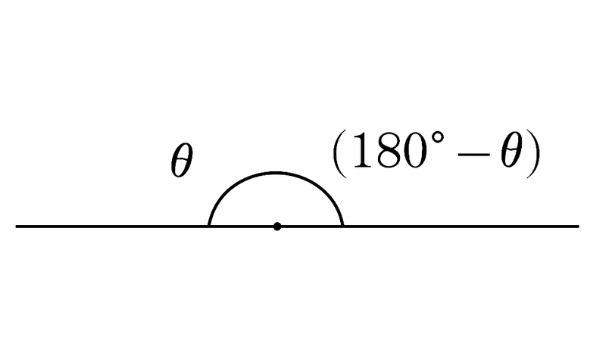
Two angles are supplementary if and only if their measures sum to 180 degrees.
If angle A and angle B are supplementary, then: A + B = 180°
This means:
- If one angle is 120°, its supplement is 180° – 120° = 60°
- If one angle is 90°, its supplement is 90° — a right angle is its own supplement
- If one angle is 45°, its supplement is 135°
What does supplementary mean?
The word supplementary comes from the Latin supplementum meaning something added to complete a whole. Two supplementary angles complete a straight angle — 180 degrees — together.
A useful memory aid: Supplementary goes with Straight. Both start with S, and a straight angle measures 180 degrees. Complementary goes with Corner — a right angle in a corner measures 90 degrees.
Supplementary angles vs complementary angles
Supplementary and complementary angles are frequently confused because both describe pairs of angles that add to a specific sum. The distinction is straightforward but must be automatic for AMC 8 problems.
| Supplementary angles | Complementary angles | |
|---|---|---|
| Sum | 180 degrees | 90 degrees |
| Visual reference | Straight line | Right angle |
| Memory aid | S for Straight | C for Corner |
| Example | 120° and 60° | 55° and 35° |
| If one angle is x | Supplement = 180 – x | Complement = 90 – x |
Complementary and supplementary angles — examples
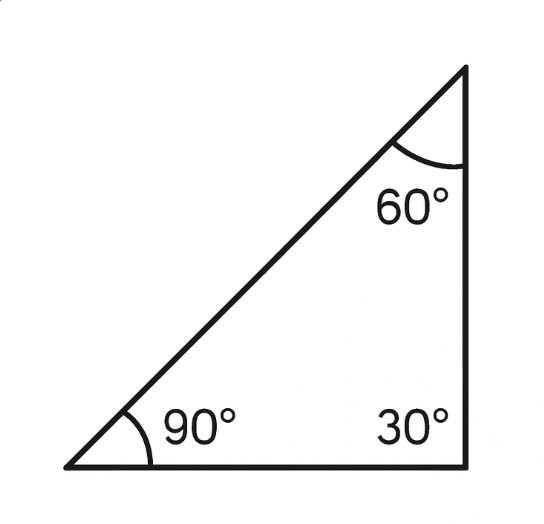
Complementary angles add to 90 degrees:
- 30° and 60° are complementary because 30 + 60 = 90
- 45° and 45° are complementary
- 72° and 18° are complementary
Supplementary angles add to 180 degrees:
- 110° and 70° are supplementary because 110 + 70 = 180
- 90° and 90° are supplementary
- 135° and 45° are supplementary
An angle can have both a complement and a supplement as long as it is between 0 and 90 degrees. An angle greater than 90 degrees has a supplement but no complement — you cannot have a negative angle.
Complementary angles and supplementary angles together in AMC 8
Some AMC 8 problems involve both complementary and supplementary relationships simultaneously. A common problem type gives you information about both the complement and supplement of an unknown angle and asks you to find the angle.
Example: The supplement of an angle is three times its complement. Find the angle.
Solution: Let the angle be x. Supplement = 180 – x Complement = 90 – x
180 – x = 3(90 – x) 180 – x = 270 – 3x 2x = 90 x = 45°
Answer: 45°
Key insight: Set up an equation using both relationships. Problems that give a relationship between the supplement and complement of an angle always lead to a linear equation with one unknown.
How to find a supplementary angle
Finding the supplement of a given angle is always the same calculation: subtract the given angle from 180 degrees.
Supplement of angle x = 180 – x
| Angle | Supplementary angle |
|---|---|
| 30° | 150° |
| 45° | 135° |
| 60° | 120° |
| 90° | 90° |
| 120° | 60° |
| 135° | 45° |
| 150° | 30° |
| 170° | 10° |
Finding supplementary angles with algebra
When the angles are expressed algebraically rather than as numbers, set up an equation and solve.
Example: Two supplementary angles are in the ratio 2:7. Find both angles.
Solution: Let the angles be 2k and 7k. 2k + 7k = 180 9k = 180 k = 20
Angles are 2 x 20 = 40° and 7 x 20 = 140°
Verification: 40 + 140 = 180 ✓
Key insight: Ratio problems involving supplementary angles always follow the same structure — introduce a variable k, write both angles in terms of k, set their sum equal to 180, solve for k, then find the individual angles.
Types of supplementary angle pairs
Linear pair
A linear pair is a specific type of supplementary angle pair where the two angles are adjacent — they share a vertex and a side — and together form a straight line. All linear pairs are supplementary but not all supplementary angles form a linear pair.
When two lines intersect, they form two linear pairs. This is the most common context for supplementary angles in geometry diagrams.
Supplementary angles on a straight line
When a straight line is cut by one or more rays, the angles on one side of the line always add up to 180 degrees. This is one of the most useful facts in AMC 8 geometry because it appears in almost every diagram involving intersecting lines.
If three rays from the same point all lie on one side of a straight line, the three angles between them add up to 180 degrees. If two of the three angles are known, the third can be found by subtracting from 180.
Supplementary angles with parallel lines
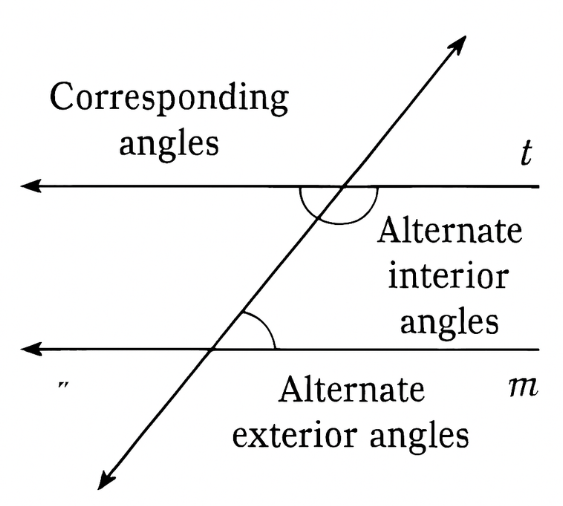
When a transversal crosses two parallel lines, several angle relationships are created. The co-interior angles — also called consecutive interior angles or same-side interior angles — are supplementary. They sit between the parallel lines on the same side of the transversal and add up to 180 degrees.
This relationship is heavily tested in AMC 8 problems involving parallel lines. Students who know the co-interior angle rule can solve these problems in one step rather than working through multiple angle relationships.
Supplementary angles in triangles and polygons
Supplementary angles in triangles
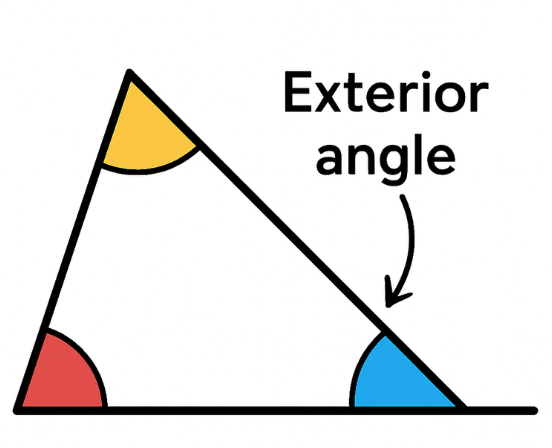
The angles in a triangle always sum to 180 degrees. This means the three angles of a triangle are related in the same way as supplementary angles — they collectively complete a straight angle.
More specifically, any exterior angle of a triangle is supplementary to the interior angle it is adjacent to. This is because the interior and exterior angle at any vertex of a triangle form a linear pair on a straight line.
The exterior angle theorem states that an exterior angle of a triangle equals the sum of the two non-adjacent interior angles. This can be derived from the fact that the exterior angle and the adjacent interior angle are supplementary.
Many triangle problems that involve supplementary angles also require the Pythagorean theorem to find a missing side — see our Pythagorean Theorem Worksheet: Practice Problems for AMC 8 Students for full practice on that technique.
Supplementary angles in polygons
Each interior angle of a regular polygon and the adjacent exterior angle are supplementary — they form a linear pair. This fact is useful for finding interior angles of regular polygons quickly.
For a regular hexagon with interior angle 120°, the exterior angle is 180° – 120° = 60°. For a regular pentagon with interior angle 108°, the exterior angle is 72°.
The sum of all exterior angles of any convex polygon is always 360 degrees. Each exterior angle is supplementary to its adjacent interior angle.
For more polygon geometry practice including area and perimeter of regular shapes, see our Area and Perimeter Worksheets: How to Solve Every AMC 8 Geometry Problem.
Supplementary angles practice problems — worksheet
Work through each problem before reading the solution. Draw a diagram for every problem involving a geometric context.
Problem 1 — direct calculation
Find the supplement of 67°.
Solution: 180 – 67 = 113°
Answer: 113°
Problem 2 — algebra
Two supplementary angles have measures (3x + 10)° and (2x – 5)°. Find both angles.
Solution: (3x + 10) + (2x – 5) = 180 5x + 5 = 180 5x = 175 x = 35
First angle: 3(35) + 10 = 115° Second angle: 2(35) – 5 = 65°
Verification: 115 + 65 = 180 ✓
Answer: 115° and 65°
Problem 3 — ratio
Two supplementary angles are in the ratio 5:4. Find both angles.
Solution: Let angles be 5k and 4k. 5k + 4k = 180 9k = 180 k = 20
Angles: 5 x 20 = 100° and 4 x 20 = 80°
Answer: 100° and 80°
Problem 4 — complement and supplement
An angle is 40° less than its supplement. Find the angle.
Solution: Let the angle be x. Its supplement is 180 – x. x = (180 – x) – 40 x = 140 – x 2x = 140 x = 70°
Verification: Supplement = 110°. 110 – 70 = 40 ✓
Answer: 70°
Problem 5 — straight line
Three angles on a straight line measure (2x)°, (3x + 5)°, and (x – 5)°. Find the value of x and the measure of each angle.
Solution: Angles on a straight line sum to 180°. 2x + (3x + 5) + (x – 5) = 180 6x = 180 x = 30
Angles: 60°, 95°, and 25°
Verification: 60 + 95 + 25 = 180 ✓
Answer: x = 30, angles are 60°, 95°, and 25°
Problem 6 — parallel lines
Two parallel lines are cut by a transversal. One co-interior angle measures 112°. What is the measure of the other co-interior angle?
Solution: Co-interior angles are supplementary. 180 – 112 = 68°
Answer: 68°
Problem 7 — triangle exterior angle
In a triangle, two interior angles measure 55° and 72°. What is the measure of the exterior angle adjacent to the third interior angle?
Solution: Third interior angle = 180 – 55 – 72 = 53° Exterior angle = 180 – 53 = 127°
Alternatively using the exterior angle theorem: Exterior angle = 55 + 72 = 127°
Answer: 127°
Key insight: The exterior angle theorem gives the faster solution here — the exterior angle equals the sum of the two non-adjacent interior angles directly. Both methods give the correct answer but the theorem saves a step.
AMC 8 style supplementary angles problems
The following problems are written in the style of questions that appear across the AMC math competition series. For a full overview of what the AMC math competition involves, see our AMC Math: What It Is, How to Prepare and Why It Matters for University.
Problem 8 — AMC 8 style
In the diagram, lines AB and CD intersect at point E. Angle AEC measures 3x + 15 degrees and angle CEB measures 2x + 5 degrees. What is the value of x?
Solution: Angles AEC and CEB form a linear pair — they are supplementary. (3x + 15) + (2x + 5) = 180 5x + 20 = 180 5x = 160 x = 32
Answer: x = 32
Problem 9 — AMC 8 style
Two supplementary angles differ by 46 degrees. What is the measure of the larger angle?
Solution: Let the smaller angle be x. Then the larger is x + 46. x + (x + 46) = 180 2x + 46 = 180 2x = 134 x = 67°
Larger angle = 67 + 46 = 113°
Answer: 113°
Problem 10 — AMC 8 style
The supplement of an angle is five times the complement of the same angle. What is the angle?
Solution: Let the angle be x. Supplement = 180 – x Complement = 90 – x
180 – x = 5(90 – x) 180 – x = 450 – 5x 4x = 270 x = 67.5°
Answer: 67.5°
Problem 11 — AMC 8 style
In triangle ABC, angle A is twice angle B, and angle C is supplementary to angle A. Find all three angles.
Solution: Angle C is supplementary to angle A, so: Angle C = 180 – angle A
Angles in a triangle sum to 180: Angle A + angle B + angle C = 180 Angle A + angle B + (180 – angle A) = 180 Angle B = 0°
This is a contradiction — no valid triangle exists with these conditions unless we reinterpret. Re-reading: angle C is supplementary to angle A means angle A + angle C = 180. But in a triangle all three angles must sum to 180 and all must be positive. If A + C = 180 then B = 0 which is impossible.
This is a deliberately tricky AMC-style problem. The answer is that no such triangle exists.
Key insight: Not every AMC geometry problem has a solution — some test whether students can identify when given conditions are contradictory. Always check whether a proposed solution makes geometric sense before writing it down.
Problem 12 — AMC 8 style, hardest
In a regular polygon, each interior angle is supplementary to an exterior angle of 30 degrees. How many sides does the polygon have?
Solution: Each exterior angle = 30° Interior angle = 180 – 30 = 150°
Sum of interior angles of an n-sided polygon = (n-2) x 180 Each interior angle of a regular polygon = (n-2) x 180 / n = 150
(n-2) x 180 = 150n 180n – 360 = 150n 30n = 360 n = 12
Answer: 12 sides (a regular dodecagon)
Key insight: The exterior angle of a regular polygon equals 360 divided by the number of sides. So n = 360/30 = 12 — a faster approach once you know this formula. Both methods give the same answer and both are worth knowing.

Supplementary angles quick reference
Key facts to memorise
- Supplementary angles sum to 180°
- Complementary angles sum to 90°
- A linear pair is always supplementary
- Co-interior angles in parallel lines are supplementary
- Exterior angle of a triangle is supplementary to its adjacent interior angle
- Interior and exterior angle of any polygon at the same vertex are supplementary
Common problem types and approaches
| Problem type | Approach |
|---|---|
| Find missing supplementary angle | Subtract from 180 |
| Two supplementary angles in a ratio | Let angles be nk and mk, set sum to 180 |
| Supplementary angles expressed algebraically | Set up equation, sum = 180 |
| Supplement equals a multiple of complement | Write both expressions, set equation |
| Parallel lines and transversal | Co-interior angles are supplementary |
| Exterior angle of triangle | Equals sum of two non-adjacent interior angles |
| Regular polygon from angle information | Use exterior angle = 360/n |
Frequently Asked Questions
What are supplementary angles? Supplementary angles are two angles whose measures add up to exactly 180 degrees. They can be adjacent — forming a straight line — or non-adjacent. Any two angles that sum to 180 degrees are supplementary regardless of their position.
What is the difference between supplementary and complementary angles? Supplementary angles add up to 180 degrees. Complementary angles add up to 90 degrees. A useful memory aid: Supplementary goes with Straight (180 degrees), Complementary goes with Corner (90 degrees — a right angle in a corner).
How do you find a supplementary angle? Subtract the given angle from 180 degrees. If one angle is x degrees, its supplement is 180 minus x degrees. For example, the supplement of 65° is 115° because 180 – 65 = 115.
Can an obtuse angle have a supplement? Yes. Any angle between 0 and 180 degrees has a supplement. The supplement of an obtuse angle (greater than 90°) is an acute angle (less than 90°). For example, the supplement of 120° is 60°.
Can an angle be both supplementary and complementary? No. For an angle to be supplementary to another it must add to 180 degrees. For it to be complementary to another it must add to 90 degrees. No single pair of angles can satisfy both conditions simultaneously.
What is a linear pair? A linear pair is two adjacent angles that together form a straight line. Linear pairs are always supplementary — they always add up to 180 degrees. When two lines intersect, they form two linear pairs.
How do supplementary angles appear in AMC 8 problems? Supplementary angles appear in AMC 8 problems involving straight lines and intersecting lines, parallel lines cut by a transversal (co-interior angles), exterior angles of triangles, interior and exterior angles of polygons, and algebra problems where two expressions sum to 180. Recognising supplementary angle relationships quickly is essential for solving geometry problems efficiently under competition conditions. For other geometry and data topics that appear alongside supplementary angles in AMC 8 past papers, see our guides on Area and Perimeter Worksheets and What is a Broken Line Graph.
What are co-interior angles? Co-interior angles, also called consecutive interior angles or same-side interior angles, are formed when a transversal crosses two parallel lines. They sit between the parallel lines on the same side of the transversal. Co-interior angles are supplementary — they always add up to 180 degrees.



That’s a really clear explanation, thanks for breaking down supplementary angles like this. It makes a lot more sense now!
That’s a really clear explanation, thanks for including the AMC 8 examples too – they’re always tricky!