


Equivalent fractions are fractions that represent the same value despite having different numerators and denominators — and they appear more frequently in AMC 8 problems than most students expect. From simplifying expressions and comparing fractions to solving ratio problems and working with probability, equivalent fractions math underpins a significant portion of AMC 8 number theory and arithmetic. This equivalent fractions worksheet covers the definition, two reliable methods for finding and checking equivalent fractions, worked examples at every difficulty level, and a full set of practice problems written in the style of AMC 8 past contest questions.

What are equivalent fractions?
Equivalent fractions are fractions that have the same value when simplified, even though their numerators and denominators are different numbers. Two fractions are equivalent if dividing the numerator by the denominator gives the same result for both.
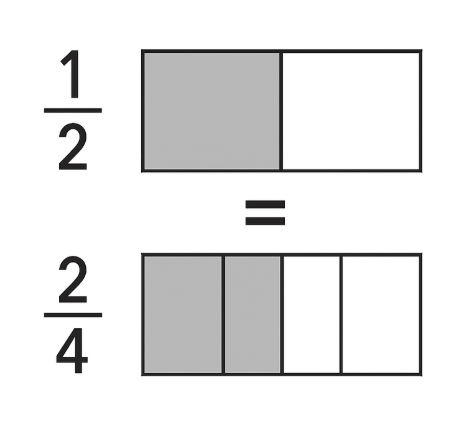
The simplest example is 1/2 and 2/4. Dividing 1 by 2 gives 0.5. Dividing 2 by 4 also gives 0.5. The fractions look different but represent exactly the same quantity.
A fraction and all its equivalent fractions form a family. Every member of the family can be obtained from any other member by multiplying or dividing both the numerator and denominator by the same non-zero number.
The best way to understand equivalent fractions is by trying out problems with them yourself. This article contains an equivalent fractions worksheet for you to get your own experience with them.
The fundamental rule of equivalent fractions
Multiplying or dividing both the numerator and denominator of a fraction by the same non-zero number produces an equivalent fraction.
If a/b is a fraction and k is any non-zero number:
(a x k) / (b x k) = a/b
This rule works in both directions:
- Multiplying both by k scales the fraction up to a larger equivalent fraction
- Dividing both by k scales it down to a smaller equivalent fraction — this is called simplifying
Why equivalent fractions matter in AMC 8
Equivalent fractions appear in AMC 8 problems in several forms. Comparing fractions requires finding a common denominator, which means converting fractions into equivalent forms with the same denominator. Probability problems often produce fractions that need simplifying to match one of the answer choices. Ratio problems require recognising when two ratios represent the same relationship. Students who can quickly generate and identify equivalent fractions by practising with an equivalent fractions worksheet solve these problems significantly faster than students who work from first principles each time.
Two methods for finding equivalent fractions
Method one — multiply numerator and denominator
To scale a fraction up, multiply both the numerator and denominator by the same number.
Example: Find three fractions equivalent to 3/5.
Multiply by 2: (3 x 2)/(5 x 2) = 6/10 Multiply by 3: (3 x 3)/(5 x 3) = 9/15 Multiply by 4: (3 x 4)/(5 x 4) = 12/20
All of 6/10, 9/15, and 12/20 are equivalent to 3/5.
Method two — divide numerator and denominator (simplifying)
To scale a fraction down, divide both the numerator and denominator by their greatest common factor.
Example: Simplify 18/24 to its lowest terms.
GCF of 18 and 24 = 6 (18 / 6) / (24 / 6) = 3/4
So 18/24 is equivalent to 3/4 in its simplest form.
For more on GCF, including questions and solutions, read: What is the GCF? How to Find the Greatest Common Factor With Examples.
How to check if two fractions are equivalent
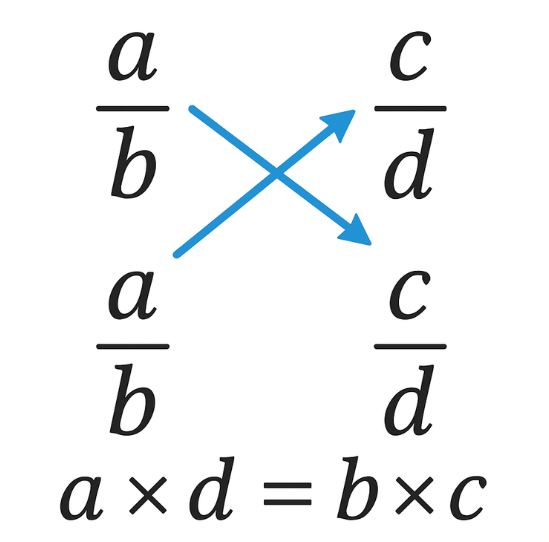
Use cross multiplication. If a/b and c/d are equivalent then a x d = b x c.
Example: Check whether 4/6 and 10/15 are equivalent.
4 x 15 = 60
6 x 10 = 60
The cross products are equal, so the fractions are equivalent.
Example: Check whether 3/7 and 5/12 are equivalent.
3 x 12 = 36
7 x 5 = 35
The cross products are not equal, so the fractions are not equivalent.
Fractional equivalent — finding a missing numerator or denominator
Many AMC 8 problems and this equivalent fractions worksheet ask you to find the missing number that makes two fractions equivalent. This is called finding the fractional equivalent and uses the same cross multiplication principle.
Finding a missing numerator
Example: Find 𝑥 such that 𝑥/20 = 3/4.
Cross multiply: 𝑥 x 4 = 20 x 3
4𝑥 = 60
𝑥 = 15
So 15/20 is the fractional equivalent of 3/4 with denominator 20.
Alternative method: The denominator went from 4 to 20 — it was multiplied by 5. So multiply the numerator by 5 as well: 3 x 5 = 15.
Finding a missing denominator
Example: Find y such that 7/y = 21/45.
Cross multiply: 7 x 45 = 21 x y
315 = 21y
y = 15
So 7/15 is the fractional equivalent of 21/45.
Alternative method: The numerator went from 7 to 21 — it was multiplied by 3. So multiply the denominator by 3 as well: 5 x 3 = 15.
When to use cross multiplication vs the scaling method
For simple fractions where the scaling factor is obvious, the scaling method is faster. If 2/3 = 𝑥/12, it is immediately clear that the denominator was multiplied by 4, so the numerator is 8.
For less obvious fractions, cross multiplication is more reliable. Always use cross multiplication when the scaling factor is not immediately apparent or when verifying whether two fractions are equivalent.
Equivalent fractions worksheet — Level 1 problems
These problems test direct application of the equivalent fractions rule. They are equivalent in difficulty to questions 1 to 8 on the AMC 8.
Problem 1
Find four fractions equivalent to 2/3.
Solution: Multiply numerator and denominator by 2, 3, 4, and 5: 4/6, 6/9, 8/12, 10/15
Answer: 4/6, 6/9, 8/12, 10/15 (any four correct answers accepted)
Problem 2
Simplify 36/48 to its lowest terms.
Solution: Find the GCF of 36 and 48. 36 = 2² x 3²
48 = 2⁴ x 3
GCF = 2² x 3 = 12
36/12 = 3
48/12 = 4
Answer: 3/4
Problem 3
Find 𝑥 such that 𝑥/35 = 4/7.
Solution: Denominator scaled from 7 to 35 — multiplied by 5. Numerator: 4 x 5 = 20.
Answer: 𝑥 = 20
Problem 4
Are 15/25 and 9/15 equivalent fractions?
Solution: Cross multiply: 15 x 15 = 225 and 25 x 9 = 225. Equal cross products — yes, they are equivalent.
Alternatively, simplify both: 15/25 = 3/5 (divide by 5)
9/15 = 3/5 (divide by 3)
Both simplify to 3/5 — equivalent.
Answer: Yes
Problem 5
Write 5/8 as an equivalent fraction with denominator 56.
Solution: 56 / 8 = 7. Multiply numerator by 7: 5 x 7 = 35.
Answer: 35/56
Problem 6
Which of the following is not equivalent to 2/5? (A) 4/10
(B) 6/15
(C) 8/25
(D) 10/25
(E) 14/35
Solution: Check each by simplifying or cross-multiplying:
4/10 = 2/5 ✓
6/15 = 2/5 ✓
8/25: cross multiply 8 x 5 = 40, 25 x 2 = 50.
Not equal ✗
No need to check further.
Answer: (C) 8/25
Key insight: This is the style of an AMC 8 multiple-choice problem involving equivalent fractions. The fastest approach is to simplify each option and check whether it equals 2/5, or cross multiply. Checking in order from A ensures you do not skip the correct answer.
Equivalent fractions worksheet — Level 2 problems
These problems require applying equivalent fractions in a broader context — comparing, ordering, and using them in calculations. They are equivalent in difficulty to questions 8 to 16 on the AMC 8.
Problem 7 — comparing fractions
Which is greater, 7/12 or 5/9?
Solution: Find equivalent fractions with a common denominator. LCM of 12 and 9 = 36.
7/12 = 21/36 (multiply by 3)
5/9 = 20/36 (multiply by 4)
21/36 > 20/36, so 7/12 > 5/9.
Answer: 7/12 is greater
Key insight: Comparing fractions always requires a common denominator. Find the LCM of the two denominators, convert each fraction to an equivalent form with that denominator, then compare the numerators directly.
Problem 8 — ordering fractions
Arrange in ascending order: 3/4, 2/3, 5/6, 7/12.
Solution: Common denominator = 12.
3/4 = 9/12
2/3 = 8/12
5/6 = 10/12
7/12 = 7/12
Ascending order: 7/12, 8/12, 9/12, 10/12
Which is: 7/12, 2/3, 3/4, 5/6.
Answer: 7/12, 2/3, 3/4, 5/6
Problem 9 — ratio problem
A recipe uses flour and sugar in the ratio 3:5. If 24 grams of flour are used, how many grams of sugar are needed?
Solution: 3/5 = 24/𝑥
Cross multiply: 3𝑥 = 120
𝑥 = 40
Answer: 40 grams of sugar
Key insight: Ratio problems are equivalent fraction problems in disguise. Setting up the proportion as two equivalent fractions and cross-multiplying is the most reliable method.
Problem 10 — probability
A bag contains 12 red marbles and 8 blue marbles. What fraction of the marbles are red? Express in simplest form.
Solution: Total marbles = 20.
Fraction red = 12/20.
Simplify: GCF of 12 and 20 = 4.
12/20 = 3/5.
Answer: 3/5
Problem 11 — missing value in a proportion
If 3/𝑥 = 𝑥/12, find the positive value of 𝑥.
Solution: Cross multiply: 3 x 12 =𝑥 x 𝑥
36 = 𝑥²
𝑥 = 6
Answer: 𝑥 = 6
Key insight: This type of problem — finding the geometric mean — uses cross multiplication on a proportion where the same variable appears in both fractions. It appears in AMC 8 problems involving similar triangles and proportional reasoning.
Problem 12 — equivalent fractions with variables
If (2𝑥)/(3𝑥 + 1) = 6/10, find 𝑥.
Solution: Cross multiply: 2𝑥 x 10 = 6 x (3𝑥 + 1)
20𝑥 = 18𝑥+ 6
2𝑥 = 6𝑥 = 3
Verification: (2 x 3)/(3 x 3 + 1) = 6/10. 6/10 = 6/10 ✓
Answer: 𝑥 = 3

Equivalent fractions worksheet — AMC 8 style problems
These problems are written in the style of actual AMC 8 past contest questions. They require recognising that equivalent fractions are involved without being told explicitly.
Problem 13
What fraction of the numbers from 1 to 30 are divisible by 6? Express as a fraction in simplest form.
Solution: Numbers divisible by 6: 6, 12, 18, 24, 30 — five numbers.
Fraction = 5/30.
Simplify: GCF of 5 and 30 = 5.
5/30 = 1/6.
Answer: 1/6
Problem 14
A school has 360 students. If 2/5 of them play sport and 3/4 of those who play sport also play a musical instrument, how many students play both sport and a musical instrument?
Solution: Students who play sport = 2/5 x 360 = 144.
Students who play both = 3/4 x 144 = 108.
Answer: 108
Problem 15
Two fractions have a sum of 1. One fraction is 3/7. What is the other fraction in simplest form?
Solution: Other fraction = 1 – 3/7 = 7/7 – 3/7 = 4/7.
Answer: 4/7
Problem 16
Three fractions are in the ratio 1:2:3, and their sum is 1. What is the largest fraction?
Solution: Let the fractions be k, 2k, and 3k. k + 2k + 3k = 1
6k = 1 k = 1/6
Largest fraction = 3k = 3/6 = 1/2.
Answer: 1/2
Key insight: When fractions are in a given ratio and their sum is known, introduce a variable k, write each fraction as a multiple of k, and set their sum equal to the known total.
Problem 17
In a class of 40 students, the ratio of boys to girls is 3:5. How many girls are in the class?
Solution: Total parts = 3 + 5 = 8.
Girls = 5/8 x 40 = 25.
Answer: 25
Problem 18
A number is multiplied by 3/4, and then the result is multiplied by 8/9. The final result is 2. What was the original number?
Solution: Let the number be 𝑥.
𝑥 x 3/4 x 8/9 = 2𝑥 x 24/36 = 2𝑥 x 2/3 = 2𝑥 = 3
Verification: 3 x 3/4 = 9/4. 9/4 x 8/9 = 72/36 = 2 ✓
Answer: 3
Key insight: Multiply the fractions together first before solving for 𝑥 — 3/4 x 8/9 = 24/36 = 2/3. This simplification step using equivalent fractions makes the arithmetic much cleaner.
Problem 19
Which value of n makes the fractions 4/7, n/21, and 20/35 all equivalent?
Solution: Simplify 20/35: GCF of 20 and 35 = 5. 20/35 = 4/7. So the target fraction is 4/7.
For n/21: 21/7 = 3. So n = 4 x 3 = 12.
Verification: 4/7 = 12/21 = 20/35. Cross multiply to check: 4 x 21 = 84, 7 x 12 = 84 ✓
Answer: n = 12
Problem 20 — hardest
The fraction (2a + 3)/(3a + 5) equals 5/7 for some value a. What is the value of 4a?
Solution: Cross multiply: 7(2a + 3) = 5(3a + 5)
14a + 21 = 15a + 25
14a – 15a = 25 – 21 -a = 4 a = -4
4a = -16
Verification: (2(-4) + 3)/(3(-4) + 5) = (-8 + 3)/(-12 + 5) = -5/-7 = 5/7 ✓
Answer: 4a = -16
Key insight: The question asks for 4a, not a — re-read the question before writing the final answer. This is a deliberate AMC technique to catch students who solve correctly but answer the wrong thing.
Equivalent fractions reference sheet
| Concept | Rule |
|---|---|
| Generating equivalent fractions | Multiply or divide numerator and denominator by the same non-zero number |
| Simplifying to lowest terms | Divide both by their GCF |
| Checking equivalence | Cross multiply — if a x d = b x c then a/b = c/d |
| Finding missing numerator or denominator | Cross multiply and solve |
| Comparing fractions | Convert to equivalent fractions with a common denominator |
| Adding or subtracting fractions | Convert to equivalent fractions with a common denominator first |
| Ratio problems | Set up as equivalent fractions and cross multiply |
How to use this equivalent fractions worksheet
Work through the problems in order from Level 1 to Level 3. Do not skip ahead — each level introduces techniques that appear in the harder problems.
Attempt every problem before reading the solution. Write down what you know, identify which method applies — scaling, cross multiplication, or simplification — and carry out the calculation before checking. The attempt builds the pattern recognition that AMC 8 conditions demand.
When you encounter an equivalent fractions math problem that involves an unfamiliar context — probability, ratios, algebraic fractions — ask yourself whether it can be solved by setting up two equivalent fractions and cross multiplying. A large proportion of AMC 8 arithmetic problems reduce to this single technique once the structure is recognised.
Return to this equivalent fractions worksheet after a few weeks of other preparation. Problems that required effort initially should feel straightforward on the second attempt. If they do not, that specific problem type needs more focused practice before the competition.
Read AMC 8 Math Competition: The Complete Guide for Canadian Students for a full guide to AMC 8.
Want to learn more about factors? Check out Factors of 24 and 45: How to Find All Factors AMC 8 Guide.
For an in-depth explanation of GCF and how it is presented in AMC 8 questions, see: What is the GCF? How to Find the Greatest Common Factor With Examples.
Find out more about area and perimeter, including free worksheets and example problems and solutions, at: Area and Perimeter Worksheets: How to Solve Every AMC 8 Geometry Problem.
Frequently Asked Questions
What are equivalent fractions? Equivalent fractions are fractions that represent the same value despite having different numerators and denominators. They are produced by multiplying or dividing both the numerator and denominator of a fraction by the same non-zero number. For example 1/2, 2/4, 3/6, and 50/100 are all equivalent fractions.
How do you find equivalent fractions? Multiply both the numerator and denominator by any non-zero whole number to produce a larger equivalent fraction. Divide both by their GCF to produce the simplest equivalent fraction. Both operations preserve the value of the fraction.
How do you check if two fractions are equivalent? Use cross multiplication. Multiply the numerator of the first fraction by the denominator of the second, and the denominator of the first by the numerator of the second. If the two products are equal the fractions are equivalent.
What is a fractional equivalent? A fractional equivalent is a fraction that has the same value as another fraction but a different numerator and denominator. Finding a fractional equivalent with a specific denominator is a common AMC 8 problem type — cross multiply to find the missing numerator.
How does equivalent fractions math appear in AMC 8? Equivalent fractions math appears in AMC 8 problems involving comparing and ordering fractions, simplifying probability answers, solving ratio and proportion problems, working with algebraic fractions, and finding missing values in proportions. The cross multiplication technique and the ability to simplify fractions quickly are the two most important skills for these problem types.
What is the fastest way to simplify a fraction? Find the GCF of the numerator and denominator and divide both by it. This produces the simplest equivalent fraction in one step. If you cannot find the GCF immediately, divide by any common factor and repeat until no common factors remain.
Why do equivalent fractions have the same value? Multiplying the numerator and denominator of a fraction by the same number is equivalent to multiplying the fraction by k/k, which equals 1. Multiplying any number by 1 does not change its value. This is why equivalent fractions represent the same quantity despite looking different.



This is a really helpful breakdown. I’ve always struggled to visualize how different fractions can actually be equal.
I found this explanation really helpful, it makes the concept of equivalent fractions much clearer. Thanks for sharing!