


Looking for an EQAO practice test for Grade 6? You’re in the right place. EQAO — the Education Quality and Accountability Office — publishes free official sample tests for the Grade 6 assessment, and they’re the single most useful resource for any Ontario parent whose child is preparing for it. This guide covers where to find the official EQAO Grade 6 practice test, what’s actually tested across math and language, how the assessment is scored, where to find EQAO Grade 6 practice test PDF resources, and a sensible at-home plan for grade 6 EQAO practice that doesn’t turn the spring into a stressful sprint. The Grade 6 EQAO isn’t graded, doesn’t appear on your child’s report card, and doesn’t affect Grade 7 placement — but a calm, confident performance gives a useful signal about where your child stands at the end of elementary school, which is genuinely valuable information.
For a complete introduction to the Grade 6 EQAO test, check out EQAO Grade 6: The Complete Guide for Ontario Parents and Students.
What is the EQAO Grade 6 assessment?
The EQAO Grade 6 assessment is one of four province-wide assessments Ontario students write during their school years. EQAO runs assessments in Grade 3, Grade 6, Grade 9, and Grade 10 (the OSSLT literacy test). The Grade 6 version covers both mathematics and language (reading and writing), making it the most comprehensive of the elementary assessments.
It’s written by every Grade 6 student in publicly funded Ontario schools, usually in late May or early June, near the end of the school year. The assessment is computer-based, takes around three hours spread across multiple sittings, and is administered by your child’s regular classroom teacher.
Does Grade 6 EQAO affect my child’s mark or placement?
No. This is one of the most common misconceptions Ontario parents have about the Grade 6 EQAO. Unlike the Grade 9 EQAO, which counts as 10% of the final MTH1W mark in most boards, the Grade 6 result:
- Does not appear on the report card
- Does not affect Grade 7 class placement
- Does not factor into gifted program eligibility (though some boards may use it as one data point)
- Does not affect high school course recommendations later on
What it does do is provide a snapshot of where your child stands against the Ontario provincial standard at the end of elementary school. That’s genuinely useful information, especially for parents trying to decide whether their child needs extra support before Grade 7, or whether they’re ready for more challenging material.
H3: Why bother preparing at all then?
Two reasons. First, the Grade 6 assessment is a chance for your child to practise sitting a longer, structured test under real conditions — which becomes a regular part of school life from Grade 7 onward. Second, the topics tested are the foundation for everything in Grade 7 and 8 math, and EQAO results give you a clear picture of where the gaps are before those gaps become harder to close.
If you want the broader picture of what Ontario kids learn before Grade 6, our Ontario Math Curriculum guide for Grades 1–8 walks through every grade. For Grade 6 specifically, our Grade 6 Math Curriculum guide covers exactly what your child should know by the end of the year.
Where to find the official EQAO Grade 6 practice test
The best preparation resource is the one EQAO itself produces, because it uses the same computer-based interface and question style as the real assessment.
The official EQAO sample test
EQAO publishes a free, full-length EQAO Grade 6 practice test on eqao.com. It includes:
- A complete practice version of both the math and language sections
- The same computer-based interface as the real assessment
- The on-screen calculator that students will have during the math section
- All three question types: multiple choice, open response, and drag-and-drop
- An optional reference sheet (more on this below)
There’s no login, no fee, and no time limit on when you can use it. The platform works on most modern browsers — EQAO recommends Chrome or Edge on a laptop for the closest match to the real test environment.
Released items and past questions
In addition to the full sample test, EQAO publishes individual released items from past assessments. These are organised by strand and include answer keys with explanations. They’re particularly useful when you’ve identified a specific weak area and want focused practice without doing a full test.
Framework documents
EQAO also publishes framework documents that explain exactly what each strand tests and how it’s weighted. These aren’t practice problems, but they’re useful for parents trying to understand what their child should know by the end of Grade 6.
EQAO Grade 6 practice test PDF: what’s available
Many parents specifically search for an EQAO Grade 6 practice test PDF because they want to print the test, work through it at the kitchen table, and check answers by hand. Here’s what’s actually available.
Official PDF resources
EQAO doesn’t publish the full Grade 6 sample test as a single downloadable PDF, because the real assessment is computer-based and the practice version is designed to mirror that. However, EQAO does publish individual past questions and framework documents as PDFs, all free from eqao.com.
Third-party practice PDFs
Several Ontario tutoring organisations publish unofficial EQAO Grade 6 practice test PDF documents. Quality varies. The better ones:
- Match the current Ontario curriculum (post-2020 elementary math curriculum)
- Cover both math strands and language strands proportionally
- Include detailed worked solutions, not just answer keys
- Use question style and difficulty similar to the official EQAO
A word of caution: anything dated before 2020 was written for the old elementary math curriculum, which has since been replaced. The newer curriculum places more emphasis on financial literacy, coding concepts, and social-emotional learning — topics that older PDFs miss entirely.
How to use a printed practice test effectively
If you’re working through a PDF version with your child:
Sit it under timed conditions — about 50–60 minutes per major section, no help from you during the test itself. Mark it together using the answer key the same day, while the questions are still fresh. For any question your child got wrong, ask them to redo it without looking at the solution first. Then read the worked solution together, even for questions they got right — sometimes the official method is faster than what they did. Tag any patterns in the mistakes: concept gap, careless arithmetic, misread the question, or rushed at the end.
This approach turns a single practice test into 90 minutes of genuinely useful learning, rather than just a score.
What’s actually tested on the EQAO Grade 6 assessment
The Grade 6 EQAO covers two main subject areas: mathematics and language. Each is built directly on the Ontario curriculum.
Mathematics strands
The math section tests the same six strands as the Grade 6 curriculum:
| Strand | What it covers |
|---|---|
| Number | Whole numbers, decimals, fractions, percentages, integers (basic), proportional reasoning |
| Algebra | Patterns, simple equations, coding concepts |
| Data | Reading and creating graphs, measures of central tendency, basic probability |
| Spatial sense | Geometry, measurement, angles, area, perimeter, volume |
| Financial literacy | Money basics, budgeting, simple interest concepts |
| Social-emotional learning and math thinking | Embedded across all strands |
The math section is weighted roughly equally across these strands, with slightly more questions on Number and Spatial Sense (the two largest in the Grade 6 curriculum).
Language strands
The language section covers reading and writing:
- Reading: comprehension of short passages, finding main ideas, identifying author’s purpose, vocabulary in context
- Writing: short open-response questions where students write paragraphs in response to a prompt (typically a personal narrative or opinion piece)
The reading section uses both fiction and non-fiction passages. The writing section is marked on organisation, clarity, grammar, and use of evidence.
Question types
The Grade 6 assessment uses three main question types:
- Multiple choice — four-option questions, similar to a school quiz
- Open response — students type a short numerical answer (math) or written response (language)
- Drag-and-drop / interactive — students match items, order steps, or fill in diagrams
Students have access to an on-screen calculator throughout the math section and a reference sheet with common formulas.
How is the EQAO Grade 6 assessment scored?
EQAO reports Grade 6 results on a four-level scale, the same scale used across all EQAO assessments and matched to Ontario report card achievement levels.
| Level | Description | Approximate report card equivalent |
|---|---|---|
| Level 4 | Surpasses the provincial standard | A (80%+) |
| Level 3 | Meets the provincial standard | B (70–79%) |
| Level 2 | Approaching the provincial standard | C (60–69%) |
| Level 1 | Below the provincial standard | D (50–59%) |
| NE1 | Insufficient evidence | Below 50% |
The provincial standard is Level 3. EQAO and the Ontario Ministry of Education consider Level 3 the benchmark for a student who has met the Grade 6 curriculum expectations and is ready for Grade 7 mathematics and language.
What counts as a good score?
For most students, Level 3 is the appropriate target. It indicates your child is on track for the Grade 7 curriculum. Students aiming for gifted programs, French immersion continuation in some boards, or competitive academic streams later on should target Level 4 in both math and language.
For context: across recent years, around half of Ontario Grade 6 students reach Level 3 or 4 in math, with somewhat higher proportions in language. The exact numbers shift year to year and are published openly on the EQAO website.
When do results come out?
Individual student results are released to schools in the fall of the following school year, usually October or November. Parents receive a report through their school. School-level and board-level results are published publicly on the EQAO website around the same time.
A sensible Grade 6 EQAO practice plan
The biggest mistake parents make is treating EQAO as a high-stakes event that requires months of cramming. It isn’t. The Grade 6 assessment doesn’t count toward your child’s mark, doesn’t affect placement, and doesn’t determine anything about their future. A calm, low-pressure approach produces better results than a stressful sprint.
Here’s a sensible 6-week plan for grade 6 EQAO practice that builds confidence without burnout.
Weeks 1–2: Diagnose
Sit one full official EQAO Grade 6 sample test under timed conditions. The goal isn’t a score — it’s information. Mark it together and look for patterns: which math strands are weakest? Is reading comprehension strong but writing rushed, or vice versa? Are there specific topics (decimals, fractions, geometry) that need work?
Identify the two weakest areas — one in math, one in language. These become the focus for the next three weeks.
Weeks 3–5: Targeted topic work
Spend about 20 minutes a day, three or four days a week, on the weak areas identified in the diagnostic. Twenty focused minutes beats two hours on Sunday — consistency matters more than duration at this age.
For math, the most common weak areas at the Grade 6 level are:
- Fractions and decimals — particularly converting between them, comparing them, and operations involving fractions with different denominators
- Geometry and measurement — area and perimeter of composite shapes, surface area of rectangular prisms, angles
- Proportional reasoning — ratios, rates, percentages, scaling problems
- Data interpretation — reading graphs carefully, calculating mean/median/mode, simple probability
For language:
- Reading comprehension — practise finding evidence in the passage to support answers, rather than guessing from general impression
- Writing organisation — short, structured responses with a clear introduction, supporting details, and conclusion
Week 6: Second practice test and rehearsal
In the final week before the assessment, sit one more official sample test, again under timed conditions. Compare it to the first attempt — there should be visible improvement in the targeted strands. Walk through any remaining mistakes together.
Spend the last few days not practising. Get good sleep, eat properly, and treat the assessment day like a normal school day. Your child has done the work.
Where most parents go wrong
After working with hundreds of Ontario families through the Grade 6 EQAO season, the same handful of mistakes come up over and over.
Treating it as high-stakes. It isn’t. The Grade 6 EQAO doesn’t count toward anything formal. Stress at home creates stress in the test, which produces worse results than the same student would get in a calm setting.
Practising without timing. A child who can solve every problem given unlimited time will still struggle on a timed test. Always use a timer during practice.
Skipping the post-mortem. Doing a practice test and just looking at the final score is worthless. The mark comes from the analysis afterward: which questions were missed, why, and what the pattern is across multiple tests.
Using outdated practice tests. Anything pre-2020 was written for the old elementary curriculum. Make sure any practice material — official or third-party — is dated 2020 or later, when the new curriculum took effect.
Focusing only on math. The Grade 6 EQAO is half language. A strong math student with weak reading comprehension often scores lower overall than a balanced student.
Cramming the week before. This is the worst possible approach. The Grade 6 curriculum is broad and can’t be cramped in seven days. If your child isn’t ready by mid-May, accept that and focus on confidence rather than content for the final stretch.
How EQAO Grade 6 connects to the bigger picture
The Grade 6 EQAO isn’t an endpoint — it’s a checkpoint. The topics covered are the foundation for everything that follows.
The fractions, decimals, and percentages tested in Grade 6 reappear in Grade 7 and 8 as the foundation for algebra. The geometry and measurement work prepares students for Grade 9 area and surface area problems, and the proportional reasoning becomes the basis for linear relationships in MTH1W. The reading and writing skills tested in Grade 6 are the foundation for the OSSLT literacy test in Grade 10.
For families thinking even further ahead, strong Grade 6 EQAO performance is also a useful predictor of readiness for Canadian math contests. Students who reach Level 4 are often ready to write the Gauss Math Contest in Grade 7 or 8, which is the first step in the Waterloo CEMC contest pipeline that eventually leads to the Pascal, Cayley, and Fermat contests in high school.
For the bigger picture on the Ontario assessment landscape, our EQAO Grade 9 guide covers what comes next.
How Think Academy Canada supports Grade 6 students
Think Academy is the international arm of TAL Education Group, one of the largest education companies in the world. Our Canadian programs are built around a carefully paced math curriculum, an online interactive platform built specifically for math, and gamified rewards that keep students engaged across the full school year.
For Grade 6 students preparing for EQAO and the transition to Grade 7:
Our curriculum runs ahead of the Ontario standard. Grade 6 students at Think Academy meet Grade 7 content before their school classmates do, which means EQAO topics become straightforward review rather than new learning.
Our practice problem library includes hundreds of Ontario-curriculum-aligned questions written in EQAO question style, organised by strand and difficulty.
Our teachers mark every homework set personally, with written feedback on the types of mistakes a student is making — not just whether they got the answer right. Auto-graded software can tell a child they got a question wrong; it can’t tell them whether the issue was a careless mistake or a deeper conceptual gap.
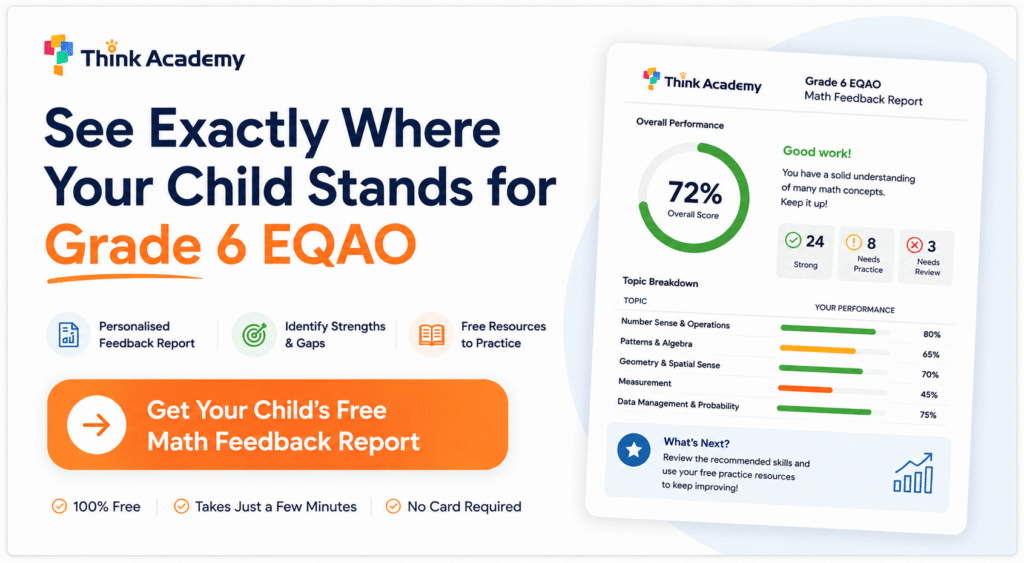
Our free Grade 6 math assessment is the fastest way to find out where your child stands. They complete a short online test aligned to the Ontario curriculum, and you get a detailed feedback report on strengths and gaps by strand, plus free practice resources tailored to their level. No commitment, no sales pressure — just the diagnostic information most parents otherwise have to wait until report card season to see.
Our gamified rewards keep students engaged across the full year, which matters at the Grade 6 level where attention spans are still building and consistency beats intensity every time.
Frequently asked questions
Where can I find a free EQAO Grade 6 practice test?
The official EQAO Grade 6 practice test is free on eqao.com. It uses the same computer-based interface as the real assessment and covers both math and language. EQAO also publishes individual released items and framework documents as supplementary resources.
Is there an EQAO Grade 6 practice test PDF I can print?
EQAO doesn’t publish the full practice test as a single downloadable PDF, but individual past questions are available as PDFs from eqao.com. Several third-party tutoring organisations also publish unofficial Grade 6 practice tests with answers in PDF format, though quality varies. Always check the test was written for the post-2020 Ontario curriculum.
When does my child write the EQAO Grade 6 assessment?
The Grade 6 EQAO is usually written in late May or early June, near the end of the school year. The exact date is set by your child’s school within the EQAO testing window. Your child’s teacher will confirm the specific date a few weeks before.
Does the EQAO Grade 6 result affect my child’s report card?
No. Unlike the Grade 9 EQAO, which counts as 10% of the final MTH1W mark, the Grade 6 EQAO result is not part of the report card and does not affect placement in Grade 7.
How long is the EQAO Grade 6 assessment?
The full assessment takes around three hours total, split across multiple sittings over one or two days. Your child completes it during regular school hours under their classroom teacher’s supervision.
What subjects does the EQAO Grade 6 cover?
Mathematics and language (reading and writing). The math section covers all six Ontario curriculum strands; the language section tests reading comprehension and short written responses.
How many practice tests should my child do?
Two is usually enough — one diagnostic at the start of preparation, and one rehearsal in the final week. More than that produces diminishing returns at the Grade 6 level. The value is in the analysis between tests, not the total number completed.
What’s a good EQAO Grade 6 score?
The provincial Level 3 benchmark is the appropriate target for most students. Students aiming at gifted programs or competitive academic streams should target Level 4 in both math and language.
Should I be worried if my child scores Level 2?
Not panicked — but pay attention. Level 2 indicates topic gaps that should be addressed before Grade 7. A short summer of targeted support on the specific weak strands usually closes the gap before the new school year begins.
Can my child use a calculator on the EQAO Grade 6 math section?
Yes, an on-screen calculator is built into the EQAO platform and available throughout the math section. Your child should practise with this calculator during preparation rather than a physical one, so the interface is familiar on test day.
About Think Academy Canada
Think Academy Canada, part of TAL Education Group, supports K–12 students with structured math programs built around an online interactive platform, gamified learning, and teachers who personally mark every homework set. Our curriculum runs ahead of the provincial standards and is designed to prepare students for both school excellence and Canadian math competitions, including the Gauss, Pascal, Cayley, Fermat, and Euclid contests.


This is really helpful, thanks for putting this together for parents. It’s great to have a free resource like this to help kids prepare.
This is really helpful information for parents preparing their kids for the EQAO test. It’s great to have a free guide available.