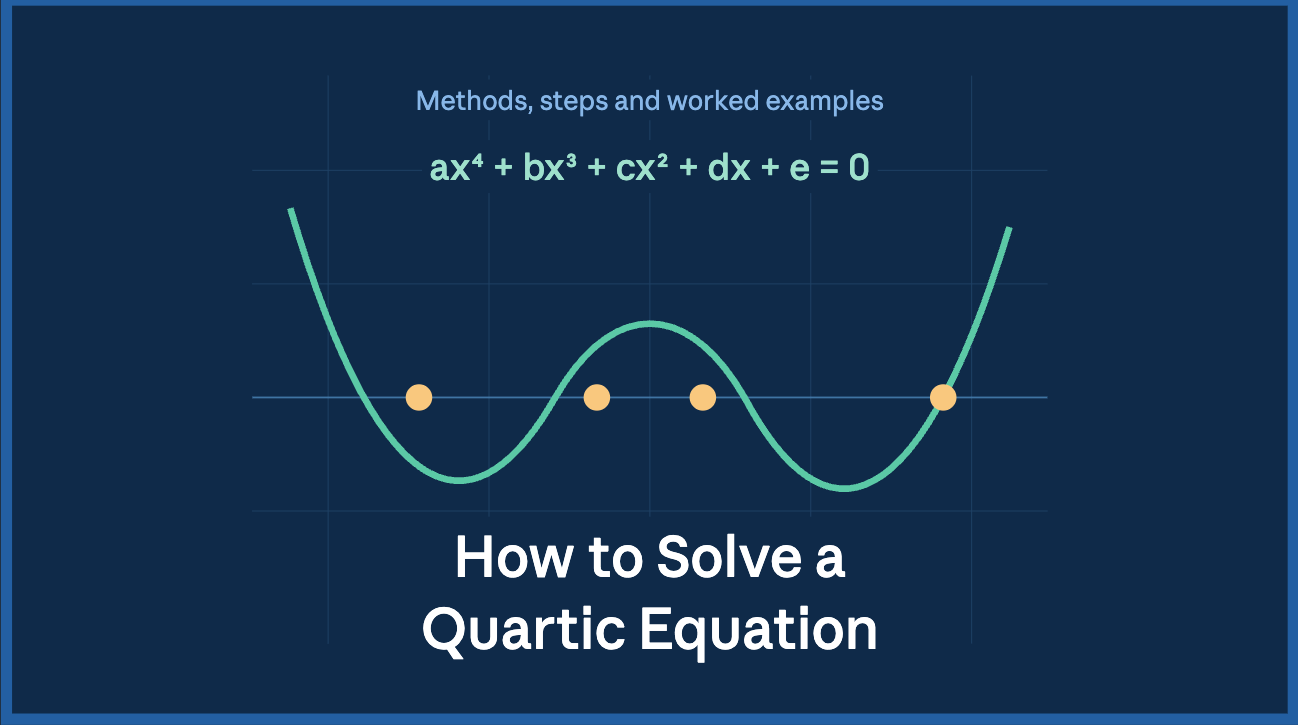
A quartic equation is any equation of the form ax⁴ + bx³ + cx² + dx + e = 0, where a ≠ 0 — a polynomial whose highest power is four. Quartics can have up to four real roots, and learning to solve a quartic equation is a rite of passage for students in senior high school math, AP, and IB. The good news: most quartics you’ll meet in a classroom aren’t solved with the terrifying general formula. They’re solved with one of a few practical techniques — factoring, a clever substitution, or the rational root theorem — that turn a fourth-degree problem into a quadratic you already know how to handle. This guide walks through every practical method in order of difficulty, with full worked examples, and shows you how to recognise which method a given quartic needs.

What is a quartic equation? How to solve a quartic equation?
A quartic equation is a polynomial equation of degree four — meaning the highest exponent on the variable is 4. Its general form is:
ax⁴ + bx³ + cx² + dx + e = 0
where a, b, c, d, and e are constants and a ≠ 0 (if a were zero, it wouldn’t be a quartic).
A few key facts about quartics:
- A quartic has at most four roots (solutions). Some may be real, some may be complex, and some may repeat.
- The graph of a quartic function is a smooth curve that can cross the x-axis 0, 1, 2, 3, or 4 times. Each x-axis crossing is a real root.
- Unlike quadratics, there is no simple, memorisable formula that students are expected to use. There is a general quartic formula (more on that below), but it’s so complex that almost nobody uses it by hand.
Quartic vs quadratic — why quartics are harder when solving a quartic equation
A quadratic (ax² + bx + c = 0) has a clean formula every student memorises: x = (−b ± √(b² − 4ac)) / 2a. Plug in three numbers, get your answers.
Quartics don’t work that way. The general quartic formula exists, but it runs to dozens of terms and is impractical by hand. Instead, the skill in solving quartics is pattern recognition: spotting which special structure a given quartic has, and using the right shortcut. That’s what this guide teaches.
The four methods to solve a quartic equation
There are four practical approaches, ordered here from easiest to hardest. The first step in solving any quartic is figuring out which one applies.
| Method | When to use it | Difficulty |
|---|---|---|
| Factor out a common factor | When there’s no constant term (e = 0) | Easiest |
| Biquadratic substitution | When there’s no x³ or x term (only x⁴, x², constant) | Easy |
| Rational root theorem + division | When the quartic has nice integer roots | Medium |
| Ferrari’s method (resolvent cubic) | When nothing else works (the general case) | Hard |
Always check the methods in this order. Reaching for Ferrari’s method when a simple substitution would work is a classic way to waste an hour on a five-minute problem.
Method 1 — factor out a common factor
This is the easiest case and the first thing to check. If a quartic has no constant term (e = 0), then every term contains at least one x, so you can factor x out to solve the quartic equation.
Why this works
If e = 0, the equation looks like ax⁴ + bx³ + cx² + dx = 0. Factoring out x gives:
x(ax³ + bx² + cx + d) = 0
This immediately tells you that x = 0 is one root, and the rest of the roots come from solving the cubic in the bracket — which is one degree lower and easier.
Worked example
Solve quartic equation: x⁴ − 5x³ + 6x² = 0
Every term has at least x², so factor out x²:
x²(x² − 5x + 6) = 0
Now you have two pieces:
- x² = 0, which gives x = 0 (a repeated root)
- x² − 5x + 6 = 0, which factors as (x − 2)(x − 3) = 0, giving x = 2 and x = 3
The roots are x = 0 (twice), x = 2, and x = 3.
This is the fastest possible quartic to solve — always check for a missing constant term first.
Method 2 — the biquadratic substitution
The most useful quartic-solving trick. A biquadratic equation has only even powers of x: an x⁴ term, an x² term, and a constant, with no x³ or x term. It looks like:
ax⁴ + cx² + e = 0
Why this works
Because x⁴ = (x²)², you can substitute u = x². This turns the quartic into a quadratic:
au² + cu + e = 0
Solve that quadratic for u (by factoring or the quadratic formula), then substitute back to find x using x = ±√u. The “±” matters — each positive value of u gives two values of x.
Worked example
Solve quartic equation: x⁴ − 13x² + 36 = 0
There’s no x³ or x term, so it’s biquadratic. Let u = x²:
u² − 13u + 36 = 0
Factor:
(u − 4)(u − 9) = 0
So u = 4 or u = 9.
Now substitute back. Since u = x²:
- u = 4 means x² = 4, so x = ±2
- u = 9 means x² = 9, so x = ±3
The four roots are x = 2, −2, 3, and −3.
Watch out for negative u values
If solving the quadratic gives a negative value for u, remember that x² = (negative number) has no real solutions — those roots are complex. For example, if u = −5, then x² = −5 gives x = ±√(−5) = ±i√5, which are complex roots. At the high school level, you’d typically state that those roots are not real (or write them as complex numbers if your course covers them).

Method 3 — the rational root theorem and synthetic division
When a quartic isn’t biquadratic and has no missing constant, the next approach is to hunt for rational roots — roots that are simple fractions or integers. Many textbook and contest quartics are designed to have at least one or two nice rational roots.
The rational root theorem
The rational root theorem says that any rational root of ax⁴ + bx³ + cx² + dx + e = 0 must be of the form:
± (factor of e) / (factor of a)
In plain terms: take all the factors of the constant term (e), divide by all the factors of the leading coefficient (a), and try those values (both positive and negative). One of them is often a root.
Worked example
Solve quartic equation: x⁴ − 2x³ − 13x² + 14x + 24 = 0
The constant term is 24, the leading coefficient is 1. So the possible rational roots are the factors of 24 divided by the factors of 1: ±1, ±2, ±3, ±4, ±6, ±8, ±12, ±24.
Test x = −1 by substituting:
(−1)⁴ − 2(−1)³ − 13(−1)² + 14(−1) + 24 = 1 + 2 − 13 − 14 + 24 = 0 ✓
So x = −1 is a root, which means (x + 1) is a factor. Divide the quartic by (x + 1) using synthetic division or long division. This gives:
x⁴ − 2x³ − 13x² + 14x + 24 = (x + 1)(x³ − 3x² − 10x + 24)
Now solve the cubic x³ − 3x² − 10x + 24 = 0 by the same method. Test x = 2:
8 − 12 − 20 + 24 = 0 ✓
So x = 2 is a root, and (x − 2) is a factor. Dividing gives:
x³ − 3x² − 10x + 24 = (x − 2)(x² − x − 12)
Finally, factor the quadratic:
x² − x − 12 = (x − 4)(x + 3)
So the complete factorisation is (x + 1)(x − 2)(x − 4)(x + 3) = 0, and the four roots are x = −1, 2, 4, and −3.
Why this method matters
The rational root theorem is the workhorse for most exam and contest quartics. The strategy is always the same: find one rational root, divide to reduce the quartic to a cubic, find another root, divide to reduce to a quadratic, then finish with factoring or the quadratic formula. Each division drops the degree by one until you’re back in familiar territory.
Method 4 — Ferrari’s method (the general case)
When a quartic has no rational roots and isn’t biquadratic, you need the heavy machinery: Ferrari’s method, developed by Lodovico Ferrari in the 1500s. This is the general technique that works on any quartic, but it’s involved, and it’s rarely required in a standard high school course.
How Ferrari’s method works (overview)
The method has three stages:
- Depress the quartic. Divide through by the leading coefficient, then substitute to eliminate the x³ term. This gives a “depressed quartic” of the form y⁴ + py² + qy + r = 0.
- Factor into two quadratics. Write the depressed quartic as a product of two quadratic factors with unknown coefficients. Equating coefficients produces a system of equations that reduces to a single cubic equation — called the resolvent cubic.
- Solve the resolvent cubic, then the quadratics. Solve the resolvent cubic (using the cubic formula or by finding a rational root), substitute back to get the two quadratic factors, then solve each quadratic with the quadratic formula.
Should you learn Ferrari’s method?
For most students, no — at least not by memorisation. It’s worth understanding the idea (reduce a quartic to a cubic, then to quadratics), but the full execution is error-prone and almost never appears on standardised exams. Even the Art of Problem Solving community, which trains competitive mathematicians, advises against memorising the quartic formula and recommends working through the process step by step instead.
If you encounter a quartic in a high school or early university course that genuinely needs Ferrari’s method, it’s far more likely you’ve made an arithmetic error earlier, or missed a simpler method. Double-check for rational roots and biquadratic structure before reaching for Ferrari.
The general quartic formula
There is a closed-form formula that gives the roots of any quartic directly. It exists, it’s exact, and it’s so long it spans multiple lines and is essentially impossible to use reliably by hand. In practice, nobody uses it — when a closed-form answer is genuinely needed, mathematicians and engineers use a computer algebra system or a numerical solver instead. Knowing the formula exists is enough; memorising it serves no practical purpose.
How to choose the right method to solve a quartic equation
Faced with a quartic, work through this decision sequence:
- Is there no constant term (e = 0)? Factor out x. (Method 1)
- Are there only even powers (no x³ or x term)? Use the biquadratic substitution u = x². (Method 2)
- Does it have nice integer or simple fractional roots? Use the rational root theorem and synthetic division. (Method 3)
- None of the above? Either it needs Ferrari’s method, or — far more likely in a school setting — recheck your work, because most classroom quartics are designed to be solved by methods 1–3.
In practice, 90% of the quartics you’ll meet in school are solved by methods 2 or 3.
Using a quartic equation solver
Sometimes you just need the answer — to check your work, or because the quartic genuinely doesn’t factor nicely. A quartic equation solver computes the roots for you to solve a quartic equation.
When a solver is appropriate
A solver is a legitimate tool for:
- Checking your hand-worked answer. Solve it yourself first, then verify with a solver.
- Quartics with irrational or complex roots that don’t factor cleanly.
- Real-world problems in physics or engineering where the quartic comes from data and isn’t designed to be pretty.
When a solver hurts you
A solver is the wrong tool when:
- You’re learning the methods. Reaching for a solver before attempting the problem yourself means you never build the pattern-recognition skill that exams test.
- The quartic is designed to factor. Most homework and exam quartics have nice roots specifically so you can practise the methods. Using a solver skips the actual learning.
The healthy approach: solve by hand first, then use a solver to confirm. Graphing tools like Desmos or GeoGebra are particularly useful because they show you the roots visually (where the curve crosses the x-axis) while you work through the algebra.
Common mistakes when solving quartics
After working with many senior math students, the same errors come up repeatedly.
Forgetting the ± when substituting back in a biquadratic. If u = x² = 4, then x = ±2, not just x = 2. Each positive u value gives two x values. Forgetting the negative roots is the single most common quartic mistake.
Treating negative u values as real roots. If the substitution gives u = −5, then x² = −5 has no real solutions. Those roots are complex, not real.
Stopping after finding one root with the rational root theorem. Finding one root only reduces the quartic to a cubic. You still have to keep going — divide, find the next root, divide again — until you’ve found all four (or confirmed some are complex).
Sign errors in synthetic division. The most error-prone step in Method 3. Work carefully and double-check by substituting your roots back into the original equation.
Reaching for Ferrari’s method too early. If you find yourself attempting the resolvent cubic on a homework problem, stop and recheck — you almost certainly missed a rational root or a biquadratic structure.
Not checking answers. Every root you find should satisfy the original equation when substituted back. This catch takes 30 seconds and prevents most lost marks.
Where quartics fit in your math journey
Quartic equations sit at the top end of high school algebra and the start of university-level polynomial theory.
In Grade 11 and 12 Ontario math (Functions and Advanced Functions), students study polynomial functions including quartics, focusing mostly on the factoring and rational root methods covered above. For the foundational function concepts that lead into this, see our Grade 11 Functions (MCR3U) guide.
In AP Calculus, IB Math, and first-year university, quartics appear in optimisation problems, curve sketching, and as characteristic equations in differential equations.
In math competitions like the Euclid Contest and beyond, quartics show up in clever disguises where spotting a biquadratic structure or a hidden factorisation is the entire challenge. Our Euclid Math Contest preparation guide covers the kind of algebraic pattern recognition these problems reward.
The deeper point: quartics are where students stop relying on memorised formulas and start relying on strategy. Recognising structure, choosing the right method, and reducing a hard problem to an easier one are the exact skills that separate strong senior math students from the rest.
How Think Academy Canada supports senior math students
Think Academy is the international arm of TAL Education Group, one of the largest education companies in the world. Our Canadian programs build senior math the same way we build every other topic: understanding the structure first, then the methods, then application across increasing difficulty.
For polynomial and senior algebra topics like quartics:
We teach method selection, not just method execution. Students who understand why you check for biquadratic structure before reaching for the rational root theorem solve problems faster and make fewer errors than students who’ve only memorised individual techniques.
Our curriculum runs ahead of the Ontario standard, so students meet polynomial factoring with full fluency before it appears in Grade 11 and 12 courses.
Our practice library includes hundreds of polynomial problems, scaling from straightforward factoring up to Euclid and contest-level quartics that hide their structure.
Our teachers mark every homework set personally, with feedback on the types of mistakes a student is making — sign errors in synthetic division, forgotten ± signs, premature method choices.
Our free math assessment is the fastest way to find out where your senior math foundation actually stands. Your child completes a short online test, and you get a detailed feedback report on strengths and gaps, plus free resources tailored to their level. No commitment, no sales pressure.
Frequently asked questions
How do you solve a quartic equation?
Work through four methods in order of difficulty. First, if there’s no constant term, factor out x. Second, if there are only even powers (no x³ or x term), substitute u = x² to turn it into a quadratic. Third, use the rational root theorem to find simple roots, then divide to reduce the degree. Fourth, if nothing else works, use Ferrari’s method. Most classroom quartics are solved by the second or third method.
What is a quartic equation?
A quartic equation is a polynomial equation of degree four, written as ax⁴ + bx³ + cx² + dx + e = 0 where a ≠ 0. It can have up to four roots, which may be real or complex.
Is there a formula for solving quartic equations?
Yes, there is a general quartic formula, but it’s extremely long and impractical to use by hand. In practice, students solve quartic equations using factoring, substitution, or the rational root theorem, and use computers when a closed-form answer to an arbitrary quartic is genuinely needed.
What is a biquadratic equation?
A biquadratic equation is a quartic with only even powers of x — an x⁴ term, an x² term, and a constant, with no x³ or x term. It’s solved by substituting u = x², which turns it into a quadratic.
How many solutions does a quartic equation have?
A quartic has at most four solutions (roots). Depending on the equation, these can be four real roots, two real and two complex, or four complex roots. Some roots may repeat.
What is the rational root theorem for quartics?
The rational root theorem says any rational root of a quartic must equal a factor of the constant term divided by a factor of the leading coefficient. You test these candidate values to find actual roots, then divide to reduce the quartic to a cubic and continue.
Do I need to learn Ferrari’s method?
For most students, no. It’s worth understanding the idea (reduce a quartic to a cubic, then to two quadratics), but memorising the full method isn’t necessary for standard high school or early university courses. Most quartics you’ll encounter are designed to be solved by simpler methods.
Can I use a calculator or solver for quartics?
Yes, but use it to check your work, not to replace learning the methods. Graphing tools like Desmos and GeoGebra also help by showing the real roots visually as x-axis crossings. Solve by hand first, then verify with a solver.
What grade do you learn quartic equations?
Quartic equations are typically introduced in Grade 11 and 12 (in Ontario, in Functions and Advanced Functions courses), and studied further in AP Calculus, IB Math, and first-year university. They are not part of the Grade 9 or 10 curriculum.
What’s the difference between a quartic and a quadratic?
A quadratic has degree two (highest power is x²) and at most two roots, solved with a simple memorisable formula. A quartic has degree four (highest power is x⁴) and at most four roots, solved with a combination of factoring, substitution, and the rational root theorem rather than a single formula.
About Think Academy Canada
Think Academy Canada, part of TAL Education Group, supports K–12 students with structured math programs built around an online interactive platform, gamified learning, and teachers who personally mark every homework set. Our curriculum runs ahead of the provincial standards and is designed to prepare students for both school excellence and Canadian math competitions, including the Gauss, Pascal, Cayley, Fermat, and Euclid contests.