


Ontario has more private schools than any other province in Canada — over 700 registered independent schools, ranging from small faith-based communities to some of the most academically prestigious institutions in the country. For families considering private education, the options are broad enough to be overwhelming without a clear framework for evaluating them. This guide covers how private schools in Ontario Canada work, what it costs, how admissions work across the province, where the SSAT fits in, and how to judge whether a specific school is the right match for your child.
How Ontario’s private school system works
Private schools in Ontario Canada are independently operated and not funded by the provincial government — unlike Catholic schools, which receive public funding despite being faith-based. This means private school tuition is paid entirely by families, without the partial government subsidy that applies in Alberta or some other provinces.
Private schools in Ontario Canada are not required to follow the Ontario Ministry of Education curriculum, though most choose to offer the Ontario Secondary School Diploma (OSSD), IB (International Baccalaureate), or AP (Advanced Placement) programmes to ensure their graduates meet provincial academic standards and remain competitive for university admissions.
With over 718 registered private schools in Ontario Canada, the sector spans an enormous range — from small community-based programmes with tuition as low as a few hundred dollars per year, to elite university-preparatory boarding schools charging $40,000-$90,000 annually.
What private school costs in Ontario, Canada
Tuition varies significantly across the province and across school types:
| School type | Typical annual tuition range |
|---|---|
| Small/community private schools | $350–$8,000 |
| Mid-range day schools | $8,000–$25,000 |
| Established academic day schools (Toronto) | $25,000–$48,000 |
| Boarding schools | $38,000–$93,000 (room and board included) |
| Provincial average (day) | ~$17,000–$24,000 |
The most well-known Ontario private schools — Upper Canada College, Branksome Hall, Bishop Strachan, University of Toronto Schools, Havergal College, Trinity College School — sit at the higher end of this range. Day tuition at established Toronto schools runs from roughly $29,000 to $48,000 per year; boarding schools can significantly exceed this.
Financial aid is available at many schools. The top schools in Toronto and across Ontario typically allocate $1.5–6 million annually in bursaries and merit scholarships. Approximately 25% of students at some schools receive financial assistance. Aid applications run alongside main admissions applications — families should apply for both simultaneously.
Private schools across Ontario: beyond Toronto
Most coverage of Ontario private schools focuses on Toronto, where the largest and most established schools are concentrated. But private options exist across the province, and for families outside the GTA, several cities have genuinely strong independent schools.
Mississauga — several well-regarded private schools within commuting distance of Toronto, including options with IB programmes and smaller class sizes than equivalent Toronto schools. See our guide to private schools in Mississauga.
Ottawa — the capital region has a small but strong private school sector, including Ashbury College (boarding), Elmwood School (girls’ day and boarding), and Lycée Claudel (French-language). Tuition ranges from approximately $12,000 to $70,000 per year. Many Ottawa private schools accept the SSAT and some require it.
Guelph, Waterloo, and surrounding areas — a number of independent schools serve families in Southwestern Ontario, generally with lower tuition than Toronto equivalents and a strong emphasis on curriculum enrichment and university preparation.
Boarding schools outside Toronto — Lakefield College School (Lakefield, near Peterborough) and Trinity College School (Port Hope) are among the most respected boarding options in the province, both offering day and boarding from Grades 9 to 12. Lakefield day tuition runs around $30,000; Trinity around $16,000–$22,000 for day students and $38,000–$39,500 for boarding.
For families weighing the public vs private question across Ontario, see our private or public schools checklist.
How Ontario private school admissions work
The typical admissions timeline
Most Ontario private schools follow a similar annual cycle for September entry:
- September–October: Open houses, information sessions, shadow days
- October–December 1: Applications open; most top schools close applications by December 1
- January–February: Entrance assessments, interviews, SSAT submission
- February–March: Admissions decisions and offers
- April–May: Enrolment confirmation and deposit deadlines
For September 2027 entry, families should be attending open houses and beginning the application process in September 2026. Most families who are rushed in private school applications started the process 12–18 months too late.
What selective schools look for
The most academically selective Ontario private schools evaluate applications holistically:
Academic records — report cards from the past 2–3 years. Consistent strong performance matters more than a single strong term.
Standardised test scores — most top Ontario private schools, particularly for Grade 7 and Grade 9 entry, require the SSAT (Secondary School Admission Test). This is a calculator-free standardised test covering verbal reasoning, reading comprehension, and mathematics. The math section in particular tests deep arithmetic fluency in ways that surprise even strong students who are used to Ontario curriculum assessments.
Teacher references — typically 2–3 from current teachers, usually including a homeroom or English teacher and a math teacher.
Interview — most selective schools include an interview as a component of the process. Candidates who can speak to genuine intellectual interests, specific academic achievements, and concrete examples of working hard on something difficult make meaningfully stronger impressions than those with generic or prepared-sounding answers.
The SSAT and Ontario private school admissions
The SSAT (Secondary School Admission Test) is the most widely used standardised test in Ontario private school admissions. It is required by most of the province’s selective independent schools for entry at Grade 7 or Grade 9 — the two most common transition points.
Highly selective schools in Toronto typically expect SSAT scores in the 80th percentile or higher, with 90th percentile or above preferred for the most competitive programmes. Lower scores are not automatically disqualifying if other parts of the application are strong, but they create an uphill position that is difficult to overcome.
The SSAT has three levels:
- Elementary Level — for students currently in Grades 3–4 (applying to Grade 4–5)
- Middle Level — for students currently in Grades 5–7 (applying to Grade 6–8)
- Upper Level — for students currently in Grades 8–11 (applying to Grade 9–12)
For most Ontario private school applications, the Middle Level (Grade 5–7 students) and Upper Level (Grade 8–11 students) are the relevant versions.
The SSAT math section is notably different from Ontario curriculum assessments — it is calculator-free and tests mathematical reasoning in ways that many students find harder than expected, even when they are performing well in school. Specific preparation for the SSAT math section consistently improves scores significantly over students who rely on school performance alone.
For a complete guide to the SSAT, including what each section tests, score ranges, and preparation strategy, see our SSAT guide for Canadian parents. For practice test resources, see our SSAT practice test guide.
Choosing between Ontario private schools: what actually matters
With over 700 options, the question isn’t whether a good private school exists in Ontario — it’s which type is the right fit for your specific child.
IB vs AP vs OSSD — the International Baccalaureate tends to suit students who thrive in an inquiry-based, interdisciplinary environment. Advanced Placement suits students targeting US universities or preferring a subject-specific, exam-oriented academic track. Most Ontario private schools that offer both give students choice between them in senior years.
Day vs boarding — boarding schools offer a more immersive, structured academic environment and often stronger co-curricular programmes, at significantly higher cost. Day schools are more accessible and allow family life to continue normally.
Co-educational vs single-gender — single-gender schools offer focused environments that some families value; the research on academic outcomes is mixed. Fit with your child’s personality matters more than the structure itself.
Academic selectivity vs inclusive admission — some Ontario private schools are genuinely selective and highly competitive; others have open or near-open admissions. A selective school is only the right choice if your child’s current academic level matches what that school expects. An application to a school where your child would be near the bottom of the cohort is not in their interest, regardless of the school’s reputation.
How Think Academy Canada supports Ontario private school preparation
Think Academy Canada works with motivated, high-performing students across Canada from Grade 1 through Grade 12, fully online. For Ontario families preparing for private school applications, our work focuses on two things: understanding where a child’s academic skills actually sit, and building the mathematical fluency that SSAT preparation requires.
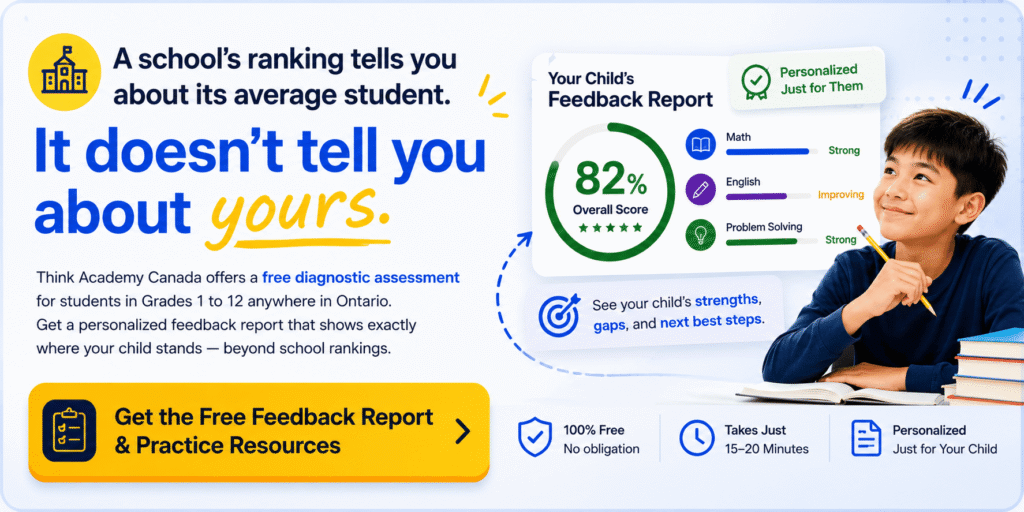
Our free diagnostic assessment gives you an objective, current picture of your child’s mathematical ability — independent of school grades, which can vary significantly in rigour between schools and even between teachers. For families targeting selective schools with SSAT requirements, this is the right starting point before formal preparation begins.
Many families applying to top Ontario private schools start SSAT preparation 6–12 months before their target test date. Think Academy’s structured mathematics programme builds exactly the arithmetic fluency and reasoning skills the SSAT math section rewards — and the same skills that competition mathematics and enrichment programmes develop, making the preparation dual-purpose for families interested in both school excellence and mathematical development.
FAQ
How many private schools are there in Ontario?
There are over 718 registered private schools in Ontario, making it the province with the largest private school sector in Canada.
What is the average tuition for private schools in Ontario?
The provincial average is approximately $17,000–$24,000 per year for day school, though the range is enormous — from under $1,000 for some small community schools to over $90,000 for elite boarding schools.
Do Ontario private schools require the SSAT?
Most academically selective Ontario private schools require the SSAT for Grade 7 and Grade 9 entry. The most competitive Toronto schools typically expect scores in the 80th percentile or above. Some schools accept alternative standardised tests, but the SSAT is the most widely used.
When should I apply to a private school in Ontario?
Applications for September 2027 entry should begin in September or October 2026. Most top schools close applications by December 1. Starting 12–18 months ahead of intended entry is strongly recommended, particularly if SSAT preparation is needed.
What private schools are in Ontario outside Toronto?
Ontario has private schools across the province, including strong options in Mississauga, Ottawa, Guelph, Waterloo, Kingston, and several boarding schools in communities like Lakefield and Port Hope. Toronto has the largest concentration of highly selective schools.
Do Ontario private schools follow the Ontario curriculum?
Most reputable Ontario private schools offer the Ontario Secondary School Diploma (OSSD), IB, or AP, even though they are not legally required to do so. Schools that offer OSSD ensure graduates meet Ontario university entrance requirements.
What financial aid is available at Ontario private schools?
Many Ontario private schools offer bursaries and merit scholarships. The most established schools allocate significant annual budgets — some distributing over $3–6 million per year. Aid applications typically run alongside main admissions applications, so families should apply for both simultaneously.
Is the SSAT math hard?
The SSAT math section is calculator-free and tests arithmetic fluency and mathematical reasoning in ways that differ from Ontario curriculum assessments. Many students who perform well in school find it harder than expected. Specific preparation — particularly for the calculator-free arithmetic sections — consistently improves scores.
What is the difference between IB and AP at Ontario private schools?
IB (International Baccalaureate) is an inquiry-based, interdisciplinary programme recognised internationally. AP (Advanced Placement) offers individual university-level courses in specific subjects, recognised particularly by US universities. Both carry weight in Canadian and international university admissions. The right choice depends on a student’s learning style and university goals.
How can Think Academy Canada help with Ontario private school preparation?
Think Academy Canada offers a free diagnostic assessment showing exactly where a student’s mathematical skills currently sit. For families targeting SSAT-requiring schools, this gives a clear, objective starting point before preparation begins. Our mathematics programme builds the arithmetic fluency and problem-solving reasoning that the SSAT math section specifically rewards.
About Think Academy Canada Think Academy Canada is a K-12 mathematics tutoring programme, part of TAL Education Group. We work with motivated, high-performing students across Canada from Grade 1 through Grade 12, with a focus on curriculum enrichment, SSAT preparation, and competition mathematics including CEMC and AMC. All lessons are delivered online. Follow us on Instagram at @thinkacademyca.

