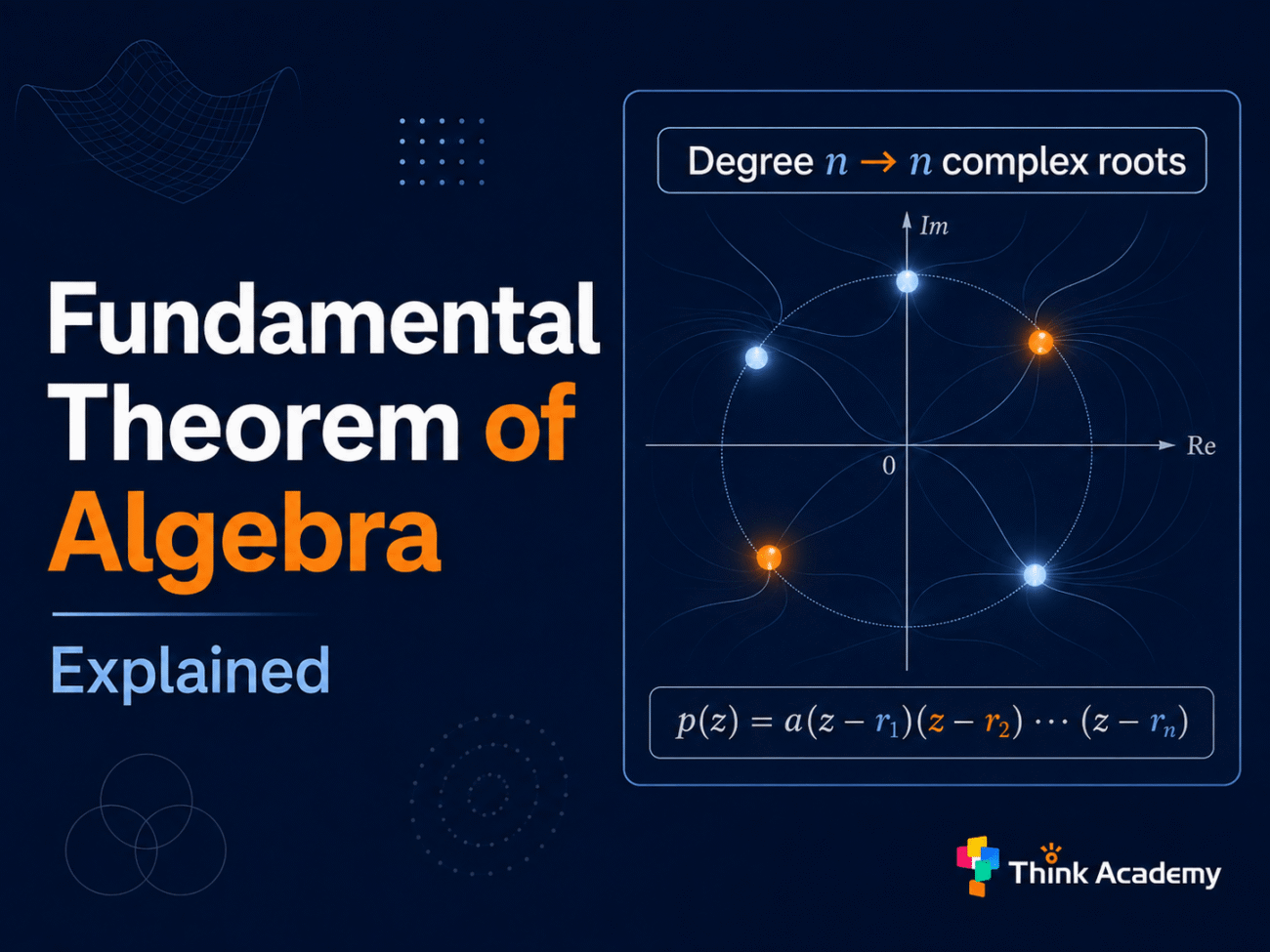
Every polynomial equation has a solution. Not every solution looks the way you might expect — but it exists. This seemingly simple guarantee is what the fundamental theorem of algebra states, and proving it rigorously requires some of the deepest ideas in mathematics.
The fundamental theorem of algebra states:
Every non-constant polynomial with complex coefficients has at least one complex root.
Equivalently: every polynomial of degree n ≥ 1 (with complex coefficients) has exactly n roots in the complex numbers, counted with multiplicity.
That second formulation — n roots for a degree-n polynomial — is the one most students encounter in MCR3U and MHF4U. The first formulation is how mathematicians typically state it, and understanding why the two are equivalent is itself illuminating.
What the Fundamental Theorem of Algebra Actually Says
Let’s unpack the statement carefully, because each word carries meaning.
“Every non-constant polynomial…”
A constant polynomial — f(x) = 5, f(x) = −3 — has no roots (no value of x makes it zero, since it is always 5 or always −3). The theorem excludes these, sensibly. For any polynomial of degree 1 or higher, the theorem applies.
“…with complex coefficients…”
The theorem applies to polynomials whose coefficients may be complex numbers — things like f(x) = x² + (2 + 3i)x − i. In practice, most polynomials students encounter have real (or even integer) coefficients, which are a special case of complex. The theorem applies to all of them.
“…has at least one complex root.”
A root of f(x) is a value c such that f(c) = 0. The theorem guarantees such a c exists in the complex numbers ℂ. It does not guarantee a real root — and this matters, because many polynomials have no real roots.
Why “at least one” leads to “exactly n”:
If f(x) is a degree-n polynomial and c₁ is a root (which the theorem guarantees), then f(x) = (x − c₁) · g(x) where g(x) is a polynomial of degree n − 1 (by the Factor Theorem). Apply the theorem again to g(x) — it has a root c₂. Continue until the polynomial is fully factored into n linear factors. The result: every degree-n polynomial factors as:f(x)=an(x−c1)(x−c2)⋯(x−cn)
where c₁, c₂, …, cₙ are the n complex roots (not necessarily distinct) and aₙ is the leading coefficient.
Counting with multiplicity:
If (x − c)² appears in the factorisation, c is a root of multiplicity 2 — it is “counted twice.” This is what “with multiplicity” means. The polynomial x² − 2x + 1 = (x − 1)² has one distinct root (x = 1) but two roots counted with multiplicity.
Why This Is Not Obvious
The fundamental theorem of algebra sounds almost too simple to be worth stating — of course polynomials have roots, you might think. But the theorem is anything but obvious, and it took centuries of mathematical development to prove rigorously.
The problem of existence:
Consider f(x) = x² + 1. Over the real numbers, this has no root — there is no real number x with x² = −1. If we insisted on only real numbers, many polynomials would have “no roots” in a legitimate sense. The theorem works precisely because it allows complex numbers.
The question is: how do we know that every polynomial has a complex root? Why can’t there be some polynomial that has no root in ℂ — or, worse, that requires some further extension of the number system beyond ℂ?
The theorem says: no further extension is needed. The complex numbers are algebraically closed — every polynomial with complex coefficients already has all its roots in ℂ. This is a non-trivial fact.
The proofs require analysis:
The first rigorous proof of the fundamental theorem of algebra was given by Carl Friedrich Gauss in his doctoral dissertation in 1799. (In fact, Gauss gave four different proofs over his lifetime — a sign of how important he considered the result.) Every known proof of the fundamental theorem of algebra requires tools from analysis — specifically, some version of the intermediate value theorem, or complex analysis, or topology. There is no purely algebraic proof.
This is a subtle and important point: a theorem about algebra cannot be proved by algebra alone. It requires analysis — the mathematics of limits, continuity, and the structure of the real and complex number systems. This is why the theorem is remarkable.
The Fundamental Theorem of Algebra and Real Polynomials
For polynomials with real coefficients, the fundamental theorem has an important consequence:
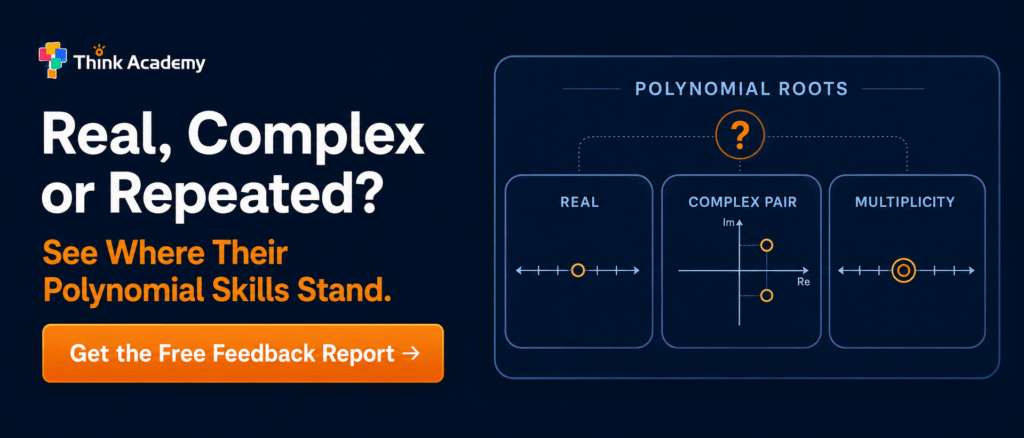
Complex roots come in conjugate pairs.
If f(x) has real coefficients and c = a + bi (with b ≠ 0) is a complex root, then its conjugate c̄ = a − bi is also a root.
Proof: If f(c) = 0 and f has real coefficients, then f(c̄) = f(c)‾ = 0̄ = 0. □
This means every polynomial with real coefficients factors over the reals into:
- Linear factors (x − r) for each real root r
- Irreducible quadratic factors (x² + bx + c) for each pair of complex conjugate roots
Consequences:
- Every odd-degree polynomial with real coefficients has at least one real root (since complex roots come in pairs, and the total count is odd, at least one must be real)
- Every real polynomial of even degree might have no real roots (all roots could be complex conjugate pairs)
Example: f(x) = x³ + x = x(x² + 1) has one real root (x = 0) and two complex roots (x = ±i). The odd-degree polynomial has at least one real root, as guaranteed.
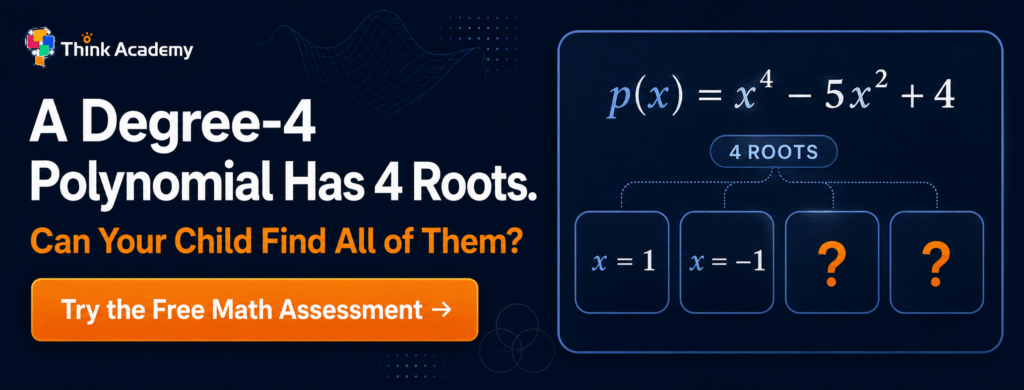
Example: f(x) = x⁴ + 4x² + 4 = (x² + 2)² has no real roots — all four roots are purely imaginary (x = ±i√2, each with multiplicity 2).
Worked Examples
Example 1 — Degree 3, All Real Roots
Factor f(x) = x³ − 6x² + 11x − 6 completely over ℂ.
By the rational root theorem: candidates are ±1, ±2, ±3, ±6.
f(1) = 1 − 6 + 11 − 6 = 0. Root: x = 1. Quotient: x² − 5x + 6 = (x − 2)(x − 3).
f(x) = (x − 1)(x − 2)(x − 3). Three real roots: 1, 2, 3.
The fundamental theorem guarantees 3 roots for a degree-3 polynomial — confirmed.
Example 2 — Degree 2, Complex Roots
Find all roots of f(x) = x² + x + 1.
Using the quadratic formula: x = (−1 ± √(1 − 4))/2 = (−1 ± √(−3))/2 = (−1 ± i√3)/2
Two complex roots: x = (−1 + i√3)/2 and x = (−1 − i√3)/2
Note these are complex conjugates — as guaranteed for a polynomial with real coefficients.
The fundamental theorem guarantees 2 roots for a degree-2 polynomial — confirmed. No real roots exist, but the theorem says roots must exist somewhere in ℂ, and they do.
Example 3 — Multiplicity
Factor f(x) = x⁴ − 4x³ + 6x² − 4x + 1.
Observe: this is (x − 1)⁴.
f(x) = (x − 1)⁴
One distinct root (x = 1) with multiplicity 4. The theorem says a degree-4 polynomial has 4 roots in ℂ, counted with multiplicity — here, all four are x = 1.
Example 4 — Mixed Real and Complex Roots
Factor f(x) = x³ − x² + x − 1.
f(1) = 1 − 1 + 1 − 1 = 0. Root: x = 1. Quotient: x² + 1 = (x − i)(x + i) over ℂ.
f(x) = (x − 1)(x − i)(x + i) over ℂ.
Three roots: 1 (real), i, −i (complex conjugate pair). Exactly 3 roots for a degree-3 polynomial.
Over the reals: f(x) = (x − 1)(x² + 1) — factored as far as possible with real factors.
The Fundamental Theorem and the History of Complex Numbers
The fundamental theorem of algebra is inseparable from the history of complex numbers — because the theorem is precisely what justifies taking complex numbers seriously as a number system.
For centuries, mathematicians encountered expressions like √(−1) in the solutions to cubic equations and treated them with suspicion. Cardano’s formula for solving cubic equations (1545) sometimes produced expressions involving √(−1) even when the final answer was a real number — a phenomenon that baffled mathematicians for decades.
The gradual acceptance of complex numbers in the 17th and 18th centuries came partly from their usefulness and partly from the growing understanding that polynomials — equations that seemed like they should always have solutions — sometimes required them. The fundamental theorem of algebra made this precise: if you want every polynomial to have all its roots, you must include ℂ.
Gauss’s 1799 proof put the theorem on rigorous footing and simultaneously established ℂ as the right setting for algebraic equations. Today complex numbers are foundational to physics (quantum mechanics uses them essentially), engineering (electrical circuits, signal processing), and every branch of advanced mathematics.
Where the Fundamental Theorem of Algebra Shows Up
MCR3U (Ontario Grade 11, Unit 2: Polynomial Functions): The statement “a degree-n polynomial has exactly n roots counted with multiplicity” is used throughout the polynomial unit, even if the theorem itself is not formally proved. When students factor a cubic and find three roots (as in Example 1), or when they note that a quadratic with negative discriminant has no real roots but understand it has two complex roots, they are using the fundamental theorem of algebra as background knowledge. For the full MCR3U polynomial context, see our MCR3U complete guide.
MHF4U (Ontario Grade 12): MHF4U extends polynomial work to higher degrees and introduces rational functions. The guarantee that a degree-n polynomial has exactly n complex roots — and that real polynomials have complex roots in conjugate pairs — is used when discussing the number of x-intercepts a polynomial graph can have and when constructing polynomials with specified roots. See our MHF4U guide.
Euclid Contest and COMC: The fundamental theorem itself is not directly tested on these competitions, but its consequences — particularly the conjugate root theorem and the structure of polynomial factorisations over ℝ and ℂ — appear in problems involving polynomials with specific root structures. A student who understands why a real polynomial of odd degree must have at least one real root can answer questions that students without this understanding find confusing. See our Euclid math contest guide and COMC math contest guide.
University mathematics: The fundamental theorem of algebra is the first major result a student encounters that genuinely requires analysis — the intermediate value theorem, continuity, or complex analysis — to prove. It marks the boundary between algebraic manipulation and analytic reasoning. Students who find this interesting are likely to enjoy real analysis, complex analysis, and abstract algebra at university — the courses where these ideas live.
If the idea that a theorem about algebra cannot be proved by algebra alone — that you need the topology of the complex plane to guarantee the existence of roots — strikes your child as genuinely surprising and interesting, that reaction is the beginning of mathematical maturity. Think Academy’s competition and enrichment programmes develop exactly this kind of mathematical depth. Find out what that looks like →
The Fundamental Theorem vs Related Results
It is worth distinguishing the fundamental theorem of algebra from related statements students often encounter.
Fundamental theorem of algebra: Every degree-n polynomial (complex coefficients) has exactly n roots in ℂ, counted with multiplicity.
Rational root theorem: If a polynomial has integer coefficients and p/q is a rational root in lowest terms, then p divides the constant term and q divides the leading coefficient. This helps find rational roots — it does not guarantee roots exist (the fundamental theorem does that). See our rational root theorem guide.
Factor theorem: (x − c) is a factor of f(x) if and only if f(c) = 0. This connects roots to factors — it is how you extract a root once you know it exists. See our polynomial remainder theorem guide.
The three together: The fundamental theorem guarantees n roots exist. The rational root theorem helps locate rational roots. The factor theorem extracts them one at a time. These three results form the core toolkit for polynomial factoring at the MCR3U and MHF4U level.
Frequently Asked Questions
What does the fundamental theorem of algebra state? Every non-constant polynomial with complex coefficients has at least one complex root. Equivalently, every degree-n polynomial has exactly n roots in ℂ, counted with multiplicity.
Why does the fundamental theorem require complex numbers? Real numbers are not sufficient — the polynomial x² + 1 has no real roots. Complex numbers are the right setting because ℂ is algebraically closed: every polynomial with complex coefficients has all its roots already in ℂ, with no further extension needed.
Does the fundamental theorem guarantee real roots? No. It guarantees complex roots. A polynomial like x² + 1 has no real roots but has two complex roots (±i). For polynomials with real coefficients, complex roots come in conjugate pairs — but real roots are not guaranteed for even-degree polynomials.
Does every odd-degree real polynomial have a real root? Yes. If f(x) has odd degree and real coefficients, complex roots come in pairs — so the number of complex (non-real) roots is even. Since the total number of roots equals the degree (which is odd), at least one root must be real.
Who proved the fundamental theorem of algebra? The first rigorous proof is due to Carl Friedrich Gauss in his doctoral dissertation in 1799. Earlier partial arguments had been given by d’Alembert and others, but Gauss identified gaps in those arguments and provided a complete proof. He went on to give three more proofs across his career.
Why can’t the fundamental theorem be proved using algebra alone? Because every known proof requires some form of topological or analytic argument — the intermediate value theorem, complex analysis, or winding number arguments. Algebra alone (field theory, ring theory) cannot prove that ℂ is algebraically closed; that requires the completeness of the real numbers as a foundational ingredient.
How does the fundamental theorem connect to what’s taught in MCR3U and MHF4U? In MCR3U and MHF4U, the consequence “a degree-n polynomial has n roots counted with multiplicity” is used throughout the polynomial units. When a student uses the rational root theorem and Factor Theorem to fully factor a cubic, they are implicitly relying on the fundamental theorem’s guarantee that three roots exist. The theorem also explains why a polynomial graph can cross the x-axis at most n times.
See our related guides: rational root theorem guide · polynomial remainder theorem guide · MCR3U complete guide · MHF4U Advanced Functions guide · types of function in math guide · Euclid math contest guide · COMC math contest guide · Canadian Mathematical Olympiad guide · Goldbach conjecture guide