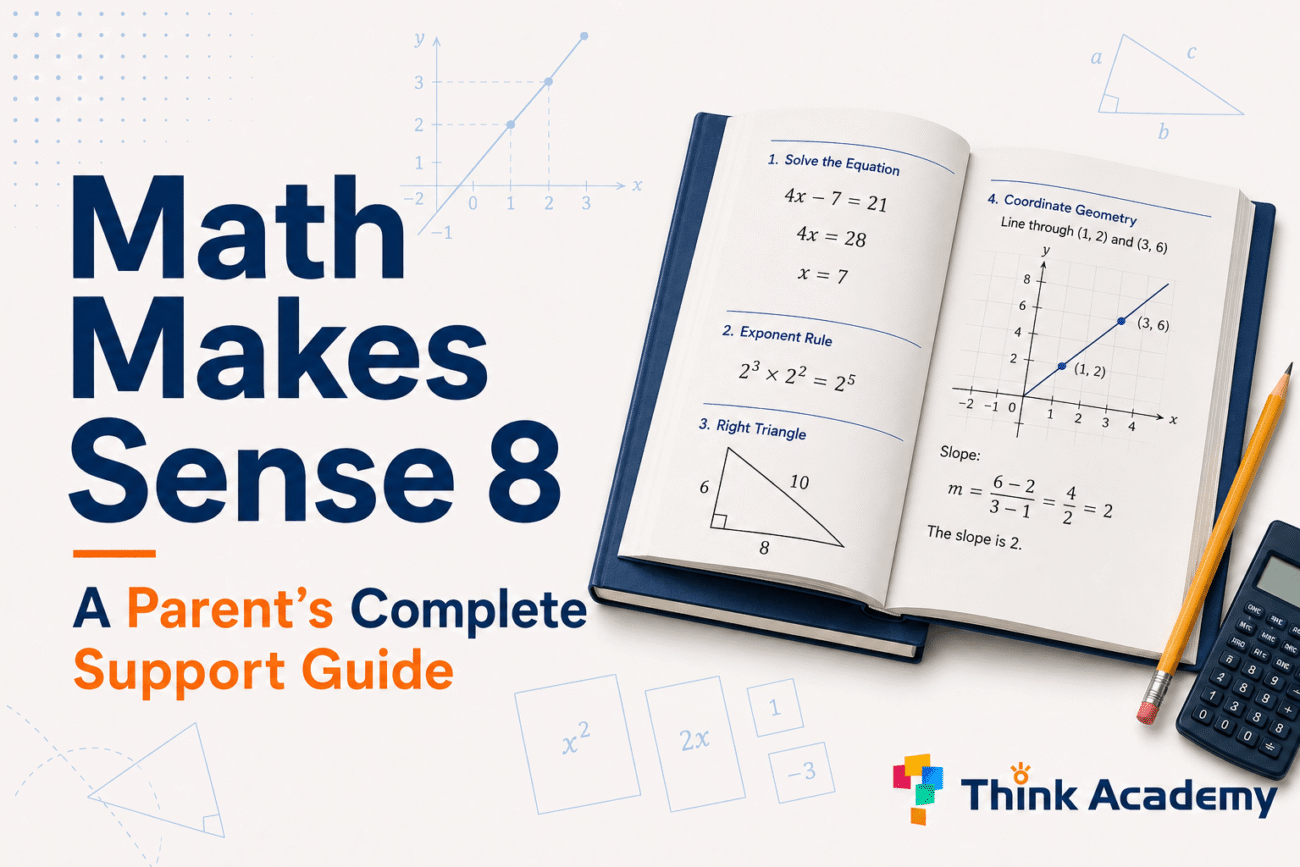
If your child’s school uses Math Makes Sense 8, you already know the textbook is demanding. Grade 8 is the last year of elementary mathematics in Ontario — and Math Makes Sense 8 is designed to bring students to the threshold of secondary school mathematics. What they understand by June directly determines how well they are positioned when Grade 9 starts in September.
This guide is written for parents, not students. It covers what Math Makes Sense 8 contains, where students most commonly struggle, and what you can do to support your child through Grade 8 mathematics this year — and into Grade 9 next year.
What Is Math Makes Sense 8?
Math Makes Sense 8 (MMS 8) is a Canadian mathematics textbook published by Pearson Education and widely used in Ontario and other Canadian provinces for Grade 8 mathematics. It is designed to cover the Ontario Grade 8 mathematics curriculum and is one of the most commonly assigned textbooks in Ontario elementary schools for the final year before secondary school.
Like Math Makes Sense 9, MMS 8 takes a spiral approach — concepts introduced early return later in greater complexity. A student who doesn’t solidify Chapter 1 content will find it reappearing, harder, in Chapter 5. This is by design, but it means gaps left unaddressed early in the year compound rather than fade.
MMS 8 is not the only textbook used for Ontario Grade 8 mathematics — some schools use Nelson Mathematics 8 or board-developed materials. But if your child has been assigned MMS 8, this guide covers exactly what they are working through.
For a full breakdown of the Ontario Grade 8 curriculum regardless of textbook, see our Grade 8 math curriculum Ontario guide.
What Does Math Makes Sense 8 Cover?
Math Makes Sense 8 is structured around the Ontario Grade 8 mathematics curriculum strands. Here is what each chapter covers and why it matters:
Chapter 1: Square Roots and the Pythagorean Theorem
Perfect squares, square roots, and estimating irrational square roots. The Pythagorean theorem — c² = a² + b² — is introduced here and applied to right triangles in two and three dimensions. This chapter is the first point where students encounter irrational numbers, and the conceptual jump from “every number has a neat answer” to “this square root is approximately 5.3” throws many students off for the first time.
The Pythagorean theorem is not just a Grade 8 topic. It recurs in Grade 9 geometry, Grade 10, and beyond. Students who leave Chapter 1 with a procedural memory of c² = a² + b² but without understanding which side is the hypotenuse and why will make errors on every downstream problem involving right triangles.
Chapter 2: Powers and Exponent Laws
Exponent notation, the laws for multiplying and dividing powers, and powers of powers. The exponent laws are the first real set of algebraic rules students are expected to memorise and apply flexibly — and the most common error is applying them inconsistently, confusing multiplication of powers with raising a power to a power.
Chapter 3: Fractions, Decimals and Percents
Operations with fractions, converting between fractions, decimals, and percentages, and multi-step problems combining all three. For students who did not fully consolidate fraction operations in Grades 6 and 7, this chapter is where those gaps surface clearly. A student who is uncertain about multiplying fractions will compound that uncertainty when fractions appear in algebraic contexts in Chapters 5 and 6.
Chapter 4: Circles
Circumference, area, and the relationship between diameter, radius, and π. This chapter is more conceptually accessible than the algebra chapters but introduces the idea of applying a formula in context — not just calculating, but setting up the right calculation from a word problem or diagram.
Chapter 5: Surface Area and Volume
Surface area and volume of prisms, cylinders, spheres, and cones. Students must visualise three-dimensional shapes, recall the right formula, and substitute correctly — three operations that need to work together smoothly. The cylinder and sphere formulas involving π are often where students make algebraic substitution errors even when they know the formula.
For practice with surface area and volume specifically, see our area and surface area of a cylinder guide.
Chapter 6: Linear Relations
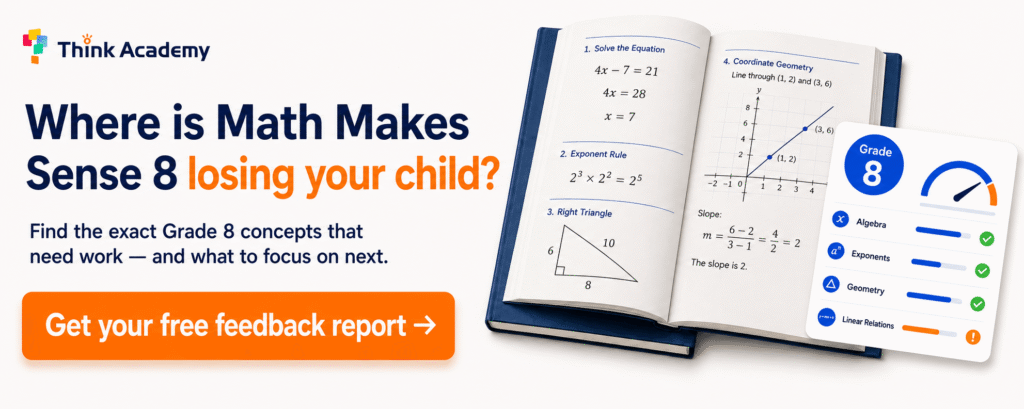
Tables of values, graphing, slope, y-intercept, and the equation of a line. This is the most consequential chapter in Math Makes Sense 8 — and the one parents should pay most attention to. Linear relations is where the mathematics becomes genuinely algebraic for the first time, and it feeds directly into the first major units of Grade 9 MTH1W. A student who leaves Chapter 6 without genuinely understanding what slope means, what the y-intercept represents, and how to move between a table, a graph, and an equation is not prepared for Grade 9.
Chapter 7: Solving Linear Equations
Multi-step equation solving, including equations with variables on both sides and equations involving fractions. This is the second chapter parents should prioritise. Equation solving is assumed knowledge from day one of Grade 9 algebra — students who find this chapter confusing will find Grade 9 harder than it needs to be.
Chapter 8: Data Analysis and Probability
Collecting and organising data, scatter plots and trends, theoretical and experimental probability. This strand is often the most underestimated in preparation — students treat it as the “easy” part of Grade 8 and do not prepare specifically for it, then lose marks on data and probability questions in the Grade 9 EQAO assessment.
Where Students Struggle Most in Math Makes Sense 8
Chapters 6 and 7: Linear Relations and Equations
These are the two chapters that matter most for Grade 9 readiness — and the two where parents most often report their child coming home stuck.
Linear relations (Chapter 6) requires a student to hold three representations of the same mathematical relationship simultaneously: a table of values, a graph, and an equation. Moving fluently between the three is a skill that takes practice in a way that earlier mathematics did not require. Students who have only experienced mathematics as “calculate this answer” find the relational thinking of Chapter 6 genuinely difficult.
Equation solving (Chapter 7) compounds this: the rules for maintaining balance across an equation, applied across multiple steps with negative numbers and fractions, is where most Grade 8 students make their highest volume of errors. A student who cannot reliably solve 2(3x − 4) = 4(x + 1) is not ready for the algebraic content Grade 9 introduces in its first month.
Chapter 1: The Pythagorean Theorem in Non-Standard Contexts
The Pythagorean theorem itself is not hard to memorise. Applying it correctly — identifying which side is the hypotenuse in a non-standard diagram, applying it to find a missing leg rather than the hypotenuse, or using it in a multi-step word problem — is where students lose marks. The error is almost always the same: treating c² = a² + b² as a formula to plug into rather than a relationship to reason about.
Chapter 2: Inconsistent Exponent Law Application
Students who memorise exponent laws without understanding them apply them inconsistently under test conditions — getting some questions right and others wrong in ways that seem random but actually reflect specific conceptual confusions. The most common: multiplying the exponents when multiplying powers (wrong) instead of adding them (right), or confusing (x²)³ = x⁶ with x² × x³ = x⁵.
Word Problems Throughout
Math Makes Sense 8 integrates applied word problems across every chapter. Students who cannot translate a written scenario into a mathematical setup lose marks across every strand — not because they don’t understand the mathematics, but because mathematical modelling is a separate skill that requires specific practice.
How to Support Your Child Through Math Makes Sense 8
Prioritise Chapters 6 and 7 above everything else. If your child is struggling anywhere in MMS 8, linear relations and equation solving are the highest-stakes chapters to address — both for the current year and for Grade 9 readiness. Time spent solidifying these two chapters is the single highest-leverage investment a parent can make in their child’s mathematics this year.
Check comprehension, not just completion. A child who has completed a chapter’s homework is not necessarily a child who understands the chapter. Ask them to explain — in their own words, without looking at the textbook — what slope means, or how to decide which operation to do first when solving an equation. The ability to explain is a reliable indicator of genuine understanding. The inability to explain, even with the right answers on the page, is a signal that something is procedural rather than understood.
Don’t wait for the test result. The pattern with MMS 8 is consistent: student struggles with a chapter, says nothing, the test arrives, the mark comes back low, the parent notices. By that point the class has moved to the next chapter. Getting ahead of this — asking regularly whether the current chapter makes sense, not just whether the homework is done — prevents the most common Grade 8 trajectory.
Address fractions before they appear in algebra. If your child is uncertain about fraction operations, Chapter 7 will be harder than it needs to be — because equation solving with fractional coefficients requires reliable fraction fluency. Addressing fraction gaps before Chapter 7 arrives is more efficient than trying to address them at the same time as learning to solve equations.
Understand the Grade 9 implications. Chapter 6 (linear relations) and Chapter 7 (equations) are not self-contained Grade 8 topics. They are the direct prerequisites for the first major units of MTH1W — the Ontario Grade 9 mathematics course. A student who leaves Grade 8 with a weak understanding of these chapters will not have a clean slate in September; they will have the same gaps in a faster, more demanding context. For more on what Grade 9 expects from day one, see our Ontario Grade 9 math curriculum guide and Grade 9 math September preparation guide.
What a Strong Math Makes Sense 8 Result Leads To
The path from Math Makes Sense 8 to university is more direct than most Grade 8 parents realise.
MTH1W (Grade 9) → MPM2D (Grade 10) → MCR3U (Grade 11) → MHF4U and MCV4U (Grade 12) → university admissions average.
The Grade 12 mathematics marks — Advanced Functions and Calculus and Vectors — are among the six marks that determine admissions averages for engineering, computer science, commerce, and sciences at Ontario universities. Those Grade 12 marks depend on Grade 11 foundations. Grade 11 foundations depend on Grade 10. Grade 10 depends on Grade 9. And Grade 9 depends directly on what a student understands in Math Makes Sense 8.
This is not an argument for anxiety. It is an argument for attention — because a student who moves through Grade 8 with genuine understanding, not just completed homework, arrives at each subsequent level better positioned than one who scraped through.
For a full picture of the Ontario secondary mathematics pathway, see our Grade 10 math Ontario guide and choosing high school math courses guide.
How Think Academy Helps Grade 8 Students with Math Makes Sense 8
Think Academy Canada works with Grade 8 students across Ontario who are using Math Makes Sense 8 and finding specific chapters difficult. Our approach is diagnostic: we identify exactly which concepts are causing difficulty — linear relations, equation solving, Pythagorean theorem applications — and address those specifically rather than reviewing the full Grade 8 curriculum.
Our Grade 8 programme:
- Aligns to the Ontario Grade 8 curriculum covered in Math Makes Sense 8
- Starts with a diagnostic that pinpoints exactly which chapters and concepts have gaps
- Includes a specific Grade 9 transition component for students approaching the end of Grade 8
- Builds algebraic fluency in linear relations and equation solving — the two areas most predictive of Grade 9 success
The free diagnostic assessment takes 20 minutes and produces a written feedback report. No commitment required — just a clear, specific picture of where your child stands in the MMS 8 curriculum and what targeted preparation looks like.
Frequently Asked Questions
What is Math Makes Sense 8? A Canadian Grade 8 mathematics textbook published by Pearson Education, widely used in Ontario schools. It covers the Ontario Grade 8 curriculum across eight chapters, including the Pythagorean theorem, exponent laws, fractions, linear relations, and equation solving.
Is Math Makes Sense 8 hard? Grade 8 is genuinely more demanding than Grade 7, particularly in the linear relations and equation solving chapters. The pace increases, the content becomes more abstract, and the problems require more multi-step reasoning. Most students find Chapters 6 and 7 the most challenging.
Where can I find Math Makes Sense 8 answers? Answers to odd-numbered questions are typically at the back of the student textbook. Complete answer keys are in the teacher’s edition, which is not publicly available. For worked solutions to key concept types, our curriculum guides and the Grade 8 worksheets linked below cover the most commonly tested content.
My child understands the textbook but fails the tests. Why? Two common reasons. First, understanding a concept with the book open is different from retrieving and applying it independently under test conditions. Second, Grade 8 tests combine concepts from multiple chapters in single problems — which requires deciding which approach to use before applying it. Building this flexibility requires varied practice, not re-reading the textbook. See our Grade 8 math worksheets for practice problems across all strands.
What is the difference between Math Makes Sense 8 and Math Makes Sense 9? MMS 8 covers the Ontario Grade 8 curriculum — the final year of elementary school mathematics. MMS 9 covers the Ontario Grade 9 MTH1W course — the first year of secondary school mathematics. The two books connect directly: what a student learns in MMS 8 Chapters 6 and 7 is exactly what MMS 9 Chapters 4 and 6 build on. For the MMS 9 companion guide, see our Math Makes Sense 9 parent guide.
Does Think Academy align to Math Makes Sense 8? Yes. Our Grade 8 programme is built around the Ontario Grade 8 curriculum that Math Makes Sense 8 covers. We can work with a student on the specific chapter they are struggling with, or support them across the full year — including preparation for the Grade 9 transition.
What comes after Math Makes Sense 8? Grade 9 mathematics in Ontario — MTH1W, the destreamed course introduced in 2021. See our Ontario Grade 9 math curriculum guide for what that transition involves and our Math Makes Sense 9 parent guide for the textbook equivalent.
See our related guides: Grade 8 math curriculum Ontario · Grade 8 math worksheets · Math Makes Sense 9 parent guide · Ontario Grade 9 math curriculum guide · Grade 9 math September preparation · Grade 10 math Ontario guide · MHF4U Advanced Functions guide · area and surface area of a cylinder · adding and subtracting integers · choosing high school math courses
Grade 8 is the foundation. Make sure it’s solid before September.