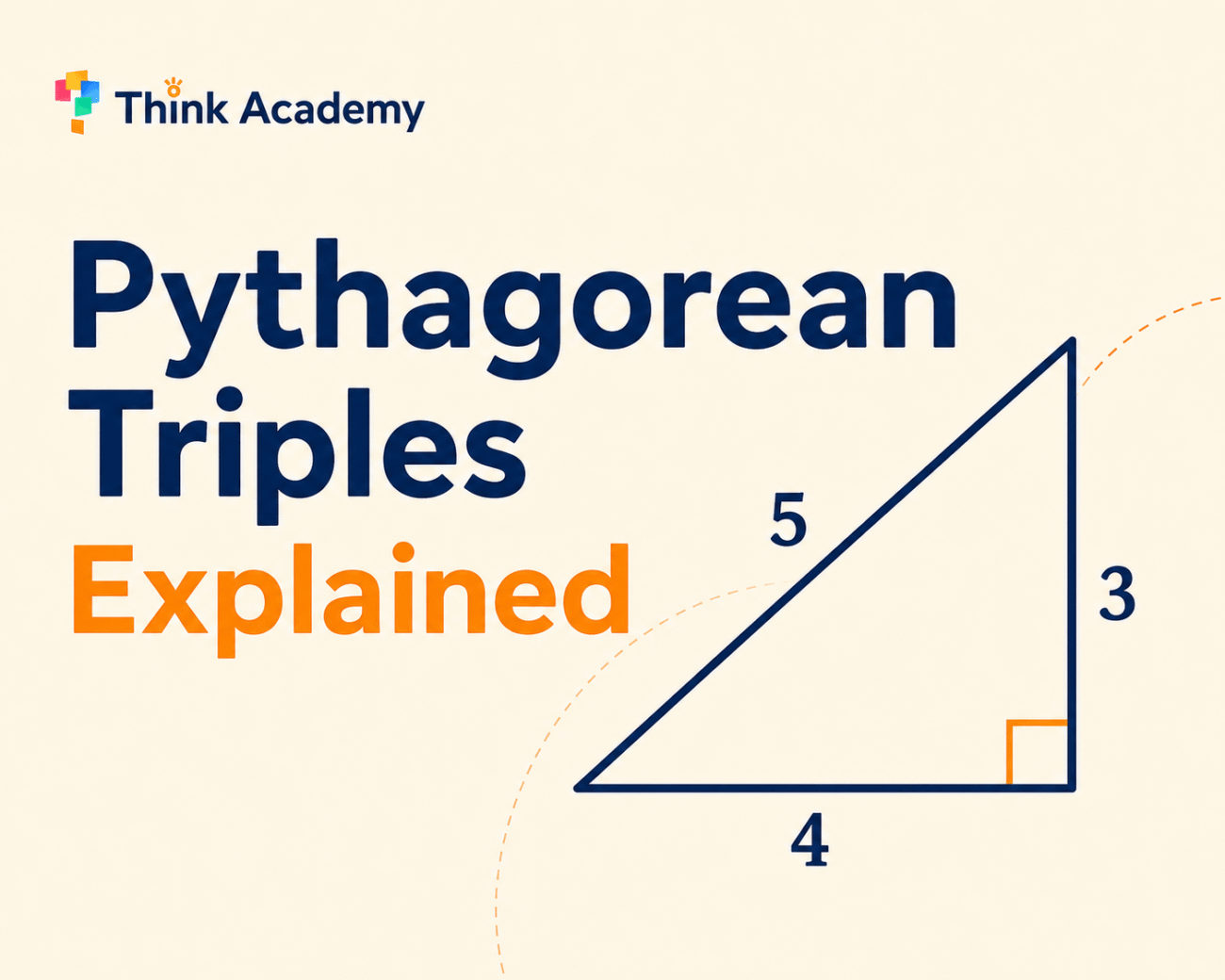
Pythagorean triples are a set of three positive integers (a, b, c) that satisfy the Pythagorean theorem:a2+b2=c2
The most familiar example is (3, 4, 5): 9 + 16 = 25. But there are infinitely many Pythagorean triples — and knowing the most common ones by heart is one of the most useful shortcuts available in both school mathematics and competition problems.
What Makes a Pythagorean Triple?
For three positive integers a, b, c to form a Pythagorean triple, the sum of the squares of the two smaller numbers must equal the square of the largest.
(3, 4, 5): 3² + 4² = 9 + 16 = 25 = 5² ✓
(5, 12, 13): 5² + 12² = 25 + 144 = 169 = 13² ✓
(8, 15, 17): 8² + 15² = 64 + 225 = 289 = 17² ✓
Any multiple of a Pythagorean triple is also a Pythagorean triple — called a scaled triple:
- (3, 4, 5) scaled by 2 → (6, 8, 10): 36 + 64 = 100 ✓
- (3, 4, 5) scaled by 3 → (9, 12, 15) ✓
- (5, 12, 13) scaled by 2 → (10, 24, 26) ✓
A primitive Pythagorean triple is one where a, b, and c share no common factor greater than 1. (3, 4, 5) is primitive. (6, 8, 10) is not — it is a multiple of (3, 4, 5).
The Pythagorean Triples Every Student Should Memorise
These are the primitive triples that appear most frequently in school assessments, EQAO, and mathematics competitions. Knowing them on sight saves significant time.
| Triple | Verification |
|---|---|
| (3, 4, 5) | 9 + 16 = 25 |
| (5, 12, 13) | 25 + 144 = 169 |
| (8, 15, 17) | 64 + 225 = 289 |
| (7, 24, 25) | 49 + 576 = 625 |
| (20, 21, 29) | 400 + 441 = 841 |
| (9, 40, 41) | 81 + 1,600 = 1,681 |
| (12, 35, 37) | 144 + 1,225 = 1,369 |
And their most common scaled versions:
| Scaled Triple | Derived From |
|---|---|
| (6, 8, 10) | 2 × (3, 4, 5) |
| (9, 12, 15) | 3 × (3, 4, 5) |
| (10, 24, 26) | 2 × (5, 12, 13) |
| (15, 36, 39) | 3 × (5, 12, 13) |
The most important to know cold: (3, 4, 5) and (5, 12, 13). These two — and their multiples — account for the majority of Pythagorean triple problems at the Grade 7–10 level.
How to Generate Pythagorean Triples
There are two systematic methods for generating all primitive Pythagorean triples.
Method 1: Euclid’s Formula
For any two positive integers m and n where m > n, m and n have no common factors, and exactly one of m, n is even:a=m2−n2,b=2mn,c=m2+n2
Example (m = 2, n = 1):
- a = 4 − 1 = 3
- b = 2 × 2 × 1 = 4
- c = 4 + 1 = 5
- Triple: (3, 4, 5) ✓
Example (m = 3, n = 2):
- a = 9 − 4 = 5
- b = 2 × 3 × 2 = 12
- c = 9 + 4 = 13
- Triple: (5, 12, 13) ✓
Example (m = 4, n = 1):
- a = 16 − 1 = 15
- b = 2 × 4 × 1 = 8
- c = 16 + 1 = 17
- Triple: (8, 15, 17) ✓
Method 2: Odd Number Pattern (for triples with consecutive legs)
When the two larger numbers in a Pythagorean triple are consecutive integers (like 3,4,5 where 4 and 5 are consecutive, or 20,21,29 — wait, actually 3,4,5 and 20,21,29 have the pattern where b and c are consecutive):
If c = b + 1, then: a² = c² − b² = (b+1)² − b² = 2b + 1
So a must be an odd number, and:
- b = (a² − 1)/2
- c = (a² + 1)/2
For a = 3: b = (9−1)/2 = 4, c = (9+1)/2 = 5 → (3, 4, 5) For a = 5: b = (25−1)/2 = 12, c = (25+1)/2 = 13 → (5, 12, 13) For a = 7: b = (49−1)/2 = 24, c = (49+1)/2 = 25 → (7, 24, 25) For a = 9: b = (81−1)/2 = 40, c = (81+1)/2 = 41 → (9, 40, 41)
This pattern generates the family of triples where the two larger numbers differ by 1.
Recognising Pythagorean Triples in Problems
The most important skill is recognising when a problem is secretly using a Pythagorean triple — even when the numbers are scaled or the triple is not immediately obvious.
Example 1: A right triangle has legs of 6 and 8. Find the hypotenuse.
Without recognising the triple: √(36 + 64) = √100 = 10.
With the triple: (6, 8, 10) is 2 × (3, 4, 5). Hypotenuse = 10 instantly.
Example 2: A right triangle has a hypotenuse of 26 and one leg of 24. Find the other leg.
Without the triple: √(676 − 576) = √100 = 10.
With the triple: (10, 24, 26) is 2 × (5, 12, 13). Other leg = 10 instantly.
Example 3: A ladder 13 m long leans against a wall. The base is 5 m from the wall. How high up the wall does it reach?
Without the triple: √(169 − 25) = √144 = 12.
With the triple: (5, 12, 13) is a primitive triple. Height = 12 instantly.
In each case, recognising the triple eliminates the square root calculation and saves time — especially valuable on no-calculator assessments and competitions.
Pythagorean Triples on Non-Right Triangles: The Converse
The converse of the Pythagorean theorem is equally useful: if a² + b² = c², then the triangle is a right triangle.
This means you can use Pythagorean triples to verify whether a triangle is right-angled — without needing an angle measurement.
Example: Is a triangle with sides 10, 24, 26 a right triangle?
10² + 24² = 100 + 576 = 676 = 26² ✓
Yes — it is (10, 24, 26) = 2 × (5, 12, 13), a right triangle.
Example: Is a triangle with sides 6, 7, 9 a right triangle?
6² + 7² = 36 + 49 = 85 ≠ 81 = 9²
No — it is not a right triangle.
Pythagorean Triples in Coordinate Geometry
Pythagorean triples appear naturally in coordinate geometry problems involving distances.
Example: Find the distance between points (1, 2) and (4, 6).
Horizontal distance = 4 − 1 = 3 Vertical distance = 6 − 2 = 4
Distance = √(3² + 4²) = √(9 + 16) = √25 = 5
Recognising (3, 4, 5): distance = 5 instantly.
Example: Find the distance between (−1, 3) and (11, 8).
Horizontal = 12, Vertical = 5
(5, 12, 13): distance = 13 instantly.
Where Pythagorean Triples Show Up in Contests
This is where knowing your triples pays off most directly.
AMC 8: Pythagorean triples appear in geometry problems on almost every AMC 8 paper. The most common format: a right triangle with two sides given (often 6 and 8, or 5 and 12), asking for the third side or the area. A student who recognises (3, 4, 5) and (5, 12, 13) cold solves these in seconds. A student who does not runs a square root calculation under time pressure. See our AMC 8 guide for more on how geometry appears in the contest.
AMC 10: Pythagorean triples appear in more complex geometric configurations — combined with area problems, 3D geometry, or coordinate geometry. The (8, 15, 17) and (7, 24, 25) triples become relevant at this level.
Gauss Contest (CEMC): Right triangle problems with Pythagorean triples appear regularly in Parts A and B. The (3, 4, 5) family accounts for most of them, with (5, 12, 13) appearing in the harder questions.
EQAO Grade 8: The Pythagorean theorem is explicitly tested. Problems involving the (3, 4, 5) and (5, 12, 13) triples are standard. See our EQAO Grade 9 complete guide for the secondary assessment context.
Euclid Contest (CEMC): Pythagorean triples appear in more sophisticated configurations — combined with other geometric theorems, in 3D problems, or embedded in algebra problems that reduce to a distance calculation. Knowing all the common triples including (8, 15, 17) and (7, 24, 25) is useful at this level.
If this kind of problem — recognising patterns and using mathematical shortcuts to solve geometry problems efficiently — is something your child enjoys, that instinct is exactly what competition mathematics develops systematically. Think Academy’s contest preparation programmes cover the AMC 8, Gauss, Cayley, and Euclid series, building the pattern recognition and problem-solving fluency that makes these techniques automatic. Find out what structured contest training looks like →
Common Mistakes with Pythagorean Triples
Mistake 1: Using a scaled triple but forgetting the scaling factor elsewhere in the problem. If a triangle has legs 6 and 8 (a 2× scaled (3, 4, 5) triple), its area is (6 × 8)/2 = 24, not (3 × 4)/2 = 6. The triple tells you the hypotenuse is 10 — but all subsequent calculations use the actual dimensions, not the primitive triple.
Mistake 2: Confusing which side is the hypotenuse. In a Pythagorean triple (a, b, c), c is always the hypotenuse — the longest side, opposite the right angle. A student who applies the formula with the wrong value as c will get a wrong answer even if they know the triple.
Mistake 3: Assuming every right triangle uses a Pythagorean triple. Pythagorean triples involve only integers. A right triangle with legs 1 and 1 has hypotenuse √2 — not a Pythagorean triple. The triple approach only applies when the problem’s numbers are integers (or when the problem’s numbers are multiples of a known triple’s integers).
Mistake 4: Missing a scaled triple. A student who knows (3, 4, 5) but does not recognise (15, 20, 25) = 5 × (3, 4, 5) will calculate √(225 + 400) = √625 = 25 rather than recognising the triple immediately. Practise identifying the common factor: GCD(15, 20, 25) = 5, so divide by 5 to get (3, 4, 5).
Practice Problems
Solve each problem, using Pythagorean triples where possible.
- A right triangle has legs of 9 and 12. Find the hypotenuse.
- A right triangle has a hypotenuse of 25 and one leg of 7. Find the other leg.
- Find the distance between (0, 0) and (5, 12).
- A right triangle has a hypotenuse of 17 and one leg of 8. Find the other leg and the area.
- Is a triangle with sides 20, 48, 52 a right triangle? If so, which primitive triple is it a multiple of?
- A diagonal path across a rectangular park is 13 m long. One side of the park is 5 m. How wide is the park?
- Generate the Pythagorean triple from Euclid’s formula using m = 4, n = 3.
- A right triangle has area 54 and one leg is 12. The hypotenuse is an integer. Find the hypotenuse.
Answers:
- (9, 12, 15) = 3 × (3, 4, 5). Hypotenuse = 15
- (7, 24, 25). Other leg = 24
- (5, 12, 13). Distance = 13
- (8, 15, 17). Other leg = 15. Area = (8 × 15)/2 = 60
- 20² + 48² = 400 + 2,304 = 2,704 = 52². Yes. GCD(20, 48, 52) = 4. 4 × (5, 12, 13). Yes, a multiple of (5, 12, 13)
- (5, 12, 13). Width = 12 m
- m = 4, n = 3: a = 16 − 9 = 7, b = 2 × 4 × 3 = 24, c = 16 + 9 = 25. Triple: (7, 24, 25)
- Area = (1/2)(12)(other leg) = 54 → other leg = 9. Check: (9, 12, ?) → 81 + 144 = 225 = 15². Hypotenuse = 15
Frequently Asked Questions
What are Pythagorean triples? Pythagorean triples are sets of three positive integers (a, b, c) satisfying a² + b² = c² — the Pythagorean theorem. They represent right triangles with integer side lengths.
What are the most common Pythagorean triples? The most important to know are (3, 4, 5), (5, 12, 13), (8, 15, 17), and (7, 24, 25), along with their multiples. (3, 4, 5) and (5, 12, 13) are the most frequently used in school and competition problems.
Are there infinitely many Pythagorean triples? Yes. Euclid’s formula generates all primitive Pythagorean triples from pairs of integers m > n, and scaling any triple by any positive integer produces another triple. So there are infinitely many.
What is a primitive Pythagorean triple? A primitive triple is one where a, b, and c share no common factor greater than 1. (3, 4, 5) is primitive; (6, 8, 10) is not (it is 2 × (3, 4, 5)).
Do Pythagorean triples appear on the AMC 8? Yes, regularly. Right triangle geometry problems on the AMC 8 very frequently use (3, 4, 5) and (5, 12, 13) triples. Recognising them instantly is one of the most practical shortcuts for AMC 8 geometry.
Is (0, anything, anything) a Pythagorean triple? No. Pythagorean triples require three positive integers. Zero is excluded.
See our related guides: AMC 8 complete guide · Gauss math contest guide · Euclid math contest guide · math competitions in Canada · Grade 8 math curriculum Ontario · EQAO Grade 9 complete guide · special triangles in trigonometry · math enrichment guide