Most students preparing for the SSAT do some practice tests. Far fewer use those tests effectively. This guide covers not just where to find an SSAT mock test but how to run them, score them, and turn the results into an actual improvement plan — which is the part that determines whether your child’s preparation time converts into a better score.
A mock test shows you where your child stands — a structured programme shows you how to fix it.
What Is an SSAT Mock Test and Why It Matters
An SSAT mock test is a full-length practice version of the Secondary School Admissions Test, structured to replicate the real exam as closely as possible in format, question types, timing, and difficulty. The goal is not just to give a student more questions to practice on — it is to produce a reliable data point about where their performance actually sits before the real test, with enough time to do something about it.
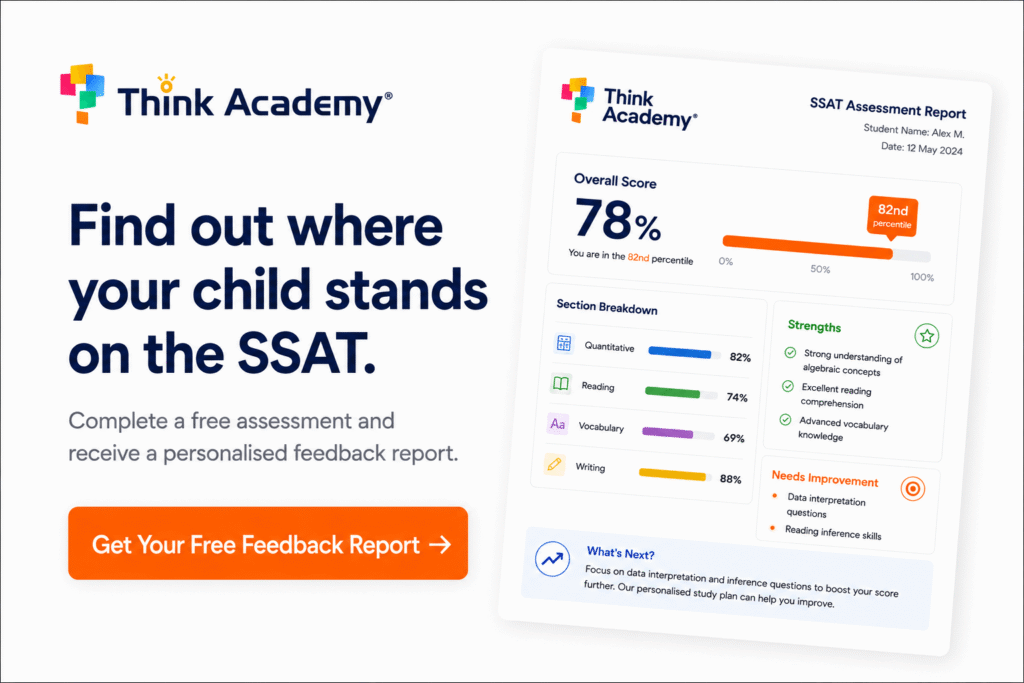
The SSAT is scored on a scaled score system and reports a percentile rank compared to other students who have taken the test over the past three years — a competitive norm group, not a grade-based standard. That means knowing that your child scored 75% on a random practice sheet tells you almost nothing about how they will perform on the actual exam. A properly administered mock test, scored using official methodology, tells you something real.
A mock test matters for three reasons. First, it reveals actual weak areas — specific question types or content strands where your child consistently loses marks, which is far more actionable than a general sense that they need “more practice.” Second, it builds test-format familiarity, reducing the cognitive load of navigating an unfamiliar structure on test day. Third, it develops pacing — the ability to move through sections at the right speed, which is a learnable skill that meaningfully affects scores.
For background on the SSAT’s structure, sections, and how it is used in Canadian independent school admissions, see our complete SSAT Guide.
Where to Find Official SSAT Mock Tests
The Admission Testing Program (ATP) / SSAT.org is the primary official source. The official SSAT website provides sample questions and, through its store, official practice materials including full-length practice tests. These are the most reliable materials available because they are calibrated to actual test difficulty and format — which third-party materials, however well-made, approximate rather than replicate.
The Official SSAT Guide (available for purchase through SSAT.org) includes multiple full-length practice tests with answer explanations. This is the standard starting point for structured preparation.
Free sample questions on SSAT.org give a sense of format and difficulty at no cost, though they are not substitutes for a full-length timed practice test.
Third-party prep books from publishers such as Kaplan, Princeton Review, and others include additional practice tests. These are useful for volume once official materials have been used, but treat their difficulty calibration as approximate rather than definitive — they do not have access to the proprietary scoring data that SSAT.org uses.
Prep programmes, including Think Academy, provide structured practice materials alongside guided instruction — combining the test familiarity of mock testing with targeted support for the specific areas where a student is losing marks.
For a Canadian-focused breakdown of practice test resources and how to access them, see our SSAT Practice Test guide.
How to Simulate Real Test Conditions at Home
The value of a mock test is directly proportional to how closely it replicates the actual test environment. A practice paper completed over two evenings with no time pressure tells you almost nothing about how a student will perform under real conditions.
Time every section strictly. The SSAT has specific time limits per section — these are not guidelines, they are hard limits, and a student who consistently runs out of time on the real test will have shown no sign of this problem if they completed practice papers at their own pace. Set a timer and enforce it.
No interruptions. The real test environment does not allow phone checks, snack breaks between sections, or pauses to look something up. A home mock test should replicate this as closely as possible — a dedicated block of time, in a quiet space, with no access to notes or devices.
Use pencil and paper, not a screen. The SSAT is a paper-based test. Practising on a screen creates a different cognitive experience and does not build the specific reading and attention patterns that the paper format requires.
Schedule it at the same time of day as the real test. Most SSAT administrations take place in the morning. A student who consistently practises in the evening may find their performance dips when asked to produce their best work at 9am.
Take the full test in one sitting. The SSAT includes multiple sections administered consecutively. Splitting a practice test across multiple sessions does not build the stamina required to maintain focus and accuracy through the full exam.
After completing a section, the answers stay sealed until all sections are done — no peeking between sections, just as in the real test.
How to Score Your SSAT Mock Test
Scoring an SSAT mock test correctly is more involved than simply counting right answers, and getting this step wrong means the data you produce is less useful than it should be.
Raw score. Count the number of correct answers. On the SSAT, incorrect answers incur a penalty of ¼ point deducted from the raw score (for multiple choice), while omitted questions score zero. This guessing penalty is significant and affects strategy — a student who guesses randomly on all questions they are unsure of will likely score lower than one who leaves uncertain questions blank.
Scaled score. The raw score converts to a scaled score on a fixed scale (for most levels, this runs from 440–710 per section). Official practice materials from SSAT.org include the conversion tables needed for this step. Third-party materials include their own conversion tables, which are approximations.
Percentile rank. The scaled score then maps to a percentile rank based on the norm group. This is the number most admissions teams look at, since it tells them where an applicant sits relative to the actual population of test takers — not just whether they got questions right.
The percentile calculation requires current norm group data, which SSAT.org updates periodically. Use the most recent conversion data available, which is accessible through official SSAT materials.
What Your Mock Test Score Means
A single mock test score tells you three things and has one significant limitation.
It tells you current performance level — roughly where your child’s percentile rank would land if they sat the real exam today under similar conditions. It tells you section-level strengths and weaknesses — which of the three scored sections (verbal, quantitative, reading) is strongest and which needs the most work. And it tells you question-type patterns — within each section, which specific types of questions your child is consistently getting right and consistently getting wrong.
The limitation is that a single mock test has a meaningful margin of error. A student who scores at the 72nd percentile on one mock might score anywhere from the 65th to the 79th on another, depending on how they were feeling that day, how familiar they were with the specific questions, and random variation in a test of this length. This is why two or three mock tests across the preparation period give a more reliable picture than any single result.
What a mock test score does not tell you is ceiling. Many students improve significantly between their first mock and the real exam with structured, targeted preparation in between. The mock test identifies where to focus that preparation — it is the starting point of the improvement plan, not a prediction of the final score.
How to Use Mock Test Results to Improve
The gap between students who improve through mock test practice and those who plateau is almost always in what they do between tests, not in how many tests they take.
Analyse errors by type, not just by count. Go through every incorrect answer and categorise why it was wrong: was it a content gap (they didn’t know the concept), a careless error (they knew the concept but misread or miscalculated), or a time pressure error (they guessed at the end of a section)? Each category requires a different response.
Content gaps need targeted instruction or review — not more practice tests, but direct work on the specific vocabulary, mathematical concept, or reading strategy that is missing.
Careless errors are usually resolved through slower, more deliberate practice on that question type until accuracy becomes automatic, followed by rebuilding speed only once accuracy is consistent.
Time pressure errors often require pacing strategy adjustment — learning when to skip a question and return to it, and practising that decision-making under timed conditions until it becomes instinctive.
Don’t sit the next mock test until you’ve addressed the errors from the last one. Multiple mock tests taken back-to-back without targeted work in between do not produce meaningful improvement — they produce data that all looks the same, which is demoralising and wasteful of preparation time.
SSAT Mock Test Strategy by Section
Verbal Section (Synonyms and Analogies)
Vocabulary is the foundation of the verbal section, and vocabulary at SSAT level is built over months of deliberate reading and word study — not cramming lists in the final weeks. Mock test results here primarily identify whether a student’s reading background is strong enough to handle the word difficulty of the actual test.
If verbal scores are significantly weaker than quantitative scores, the improvement plan should prioritise daily reading at a challenging level (above comfort zone, not at it), structured vocabulary study using high-frequency SSAT word lists, and analogy pattern practice — analogies follow a limited set of logical relationship types that become recognisable with practice.
Quantitative Section (Mathematics)
The SSAT quantitative section tests mathematical reasoning and problem-solving, not just computation. Content for the Middle Level SSAT covers arithmetic, fractions, decimals, percentages, basic algebra, and geometry. Upper Level adds more complex algebra, number theory, and geometric reasoning.
Mock test errors here are the most diagnosable by content strand. Go through incorrect answers and map them to specific mathematical topics — if a student misses five out of six questions involving ratios and proportions, that is a clear, addressable gap. Targeted practice on that specific topic, not general maths review, is the right response.
Mathematical fluency matters as well as conceptual understanding — students who are slow at arithmetic will run out of time even if they understand the underlying concepts. Timed calculation practice builds the automaticity that frees up cognitive resources for the harder problem-solving questions.
Reading Comprehension Section
The reading section tests comprehension across a range of passage types: narrative, argumentative, scientific, and poetic. Common error patterns include misidentifying the main idea of a passage, over-relying on memory rather than returning to the text, and losing time on long passages at the expense of shorter but equally weighted questions.
Mock test strategy for reading: note which passage types consistently cause errors. Students who struggle with scientific passages need practice reading and summarising dense informational text. Students who lose time on long passages need active reading strategies — annotating key ideas as they go rather than reading passively and then searching.
How Many Mock Tests Should Your Child Do Before the Real Exam?
The answer depends on how much preparation time is available and what the results of each test are showing.
Minimum: two full-length mock tests — one near the start of preparation to establish a baseline, and one close to the exam date to measure progress and identify any remaining gaps. Anything less than two gives you a single data point, which is not enough to distinguish genuine performance from a good or bad day.
Realistic for most students: three to four mock tests across a preparation period of three to six months, with targeted work between each one. This allows enough time between tests for genuine improvement to register, and produces enough data points to identify consistent patterns rather than one-off errors.
More is not always better. A student who sits eight mock tests in eight weeks without doing targeted work in between will have spent significant time and emotional energy producing data they are not using. Test fatigue is real, and it can undermine confidence if a student is sitting test after test without visible improvement.
The quality of what happens between mock tests is the determinant of improvement. The tests themselves are the measuring instrument, not the preparation mechanism.
Frequently Asked Questions
Is there a free SSAT mock test I can download?
SSAT.org provides free sample questions, but full-length official practice tests generally require purchase through the official guide or prep materials. Some third-party providers offer free practice tests of varying quality — these can be useful for additional volume but should be treated as approximate in their difficulty calibration and scoring.
How similar are SSAT mock tests to the real exam?
Official SSAT materials are calibrated to real test difficulty and format. Third-party materials are approximations — generally close but not identical in difficulty distribution. The closer your practice materials are to official sources, the more reliable your mock test scores will be as predictors of real performance.
My child scored at the 60th percentile on a mock test — is that good enough?
It depends entirely on the schools you’re applying to. Selective independent schools in Toronto, Vancouver, and Calgary typically expect applicants in the 70th–90th percentile range for competitive entry. A 60th percentile result from a mock test tells you there is work to do if the target schools are selective — and provides a clear baseline to work from.
How long before the real SSAT should my child start taking mock tests?
Ideally, the first mock test should be taken three to six months before the real exam, early enough for genuine improvement to be built rather than just identified. A mock test taken two weeks before the real test produces data too late to act on meaningfully.
Can mock test results predict the actual SSAT score?
Approximately, not precisely. Mock tests taken under proper timed conditions with official materials tend to be fairly reliable predictors within a range of plus or minus 5–10 percentile points. Multiple mock tests give a more reliable range than a single result.
See our related guides: complete SSAT Guide for Canadian students · SSAT Practice Test guide · Toronto private schools · best private schools in Ontario
Your child’s SSAT preparation shouldn’t stop at mock tests.