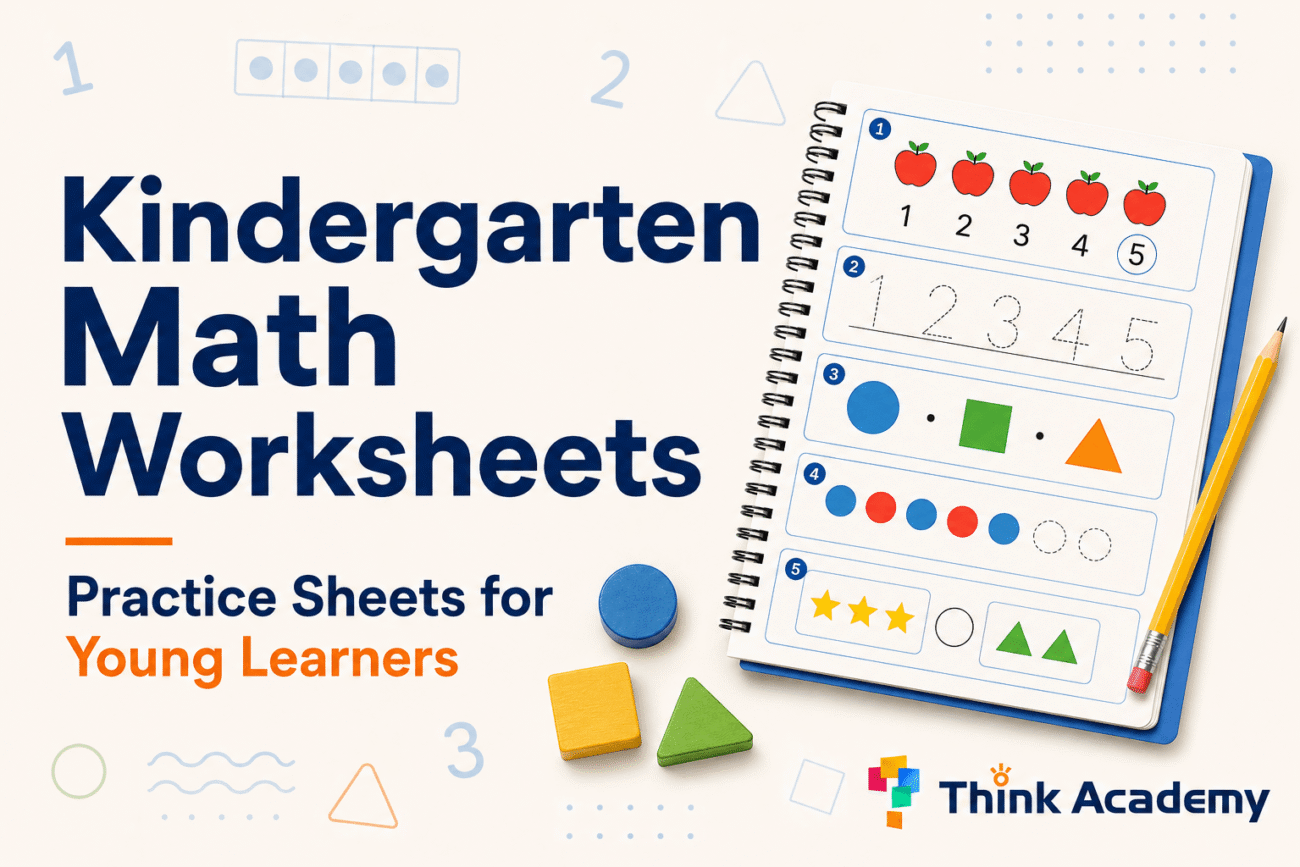
Kindergarten mathematics might look simple from the outside — counting to 10, recognising shapes, sorting by colour. But what happens in Kindergarten mathematics is far more important than the content alone suggests. The mathematical habits, number sense, and spatial reasoning built in these early years are the foundation for every year of school mathematics that follows. This page provides free kindergarten math worksheets and practice activities across every major concept area, with parent guidance on how to use them effectively. The worksheets are designed to be done together — not as independent homework, but as shared mathematical conversations between parent and child.
What Kindergarten Math Covers in Canada
The Ontario Kindergarten mathematics curriculum — closely aligned with other Canadian provincial programmes — covers five main concept areas:
- Number — counting to 30, recognising numerals 0–10, comparing quantities (more/less/equal), basic addition and subtraction concepts
- Algebra — sorting and classifying, repeating patterns, recognising and extending patterns
- Data — sorting objects by attribute, simple graphs and charts
- Spatial Sense — 2D and 3D shapes, positional language (above/below/beside), symmetry
- Measurement — comparing length, weight, and capacity using non-standard units; ordering by size
For a fuller picture of what early mathematics development looks like across Kindergarten and the early elementary years, see our number sense parent guide and Grade 1 math curriculum Ontario guide.
Kindergarten Math Worksheets: Counting Practice Activities
Counting to 30
Activity Set 1 — Counting Forwards and Backwards
Do these activities with your child, not just as printed exercises.
- Count together from 1 to 30. Point to each number on a number line or number chart as you say it.
- Count backwards from 10 to 1. Can your child do it independently?
- Count backwards from 20 to 1. This is harder — take turns if needed.
- Fill in the missing numbers:
- 1, 2, ___, 4, 5
- 7, 8, 9, ___, 11
- 15, ___, 17, 18, ___
- ___, 22, 23, ___, 25
- Start from 6. Count forward 5 more. Where do you land? ___
- Start from 14. Count back 4. Where do you land? ___
- Which number comes just before 9? ___
- Which number comes just after 17? ___
Answers: 4) 3; 10; 16, 19; 21, 24 5) 11 6) 10 7) 8 8) 18
Activity Set 2 — Counting Objects
These activities work best with real objects — blocks, coins, buttons, or small toys.
- Place 7 objects in front of your child. Can they count them correctly, touching each one once?
- Place a mixed group of 12 objects. Ask your child to count only the red ones.
- Give your child 20 small objects. Ask them to group them into sets of 5. How many groups?
- Ask: “If I have 8 apples and I add 2 more, how many do I have?” (Use objects to check.)
- Ask: “If I have 10 blocks and I take away 3, how many are left?” (Use objects to check.)
- Show 14 objects randomly scattered. Encourage your child to organise them first before counting.
Key skill to watch: One-to-one correspondence — each object gets counted exactly once. Children who count the same object twice or skip one are still developing this foundational skill.
Number Recognition and Writing
Activity Set 3 — Recognising and Writing Numerals 0–10
- Point to these numbers in random order and ask your child to name them: 3, 7, 1, 9, 5, 0, 8, 4, 2, 6
- Say each number and ask your child to write it: four, nine, two, seven, zero, six
- Draw dots and ask your child to write the matching numeral:
- ● ● ● ● ● = ___
- ● ● = ___
- ● ● ● ● ● ● ● = ___
- Which number is bigger — 7 or 4? ___
- Which number is smaller — 3 or 8? ___
- Put these in order from smallest to largest: 9, 2, 5, 7, 1
Answers: 3) 5; 2; 7 4) 7 5) 3 6) 1, 2, 5, 7, 9
Kindergarten Math Worksheets: Patterns Practice Activities
Activity Set 4 — Repeating Patterns
Patterns are one of the most important early algebra concepts. Spend real time here.
- Clap, clap, stomp. Clap, clap, stomp. What comes next? ___
- Red, blue, red, blue, red, ___. What colour comes next? ___
- Circle, triangle, circle, triangle, circle, ___. What shape comes next? ___
- Big, small, small, big, small, small, big, ___. What comes next? ___
- Create your own AB pattern using two colours of blocks or crayons. Draw it.
- Create an AAB pattern. What does it look like? ___
- A pattern goes: star, star, moon, star, star, ___. What comes next? ___
- Look at this pattern: 🔴 🔵 🔵 🔴 🔵 🔵 🔴 — what is the pattern rule? ___
Answers: 1) Clap 2) Blue 3) Triangle 4) Small 7) Moon 8) One red, two blue (ABB pattern)
Kindergarten Math Worksheets: Shapes Practice Activities
Activity Set 5 — 2D Shapes
- Draw a circle, a square, a triangle, and a rectangle.
- How many sides does a triangle have? ___
- How many corners does a square have? ___
- Name a shape with no corners. ___
- Which of these is a rectangle? (Describe to your child: tall and thin / short and wide / perfectly equal sides — all three can be rectangles, which is the point)
- Find three shapes in your home. Name each one.
- How many sides does a rectangle have? ___
- True or false: A square is a special type of rectangle. ___
Answers: 2) 3 3) 4 4) Circle 7) 4 8) True
Activity Set 6 — 3D Shapes
Use real objects from around the house for this one.
- Find something shaped like a cube. ___
- Find something shaped like a sphere. ___
- Find something shaped like a cylinder. ___
- How many flat faces does a cube have? ___
- Can a sphere roll? Can it stack? ___
- A cone has a flat circle base and a pointed top. Name something cone-shaped in real life. ___
- Which shape has no flat faces? ___
- How is a cube different from a rectangular prism? ___
Answers: 4) 6 5) Yes it can roll; no it cannot stack easily 7) Sphere 8) A cube has all equal sides; a rectangular prism can have different lengths
Kindergarten Math Worksheets: Sorting and Classifying Practice Activities
Activity Set 7 — Sorting
These activities require physical objects — use whatever is available.
- Sort a handful of mixed coins by type (pennies, nickels, dimes).
- Sort a pile of socks by colour.
- Sort a set of toy animals into two groups of your choice. What rule did you use?
- Given: a red big circle, a blue small circle, a red small square, a blue big square — sort by colour. How many in each group?
- Sort the same objects by size instead. How many in each group?
- Ask your child: “Can you sort these objects a different way?” (There is rarely only one correct answer — this builds flexible thinking.)
Key insight for parents: The ability to sort by one attribute, then re-sort by a different attribute, is an early algebra skill. It develops flexible categorical thinking that underpins mathematics and science learning throughout school.
Kindergarten Math Worksheets: Measurement Practice Activities
Activity Set 8 — Comparing and Ordering
Use non-standard units — hands, blocks, steps — not rulers. Kindergarten measurement is comparative, not precise.
- Find two objects. Which one is longer? How do you know?
- Line up three books in order from shortest to tallest.
- Use your hand to measure how long your desk is. How many hands wide is it?
- Which is heavier — your school bag or a pencil? How do you know without a scale?
- Fill a cup with water. Fill another cup less full. Which has more?
- Use blocks to measure two different paths on the floor. Which path is longer?
- Order these from lightest to heaviest: a feather, a book, a shoe.
- True or false: A long object is always heavier than a short one. ___
Answers: 8) False — length and weight are different attributes
Kindergarten Math Worksheets: Addition and Subtraction Concepts Practice Activities
Activity Set 9 — Early Number Operations
All of these should be done with physical objects first — kindergarten arithmetic is concrete, not abstract.
- I have 3 apples. I get 2 more. How many do I have now? (Use objects.) ___
- I have 5 blocks. I give away 2. How many are left? ___
- There are 4 birds on a tree. 3 more land. How many birds are there now? ___
- There are 7 fish in a bowl. 3 swim away. How many are left? ___
- I have 6 stickers. My friend has 4. How many do we have together? ___
- 2 + 2 = ___ (Use fingers or blocks.)
- 5 − 3 = ___
- 4 + 3 = ___
- 8 − 5 = ___
- 3 + 4 + 2 = ___
Answers: 1) 5 2) 3 3) 7 4) 4 5) 10 6) 4 7) 2 8) 7 9) 3 10) 9
How to Use Kindergarten Math Worksheets Effectively
Kindergarten mathematics is fundamentally different from older-grade mathematics in one crucial way: the most important learning happens through conversation, manipulation of objects, and play — not through completing printed sheets.
Kindergarten math worksheets are useful as a structure for shared mathematical activity. They are not a substitute for that activity.
Do the activities together. A kindergarten child completing a worksheet alone is likely tracing numbers without mathematical meaning. The same child working through the same content while you ask “how did you know that?” and “what if we changed the number?” is doing real mathematical thinking.
Use real objects wherever possible. Every counting and sorting activity on this page is more effective with physical objects than with printed symbols. Blocks, buttons, coins, toy cars — anything your child can touch, move, and group builds the concrete understanding that abstract numerals eventually represent.
Ask why, not just what. “How many?” is the right question. “How do you know?” is better. “Could you count them a different way and get the same answer?” is better still. These questions build the mathematical habits of mind that underpin every future year of mathematics.
Keep sessions short and positive. 10–15 minutes of focused, engaged mathematical play is worth more than 45 minutes of coerced worksheet completion. Stop while the child is still engaged — the goal is a child who wants to do mathematics tomorrow, not one who has finished today’s sheet.
Watch for the skills, not just the answers. In Kindergarten, what matters is whether your child is developing one-to-one correspondence, recognising patterns, sorting with a consistent rule, and using mathematical language (more, less, before, after). These are the indicators of mathematical readiness — not whether they can write the numeral 7 neatly.
What to Look for in Your Kindergarten Child’s Mathematical Development
The following are signs of strong mathematical development in Kindergarten — and signals that more support might be helpful.
Strong signs:
- Counts accurately to 20 or beyond with one-to-one correspondence
- Recognises numerals 0–10 reliably
- Can sort a group of objects by colour, shape, or size and explain the rule
- Recognises and extends a simple repeating pattern
- Uses mathematical language naturally: more, fewer, before, after, longer, shorter
Signs worth noting:
- Counting is inconsistent — sometimes right, sometimes skips or doubles-counts
- Numeral recognition is unreliable above 5
- Has difficulty sustaining focus on a simple sorting task
- Struggles to identify “which has more” when the difference is small (e.g. 6 vs 7)
- Shows significant anxiety or avoidance around mathematical activities
If several of these apply, it does not mean something is seriously wrong. It may simply mean your child needs more structured mathematical conversation and activity than the classroom alone is providing. Our Grade 1 math curriculum Ontario guide outlines exactly what the next step looks like — which is a useful reference for understanding where your child is heading.
Why Early Mathematical Foundations Matter More Than They Look
Parents sometimes wonder whether it is worth paying attention to Kindergarten mathematics — after all, it is counting and shapes, not calculus. But the research on early mathematical development is consistent: the foundations built in Kindergarten and Grade 1 are among the strongest predictors of mathematical performance in Grade 3, Grade 6, and beyond.
Number sense — the intuitive, flexible understanding of how numbers work — is built in these early years through counting, comparing, pattern recognition, and play. Children who build strong number sense in Kindergarten progress through the arithmetic curriculum faster and with less anxiety. Children who develop procedural habits without understanding (counting correctly but without knowing why) often hit a wall in Grade 2 or 3 when the mathematics becomes more abstract.
The investment of time and attention in Kindergarten mathematics is not about producing a prodigy. It is about building a child who thinks naturally in numbers, who approaches a new mathematical problem with curiosity rather than dread, and who arrives in Grade 1 ready to build on what they already understand — not starting from scratch.
For more on what strong number sense looks like and how to develop it, see our number sense parent guide.
How Think Academy Helps Young Learners
Think Academy Canada works with students from Grade 1 through Grade 12. For families with children in Kindergarten, our Grade 1 programme is the right starting point — building on exactly the foundations this page covers and establishing the mathematical habits that carry through every subsequent year.
Our approach with young learners:
- Short, engaging sessions structured around mathematical thinking, not worksheet completion
- Expert instructors who know how young children learn mathematics and how to make abstract concepts concrete
- Diagnostic placement — every student starts where they actually are, not where the calendar says they should be
- Parent communication so families can reinforce the same concepts between sessions
The free assessment is available for Grade 1 and above. If your child is in Kindergarten, the best first step is booking a free trial lesson to see how Think Academy’s approach works with your child specifically.
Frequently Asked Questions
What maths should a child know by the end of Kindergarten? By the end of Kindergarten, most children should count reliably to 30, recognise numerals 0–10, compare quantities using more/fewer/equal, sort objects by one attribute, identify and extend a simple repeating pattern, name basic 2D and 3D shapes, and compare objects by length, weight, or capacity using non-standard units.
Should kindergarten children be doing worksheets? Worksheets are one useful tool among many — not the primary learning vehicle. The most effective Kindergarten mathematics happens through structured play, conversation, and manipulation of physical objects. Worksheets work best as a shared activity with a parent, not as independent practice.
My child can count to 100 — are they ahead? Counting to high numbers is one indicator of mathematical readiness, but it is not the most important one. One-to-one correspondence (counting objects accurately), quantity comparison (knowing that 7 is more than 5), and number recognition matter more for Grade 1 readiness than rote counting to large numbers. A child who counts to 100 but cannot reliably say which of two groups has more is not as mathematically prepared as it might appear.
When should I start worrying about Kindergarten math? “Worrying” is rarely the right frame. But if your child reaches the end of Kindergarten unable to count reliably to 10, does not recognise basic numerals, cannot sort by a consistent rule, or shows significant anxiety around any mathematical activity, it is worth getting a clear picture of where they are through an assessment. Early is always better.
Does Think Academy work with Kindergarten students? Think Academy’s formal programme starts at Grade 1. For Kindergarten students, the best approach is a free trial lesson — our Grade 1 programme is designed to build on exactly the foundations Kindergarten develops, and many of our Grade 1 students join us before formal school begins or right at the start of Grade 1.
See our related guides: number sense parent guide · Grade 1 math curriculum Ontario · Grade 2 math curriculum Ontario · Grade 2 math worksheets · Grade 3 math worksheets · Ontario math curriculum overview · skip counting worksheets · growing patterns guide
Give your child a strong mathematical start — from the very beginning.