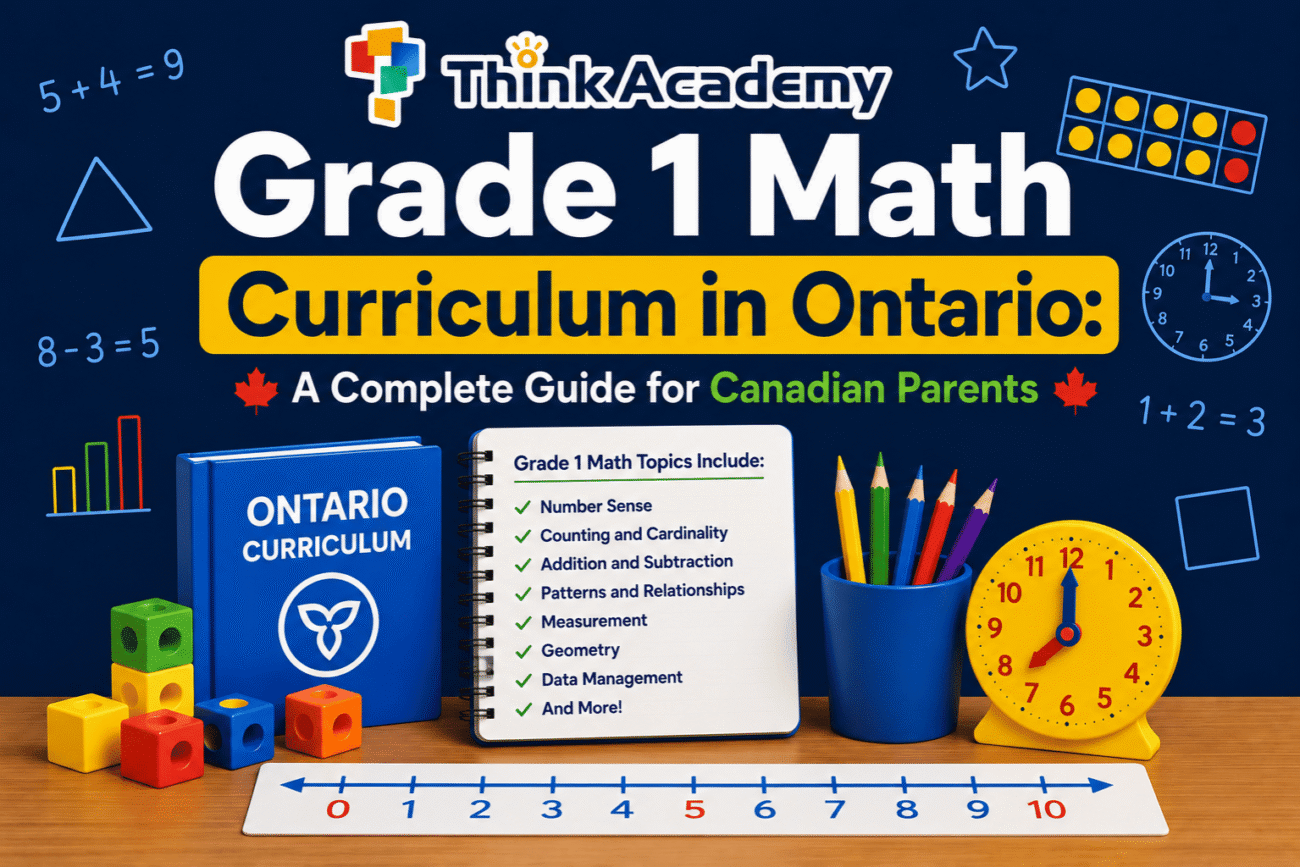
Grade 1 is where mathematical thinking begins in earnest. Before formal schooling, children count and compare informally. In Grade 1, those intuitions become structured. Numbers are read and written. Addition and subtraction are introduced as operations, not just counting. Patterns are described with rules. Shapes are sorted by properties. For parents who want to understand what their child is working on — or whether they are ahead, on track, or missing something — this guide covers every strand of the Ontario Grade 1 math curriculum completely and clearly.

Ontario Grade 1 math curriculum: the six strands
The Ontario 2020 math curriculum organises learning into six strands from Grade 1 through Grade 8. All six are active in Grade 1 throughout the year.
| Strand | Code | What it covers in Grade 1 |
|---|---|---|
| Social-Emotional Learning | A | Mathematical mindset, resilience, curiosity |
| Number | B | Whole numbers to 50; fractions; addition and subtraction; equal grouping |
| Algebra | C | Patterns; equations; coding |
| Data | D | Data collection and graphs; probability language |
| Spatial Sense | E | Geometry; measurement — length, area, mass, capacity, time |
| Financial Literacy | F | Canadian coins; value of money |
Strand B: Number
Number is the foundation of Grade 1 math and the strand that takes up the most instructional time.
B1: Number sense
Whole numbers to 50
In Grade 1, students read, represent, compose, and decompose whole numbers up to and including 50. They use a variety of representations — number lines, ten frames, base-ten blocks, written numerals — and they compare and order numbers in different contexts.
Counting to 50 is not the same as understanding numbers to 50. The curriculum requires students to understand place value at the two-digit level: that 37 means 3 tens and 7 ones, not just a symbol that comes after 36. This conceptual understanding is what separates strong early number sense from rote memorisation.
Even and odd
Students identify whether numbers are even or odd and begin to recognise patterns in even and odd sequences.
Fractions as fair sharing
Grade 1 introduces fractions through the context of equal sharing. Students divide shapes and sets of objects into equal parts and name those parts as halves, thirds, and fourths. The emphasis is entirely conceptual — each part must be equal, and a fraction describes one of those equal parts.
This is the first formal encounter with fractions. Students who understand fair sharing intuitively in Grade 1 have a significant head start on the more formal fraction work in Grades 3, 4, and 5.
Skip counting
Students skip count by 1s, 2s, 5s, and 10s forward and backward. Skip counting by 2s and 5s builds the multiplicative intuition that formal multiplication in Grade 3 will formalise.
B2: Operations
Addition and subtraction within 50
Grade 1 students add and subtract numbers up to 50, with a focus on developing a range of mental strategies rather than a single algorithm. Key strategies include:
- Counting on (starting from the larger number and counting up)
- Counting back
- Using doubles (6 + 6 = 12, so 6 + 7 = 13)
- Making ten (8 + 5 = 8 + 2 + 3 = 10 + 3 = 13)
Students are expected to recall addition and subtraction facts to 10 with increasing fluency by the end of Grade 1. Fluency with facts to 10 is one of the clearest predictors of success in Grade 2 and beyond.
Equal grouping and sharing
Grade 1 introduces the concepts of multiplication and division informally through equal grouping (how many groups of 2 are in 10?) and equal sharing (if 12 objects are shared equally among 4, how many does each get?). No formal multiplication or division is expected — the goal is to build the concept before the notation.
Strand C: Algebra
C1: Patterns and relationships
Grade 1 students identify, describe, extend, create, and translate repeating patterns. They recognise that patterns can be made of shapes, objects, sounds, colours, numbers, or letters — and that the same pattern can be represented in different ways (a pattern of red-blue-red-blue is the same structure as a pattern of clap-stomp-clap-stomp).
Students also begin to use patterns to make predictions — extending a pattern and explaining why their prediction follows the rule.
C2: Equations and inequalities
Grade 1 students use the symbols =, >, and < to describe relationships between quantities. They solve simple equations involving an unknown, such as:
- □ + 3 = 7
- 10 − □ = 4
This is the first formal introduction to algebraic thinking — the idea that a symbol can represent an unknown value. Students work with concrete materials and visual representations before moving to symbolic notation.
C3: Coding
Under the 2020 Ontario curriculum, coding is embedded in mathematics from Grade 1. Students create and follow sequential code — a series of steps — to model real-world situations and mathematical ideas. They also identify and correct errors in simple code (debugging). In Grade 1, this is typically done with unplugged activities or simple visual programming tools rather than text-based code.
Strand D: Data
D1: Data literacy
Grade 1 students collect data by sorting and organising objects and by conducting simple surveys. They display data using:
- Concrete graphs (physical objects arranged in rows or columns)
- Pictographs
- Bar graphs
- Two-way tables
They draw conclusions by comparing categories — identifying which has the most, which has the least, and how many more one category has than another.
A key Grade 1 expectation is comparing results from surveys with different populations — for example, asking both students and adults the same question and comparing their answers. This introduces the idea that data can vary depending on who provides it.
D2: Probability
Grade 1 students describe the likelihood of everyday events using the language: impossible, possible, and certain. They make simple predictions based on this language and begin to connect probability to data — if most students in a survey prefer apples, it is more likely that the next student asked will also prefer apples.
Strand E: Spatial Sense
E1: Geometric and spatial reasoning
Two-dimensional shapes
Grade 1 students identify, sort, and describe 2D shapes — squares, rectangles, triangles, circles, and other polygons — by their properties: number of sides, side lengths, angles, and lines of symmetry (where applicable). They sort shapes using a single attribute and explain their sorting rule.
Students also work with location and movement: using positional language (above, below, left, right, in front, behind) and giving and following directions to move objects from one location to another.
Three-dimensional objects
Students identify 3D objects — cubes, rectangular prisms, cylinders, cones, pyramids, spheres — and sort them by their properties (number of faces, whether they roll or slide). They connect 2D shapes to the faces of 3D objects.
E2: Measurement
Grade 1 measurement is primarily comparative and non-standard, with some introduction to standard units.
Length and area
Students compare several objects and order them by length or area. They measure length using non-standard units (such as paper clips or cubes) and begin to understand that a standard unit is needed for consistent measurement.
Mass and capacity
Students compare objects by mass (heavier, lighter) and containers by capacity (holds more, holds less) using direct comparison and non-standard units.
Time
Students identify and sequence events using the language of time: morning, afternoon, evening, yesterday, today, tomorrow. They read time to the nearest hour on analogue clocks and connect time to their daily routines.
Strand F: Financial Literacy
In Grade 1, financial literacy focuses on identifying and understanding the value of Canadian coins.
Students:
- Identify pennies, nickels, dimes, and quarters and state their values
- Represent specific amounts using different combinations of coins
- Compare the value of different combinations
- Solve simple problems involving the cost of items and whether they have enough money
The connection to number sense is direct: counting coins by 5s and 10s reinforces skip counting; comparing coin combinations reinforces comparison and ordering of numbers.

What makes Grade 1 math the most important year to get right
Grade 1 is not the most academically complex year of elementary school. But it may be the most consequential.
The skills built in Grade 1 are the direct foundation for everything that follows:
- Addition facts to 10 are the basis for Grade 2 addition to 100 with regrouping, and for multiplication in Grade 3
- Place value to 50 is the basis for numbers to 200 in Grade 2 and numbers to 10,000 in Grade 4
- Pattern reasoning is the basis for algebraic thinking from Grade 4 onward
- Fraction concepts built in Grade 1 are returned to formally in Grades 3, 4, and 5
A student who arrives at Grade 2 without fluent addition facts to 10 and solid place value understanding at two digits is already behind. The curriculum does not slow down to fill those gaps — it builds on them.
This is why Grade 1 is the highest-leverage entry point for families thinking about the long term. A student who starts with strong foundations in Grade 1 is better positioned for Grade 3 EQAO, for Grades 7 and 8 competition math, and for the full 12-year mathematics journey ahead.
Grade 1 math in context: what comes next
| Grade | Key new content built on Grade 1 foundations |
|---|---|
| Grade 2 | Numbers to 200; addition and subtraction with regrouping; fractions of sets |
| Grade 3 | Multiplication and division facts; fractions on number lines; EQAO assessment |
| Grade 4 | Multi-digit operations; equivalent fractions; area formulas; numbers to 10,000 |
| Grade 5 | Fractions, decimals, and percents connected; numbers to 100,000 |
Every row in that table depends on Grade 1 foundations being solid. A child who is confident, curious, and fluent at the end of Grade 1 has a head start that compounds for years.
Grade 1 math curriculum across Canada: how Ontario compares
| Province | Curriculum | Key Grade 1 features |
|---|---|---|
| Ontario | 2020 Ontario Math Curriculum | 6 strands; coding from Grade 1; financial literacy from Grade 1; numbers to 50 |
| BC | BC Curriculum (redesigned 2016) | Competency-based; number, patterns/relations, shape/space, statistics/probability; less prescriptive |
| Alberta | Alberta K–6 Program of Studies | Number, patterns/relations, shape/space, statistics/probability; financial literacy less prominent |
| Manitoba | Manitoba K–8 Mathematics | Western Protocol aligned; broadly similar number and operations focus |
Ontario is distinctive at the Grade 1 level for embedding coding and financial literacy as explicit strand expectations from the very first year of formal schooling. The BC curriculum covers similar mathematical content but frames expectations more broadly, making it harder for parents to track exactly what their child should know at each grade.
Common Grade 1 math struggles and what they signal
| Struggle | What it usually means |
|---|---|
| Still counting all instead of counting on | Addition strategies have not been explicitly taught or practised |
| Cannot read two-digit numbers reliably | Place value at the tens-ones level is not yet consolidated |
| Confuses the = symbol with ‘the answer goes here’ | Equation understanding is procedural, not conceptual — the = means ‘the same as’, not a signal to calculate |
| Cannot extend a simple repeating pattern | Pattern rule has not been identified — child is copying visually rather than reasoning |
| Difficulty with time vocabulary | Abstract time language needs contextual practice connected to daily routines |
Most Grade 1 struggles are entirely fixable with consistent, targeted practice. The risk is not that a Grade 1 student will fall behind permanently — it is that small gaps, if unnoticed, make Grade 2 harder than it needs to be.
How Think Academy Canada supports Grade 1 students
Think Academy Canada works with high-performing Ontario students from Grade 1 through Grade 12. Our Grade 1 programme builds the foundations that matter most for long-term mathematical development: fluent addition and subtraction strategies, solid place value understanding, confident pattern reasoning, and the curiosity that makes mathematics enjoyable.
We start with a diagnostic. Every new student completes a free assessment and receives a personalised feedback report showing exactly where their skills sit strand by strand. For Grade 1 students, the report identifies the specific areas — whether that is counting strategies, number sense, or early algebraic thinking — that would benefit most from structured support.
For parents who are thinking about the long game — Grade 3 EQAO, competition mathematics in Grades 7 and 8, or the pathway toward Waterloo CEMC contests in high school — Grade 1 is the right time to start. The earlier the foundations are built, the more time there is for them to compound.

FAQ
What are the strands in the Ontario Grade 1 math curriculum?
The Ontario Grade 1 math curriculum has six strands under the 2020 curriculum: Social-Emotional Learning (A), Number (B), Algebra (C), Data (D), Spatial Sense (E), and Financial Literacy (F). All six are taught throughout the year.
What numbers do Grade 1 students work with in Ontario?
In Grade 1, students work with whole numbers up to and including 50. They also explore fractions through equal sharing (halves, thirds, fourths) and work with Canadian coins in the financial literacy strand.
Do Grade 1 students learn addition and subtraction in Ontario?
Yes. Grade 1 students add and subtract numbers up to 50 using a variety of mental strategies. They are expected to recall addition and subtraction facts to 10 with increasing fluency by the end of the year.
What geometry do Grade 1 students learn in Ontario?
Grade 1 students identify and sort 2D shapes (by number of sides, side lengths, and angles) and 3D objects (by number of faces and whether they roll or slide). They also use positional language and give and follow directions for moving objects through space.
Is algebra taught in Grade 1 in Ontario?
Yes. Grade 1 students identify and extend repeating patterns, use symbols (=, >, <) to describe relationships, and solve simple equations with one unknown (such as □ + 3 = 7). Coding is also embedded in the algebra strand from Grade 1.
Is coding part of the Ontario Grade 1 math curriculum?
Yes. The 2020 Ontario curriculum embeds coding in the Algebra strand from Grade 1. In Grade 1, students create and follow sequential code and identify errors in simple code sequences, typically using unplugged activities or simple visual tools.
What measurement skills are expected in Grade 1?
Grade 1 measurement is primarily comparative. Students compare objects by length, area, mass, and capacity, and order several objects by these attributes. They read time to the nearest hour and use time vocabulary (morning, afternoon, yesterday, today, tomorrow).
Is financial literacy part of the Ontario Grade 1 math curriculum?
Yes. Financial literacy is a named strand in the 2020 Ontario curriculum from Grade 1 upward. In Grade 1, students identify Canadian coins, state their values, represent amounts using different coin combinations, and solve simple money problems.
What is the difference between Kindergarten and Grade 1 Ontario math?
In Kindergarten, mathematics is exploratory and embedded in play-based learning. Grade 1 introduces formal structure: specific number expectations (to 50), written equations, defined pattern rules, and explicit strand-by-strand expectations against which students are assessed. Grade 1 is where informal mathematical intuitions become formal skills.
How does Grade 1 math connect to Grade 3 EQAO?
EQAO is written in Grade 3. The content tested — number sense, operations, basic geometry, and measurement — is built on the foundations of Grades 1 and 2. A student who arrives at Grade 3 with solid Grade 1 and 2 skills is well positioned for the assessment. Gaps in early number sense often surface most visibly at the Grade 3 EQAO.
When should I be concerned about my child’s Grade 1 math progress?
If your child is still counting all objects to add (rather than counting on from the larger number), cannot reliably read two-digit numbers, or struggles to extend a simple repeating pattern by the middle of Grade 1, these are worth addressing early. They are fixable — but Grade 2 builds directly on these foundations.
How is the Ontario Grade 1 math curriculum different from BC?
Ontario specifies detailed expectations strand by strand. BC’s redesigned curriculum is competency-based and less prescriptive, framing learning through broad understandings rather than specific skills at each grade. The content is broadly similar, but Ontario parents have more precise guidance on what to expect at each grade level.
Does Think Academy Canada offer support for Grade 1 students?
Yes. Think Academy Canada serves Ontario students from Grade 1 through Grade 12. All lessons are delivered online. A free diagnostic assessment and personalised feedback report are available for any student.
What should a Grade 1 student be able to do by the end of the year?
By the end of Grade 1, students should: read and write numbers to 50; add and subtract within 50 using mental strategies; recall addition and subtraction facts to 10 with fluency; identify and extend repeating patterns; describe fractions as equal parts of a whole; sort 2D shapes and 3D objects by their properties; read time to the nearest hour; and identify Canadian coins and their values.
About Think Academy Canada Think Academy Canada is a K-12 mathematics tutoring programme, part of TAL Education Group. We work with motivated students across Canada from Grade 1 through Grade 12, with a focus on Ontario curriculum, EQAO preparation, and competition mathematics including CEMC and AMC. All lessons are delivered online. Follow us on Instagram at @thinkacademyca.