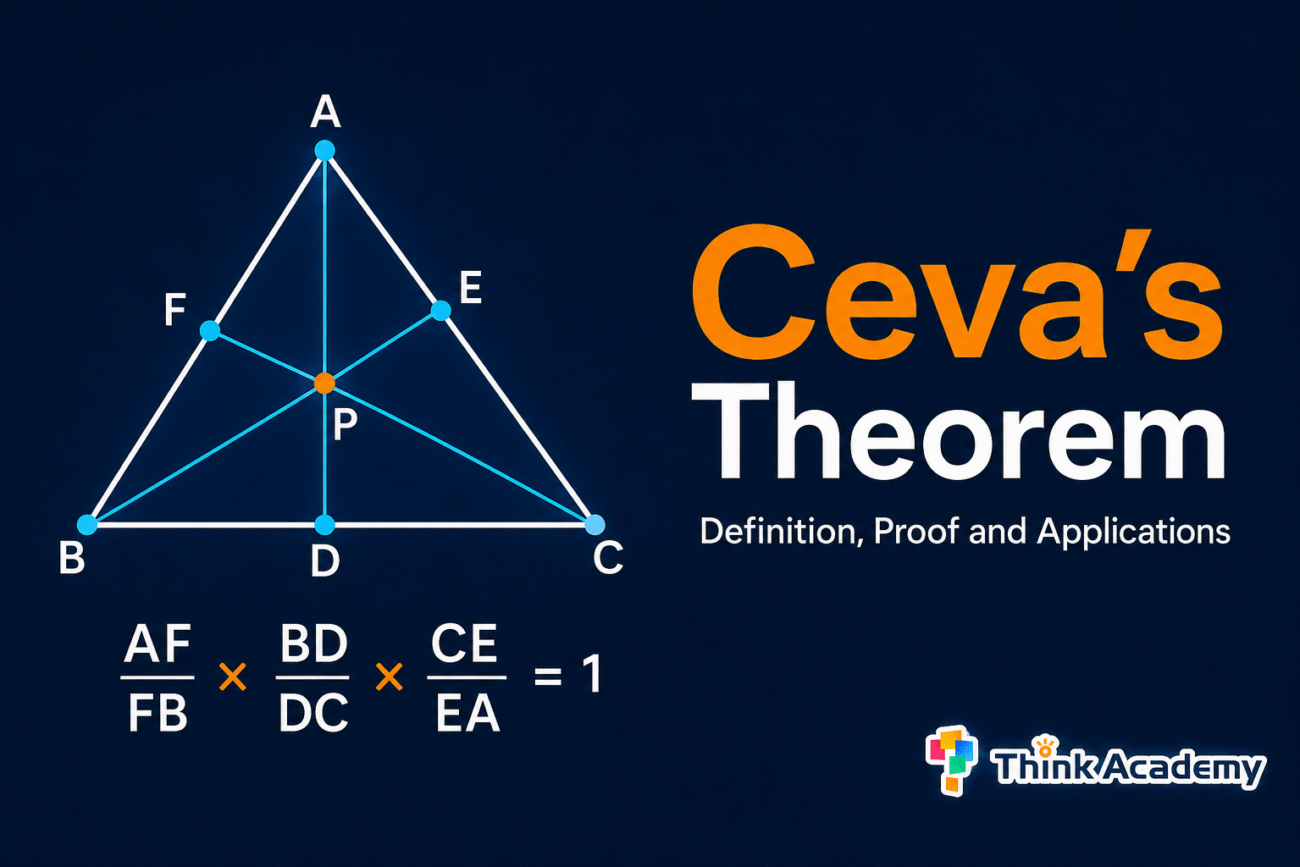
Ceva’s theorem is one of the most elegant and useful results in triangle geometry. It gives a precise, elegant condition for when three lines drawn from the vertices of a triangle all pass through a single point — a property called concurrency. It is a standard tool in competition geometry at the AMC 10, AMC 12, Euclid, and COMC level, and it connects to some of the most beautiful classical results in Euclidean geometry.
What Is a Cevian?
Before stating Ceva’s theorem, the key term: a cevian of a triangle is a line segment from a vertex of the triangle to a point on the opposite side (or its extension).
In triangle ABC:
- A cevian from vertex A meets the opposite side BC at some point D
- A cevian from vertex B meets the opposite side CA at some point E
- A cevian from vertex C meets the opposite side AB at some point F
Famous cevians:
- The medians — cevians from each vertex to the midpoint of the opposite side. All three medians are concurrent at the centroid.
- The altitudes — perpendiculars from each vertex to the opposite side. All three altitudes are concurrent at the orthocentre.
- The angle bisectors — bisectors of each interior angle. All three are concurrent at the incentre.
These three classical facts — medians, altitudes, and angle bisectors each being concurrent — are all special cases of Ceva’s theorem.
Ceva’s Theorem: Statement
Ceva’s Theorem: In triangle ABC, let D, E, F be points on sides BC, CA, AB respectively (or their extensions). The cevians AD, BE, CF are concurrent (all pass through a single point) if and only if:DCBD⋅EACE⋅FBAF=1
Note on signs: When working with points on the extensions of sides (outside the triangle), signed ratios are used. For points inside the triangle, all ratios are positive and the product equals 1 with all positive values. The signed version (sometimes called the trigonometric form when combined with angles) generalises to points outside the triangle.
The “if and only if”: Ceva’s theorem works in both directions:
- If the three cevians are concurrent, the ratio product equals 1.
- If the ratio product equals 1, the three cevians are concurrent.
This makes it both a test for concurrency and a tool for constructing concurrent cevians.
Proof of Ceva’s Theorem
The most accessible proof uses areas.
Setup: Let the three cevians AD, BE, CF be concurrent at point P inside triangle ABC.
Step 1: Express BD/DC using areas.DCBD=[△ACD][△ABD]=[△PCD][△PBD]
where [△XYZ] denotes the area of triangle XYZ. Both ratios hold because triangles sharing the same height have areas proportional to their bases.
Combining these (using the property ba=dc=b+da+c):DCBD=[△ACD]+[△PCD][△ABD]+[△PBD]
Wait — let’s use the cleaner form. Since A, B, D lie with D on BC:DCBD=[△ACD][△ABD]
and also:DCBD=[△PCD][△PBD]
Using the ratio-sum property:DCBD=[△ACP][△ABP]
Step 2: Similarly:EACE=[△ABP][△BCP],FBAF=[△BCP][△ACP]
Step 3: Multiply:DCBD⋅EACE⋅FBAF=[△ACP][△ABP]⋅[△ABP][△BCP]⋅[△BCP][△ACP]=1□
The converse: If the product equals 1, let CF′ be the cevian through the intersection of AD and BE. Then by the forward direction, F′BAF′=FBAF, so F=F′ and the three cevians are concurrent. □
The Three Classical Concurrencies: Ceva’s Theorem in Action
The Centroid (Medians are Concurrent)
The medians connect each vertex to the midpoint of the opposite side:
D = midpoint of BC: BD/DC=1 E = midpoint of CA: CE/EA=1 F = midpoint of AB: AF/FB=1
Product: 1×1×1=1 ✓
Ceva’s theorem confirms the medians are concurrent. The point of concurrence is the centroid, which divides each median in the ratio 2:1 from the vertex.
The Angle Bisector Concurrency (Incentre)
By the Angle Bisector Theorem: the bisector from vertex A to side BC divides BC in the ratio $AB:AC = c:b$.
So: BD/DC=c/b, CE/EA=a/c, AF/FB=b/a
Product: bc⋅ca⋅ab=1 ✓
The angle bisectors are concurrent at the incentre.
The Altitude Concurrency (Orthocentre)
In triangle ABC with altitude foot D on BC from A:
Using trigonometry: BD=ccosB and DC=bcosC, so BD/DC=(ccosB)/(bcosC).
Similarly: CE/EA=(acosC)/(ccosA) and AF/FB=(bcosA)/(acosB).
Product: bcosCccosB⋅ccosAacosC⋅acosBbcosA=1 ✓
The altitudes are concurrent at the orthocentre.
Three classical theorems — all special cases of Ceva’s theorem — proved in a few lines each.

Worked Examples
Example 1 — Testing Concurrency (AMC/Competition Level)
In triangle ABCABC ABC, point DD D is on BCBC BC with $BD:DC = 2:3, point $E is on CACA CA with $CE:EA = 4:1, and point $F is on ABAB AB with $AF:FB = 3:8. Are the cevians $AD , BEBE BE, CFCF CF concurrent?
Compute the product:DCBD⋅EACE⋅FBAF=32⋅14⋅83=3×1×82×4×3=2424=1
Yes — the cevians are concurrent. ✓
Example 2 — Finding an Unknown Ratio
In triangle ABCABC ABC, cevians ADAD AD, BEBE BE, CFCF CF are concurrent. Given BD/DC=3BD/DC = 3 BD/DC=3, CE/EA=2CE/EA = 2 CE/EA=2, find AF/FBAF/FB AF/FB.
By Ceva’s theorem:DCBD⋅EACE⋅FBAF=1 3⋅2⋅FBAF=1⟹FBAF=61
$AF:FB = 1:6$.
Example 3 — Using Ceva to Prove a Result
Prove that the medians of a triangle bisect each other.
By Ceva’s theorem with the three medians: BD/DC=CE/EA=AF/FB=1, product = 1. Medians are concurrent (at the centroid G).
By the section formula: if G divides AD in ratio $AG:GD, and using the area method in the proof, $G divides each median in ratio $2:1$ from the vertex.
The medians bisect each other at the centroid, which lies 2/3 of the way from each vertex.
Example 4 — Euclid-Style Application
In triangle ABCABC ABC with AB=5AB = 5 AB=5, BC=6BC = 6 BC=6, CA=7CA = 7 CA=7, the angle bisectors from AA A, BB B, CC C meet sides BCBC BC, CACA CA, ABAB AB at DD D, EE E, FF F respectively. Find BDBD BD.
By the Angle Bisector Theorem: BD/DC=AB/AC=5/7.
So BD=125×BC=125×6=25.
BD=2.5BD = 2.5 BD=2.5.
(The concurrency of the angle bisectors follows from Ceva’s theorem, as shown above.)
Example 5 — Competition Problem
Points DD D, EE E, FF F lie on sides BCBC BC, CACA CA, ABAB AB of triangle ABCABC ABC respectively such that BD=2DCBD = 2DC BD=2DC, CE=3EACE = 3EA CE=3EA. The cevians ADAD AD, BEBE BE, CFCF CF are concurrent. Find the ratio in which FF F divides ABAB AB.
BD/DC=2, CE/EA=3.
By Ceva’s theorem:2⋅3⋅FBAF=1⟹FBAF=61
FF F divides ABAB AB in ratio $AF:FB = 1:6$ (from AA A).
The Trigonometric Form of Ceva’s Theorem
The trigonometric form is particularly useful for angle bisectors and problems involving angle measures:
Trigonometric Ceva’s Theorem: Cevians AD, BE, CF in triangle ABC are concurrent if and only if:sin∠DACsin∠BAD⋅sin∠EBAsin∠CBE⋅sin∠FCBsin∠ACF=1
This form is equivalent to the standard form and is often more natural when angles are given rather than lengths.
Application: Proving the altitudes are concurrent using the trigonometric form:
The altitude from A makes angle (90°−B) with AB and (90°−C) with AC.
sin∠BAD/sin∠DAC=sin(90°−B)/sin(90°−C)=cosB/cosC
Similarly for BE and CF. The product gives (cosB/cosC)(cosC/cosA)(cosA/cosB)=1 ✓
Menelaus’ Theorem: The Companion Result
Ceva’s theorem has a companion: Menelaus’ theorem, which gives the condition for three points on the sides of a triangle (or their extensions) to be collinear (all on a single line):DCBD⋅EACE⋅FBAF=−1(using signed ratios)
Or equivalently, with unsigned ratios where an odd number of points lie on extensions:DCBD⋅EACE⋅FBAF=1(with one or three points on extensions)
The key distinction:
- Ceva’s theorem: product = 1 → cevians are concurrent
- Menelaus’ theorem: product = 1 (unsigned, odd number on extensions) → points are collinear
Together, Ceva and Menelaus form the complete toolkit for classical triangle geometry involving ratios on sides.
Where Ceva’s Theorem Appears in Competitions
Ceva’s theorem is a standard tool in competition geometry at the Grade 11–12 and competition level.
AMC 10 and AMC 12: Triangle geometry problems at the AMC 10 and 12 level frequently involve proving concurrency or using the properties of special points (centroid, orthocentre, incentre, circumcentre). A student who knows Ceva’s theorem can approach these problems systematically rather than relying on case-by-case geometric insight. See our AMC 10 guide and math competitions in Canada guide.
Euclid Contest (CEMC, Grade 12): Triangle geometry — including concurrency problems — appears in Euclid Part B and Part C. Ceva’s theorem provides an algebraic handle on geometric concurrency that can convert a proof from a long synthetic argument into a clean ratio calculation. A student who knows it solves concurrency problems reliably; one who does not must rely on geometric intuition that is harder to reproduce under time pressure. See our Euclid math contest guide and Euclid past contests guide.
COMC Part C: COMC Part C geometry problems occasionally involve cevians, concurrency, or ratios in triangles. Ceva’s theorem is one of several classical results (alongside the Pythagorean theorem, similar triangles, and circle theorems) that belong in a serious competition preparation toolkit. See our COMC math contest guide.
Canadian Mathematical Olympiad: At the CMO level, Ceva’s theorem appears as a tool within more complex geometric configurations. Students who know the theorem — including the trigonometric form and its relationship to Menelaus — have access to a more complete set of geometric tools. See our Canadian Mathematical Olympiad guide.
MHF4U (Grade 12 Ontario) and beyond: While Ceva’s theorem is not part of the standard Ontario curriculum, it bridges naturally from the triangle geometry in MCR3U and MHF4U into competition geometry. Students in Grade 12 preparing for both curriculum assessments and competitions benefit from understanding the classical geometric results that Ceva’s theorem unifies. See our MHF4U Advanced Functions guide.
Common Mistakes with Ceva’s Theorem
Mistake 1: Getting the ratio direction wrong.The ratio BD/DC has B in the numerator and the adjacent vertex of the following ratio is C — i.e., the cyclic order matters. The correct product is DCBD⋅EACE⋅FBAF where the denominator of each ratio is the starting vertex of the next. Reversing any ratio inverts the product.
Mistake 2: Confusing Ceva with Menelaus. Both give conditions involving a product of three ratios equalling 1 — but for different geometric situations. Ceva: cevians concurrent. Menelaus: points collinear. Check which situation the problem involves before applying a result.
Mistake 3: Applying the theorem when points are on extensions without using signed ratios. When cevians are drawn to extensions of sides (not between the vertices), the ratios become negative in the signed version. For the unsigned version, the product must still equal 1 but an odd number of division points must lie on extensions. Careful reading of the problem statement is essential.
Mistake 4: Checking only two cevians. Ceva’s theorem requires all three cevians. A student who verifies two ratios and assumes the third follows is making a logical error — the theorem involves all three simultaneously.
Practice Problems
Set A — Testing concurrency
In each case, determine whether the cevians are concurrent using Ceva’s theorem:
- $BD:DC = 1:2$, $CE:EA = 2:3$, $AF:FB = 3:1$
- $BD:DC = 3:1$, $CE:EA = 1:3$, $AF:FB = 3:1$
- D, E, F are midpoints of BC, CA, AB
- BD=4, DC=6, CE=3, EA=9, AF=6, FB=4
Set B — Finding ratios
- Cevians concurrent; BD/DC=4, CE/EA=3. Find AF/FB.
- Cevians concurrent; $BD:DC = 2:5$, $AF:FB = 5:6$. Find $CE:EA$.
- In triangle ABC with AB=8, BC=9, the angle bisectors from A and B meet BC and CA at D and E. The cevians are concurrent (at the incentre). Find BD.
Set C — Proof and application
- Using Ceva’s theorem, prove that the altitudes of an acute triangle are concurrent.
- Points D, E, F are on BC, CA, AB with $BD:DC = 2:1$, $CE:EA = 2:1$, $AF:FB = 2:1. Are $AD , BE, CF concurrent? If yes, find the ratio in which the point of concurrence divides each cevian from its vertex.
- The cevians AD, BE, CF are concurrent at P. Prove that AP/PD+BP/PE+CP/PF=AP/PD⋅BP/PE⋅CP/PF.
Answers:
Set A:
- 21⋅32⋅13=1 ✓ Concurrent
- 13⋅31⋅13=3=1 ✗ Not concurrent
- All ratios = 1, product = 1 ✓ Concurrent (centroid)
- 64⋅93⋅46=32⋅31⋅23=186=31=1 ✗ Not concurrent
Set B: 5. 4⋅3⋅FBAF=1⇒FBAF=121. **AF:FB=1:12** 6. 52⋅EACE⋅65=1⇒EACE=2⋅51⋅5⋅6=3. **CE:EA=3:1** 7. By Angle Bisector Theorem: BD/DC=AB/AC=8/AC. Need AC — not given directly. *Note to publisher: triangle sides needed to complete; add CA to the problem, e.g. CA=7, then BD/DC=8/7, BD=158×9=4.8.*
Set C: 8. Altitude from A: foot D on BC. BD=ABcosB=ccosB, DC=ACcosC=bcosC. So BD/DC=ccosB/bcosC. Similarly compute CE/EA and AF/FB. Product telescopes to 1 ✓. 9. Product =12⋅12⋅12=8=1. Not concurrent. 10. Use the result AP/PD=([△ABP]+[△ACP])/[△BCP]. Sum the three ratios and factor — the product identity follows from the area decomposition. (Full solution is CMO-level — outline only.)
Frequently Asked Questions
What is Ceva’s theorem?Ceva’s theorem states that in triangle ABC, cevians AD, BE, CF (where D, E, F lie on BC, CA, AB respectively) are concurrent if and only if (BD/DC)(CE/EA)(AF/FB)=1.
What is a cevian? A line segment from a vertex of a triangle to a point on the opposite side (or its extension). Medians, altitudes, and angle bisectors are all cevians.
What does Ceva’s theorem prove about medians, altitudes, and angle bisectors? All three are concurrent — medians at the centroid, altitudes at the orthocentre, and angle bisectors at the incentre. Each concurrency follows from Ceva’s theorem by verifying the product of three ratios equals 1.
How is Ceva’s theorem different from Menelaus’ theorem? Both involve a product of three ratios from a triangle’s sides. Ceva’s theorem gives the condition for three cevians to be concurrent. Menelaus’ theorem gives the condition for three points (one on each side or extension) to be collinear. They are companion results.
Does Ceva’s theorem appear in the Ontario curriculum? Not in the standard curriculum — but it appears in competition mathematics preparation for students in Grades 10–12. It is relevant for the Euclid Contest, AMC 10/12, COMC, and the Canadian Mathematical Olympiad.
What is the trigonometric form of Ceva’s theorem?(sin∠BAD/sin∠DAC)(sin∠CBE/sin∠EBA)(sin∠ACF/sin∠FCB)=1. Equivalent to the standard form and particularly useful when angles are given rather than side ratios.
See our related guides: Euclid math contest guide · Euclid past contests guide · COMC math contest guide · Canadian Mathematical Olympiad guide · triangle inequality theorem guide · Pythagorean triples guide · special triangles in trigonometry · AMC 10 guide · MHF4U Advanced Functions guide · math competitions in Canada
Ceva’s theorem is the key that unlocks triangle concurrency. Know it before competition geometry tests you on it.