Introduction
Geometry is one of the most important topics in the AMC 8 math contest. Many problems test students’ understanding of angles, polygons, circles, and 3D shapes. Having a strong grasp of geometry formulas—and knowing how to apply them—is the key to solving AMC 8 questions quickly and accurately.
In this guide, we’ll:
- Review the essential geometry formulas for AMC 8.
- Show how geometry worksheets and practice problems help students master these concepts.
- Explain how Think Academy Canada’s L3–L8 and AMC8 courses build geometry knowledge step by step.
Why Geometry Matters in AMC 8
- Geometry problems often combine formulas with logical reasoning.
- Many questions test area and perimeter of composite shapes, not just basic triangles or rectangles.
- AMC 8 geometry can include word problems, diagrams, and 3D shapes that require quick formula recall.
That’s why having a formula guide and worksheets to practice is essential.

Core AMC 8 Geometry Formulas
Here are the most important geometry formulas every AMC 8 student should know:
1. Angles and Lines
| Concept | Formula or rule |
|---|---|
| Angles on a straight line | Sum = 180° |
| Angles at a point | Sum = 360° |
| Vertically opposite angles | Always equal |
| Supplementary angles | Sum = 180° |
| Complementary angles | Sum = 90° |
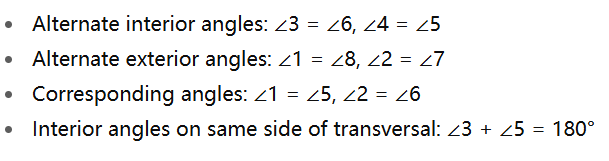
| Co-interior angles (parallel lines) | Sum = 180° |
| Alternate angles (parallel lines) | Always equal |
| Corresponding angles (parallel lines) | Always equal |
Read Supplementary Angles Explained: Definition, Examples and AMC 8 Problems for more on angles and AMC 8.
2. Triangles
| Concept | Formula or rule |
|---|---|
| Sum of interior angles | 180° |
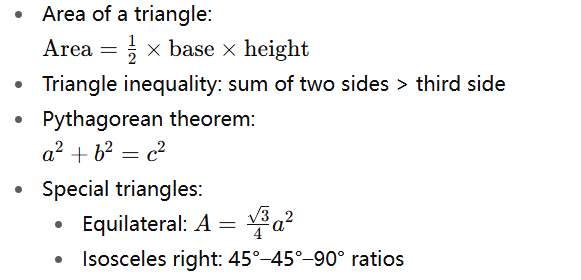
| Area | (1/2) x base x height |
| Area of equilateral triangle | (s²√3)/4 |
| Height of equilateral triangle | (s√3)/2 |
| Pythagorean theorem | a² + b² = c² |
| Exterior angle | Equals sum of two non-adjacent interior angles |
| Common Pythagorean triples | 3-4-5, 5-12-13, 8-15-17, 7-24-25 |
Pythagorean Theorem Worksheet: Practice Problems for AMC 8 Students
3. Quadrilaterals and Polygons
| Shape | Area | Perimeter |
|---|---|---|
| Square | s² | 4s |
| Rectangle | l x w | 2(l + w) |
| Parallelogram | b x h | 2(a + b) |
| Trapezoid | (1/2)(b₁ + b₂) x h | sum of sides |
| Regular polygon interior angle | (n-2) x 180 / n | — |
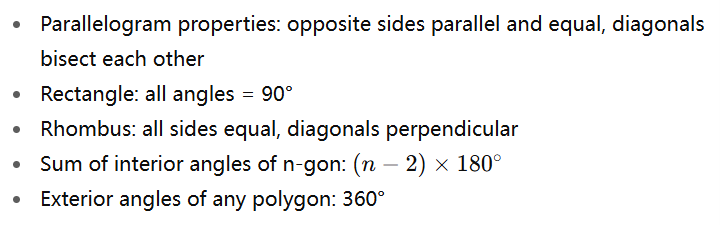
| Sum of interior angles | (n-2) x 180 | — |
| Sum of exterior angles | 360° (always) | — |
| Number of diagonals | n(n-3)/2 | — |
Area and Perimeter Worksheets: How to Solve Every AMC 8 Geometry Problem
4. Circles
| Concept | Formula |
|---|---|
| Area | πr² |
| Circumference | 2πr |
| Diameter | 2r |
| Area of semicircle | (1/2)πr² |
| Perimeter of semicircle | πr + 2r |
| Arc length (angle θ in degrees) | (θ/360) x 2πr |
| Sector area (angle θ in degrees) | (θ/360) x πr² |
Common circle fact for AMC 8: a chord’s perpendicular bisector always passes through the centre of the circle.
5. 3D Geometry
| Shape | Volume | Surface area |
|---|---|---|
| Cube (side s) | s³ | 6s² |
| Rectangular prism (l x w x h) | lwh | 2(lw + lh + wh) |
| Cylinder (radius r, height h) | πr²h | 2πr² + 2πrh |
| Sphere (radius r) | (4/3)πr³ | 4πr² |
| Cone (radius r, height h) | (1/3)πr²h | πr² + πrl (where l = slant height) |
Space diagonal of a rectangular box: √(l² + w² + h²)
These are the building blocks of AMC 8 geometry.

Using Geometry Worksheets for AMC 8 Prep
Worksheets are one of the most effective tools for AMC 8 geometry preparation.
- Area and Perimeter Worksheets
Start with rectangles, triangles, and circles.
Progress to area and perimeter of composite shapes.
- Pythagorean Theorem Practice Problems
Solve right triangle word problems.
Practice distance problems on coordinate planes.
- Polygon Worksheets
Count diagonals, calculate interior/exterior angles.
Use symmetry and rotation for regular polygons.
- 3D Geometry Worksheets
Volume and surface area of cubes, prisms, and spheres.
Real-world problems (e.g., containers, boxes).
By practicing with structured worksheets, students can move from memorizing formulas to applying them in AMC 8-style questions.
Prep Tips for Middle School Students
- Memorize smartly: Group formulas (area, perimeter, volume) instead of isolated memorization.
- Practice timed worksheets: AMC 8 allows 40 minutes for 25 questions. Time yourself.
- Mix easy and challenging problems: Balance confidence-building with stretch problems.
- Review mistakes: Write down which formulas you applied incorrectly.
Geometry problems on the AMC 8 often involve algebraic reasoning too — solving equations in coordinate geometry and working with ratios inside geometric shapes. See our companion guide 7 Must-Know Algebra Formulas for AMC 8 for the algebra formulas that appear alongside geometry.
How Think Academy Canada Helps with AMC 8 Geometry
- L3–L4: Introduction to parallelograms, trapezoids, and basic coordinate geometry.
- L5: Deeper focus on coordinates, square roots, and problem-solving with polynomials.
- L6: Proofs for congruent triangles, Pythagorean theorem, and quadrilateral proofs.
- L7–L8: Functions, inequalities, advanced problem solving, and preparation for higher contests.
- AMC 8 Fall Course: Dedicated training on grids, probability, counting figures, and geometry applications directly targeting AMC 8 problems.
- Competition Team: Covers polygons, cyclic quadrilaterals, Ptolemy’s theorem, and advanced geometry techniques for national and international contests.
This pathway ensures students are not only ready for AMC 8 but also prepared for future contests like Pascal, Cayley, Fermat, and AIME.
Geometry mastery takes consistent practice. With AMC 8 around the corner, now is the best time to build a strong foundation.
While mastering geometry is essential for AMC 8, many contest problems also mix in algebraic reasoning—such as solving equations in coordinate geometry or working with ratios inside geometric shapes. If you’d like to see how these formulas actually appeared in real contests, check out our article AMC 8 Real Questions 2025 Paper Analysis: Key Problems and How to Prepare.
Think Academy offers dedicated AMC 8 geometry preparation for Canadian students — from foundational formula practice through to competition-level problem solving. Start with a free AMC 8 evaluation to find your child’s level and the right course.