The Grade 9 EQAO window runs until 24 June 2026. If your child is in Semester 2 MTH1W, they are writing within days. This is not the time for broad review — it is the time for targeted practice on the right things, in the right format, with a clear understanding of how the assessment works. This guide covers Grade 9 EQAO practice tips – what to focus on, how to approach the adaptive format, what the formula sheet covers (and does not cover), and the preparation steps that make the most difference with limited time remaining.
For a full guide to the assessment, see our EQAO Grade 9 complete guide.

What the Grade 9 EQAO actually tests
The EQAO Grade 9 assessment tests the full MTH1W curriculum across five strands. It is fully digital and adaptive — the difficulty adjusts based on how a student performs as they go.
| Strand | Key topics tested |
|---|---|
| Number | Integers, rational numbers, powers, square roots, proportional reasoning, percent |
| Algebra | Linear relations, solving equations, slope, graphing linear functions, y-intercept |
| Data | Statistical analysis, scatter plots, data interpretation, probability |
| Geometry and Measurement | Pythagorean theorem, surface area, volume, geometric properties |
| Financial Literacy | Budgeting, simple interest, tax, discount, consumer decisions |
The assessment runs across two sessions of 60 minutes each, with 50 operational questions total. There is also a calculator-permitted section and a non-calculator section. The result counts for 10–30% of the final MTH1W mark depending on the school board.
The most important thing to understand for Grade 9 EQAO practice: adaptive testing
The Grade 9 EQAO uses adaptive testing. This means the platform adjusts the difficulty of questions based on how a student answers. Getting harder questions is a sign of good performance — not a sign that something has gone wrong.
What this means for preparation:
Students who have only practised easy or mid-level questions will be underprepared when the assessment serves harder questions. Preparation should include some exposure to challenging problems across all five strands — not just the core content.
What this means on the day:
A question that feels very difficult does not mean the student has failed. It likely means the system has registered strong performance and is probing further. Students should not panic at hard questions — work through them methodically, use the tools available, and move on if stuck.
Grade 9 EQAO practice: what to focus on with limited time
With the window closing 24 June, preparation needs to be targeted. These are the highest-yield areas by strand.
Number — highest priority
Percent problems are the most commonly tested Number topic and the one where marks are most often lost. The three types that appear most:
- Percent increase and decrease (finding the new value and finding the original value)
- Tax and discount multi-step problems
- Proportional reasoning with ratios and rates
Integers and rational numbers appear in operational questions across multiple strands — fluency with negative numbers matters everywhere, not just in the Number strand.
Algebra — highest priority
Linear relations is the largest Algebra topic on the assessment. The most tested skills:
- Finding slope from two points or from a graph
- Writing the equation of a line in slope-intercept form (y = mx + b)
- Reading y-intercept from a graph and from an equation
- Solving two-step linear equations
Students who are not confident moving between the equation, the table of values, and the graph of a linear relation should focus here first.
Geometry and Measurement — medium priority (formula sheet available)
The formula sheet covers this strand. Students who know how to apply the formulas — rather than just read them — are well placed. The most commonly tested topics:
- Surface area of cylinders and prisms
- Volume of cylinders, cones, and prisms
- Pythagorean theorem (finding missing sides in composite shapes)
The formula sheet does not help if a student cannot identify which formula applies or cannot substitute values correctly. Practise applying formulas in unfamiliar contexts, not just in standard textbook setups.
Financial Literacy — medium priority
Simple interest (I = Prt) appears consistently. Tax and discount problems overlap with the Number strand. Students who are confident with percent word problems handle Financial Literacy questions well.
Data — lower priority for most students
Data questions require reading and interpreting graphs, calculating mean/median/mode, and understanding scatter plots. Most students find these accessible. If Data is a weak area, focus on scatter plots and lines of best fit — these appear most often.
Try our practice test, which has been formulated specifically for EQAO grade 9 practice, here.
How to use the EQAO Grade 9 formula sheet
The formula sheet is available throughout the assessment in the Documents tab. You can also use our formula sheet here. It covers:
- Perimeter (rectangle, parallelogram, triangle, trapezoid)
- Area (rectangle, parallelogram, triangle, trapezoid, circle)
- Surface area (cylinder, sphere, cone, pyramid, rectangular prism, triangular prism)
- Volume (prisms, cylinder, pyramid, cone, sphere)
- Pythagorean theorem (a² + b² = c²)
What it does not cover: algebra, linear relations, slope, number sense, percent, data, and financial literacy. These strands carry the majority of the marks and have no reference material. Students who spend disproportionate time on geometry because the formula sheet feels reassuring are misallocating their preparation time.
Practise with the formula sheet open. Many students practise geometry without it, then find on assessment day that switching between the question and the Documents tab costs time and creates confusion. Use the digital formula sheet in practice exactly as it will appear on the day.
The digital format: what to practise before assessment day
The EQAO Grade 9 assessment is fully digital, and students must be comfortable with the platform, digital tools, and typing responses before test day. Paper-only preparation is not enough.
Key digital skills to practise:
- Typing mathematical responses (not just selecting multiple choice)
- Using the on-screen calculator for the permitted section
- Navigating between questions and the Documents tab (formula sheet)
- Managing time across 60-minute sessions without a physical clock in view
If your child has only used textbooks and paper worksheets to prepare, spend at least some time on digital practice — EQAO’s own sample questions are available at eqao.com and are in the correct digital format.
Grade 9 EQAO practice tips: the day before
Do not attempt a full practice test the day before. The cognitive load is counterproductive — a student who exhausts themselves the evening before will perform worse on the actual assessment.
What is worth doing the day before:
- A 20-minute review of the formula sheet — not to memorise it, but to be familiar with where things are
- Two or three slope/linear equation problems to keep that skill warm
- Two or three percent word problems
- Confirming what time the assessment starts and where it takes place
What to avoid: cramming new content, doing a full timed practice paper, or staying up late reviewing notes.
Grade 9 EQAO practice tips: during the assessment
Read every question twice before answering. Many errors on the EQAO come from misreading — particularly on multi-step word problems where students answer the wrong quantity.
Use the formula sheet early, not as a last resort. Students who wait until they are stuck to open the Documents tab are already losing time. Open it at the start of the geometry section and keep it accessible.
Show reasoning on open-response questions. The EQAO includes open-response questions where partial marks are available. A student who sets up the problem correctly but makes an arithmetic error can still earn partial credit — but only if their working is shown. Writing nothing and giving only a final answer risks losing all marks on that question.
Do not leave questions blank. There is no penalty for incorrect answers on the multiple choice sections. An educated guess is always better than a blank.
Flag and return. If a question is taking too long, flag it and move on. Return to flagged questions at the end of the session. Time management across 50 questions in 60 minutes means roughly 72 seconds per question — some will take 20 seconds, some will take 3 minutes. Avoid getting stuck on one question while easier marks sit unanswered later in the assessment.

The five most common reasons Grade 9 students underperform on EQAO
1. Spending too much time on geometry because the formula sheet feels safe. The formula sheet covers one strand. Algebra and Number carry more marks and have no reference material. Students who over-prepare geometry and under-prepare linear relations typically lose more marks than they gain.
2. Not practising the digital format. Students who have only used paper are slower on the digital platform and less comfortable with typed open responses. The format is different enough to cost time if it is unfamiliar.
3. Making sign errors on integer and algebra questions. A single sign error in a multi-step algebra problem produces a wrong answer even when the method is correct. Integer fluency underpins the entire Algebra strand.
4. Misreading word problems in Financial Literacy and Number. ‘What was the original price?’ and ‘What is the new price?’ are different questions. Students who answer quickly without re-reading the question lose marks on problems they could have answered correctly.
5. Panicking at hard questions because of the adaptive format. A hard question means the system thinks the student is performing well. Treating it as a signal of failure — rushing through it or guessing immediately — wastes a question that the system had earmarked as a scoring opportunity.
A 5-day EQAO Grade 9 practice plan
For students writing in the final week of the window, here is a focused preparation schedule.
| Day | Focus | Time |
|---|---|---|
| Day 1 | Algebra: slope, y-intercept, linear equations — 10 practice problems | 45 min |
| Day 2 | Number: percent increase/decrease, tax, discount, proportional reasoning — 10 problems | 45 min |
| Day 3 | Geometry: apply formula sheet to surface area and volume problems — 8 problems | 40 min |
| Day 4 | Financial literacy + Data: simple interest, scatter plots, data interpretation — 8 problems | 40 min |
| Day 5 | Mixed review: 20 questions across all strands, digital format if possible | 60 min |
This is not a comprehensive preparation plan — it is a targeted final push for students who have already covered the curriculum and need to consolidate before the assessment.
How Think Academy Canada supports Grade 9 EQAO preparation
Think Academy Canada works with high-performing Ontario students from Grade 1 through Grade 12. For Grade 9 students preparing for EQAO, our approach is diagnostic first.
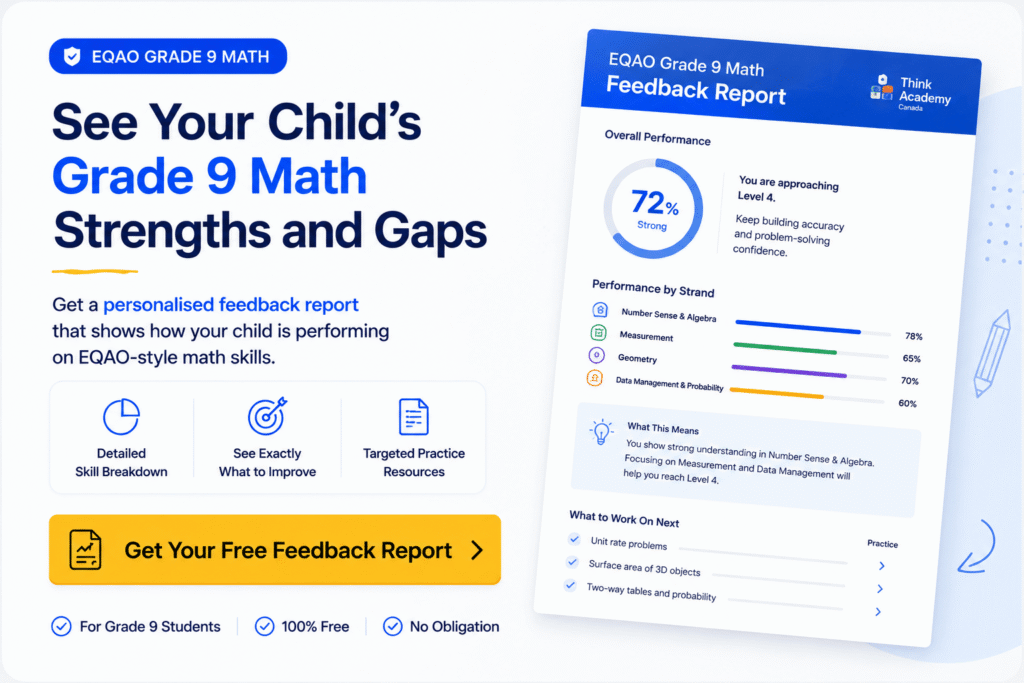
Every new student completes a free assessment and receives a personalised feedback report showing exactly where their skills sit across all five MTH1W strands. For students with days remaining before their assessment, the report identifies the one or two specific areas where targeted practice will have the most impact — rather than broad revision that spreads limited time across everything.
Our instructors understand the MTH1W curriculum and the EQAO assessment format. We work through the question types that appear on the assessment — including multi-step word problems, open-response questions requiring written reasoning, and the kind of applied algebra that the adaptive format uses to differentiate between Level 3 and Level 4 performance.
The window closes 24 June. There is still time — but targeted preparation beats broad review every time.
FAQ
When is the Grade 9 EQAO in 2026?
The Semester 2 EQAO Grade 9 window runs from 28 May to 24 June 2026, excluding 1 June. Schools choose the exact date within this window. Semester 1 students wrote in January 2026.
How much does the Grade 9 EQAO count toward the final mark?
The result counts for 10–30% of the final MTH1W mark. The Ministry of Education sets this range; individual school boards set the exact percentage within it. Check with your child’s school for the board-specific weighting.
What strands does the Grade 9 EQAO test?
The assessment covers five strands: Number, Algebra, Data, Geometry and Measurement, and Financial Literacy. All are tested. The formula sheet covers Geometry and Measurement only.
What is adaptive testing on the Grade 9 EQAO?
Adaptive testing means the platform adjusts question difficulty based on how a student performs. Getting harder questions is a sign of strong performance. Students should not interpret a difficult question as a sign that they are failing — it typically means the system is probing to see how high their performance ceiling is.
Is the Grade 9 EQAO on paper or digital?
The assessment is fully digital. Students complete it on school-provided computers or tablets. All responses are typed or selected on screen. Practising on paper only is not sufficient preparation for 2026.
What is on the EQAO Grade 9 formula sheet?
The formula sheet covers perimeter, area, surface area, and volume formulas, plus the Pythagorean theorem. It does not cover algebra, linear relations, slope, percent, data, or financial literacy — the strands that carry the majority of marks.
What should my child focus on in the last week before EQAO?
Algebra (slope, linear equations, graphing) and Number (percent word problems, proportional reasoning) are the highest-yield areas. These carry the most marks and have no formula sheet support. Geometry can be reviewed briefly using the formula sheet. Avoid trying to learn new content in the final week.
Are there open-response questions on the Grade 9 EQAO?
Yes. Open-response questions require students to show their reasoning, not just select an answer. Partial marks are available — a student who sets up a problem correctly but makes an arithmetic error can still earn credit if their working is visible.
Can my child use a calculator on the Grade 9 EQAO?
The assessment includes both a calculator-permitted section and a non-calculator section. The on-screen calculator is built into the digital platform. Students should practise using an on-screen calculator before assessment day rather than relying on a physical calculator they are more familiar with.
What is a good result on the Grade 9 EQAO?
EQAO reports results at four levels. Level 3 is the provincial standard — a student who has met the Grade 9 curriculum expectations. Level 4 indicates performance above the standard. A student at Level 3 or above is well positioned for Grade 10 mathematics.
How can Think Academy Canada help with Grade 9 EQAO preparation?
Think Academy Canada offers a free diagnostic assessment for Ontario students in Grades 1 to 12. The assessment produces a personalised feedback report identifying which MTH1W strands need the most work. For students preparing for EQAO, this gives a clear, specific starting point so limited preparation time goes to the right places.
About Think Academy Canada Think Academy Canada is a K-12 mathematics tutoring programme, part of TAL Education Group. We work with motivated students across Canada from Grade 1 through Grade 12, with a focus on Ontario curriculum, EQAO preparation, and competition mathematics including CEMC and AMC. All lessons are delivered online. Follow us on Instagram at @thinkacademyca.