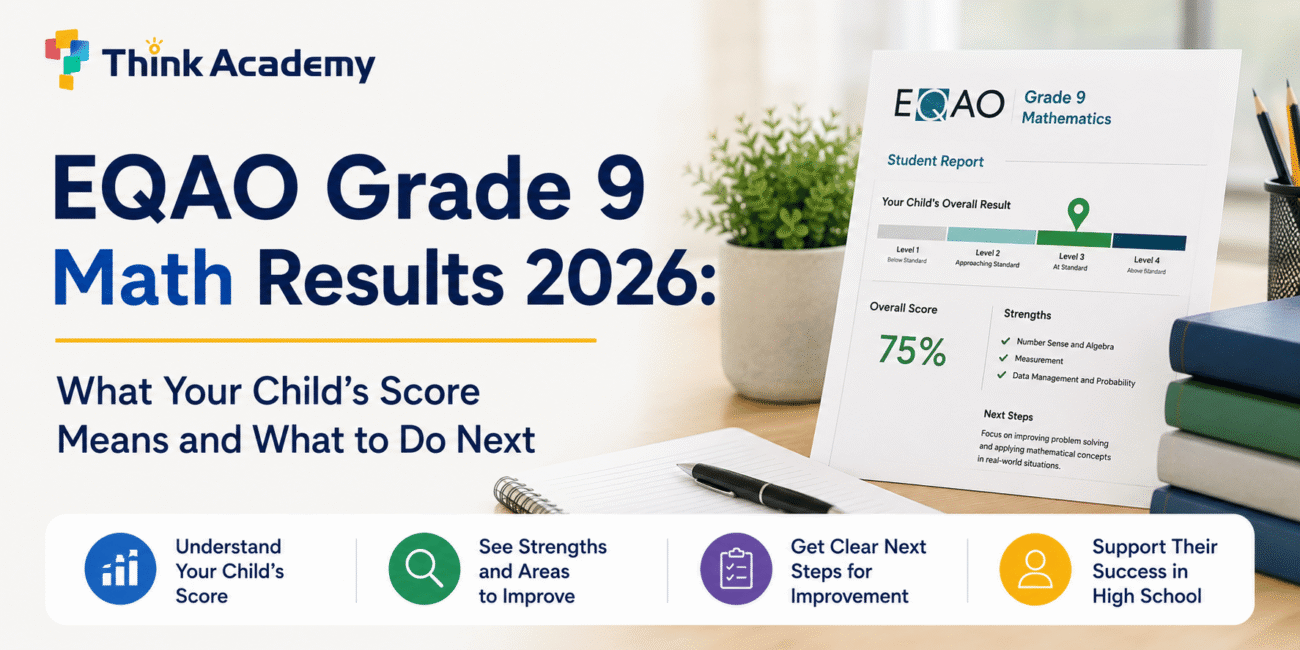
Your child’s EQAO Grade 9 Math results are one data point. Here’s what to do with it.

If you’re reading this with a result in hand, you already know the headline question: did your child meet the provincial standard, or not. This guide walks through what that score actually means, what to do next depending on the outcome, and how to set your child up properly before Grade 10 starts.
EQAO Grade 9 Math Results 2026: What’s Different This Year
There has been more attention than usual on EQAO results recently. Following reporting that the 2024–25 results from earlier assessment windows faced delays, with some data not released until December 2025, a number of parents have understandably been asking whether this year’s Grade 9 results would also be affected. As of publication, Spring 2026 Grade 9 Math results are following the standard release schedule for this assessment window, but if your child’s school has not yet shared results, it is worth checking directly with the school or board, as individual board reporting timelines can vary slightly. The rest of this guide is about your result, not the politics around it — so let’s get into it.
When and How EQAO Grade 9 Math Results Are Released
EQAO Grade 9 Math results are typically released to schools and boards first, who then share individual student results with families — usually through the school’s reporting system or a report card supplement, rather than directly from EQAO. Province-wide and board-level aggregate results are published separately by EQAO, usually a number of weeks after individual results reach families.
If you have not yet received your child’s individual result, the first step is to check with the school directly, as release timing to families can vary by board even when EQAO’s own release schedule is consistent. For background on the assessment itself, including exact testing windows, see our guide on when EQAO 2026 Grade 9 testing takes place.
How to Read Your Child’s EQAO Grade 9 Math Result
The EQAO Grade 9 Math result report includes more information than a single score, and it’s worth reading the whole thing rather than just the headline number.
Overall achievement level. Results are reported on a four-level scale, Level 1 through Level 4, corresponding loosely to the percentage grade ranges used elsewhere in the Ontario curriculum. Level 3 is the provincial standard. Level 4 indicates performance well above it.
Strand-level breakdown. This is the part most parents skip past, and it’s the most useful section for deciding what to do next. The assessment breaks performance down by mathematical strand — typically covering areas such as number sense, algebra, linear relations, and measurement and geometry, depending on the specific assessment year and course (academic or applied). A student can meet the overall provincial standard while still being notably weaker in one strand than others. That strand-level detail is exactly what should drive any tutoring or support decision — addressing the specific gap, not generic ‘more maths practice.’
Comparison to course type. Results are reported separately for students in the academic and applied math streams, since the two courses assess different content and at different levels of complexity. A result should always be read in the context of which course your child was enrolled in.
If your child’s school provided a paper or PDF report, take the time to look at the strand breakdown before deciding on next steps. It tells you far more than the single overall number does.
What ‘Meeting the Provincial Standard’ Actually Means
The provincial standard in EQAO reporting corresponds to Level 3, which is intended to represent solid, grade-appropriate achievement of the Ontario curriculum expectations for Grade 9 Math. It is not the same as ‘passing’ in the way a course grade works, and it is not designed to predict university or college readiness on its own.
It’s worth being clear about what the standard does and doesn’t tell you. Meeting it means your child demonstrated grade-appropriate competence on the specific concepts the assessment covered, on the specific day it was administered. It does not mean there are no gaps at all, and it does not mean your child is performing at the top of their cohort — Level 3 is the middle of the scale, not the top of it. Equally, not meeting the standard on this single assessment does not mean a student is fundamentally behind; it means there are specific, identifiable gaps worth addressing before they compound in Grade 10 and beyond.
This is why the strand-level breakdown matters more than the single overall level. It’s the difference between “my child needs more maths support generally” and “my child specifically needs work on linear relations and algebraic manipulation” — the second is a plan, the first is a worry.
If Your Child Met or Exceeded the Standard: How to Keep Up the Momentum
If your child met or exceeded the provincial standard, that’s a genuinely good result and worth recognising as one. The question now is how to make sure that level of performance carries forward into Grade 10, where the math curriculum builds directly on Grade 9 foundations and the gap between academic and applied streams becomes more consequential for future course selection.
A few things are worth considering even for a student who is doing well:
Check the strand breakdown for any relative weak points. Even a Level 4 overall result can mask one strand that was noticeably weaker than the others. Addressing that now, while it’s a minor gap, is far easier than addressing it once it has compounded into Grade 10 content.
Think ahead to course selection. Strong Grade 9 academic math performance is one of the clearer signals that a student is ready for more demanding Grade 10 and 11 math courses, which matters for students considering STEM-heavy post-secondary paths. It’s worth discussing course selection with the school’s guidance counsellor with this result in hand.
Maintain momentum over the summer. Students who perform well in Grade 9 sometimes lose ground over the summer simply through lack of consistent practice, then start Grade 10 needing to re-establish habits rather than build on existing ones. A structured summer programme, even a light one, prevents that regression.
For students with strong results who are looking for genuine extension rather than remediation, our guide to the Ontario Grade 9 Math curriculum is a useful reference for understanding what’s coming next in Grade 10.
If Your Child Didn’t Meet the Standard: What to Do Before Grade 10 Starts
If your child’s result came back below the provincial standard, the most useful thing you can do right now is resist the urge to treat it as a verdict on ability and instead treat it as a diagnostic. The strand-level breakdown is the single most useful piece of information in the report for deciding what to actually do.
Identify the specific gap, not the general one. “My child is bad at maths” is rarely an accurate or useful framing. “My child is solid on number sense but weak on algebra and linear relations” is both more accurate and far more actionable. Look at the strand breakdown and be specific.
Address it before Grade 10 content builds on it. Grade 10 Math assumes a working foundation in Grade 9 content, particularly algebra and linear relations, which recur throughout the Grade 10 curriculum in more complex forms. A gap that feels manageable now becomes significantly harder to close once new content is layered on top of it. The summer before Grade 10 is genuinely the best window to close this kind of gap, before the new school year adds pressure and pace.
Be realistic about timeline. A single result below standard does not require a dramatic intervention, but it does warrant a focused, time-bound plan — not vague resolutions to “do more maths” with no structure behind them.
Talk to the school. Teachers and guidance counsellors have context beyond the single assessment result, including classroom performance and which specific concepts a student struggled with during the year. That context is worth combining with the EQAO strand data.

Think Academy’s approach starts with diagnosing exactly which strand or concept is the actual gap, rather than starting from a generic curriculum review. A student weak specifically in linear relations needs a different plan than one weak in measurement and geometry — and building a plan around the actual gap, rather than guessing, is what makes the difference between a productive summer and a wasted one.
If you want a structured way to work through practice material before the next assessment cycle, our EQAO Grade 9 Practice Test guide and our Grade 9 EQAO practice tips and strategies are both good starting points.
How EQAO Grade 9 Math Results Connect to Course Selection
EQAO Grade 9 results, particularly in the academic stream, often factor into informal conversations about course selection heading into Grade 10 and beyond, even though they are not a formal prerequisite in the way a course grade is.
A strong result in the academic stream is generally read as a positive signal for continuing into more demanding senior math courses, which matters for students considering university programmes with math or science prerequisites. A weaker result is worth discussing directly with a guidance counsellor rather than assuming it locks a student out of any particular pathway. Course selection decisions should weigh the EQAO result alongside classroom performance, teacher input, and the student’s own interests and goals — not the EQAO score in isolation.
For students in the applied stream, the considerations are somewhat different, since the applied and academic pathways lead toward different post-secondary routes. If you’re unsure which pathway makes sense based on this result, that conversation is best had directly with the school rather than inferred from the EQAO report alone.
What Schools and Boards Do With These Results
It’s worth understanding what EQAO results are used for at the institutional level, partly because it explains why so much attention gets paid to them beyond the individual student.
School and board accountability. Aggregate EQAO results, reported at the school and board level, are used by the Ministry of Education and individual boards to track performance trends over time and identify schools or programmes that may need additional support or resourcing.
Public reporting and rankings. School-level aggregate EQAO data feeds into publicly available comparison tools, most notably the Fraser Institute’s school rankings, which many parents use when researching schools. If you’re researching schools more broadly using this kind of data, our guide to Fraser school rankings in Canada explains how that ranking system works and what it does and doesn’t tell you.
Curriculum and instructional planning. Individual schools sometimes use strand-level trends across their student population to identify areas where instruction might need adjustment — which is a separate use case from your individual child’s result, but explains why the strand-level detail exists in the reporting at all.
None of this institutional use changes what you, as a parent, should do with your child’s individual result. The institutional uses are aggregate and structural; your decision is individual and immediate.
How to Prepare for Next Year
Whether this year’s result was strong or disappointing, the same general principles apply heading into the next assessment cycle.
Build a consistent practice routine rather than a pre-test cram. Strand-level competence builds over months, not the weeks immediately before an assessment. Regular, structured practice across the school year is far more effective than concentrated review right before the test.
Use practice materials that mirror the actual assessment format. Familiarity with question format and timing reduces test-day anxiety and lets a student demonstrate what they actually know, rather than losing marks to unfamiliarity with the format. Our EQAO Grade 9 Practice Test guide and formula sheet guide are both built around the actual assessment structure.
Revisit strand-level performance partway through the year, not just at result time. Don’t wait for the next EQAO result to find out whether a gap has closed. Check in on specific strand performance through the year so any remaining gaps can be addressed well before the next assessment window.
For a full overview of the assessment itself — structure, timing, and what’s covered — our complete guide to EQAO Grade 9 is the best starting point.
Frequently Asked Questions
What is a good EQAO Grade 9 Math result?
Level 3 represents the provincial standard and is considered solid, grade-appropriate achievement. Level 4 indicates performance well above it. There is no single ‘good’ score independent of context — a Level 3 result with strong performance across all strands is a different picture from a Level 3 result that masks a significant weakness in one strand.
Does the EQAO Grade 9 Math result affect my child’s course mark?
No. EQAO is a separate provincial assessment and does not factor into the course grade on a student’s report card or transcript in the way classroom assessments do.
What should I do if my child didn’t meet the provincial standard?
Start by reviewing the strand-level breakdown to identify the specific area of weakness, rather than treating the result as a general indictment of ability. Address that specific gap before Grade 10 content builds on it, ideally over the summer before the gap compounds.
Is the EQAO Grade 9 Math result the same for academic and applied students?
No. Results are reported separately by course type, since the academic and applied streams cover different content and assess at different levels. A result should always be interpreted in the context of which course the student was enrolled in.
How are EQAO Grade 9 Math results used for school rankings?
Aggregate, school-level EQAO results feed into publicly available school comparison tools, including the Fraser Institute’s school rankings. These rankings reflect average school-wide performance, not individual student outcomes — see our guide to Fraser school rankings for more on how that system works.
For more on EQAO Grade 9, see our complete guide to EQAO Grade 9, EQAO Grade 9 practice test guide, practice tips and strategies, and the Ontario Grade 9 Math curriculum guide.
Book a free trial class to find out exactly where your child stands and build a plan before Grade 10 begins.