The EQAO Grade 9 assessment is the Ontario provincial test every Grade 9 student writes during their MTH1W mathematics course. Run by the Education Quality and Accountability Office, it measures whether students have met the Grade 9 mathematics learning expectations and contributes to the student’s final Grade 9 math mark in most school boards. This guide covers everything Ontario parents and students need to know: what the test actually contains, when it’s written, how it’s scored, how it counts toward your child’s report card, and a structured grade 9 EQAO practice plan that works. We’ll also walk through the EQAO Grade 9 math topics that show up most often, where to find official EQAO Grade 9 sample test resources, and how Think Academy Canada supports Ontario students preparing for it.
For more on the Canadian school system, check out Canadian School System: A Parent’s Guide.
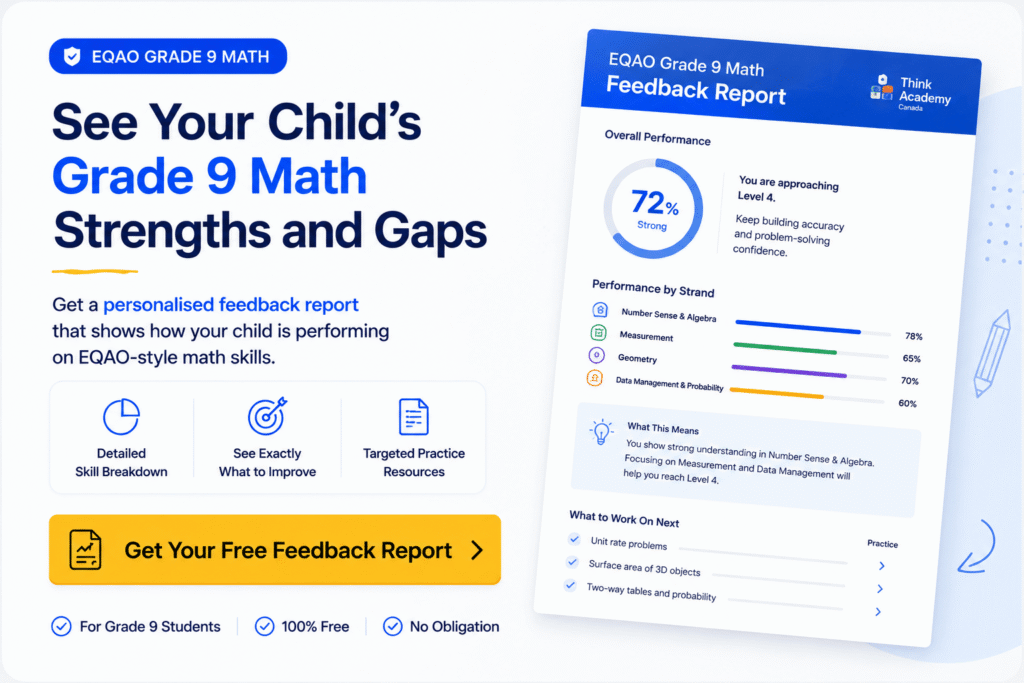
Want to see whether you’d pass an EQAO test with your current knowledge? Try our free EQAO assessment and get free feedback and resources to study with!

What is EQAO Grade 9?
EQAO stands for the Education Quality and Accountability Office, an independent agency of the Government of Ontario. It runs province-wide assessments at four points in a student’s school career: Grade 3, Grade 6, Grade 9, and the Grade 10 OSSLT (Ontario Secondary School Literacy Test).
The EQAO Grade 9 assessment is the only one that focuses specifically on mathematics. It tests whether students have met the Ontario Grade 9 mathematics curriculum expectations, which since 2021 have been delivered through the MTH1W de-streamed Grade 9 mathematics course. Before 2021, students wrote different versions of the assessment depending on whether they were enrolled in Academic or Applied math; now every Grade 9 student in Ontario writes the same assessment.
Why does EQAO Grade 9 matter?
There are three reasons the Grade 9 assessment matters more than parents often realise.
It counts toward your child’s final math mark. Most Ontario school boards include the EQAO Grade 9 result as 10% of the student’s final MTH1W grade. Some boards weight it slightly differently, but the rough rule is that a strong EQAO performance can lift a borderline mark, and a weak one can pull a strong report-card grade down.
It signals readiness for senior math. Grade 9 is the foundation for everything that follows: Grade 10 Principles of Mathematics (MPM2D), Grade 11 Functions (MCR3U), Grade 12 Advanced Functions (MHF4U), and Calculus & Vectors (MCV4U). Students who don’t meet the Grade 9 standard typically struggle in Grade 11 and beyond, where the curriculum moves quickly and assumes fluency.
It’s a public accountability tool. Schools, boards, and the province use aggregated EQAO results to identify where students are succeeding and where they need more support. Individual results aren’t published, but school-level results are.
When is EQAO 2026 Grade 9?
The EQAO Grade 9 assessment is written twice a year, once at the end of each semester, so the exact date depends on which semester your child is taking MTH1W.
Key dates for 2025/2026
| Semester | Assessment window | Notes |
|---|---|---|
| Semester 1 (Sept–Jan) | January 2026 | Schools choose a date within the EQAO testing window |
| Semester 2 (Feb–June) | June 2026 | Schools choose a date within the EQAO testing window |
| Full-year courses | June 2026 | For schools running MTH1W across the full year |
EQAO publishes the exact testing windows on its official website each year. Schools choose specific dates within the window that fit their timetables. Your child’s math teacher or guidance counsellor will confirm the exact date a few weeks before it happens.
How long is the assessment?
The Grade 9 assessment is computer-based and takes approximately two hours in total, split across two booklets. Students typically complete it during their regular math periods over one or two days. There is no significant homework or off-school preparation required on the day itself, beyond the same exam-day basics that apply to any test: sleep, breakfast, and arriving with charged devices.
What does the EQAO Grade 9 math assessment cover?
The assessment is built directly on the Ontario MTH1W curriculum, which is organised into six strands. The EQAO test draws roughly evenly from all six.
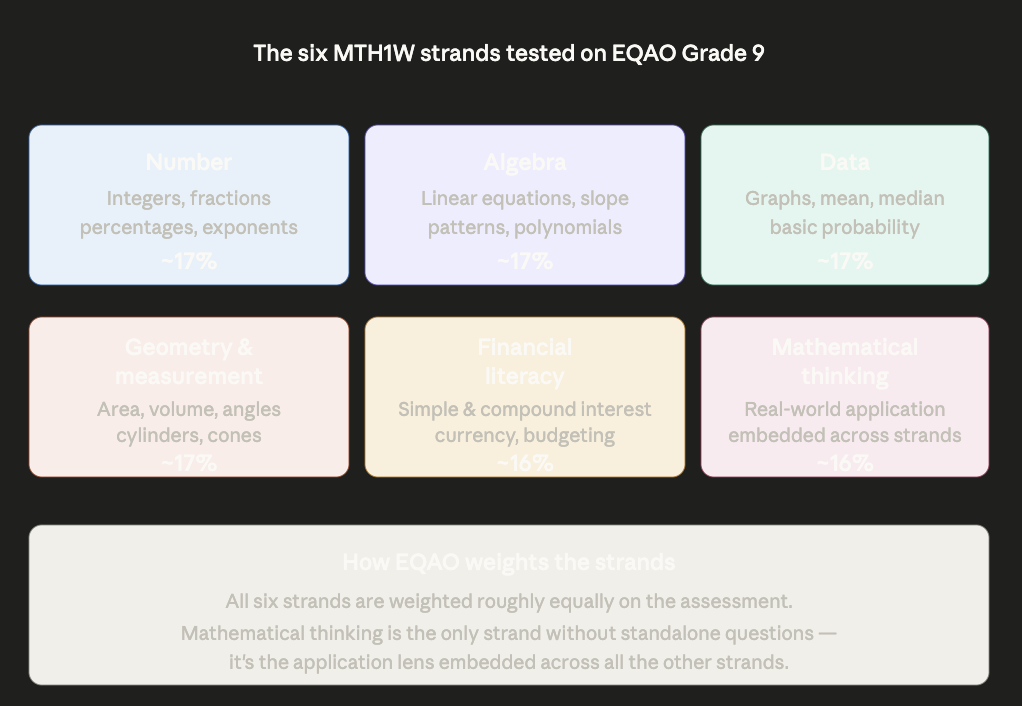
The six strands
| Strand | What it covers | Approximate weight on EQAO |
|---|---|---|
| Number | Operations with integers, fractions, decimals, percentages, ratios, rates, exponents | ~17% |
| Algebra | Patterns, equations, inequalities, polynomials, coding concepts | ~17% |
| Data | Data collection, graphs, measures of central tendency, basic probability | ~17% |
| Geometry and measurement | Angles, polygons, area, perimeter, volume, surface area | ~17% |
| Financial literacy | Budgeting, simple interest, currency exchange, financial decision-making | ~16% |
| Mathematical thinking and making connections | Embedded across all strands; problem-solving and real-world application | ~16% |
The “mathematical thinking” strand isn’t a standalone set of questions. It’s the lens applied across the other strands, testing whether students can apply their knowledge to unfamiliar contexts rather than just repeat textbook procedures.
What kinds of questions appear?
The assessment is computer-based and uses three main question types:
- Multiple choice — four-option questions, similar to a school quiz
- Open response — students type a short answer or numerical solution
- Drag-and-drop / interactive — students match items, order steps, or fill in diagrams
Students have access to an on-screen calculator throughout the assessment. They can also use a formula sheet provided by EQAO, which we’ll cover below.
The EQAO Grade 9 formula sheet
EQAO provides a formula sheet during the assessment, available as an on-screen reference. It includes:
- Area and perimeter formulas for common shapes
- Volume and surface area formulas for prisms, cylinders, pyramids, cones, and spheres
- The Pythagorean theorem
- The slope formula and point-slope form of a line
- Simple interest and compound interest formulas
Students should not rely on the formula sheet during preparation. The sheet tells you the formula but not when to use it, which is what the assessment actually tests. Treat the formula sheet as a safety net for the day, not a study aid.

How is EQAO Grade 9 scored?
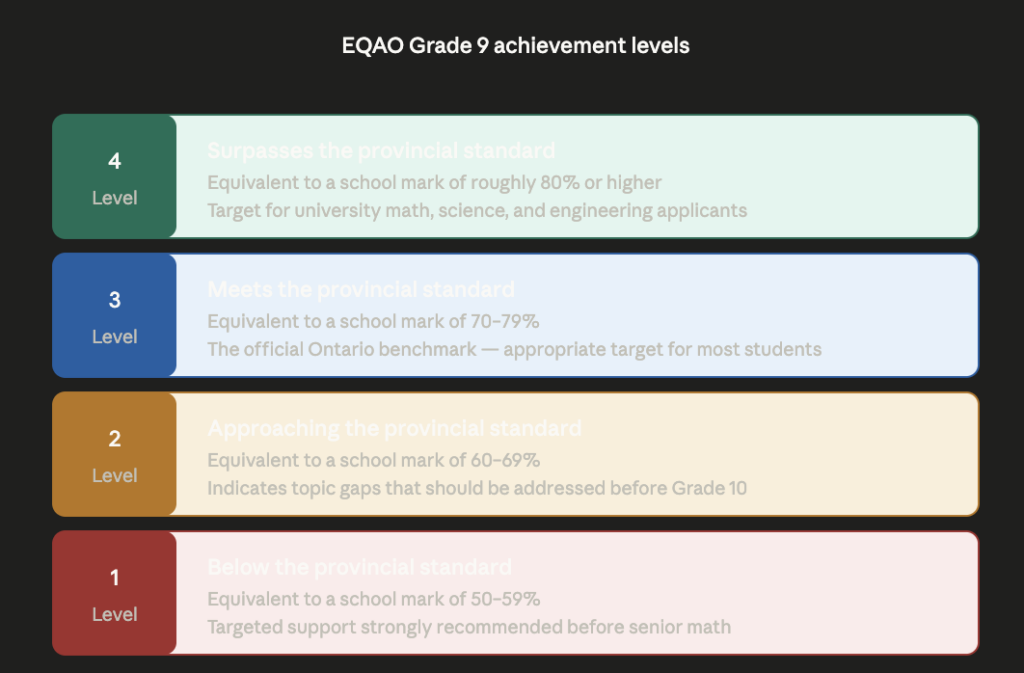
The assessment is reported on a four-level scale, which maps roughly onto the Ontario report card achievement levels.
The four achievement levels
| Level | Description | Approximate report card equivalent |
|---|---|---|
| Level 4 | Surpasses the provincial standard | A (80%+) |
| Level 3 | Meets the provincial standard | B (70–79%) |
| Level 2 | Approaching the provincial standard | C (60–69%) |
| Level 1 | Below the provincial standard | D (50–59%) |
| NE1 | Insufficient evidence | Below 50% |
The provincial standard is Level 3. EQAO and the Ministry of Education consider Level 3 the benchmark for a student who has met the Grade 9 expectations and is ready for Grade 10 mathematics.
How the result affects the report card
Most Ontario school boards count the EQAO Grade 9 result as 10% of the final MTH1W mark. The 90% term mark is determined by the school teacher through quizzes, tests, assignments, and observations across the semester.
The exact weighting can vary by board, so check with your child’s school for confirmation. In a few boards, the EQAO result is reported separately on the report card rather than blended into the final mark.
What’s a “good” EQAO Grade 9 result?
The provincial Level 3 benchmark is the formal target, but realistic goals depend on the student:
- Students aiming for university math, science, or engineering should target Level 4. The skills tested in Grade 9 EQAO are the foundation for MHF4U Advanced Functions and MCV4U Calculus, and Level 4 students enter those courses with the fluency they need.
- Students aiming for a strong overall academic profile should target Level 3. This confirms readiness for Grade 10 math and contributes positively to the report card.
- Students struggling with math fundamentals should target Level 2 or higher. Falling below Level 2 in Grade 9 is a strong signal that targeted support is needed before Grade 10.
For context: in recent years, around 40–50% of Ontario students reach Level 3 or 4 on the Grade 9 assessment. The number has shifted over time as the curriculum changed, but the rough proportion is consistent.
Grade 9 EQAO practice: a 12-week preparation plan
The biggest mistake parents make is treating EQAO as a sprint in the last two weeks before the test. The curriculum is broad, the test is computer-based with formats students don’t see in regular classes, and timed performance under pressure needs practice. Here is the structured grade 9 eqao practice plan we use at Think Academy Canada.
Weeks 1–2: Diagnose
- Sit one full official eqao grade 9 sample test under timed conditions. EQAO publishes a free practice test on its website that uses the real computer-based interface.
- Mark it and record three numbers: total score, score by strand (Number, Algebra, Data, Geometry, Financial Literacy), and topics where mistakes clustered.
- Identify the two weakest strands. These are your priorities for the next four weeks.
Weeks 3–6: Build topic foundations
Spend two weeks each on the two weakest strands from the diagnostic. Common weak areas for Grade 9 students:
- Algebra: solving linear equations, working with inequalities, simplifying polynomial expressions
- Geometry and measurement: surface area and volume of 3D solids, especially cylinders and cones
- Financial literacy: simple and compound interest calculations, currency exchange
- Data: interpreting box plots, calculating measures of central tendency from grouped data
Twenty focused minutes a day, five days a week, on a single topic produces more progress than three hours on Sunday. The Ontario curriculum is broad, so consistency beats intensity.
Weeks 7–10: Practice test rotation
Aim for one full practice test per week, building from easier to harder.
| Week | Resource |
|---|---|
| 7 | EQAO official Grade 9 sample test (full version) |
| 8 | Past-style mixed practice from school textbook |
| 9 | Topic-targeted practice on the two weakest strands |
| 10 | Second full timed practice test, this time aiming to finish 10 minutes early |
After each practice test, run a 60–90 minute post-mortem. Redo every question missed without looking at the solution first. Tag each mistake by type: concept gap, calculator misuse, careless arithmetic, misread the question, or ran out of time.
Weeks 11–12: Refine and rehearse
- Two more full practice tests under timed conditions.
- Build a personal “cheat sheet” of formulas and concepts the student keeps forgetting. Not allowed on the test, but the act of building it cements the content.
- Practise on the actual EQAO computer-based platform at least three times. The interface itself catches some students off guard on the real day.
- Review the EQAO formula sheet so the student knows what’s on it and won’t waste test time looking up formulas they could have memorised.
EQAO Grade 9 math topics that show up most often
Across recent EQAO Grade 9 assessments, certain topics appear in almost every test. Students who lock down these specific skills cover most of the assessment automatically.
Linear relationships and slope
The single most important topic. Students should be able to:
- Find the slope between two points
- Write a linear equation in slope-intercept form (y = mx + b) and point-slope form
- Interpret slope and y-intercept in real-world contexts (cost per unit, starting fee)
- Identify parallel and perpendicular lines from their slopes
- Graph a linear equation by hand and identify the equation from a graph
This single topic accounts for roughly 15–20% of an average EQAO Grade 9 paper. It is also the most heavily tested concept in Grade 10 and Grade 11, so the work compounds.
Surface area and volume of 3D solids
Especially cylinders, cones, and spheres. Students should know the formulas (they’re on the EQAO formula sheet, but knowing them by memory is faster) and recognise when a problem needs surface area versus volume. Composite shapes (a cone on top of a cylinder, for example) appear regularly.
Solving linear equations and inequalities
One-variable equations with fractions, distributing brackets, isolating variables on both sides. Students should also be comfortable with inequalities and representing solutions on a number line.
Financial literacy
Simple interest (I = Prt) and compound interest (A = P(1 + r/n)^(nt)) appear regularly, as do currency exchange problems and basic budgeting scenarios. This strand is new since 2021 and confuses students who were taught from older resources.
Integer operations and fractions
Often dismissed as elementary, but errors here account for a surprising number of lost marks. Students who consistently make sign errors when adding and subtracting integers, or who can’t add fractions with different denominators under time pressure, lose marks across every other strand.
Data and probability
Reading box-and-whisker plots, calculating mean, median, mode, and range from data sets, and basic probability problems involving one or two events.
Where to find EQAO Grade 9 sample test resources
The best preparation materials are the ones EQAO itself produces, because they use the exact same interface and question style as the real test.
Official EQAO resources
- EQAO Grade 9 sample test — A full practice version of the assessment, available free on the EQAO website. Uses the real computer-based platform.
- EQAO released items — Individual past questions with answers and explanations, organised by strand.
- EQAO framework documents — Detailed breakdowns of what each strand tests, useful for parents trying to understand what their child should know.
School resources
- The MTH1W textbook used by your child’s school. Most Ontario boards use Nelson Mathematics 9 or McGraw-Hill MathLinks 9. Both contain practice problems aligned to the curriculum.
- School-provided practice tests, often shared by the math teacher in the weeks before the assessment.
Think Academy resources
- Our MTH1W practice library, with several hundred problems organised by strand and difficulty
- Topic-specific worksheets and worked solutions
- Live preparation classes in the weeks before each EQAO assessment window
How EQAO Grade 9 fits into the bigger picture
The Grade 9 EQAO is not an endpoint. It’s a checkpoint in a longer journey through Ontario senior mathematics.
What comes next
| Grade | Course | EQAO involvement |
|---|---|---|
| 9 | MTH1W | EQAO Grade 9 assessment |
| 10 | MPM2D Principles of Mathematics | OSSLT literacy test (not math) |
| 11 | MCR3U Functions | No EQAO |
| 12 | MHF4U Advanced Functions, MCV4U Calculus & Vectors, MDM4U Data Management | No EQAO |
After Grade 9, there are no more provincial mathematics assessments. Senior math marks come entirely from the teacher and from any external exams the student chooses to write (AP, IB, or Canadian math contests like Cayley and Fermat).
Why Grade 9 fluency matters for senior math
Every concept in MTH1W reappears in Grade 11 and 12. Linear relationships become functions. Algebraic manipulation becomes the bread-and-butter of trigonometry and calculus. The Pythagorean theorem becomes the distance formula and the foundation of coordinate geometry. Students who scrape through Grade 9 typically struggle in Grade 11 Functions, where the curriculum assumes the Grade 9 material is locked in.
For students interested in Canadian math contests, the overlap is even tighter. The Grade 9 Pascal Contest, Grade 10 Cayley Contest, and Grade 11 Fermat Contest all draw on the same algebra and geometry foundations as EQAO Grade 9, just with harder problems.
How Think Academy Canada supports EQAO Grade 9 preparation
Our Canadian programs are built around a carefully paced math curriculum, an online interactive platform built specifically for math, and gamified rewards that keep students engaged across the full school year rather than burning out in a six-week sprint.
For EQAO Grade 9 specifically:
- A curriculum that covers the full MTH1W syllabus, with extra depth on the strands EQAO weights most heavily.
- Practice problems calibrated to the actual EQAO difficulty level, not just generic textbook questions. Our library includes hundreds of problems written in EQAO’s question style.
- Mock EQAO sessions in the weeks before each testing window, run on a computer-based interface similar to the real one.
- Teachers who mark homework personally. Every practice set is reviewed by the teaching team, with written feedback on what the student needs to work on.
- Free resources before you commit. Sample MTH1W problems, a free math evaluation, and access to our problem library are available before signing up for a paid program.
- Online-first delivery. Students learn from anywhere in Canada with the same teachers and the same curriculum, which matters in a province where in-person centres cluster in a handful of cities.
We charge for the package, not for individual lessons, and we expect families to stay with us across multiple grades. That long arc is what produces durable mathematical skill — not a six-week sprint before the assessment.
Frequently asked questions
What is EQAO Grade 9?
EQAO Grade 9 is the Ontario provincial mathematics assessment written by every Grade 9 student during their MTH1W course. It’s run by the Education Quality and Accountability Office and measures whether students have met the Grade 9 curriculum expectations.
When is EQAO 2026 Grade 9?
The Grade 9 assessment is written twice a year, in January 2026 for Semester 1 students and June 2026 for Semester 2 and full-year students. Schools choose the exact date within the EQAO testing window.
How much does EQAO Grade 9 count toward my child’s mark?
In most Ontario school boards, the EQAO result counts as 10% of the final MTH1W mark. The remaining 90% comes from term work assessed by the classroom teacher. Some boards weight it differently or report it separately, so check with your child’s school.
How long is the EQAO Grade 9 assessment?
The assessment takes approximately two hours total, split across two booklets, and is written on a computer at school. Students typically complete it during regular math periods over one or two days.
What does EQAO Grade 9 cover?
The assessment covers the six strands of the MTH1W curriculum: Number, Algebra, Data, Geometry and Measurement, Financial Literacy, and Mathematical Thinking. Each strand is weighted roughly equally.
Is EQAO Grade 9 hard?
The assessment is calibrated to the Grade 9 curriculum, so a student who has engaged consistently with their MTH1W course should be able to reach Level 2 or 3. Reaching Level 4 requires both strong fundamentals and the ability to apply them to unfamiliar problems, which is where targeted practice matters most.
How can my child practise for EQAO Grade 9?
The best preparation combines official EQAO sample tests (free from the EQAO website), targeted practice on the strands where the student is weakest, and timed full-length practice tests in the weeks before the assessment. Our 12-week plan above breaks this down by week.
What’s a good EQAO Grade 9 score?
Level 3 is the provincial standard and is the appropriate target for most students. Students aiming at competitive university programs in math, science, or engineering should target Level 4.
Where can I find a free EQAO Grade 9 sample test?
EQAO publishes free sample tests on its official website at eqao.com. The sample test uses the same computer-based interface as the real assessment, so it’s the closest available preview.
What’s the difference between EQAO Grade 9 and the Grade 9 final exam?
In schools that run a separate final exam, the EQAO assessment usually replaces or is combined with the final exam. The two together typically count as 30% of the final MTH1W mark (10% EQAO, 20% final exam), though this varies by board.
About Think Academy Canada
Think Academy Canada, part of TAL Education Group, supports K–12 students with structured math programs built around an online interactive platform, gamified learning, and teachers who personally mark every homework set. Our curriculum runs ahead of the provincial standards and is designed to prepare students for both school excellence and Canadian math competitions, including the Gauss, Pascal, Cayley, Fermat, and Euclid contests.
Related reading
- Ontario Grade 9 Math Curriculum (MTH1W): Parent Guide to Success
- Ontario Math Curriculum: What Kids Learn in Grades 1–8
- Grade 11 Functions (MCR3U) in Ontario: Complete Guide
- Special Triangles in Trigonometry: Grade 10 and 11 Guide
- How to Make a Study Schedule for Math Competitions
- How to Get Over Math Anxiety: Easing Math Contest Nerves