Grade 2 is where mathematical thinking starts to deepen in ways that matter for the long term. Numbers stretch past 100 for the first time. Addition and subtraction become more flexible and strategic. Patterns evolve from simple repetition into rules and predictions. For parents trying to understand what their child is working on — or where they might need extra support — this guide covers every strand of the Ontario Grade 2 math curriculum clearly and in full.

Ontario Grade 2 math curriculum: the six strands
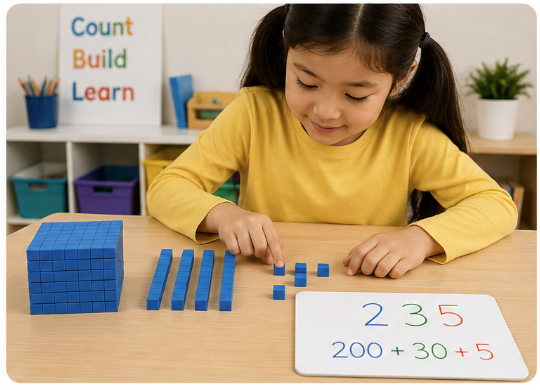
The Ontario 2020 math curriculum organises learning into six strands from Grade 1 through Grade 8. In Grade 2, all six are active throughout the year.
| Strand | Code | What it covers in Grade 2 |
|---|---|---|
| Social-Emotional Learning | A | Mathematical mindset, resilience, perseverance |
| Number | B | Whole numbers to 200; fractions; addition and subtraction; multiplication and division concepts |
| Algebra | C | Patterns; equations; coding |
| Data | D | Data collection and graphs; probability |
| Spatial Sense | E | Geometry; measurement — length, area, mass, capacity, time |
| Financial Literacy | F | Canadian currency; value of coins and bills |
Strand B: Number
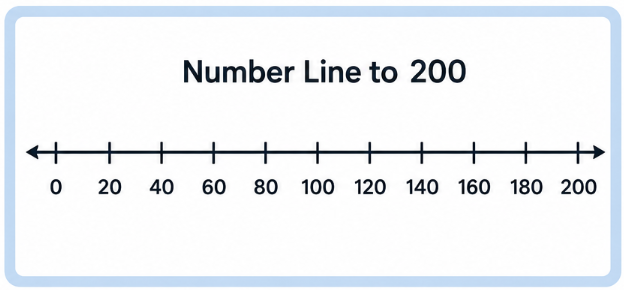
Number is the largest and most foundational strand in Grade 2. It covers number sense (B1) and operations (B2).
B1: Number sense
Whole numbers to 200
In Grade 2, students read, represent, compose, and decompose whole numbers up to and including 200. They use place value to understand two- and three-digit numbers — recognising that 143 means 1 hundred, 4 tens, and 3 ones — and they compare and order numbers on number lines and in different contexts.
This is a major step up from Grade 1, where the ceiling was typically numbers to 50. Students who are not confident with place value at three digits will find addition and subtraction of larger numbers significantly harder.
Even and odd numbers
Students identify and describe even and odd numbers, and explore patterns in sequences of even and odd numbers. This connects directly to early multiplication concepts — even numbers can always be split into pairs.
Fractions
Grade 2 introduces fractions as equal parts of a whole. Students learn to recognise and name halves, thirds, and fourths (quarters) in shapes and sets of objects. The emphasis is on understanding that fractions represent fair sharing — that each part must be equal.
Skip counting
Students skip count by 2s, 5s, 10s, and 25s, both forward and backward. Skip counting by 2s and 5s builds fluency with multiplication concepts; skip counting by 25s connects directly to money (quarters). See skip counting worksheets here.
B2: Operations
Addition and subtraction to 100 and beyond
Grade 2 students add and subtract two-digit numbers with and without regrouping, and extend this to three-digit numbers in contexts where regrouping is not required. The curriculum emphasises a range of strategies — not just one prescribed algorithm — including:
- Counting on and counting back
- Using doubles and near-doubles
- Decomposing numbers (splitting 47 + 35 into 40 + 30 + 7 + 5)
- Bridging through tens (47 + 3 = 50, then 50 + 32 = 82)
Students also recall addition and subtraction facts to 20 with fluency — this is an explicit Grade 2 expectation.
Multiplication and division concepts
Grade 2 does not require formal multiplication and division algorithms, but it does introduce the concepts. Students explore equal grouping and equal sharing through hands-on activities and connect these to the skip counting they practise in number sense. For example, skip counting by 3 six times gives 18 — which is 3 × 6.
This conceptual foundation in Grade 2 is what students build formal multiplication on in Grades 3 and 4.
Strand C: Algebra
C1: Patterns and relationships
Grade 2 students identify, describe, extend, create, and translate repeating patterns, including patterns with multiple elements and growing patterns with simple rules. They describe pattern rules in words — for example, ‘add 3 each time’ — and predict what comes next.
They also explore patterns in addition and subtraction facts, connecting arithmetic fluency to algebraic thinking.
C2: Equations and inequalities
Students in Grade 2 use symbols (including □ and ?) to represent unknown values in addition and subtraction equations. They solve equations of the form:
- □ + 4 = 9
- 12 − □ = 7
- □ + □ = 10
This is the first formal introduction to the idea of a variable — a placeholder for an unknown value. It lays the groundwork for the more explicit variable work in Grades 4 and 5.
C3: Coding
Under the Ontario 2020 curriculum, coding is embedded across Grades 1 to 8. In Grade 2, students create and follow sequential and repeating code to model real-world situations and mathematical patterns. They identify and correct errors (debugging) in simple code sequences. This is taught in the context of math, not as a separate subject.
Strand D: Data
D1: Data literacy
Grade 2 students collect data through surveys and observations, and they organise and display data using:
- Pictographs
- Bar graphs
- Line plots
- Concrete graphs
- Two-way tables
They draw conclusions from different visual representations — identifying which category has the most or fewest, comparing values, and describing trends. A key Grade 2 expectation is comparing results from different survey populations (for example, students versus adults).
D2: Probability
Students describe the likelihood of everyday events using the language of probability: impossible, possible, and certain. They make predictions about the results of surveys or experiments and explain their reasoning.
For example: is it possible, impossible, or certain that a random student in your class has a pet? This type of reasoning — combining data literacy with probability language — is the foundation of the more formal probability work in Grades 5 and 6.
Strand E: Spatial Sense
E1: Geometric and spatial reasoning
Two-dimensional shapes
Grade 2 students sort and identify 2D shapes by multiple attributes simultaneously: number of sides, side lengths, angles, and lines of symmetry. They identify congruent lengths and angles in 2D shapes and explore which shapes can tile a surface (tessellate) without gaps.
Students also work with location and movement — using positional language (above, below, left, right, in front, behind) and giving and following directions to move objects or themselves through space using cardinal directions.
Three-dimensional objects
Students identify and describe 3D objects (cubes, rectangular prisms, cylinders, cones, pyramids, spheres) and sort them by their properties — number of faces, edges, and vertices.
E2: Measurement
Measurement in Grade 2 covers four key areas:
Length
Students measure length using standard units (centimetres and metres) and non-standard units. They compare and order objects by length, estimate lengths, and record measurements. They also solve simple problems involving length — for example, finding the total length of two objects combined.
Area
Students compare the areas of 2D shapes by counting square units. They recognise that two shapes can have the same area but different perimeters — an important conceptual distinction that runs all the way through to Grade 5.
Mass and capacity
Students compare and order objects by mass (lighter, heavier) and capacity (holds more, holds less), using standard units (grams, kilograms, millilitres, litres) and non-standard units. They estimate and measure in practical contexts.
Time
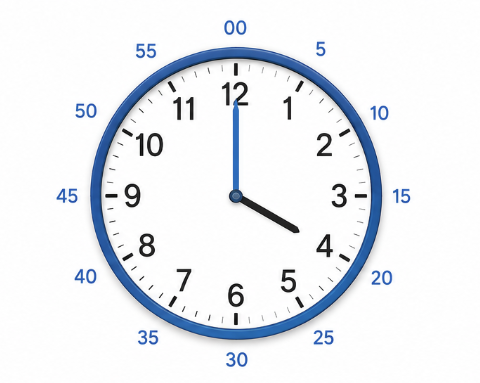
Students read and represent time to the nearest five minutes on analogue and digital clocks. They identify and sequence events using a.m. and p.m., and they solve simple elapsed time problems — for example, if an activity starts at 9:15 a.m. and lasts 30 minutes, when does it end?
Strand F: Financial Literacy
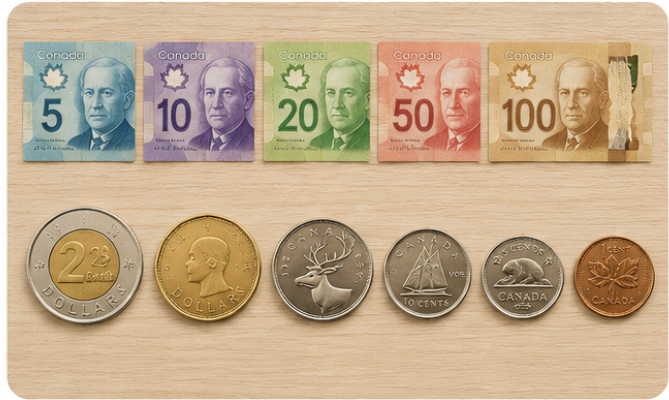
In Grade 2, financial literacy focuses on Canadian currency. Students:
- Identify and describe the value of Canadian coins and bills up to $200
- Represent amounts of money in multiple ways using different combinations of coins and bills
- Solve simple money problems involving making change
- Compare the cost of items and make decisions about purchases
The $200 ceiling for Grade 2 money connects directly to the number sense work with whole numbers to 200. Money is one of the most motivating contexts for early number work — students who understand money at Grade 2 often have stronger place value intuition than those who don’t.

What makes Grade 2 math harder than Grade 1
Three changes stand out at Grade 2:
Numbers get significantly larger. Moving from numbers to 50 in Grade 1 to numbers to 200 in Grade 2 requires students to fully internalise place value — understanding hundreds, tens, and ones as a system, not just as labels.
Addition and subtraction require regrouping. Grade 1 addition and subtraction largely avoids the need to regroup (carry or borrow). Grade 2 introduces it. Students who do not have a solid conceptual understanding of place value will find regrouping confusing and error-prone.
Patterns become predictive. Grade 1 patterns are mostly about continuing what comes next. Grade 2 introduces pattern rules and growing patterns, which require students to describe and predict — a shift from recognition to reasoning.
Grade 2 math in context: what comes next
Grade 2 is the bridge between the counting-based arithmetic of Grade 1 and the more systematic operations of Grades 3 and 4. The skills built in Grade 2 feed directly into:
- Grade 3: Multiplication and division facts; fractions on number lines; perimeter; EQAO assessment
- Grade 4: Multi-digit multiplication and division; equivalent fractions; area formulas; numbers to 10,000
- Grade 5: Numbers to 100,000; decimal-fraction-percent connections; area formulas for triangles and parallelograms
For families thinking about the long term, Grade 2 is earlier than most parents realise in terms of where gaps start to form. A student who is not fluent with addition facts to 20 and place value to 200 by the end of Grade 2 is likely to find Grade 3 multiplication difficult — because both rely on the same foundations.
Grade 2 math curriculum across Canada: how Ontario compares
| Province | Curriculum | Key Grade 2 features |
|---|---|---|
| Ontario | 2020 Ontario Math Curriculum | 6 strands; coding embedded; financial literacy from Grade 1; numbers to 200 |
| BC | BC Curriculum (redesigned 2016) | Competency-based; number, patterns/relations, shape/space, statistics/probability; less prescriptive |
| Alberta | Alberta K–6 Program of Studies | Number, patterns/relations, shape/space, statistics/probability; less explicit on financial literacy and coding |
| Manitoba | Manitoba K–8 Mathematics | Broadly similar number and operations focus; Western Protocol aligned |
Ontario’s 2020 curriculum stands out for its explicit integration of coding from Grade 1 and financial literacy as a named strand. The BC curriculum covers similar content but frames it through broad competencies rather than specific expectations, which makes it harder for parents to track exactly what is expected at each grade.
Common Grade 2 math struggles and what they signal
| Struggle | What it usually means |
|---|---|
| Difficulty with regrouping in addition | Place value understanding from Grade 1 is not fully consolidated |
| Confusing the value of coins | Weak skip counting by 5s, 10s, and 25s |
| Unable to describe a pattern rule | Patterns have been practised visually but not explained — the reasoning step is missing |
| Fractions only understood with shapes, not sets | Early fraction work has been too narrow — needs practice with fractions of groups |
| Struggles with elapsed time | Difficulty reading analogue clocks or counting on in 5-minute intervals |
Most of these are fixable with targeted practice before Grade 3. The risk is that Grade 3 introduces multiplication and formal fractions quickly — and students who arrive without solid Grade 2 foundations find the new content much harder than it needs to be.
How Think Academy Canada supports Grade 2 students
Think Academy Canada works with high-performing Ontario students from Grade 1 through Grade 12. For Grade 2 students, our programme builds the foundations that matter most: place value fluency, flexible addition and subtraction strategies, early pattern reasoning, and the number sense that supports everything from multiplication in Grade 3 to EQAO in Grade 3.
We start with a diagnostic. Every new student completes a free assessment and receives a personalised feedback report showing where their skills sit strand by strand. For Grade 2 students, the report typically identifies one or two specific areas — whether that is regrouping, fractions, or skip counting fluency — that need attention before Grade 3.
Our instructors work with motivated students who want to get ahead, not just keep up. For parents who are thinking about Grade 3 EQAO or the longer journey toward competition mathematics in Grades 7 and 8, Grade 2 is the right time to start building the habits and foundations that make everything easier later.

FAQ
What are the strands in the Ontario Grade 2 math curriculum?
The Ontario Grade 2 math curriculum has six strands under the 2020 curriculum: Social-Emotional Learning (A), Number (B), Algebra (C), Data (D), Spatial Sense (E), and Financial Literacy (F). All six are taught throughout the year.
What numbers do Grade 2 students work with in Ontario?
In Grade 2, students work with whole numbers up to and including 200. They also work with fractions (halves, thirds, and fourths) and with Canadian money amounts up to $200.
Do Grade 2 students learn multiplication in Ontario?
Grade 2 introduces multiplication concepts through equal grouping and skip counting, but formal multiplication facts are not a Grade 2 expectation. The conceptual foundation laid in Grade 2 — equal groups, skip counting by 2s, 5s, and 10s — prepares students for the formal multiplication and division curriculum in Grade 3.
What addition and subtraction skills are expected by the end of Grade 2?
By the end of Grade 2, students should recall addition and subtraction facts to 20 with fluency, add and subtract two-digit numbers with regrouping, and extend this to three-digit numbers in simpler contexts. They should be able to use multiple strategies, not just one prescribed method.
Is fractions part of the Ontario Grade 2 math curriculum?
Yes. Grade 2 introduces fractions as equal parts of a whole. Students recognise and name halves, thirds, and fourths in shapes and sets of objects. The emphasis is on understanding fair sharing — that each fractional part must be equal.
What geometry do Grade 2 students learn in Ontario?
Grade 2 students sort and identify 2D shapes by number of sides, side lengths, angles, and lines of symmetry. They also work with 3D objects, identify congruent lengths and angles, explore which shapes can tile a surface, and use positional and directional language for location and movement.
Is coding part of the Ontario Grade 2 math curriculum?
Yes. Coding (C3) is embedded in the Algebra strand from Grade 1 upward under the 2020 curriculum. In Grade 2, students create and follow sequential and repeating code, and identify and correct errors in simple code sequences. It is taught within math, not as a separate subject.
What measurement skills are expected in Grade 2?
Grade 2 measurement covers length (centimetres and metres), area (counting square units), mass (grams and kilograms), capacity (millilitres and litres), and time (to the nearest five minutes, including elapsed time problems).
What is financial literacy in Grade 2?
In Grade 2, financial literacy focuses on Canadian currency. Students identify and describe coins and bills, represent amounts up to $200 in multiple ways, make change, and solve simple money problems. This is a named strand in the Ontario 2020 curriculum from Grade 1 upward.
What is the difference between Grade 1 and Grade 2 Ontario math?
The main changes are: whole numbers extend from around 50 to 200; addition and subtraction introduce regrouping; multiplication and division concepts are introduced through equal grouping; fractions of sets are added alongside fractions of shapes; patterns develop from repetition to rule-based prediction; and measurement introduces standard units for length, mass, and capacity.
How does Grade 2 math connect to EQAO in Grade 3?
EQAO is written in Grade 3 (and Grade 6). Grade 2 content — particularly number sense, addition and subtraction, basic geometry, and measurement — forms the direct foundation for the Grade 3 EQAO assessment. Students who are not confident in Grade 2 skills are more likely to find Grade 3 EQAO challenging.
How is the Ontario Grade 2 math curriculum different from BC?
Ontario’s 2020 curriculum specifies detailed expectations strand by strand. BC’s redesigned curriculum is competency-based and less prescriptive, framing learning in terms of broad understandings rather than specific skills at each grade. The content covered is broadly similar, but Ontario parents have more specific guidance on what to expect at each grade level.
What should a Grade 2 student be able to do by the end of the year?
By the end of Grade 2, students should: read and work with numbers to 200; recall addition and subtraction facts to 20 fluently; add and subtract two-digit numbers with regrouping; understand halves, thirds, and fourths as equal parts; describe pattern rules and growing patterns; read time to the nearest five minutes; measure length in centimetres; identify Canadian coins and bills up to $200; and collect and display data in graphs.
When is EQAO and why does Grade 2 matter?
Ontario students write EQAO in Grade 3. The Grade 3 assessment draws directly on number sense, operations, geometry, and measurement skills built in Grades 1 and 2. A student who arrives at Grade 3 with strong Grade 2 foundations is well placed for the assessment — and for the more demanding curriculum content that Grade 3 introduces.
Does Think Academy Canada offer support for Grade 2 students?
Yes. Think Academy Canada serves Ontario students from Grade 1 through Grade 12. Our programme is delivered online, which means students anywhere in Ontario can access the same instructors. A free diagnostic assessment and personalised feedback report are available for any student.
About Think Academy Canada Think Academy Canada is a K-12 mathematics tutoring programme, part of TAL Education Group. We work with motivated students across Canada from Grade 1 through Grade 12, with a focus on Ontario curriculum, EQAO preparation, and competition mathematics including CEMC and AMC. All lessons are delivered online. Follow us on Instagram at @thinkacademyca.