Grade 5 is the year Ontario math gets more demanding — and more abstract. Numbers stretch to 100,000. Fractions connect to decimals and percents for the first time. Area formulas appear. Algebra moves from describing patterns to writing equations with variables. For parents trying to understand what their child is working on, or where the gaps might be, this guide breaks down every strand of the Ontario Grade 5 math curriculum clearly and completely.

Ontario Grade 5 math curriculum: the six strands
The Ontario 2020 math curriculum organises learning into six strands across all grades. In Grade 5, all six are active. Social-emotional learning (Strand A) sits across the whole year; the five content strands are Number (B), Algebra (C), Data (D), Spatial Sense (E), and Financial Literacy (F).
| Strand | Code | What it covers in Grade 5 |
|---|---|---|
| Social-Emotional Learning | A | Mathematical mindset, perseverance, collaboration |
| Number | B | Whole numbers to 100,000; fractions; decimals; operations |
| Algebra | C | Patterns; equations with variables; coding |
| Data | D | Data collection and display; probability |
| Spatial Sense | E | Geometry; measurement — area, perimeter, volume |
| Financial Literacy | F | Budgeting; financial decision-making |
Strand B: Number
Number is the largest strand in Grade 5 and the foundation for everything else. It splits into two overall expectations: number sense (B1) and operations (B2).
B1: Number sense
Whole numbers to 100,000
In Grade 5, students read, represent, compose, and decompose whole numbers up to and including 100,000. They use place value to describe numbers — understanding that 84,250 means 8 ten-thousands, 4 thousands, 2 hundreds, 5 tens, and 0 ones — and compare and order numbers in different contexts.
This is a significant step up from Grade 4, where the ceiling was 10,000. Students who are not fully confident with place value at five digits will find multi-digit multiplication and division much harder later in the year.
Fractions
Grade 5 introduces equivalent fractions and the ability to compare and order fractions with different denominators. Students learn to represent fractions on number lines and connect them to division. The concept of a fraction as part of a set (not just part of a shape) also becomes more explicit.
Decimals and percents
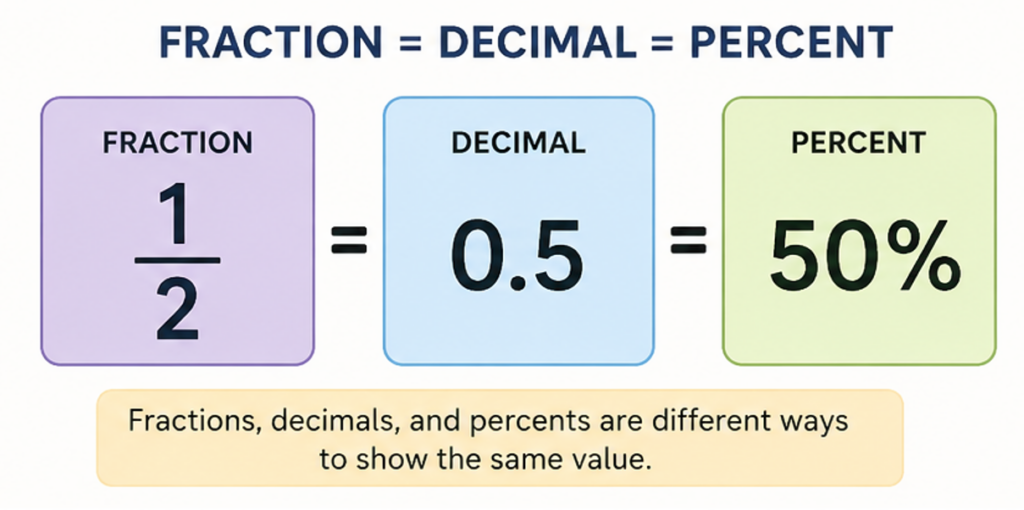
Students read, represent, compare, and order decimal numbers to hundredths. They round decimals to the nearest tenth and — critically — they show the relationships between fractions, decimals, and whole-number percents. Understanding that ½ = 0.5 = 50% is a Grade 5 expectation under the 2020 curriculum.
This fraction-decimal-percent connection is one of the most important conceptual bridges in the entire elementary curriculum. Students who understand it fluently have a significant advantage in Grades 6, 7, and 8.
B2: Operations
Multiplication and division
Students multiply and divide multi-digit whole numbers. The curriculum expects students to develop efficient strategies and algorithms, not just one prescribed method. By the end of Grade 5, most students are expected to multiply a three-digit number by a two-digit number and divide a four-digit number by a one- or two-digit divisor.
The curriculum also introduces rates and unit rates in Grade 5 — for example, working out a cost per item when buying in bulk — connecting multiplication and division to real-world problem solving.
Decimal operations
Students add and subtract decimal numbers to hundredths. They also multiply decimal numbers by whole numbers in practical contexts such as calculating costs or measurements.
Strand C: Algebra
C1: Patterns and relationships
Grade 5 students extend and create increasing and decreasing patterns using all four operations — addition, subtraction, multiplication, and division. They describe pattern rules using words and numbers, and identify the relationship between terms in a pattern.
This is preparation for the variable-based algebra in C2, and eventually for linear relations in Grade 7 and 8.
C2: Equations and inequalities
Variables enter formally in Grade 5. Students write and solve equations and inequalities involving one variable, including situations where the variable represents an unknown value. They use symbols to represent relationships between quantities.
For example: if 4 × ☐ = 36, what is ☐? Grade 5 makes this explicit and extends it to inequality notation.
C3: Coding
Under the 2020 curriculum, coding is embedded across multiple grades. In Grade 5, students use coding to create and modify algorithms — sequences of steps — that solve mathematical problems and represent real-world situations. This is integrated into math rather than taught separately.
Strand D: Data
D1: Data literacy
Students collect data by conducting surveys and experiments, and they organise and display data using a variety of graphs — including stem-and-leaf plots and double bar graphs. They analyse data by identifying trends, outliers, and conclusions, and they consider how graphs can be used or misused to represent information.
D2: Probability
Grade 5 introduces probability formally. Students describe the probability of an event using fractions, and they conduct probability experiments to compare theoretical and experimental results. For example, they might predict the probability of rolling a 4 on a standard die (1/6) and then test that prediction over 60 rolls.
Strand E: Spatial Sense
E1: Geometric and spatial reasoning
Students classify and construct two-dimensional shapes based on their properties — including angles, parallel sides, and symmetry. They identify and describe the properties of polygons, including acute, right, obtuse, and straight angles, and they sort and classify shapes using multiple criteria simultaneously.
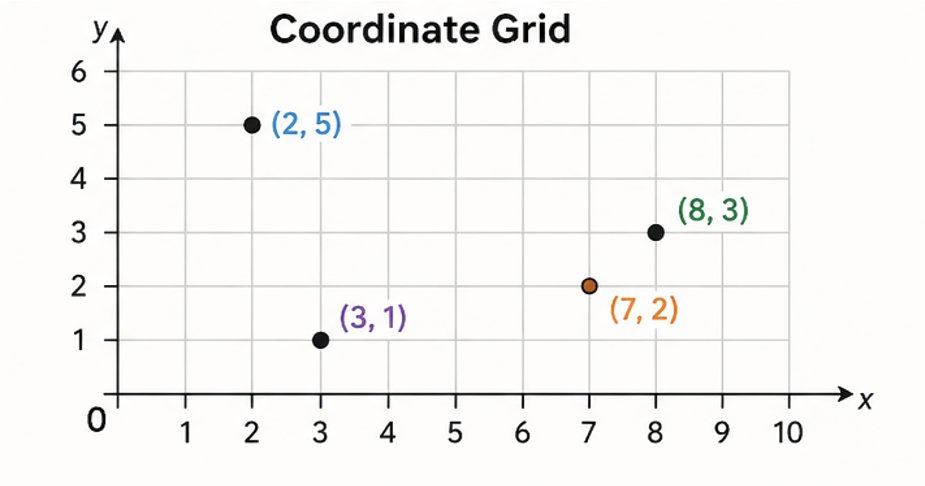
Students also work with location and movement: plotting points on a coordinate grid in the first quadrant, and describing translations (slides), reflections (flips), and rotations (turns) of shapes.
E2: Measurement
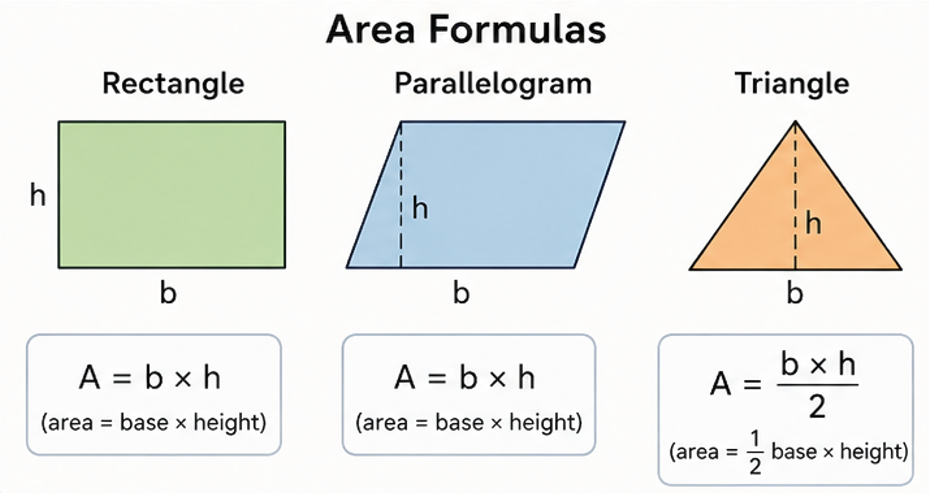
Measurement is one of the most content-heavy parts of Grade 5. Key expectations include:
Area
Students use formulas to determine the area of rectangles, parallelograms, and triangles. They understand that shapes with the same area can have different perimeters — an important conceptual distinction that is often tested.
| Shape | Area formula |
|---|---|
| Rectangle | A = l × w |
| Parallelogram | A = b × h |
| Triangle | A = ½ × b × h |
Perimeter
Students calculate the perimeter of polygons and solve problems where they are given the area or perimeter and need to find a missing side length.
Volume
Grade 5 introduces volume. Students estimate and measure the volume of rectangular prisms using unit cubes and the formula V = l × w × h.
Metric measurement
Students work with relationships between metric units: grams and kilograms, metres and centimetres, millilitres and litres. Converting between units fluently is an expectation across multiple measurement contexts.
Time
Students read and represent time to the second, and calculate elapsed time in practical situations.
Strand F: Financial Literacy
Financial literacy is embedded across the 2020 Ontario curriculum. In Grade 5, students:
- Work with money amounts up to $1,000 and make change for multi-step transactions
- Explore the concept of budgeting — comparing needs versus wants and making spending decisions
- Analyse simple financial scenarios and explain their reasoning
Financial literacy questions in Grade 5 are practical and contextual. They often involve multi-step problems that draw on number and operations skills from Strand B.
What makes Grade 5 math harder than Grade 4
Three things change significantly at Grade 5:
Numbers get larger and more abstract. Moving from 10,000 to 100,000 is not just an extra digit — it requires students to generalise their place value understanding rather than rely on rote memorisation of specific numbers.
Fractions, decimals, and percents converge. In Grades 3 and 4, these are introduced largely in isolation. Grade 5 expects students to move fluently between all three representations. Students who learned fractions procedurally — without understanding what they mean — often struggle here.
Formulas appear in measurement. Up to Grade 4, measurement is mostly about counting squares or using rulers. Grade 5 introduces algebraic formulas for area and volume. Students who are not comfortable with multiplication will find measurement significantly harder.
Grade 5 math in context: what comes next
Grade 5 is the bridge between the foundational arithmetic of Grades 1–4 and the more formal mathematical reasoning of Grades 6–8. The skills built in Grade 5 feed directly into:
- Grade 6: Ratios and rates, integers, surface area of prisms, order of operations
- Grade 7: Linear relationships, percent calculations, circle geometry, probability
- Grade 8: Algebra with multiple variables, volume of cylinders and cones, data analysis
For families thinking about the long term, Grade 5 is also the year where the gap between strong and average math students starts to widen. Students who are confident with fractions, multi-digit operations, and basic formulas at Grade 5 are well positioned for the Gauss Math Contest (Grades 7–8), EQAO in Grade 6 and 9, and eventually high-school mathematics.
Grade 5 math curriculum across Canada: how Ontario compares
If your family is considering schools in other provinces, or if you are searching for information on a different provincial curriculum, here is a brief comparison.
| Province | Curriculum | Key Grade 5 features |
|---|---|---|
| Ontario | 2020 Ontario Math Curriculum | 6 strands; fractions-decimals-percents bridge; coding integrated; financial literacy from Grade 1 |
| Alberta | Alberta K–6 Math Program of Studies | Similar number and operations focus; patterns and statistics strands; less explicit financial literacy |
| BC | BC Curriculum (redesigned 2016) | Competency-based; number, patterns/relations, shape/space, statistics/probability; less strand-prescriptive than Ontario |
| Manitoba | Manitoba K–8 Mathematics | Aligned broadly with Western Protocol; number, patterns, shape/space, statistics; financial literacy less prominent |
Ontario’s 2020 curriculum is notable for its explicit integration of coding and financial literacy from the earliest grades — features that the Alberta, BC, and Manitoba curricula do not include as directly.
Common Grade 5 math struggles and what they signal
| Struggle | What it usually means |
|---|---|
| Difficulty comparing fractions with different denominators | Incomplete understanding of equivalent fractions from Grade 4 |
| Confusion between area and perimeter | Procedural memorisation without conceptual understanding |
| Errors in multi-digit multiplication | Gaps in times tables or place value at Grade 3–4 level |
| Cannot move between fractions, decimals, and percents | The Grade 5 bridge expectation has not fully landed |
| Struggles with variables in equations | Arithmetic is not yet fluent enough to shift attention to the unknown |
Most of these struggles are fixable with targeted practice — but they tend to compound if not addressed before Grade 6, when the curriculum assumes these foundations are in place.
How Think Academy Canada supports Grade 5 students
Think Academy Canada works with high-performing Ontario students from Grade 1 through Grade 12. Our Grade 5 programme covers all six strands of the Ontario 2020 curriculum, with particular focus on the areas that matter most for long-term mathematical development: the fraction-decimal-percent connection, multi-digit operations, and the introduction of formulas in measurement.
We start with a diagnostic. Every new student completes a free assessment and receives a personalised feedback report showing exactly where their skills sit strand by strand. For Grade 5 students, the report typically highlights one or two specific areas — whether that is fractions, area formulas, or algebraic thinking — that need attention before Grade 6.
Our instructors are experienced with the Ontario 2020 curriculum and work with motivated students who want to get ahead, not just keep up.

FAQ
What are the strands in the Ontario Grade 5 math curriculum?
The Ontario Grade 5 math curriculum has six strands under the 2020 curriculum: Social-Emotional Learning (A), Number (B), Algebra (C), Data (D), Spatial Sense (E), and Financial Literacy (F). All six are taught throughout the year.
What numbers do Grade 5 students work with in Ontario?
In Grade 5, students work with whole numbers up to and including 100,000. They also work with fractions, decimals to hundredths, and whole-number percents.
Do Grade 5 students learn about fractions in Ontario?
Yes. Grade 5 expectations include comparing and ordering fractions with different denominators, finding equivalent fractions, and showing the relationship between fractions, decimals, and whole-number percents.
What geometry do Grade 5 students learn in Ontario?
Grade 5 students classify two-dimensional shapes by their properties (angles, parallel sides, symmetry), work with transformations (translations, reflections, rotations), and plot points on coordinate grids. Measurement includes area of rectangles, parallelograms, and triangles, and volume of rectangular prisms.
Is algebra taught in Grade 5 in Ontario?
Yes. Grade 5 students work with patterns using all four operations, write and solve equations involving one variable, and describe relationships between quantities using symbols and equations.
What formulas does Grade 5 cover in Ontario math?
Grade 5 introduces area formulas for rectangles (A = l × w), parallelograms (A = b × h), and triangles (A = ½ × b × h). Volume of rectangular prisms (V = l × w × h) is also introduced.
Is financial literacy part of the Ontario Grade 5 math curriculum?
Yes. Financial literacy is a strand in the Ontario 2020 curriculum from Grade 1 through Grade 8. In Grade 5, students work with money amounts up to $1,000, explore budgeting concepts, and analyse practical financial scenarios.
Is coding part of the Ontario Grade 5 math curriculum?
Yes. Coding (C3) is embedded in the Algebra strand of the Ontario 2020 curriculum. In Grade 5, students use coding to create and modify algorithms that represent and solve mathematical problems.
What is the difference between the Grade 4 and Grade 5 Ontario math curriculum?
The main changes are: whole numbers extend from 10,000 to 100,000; fractions, decimals, and percents are explicitly connected for the first time; area formulas appear for rectangles, parallelograms, and triangles; volume is introduced; and variables enter the algebra strand formally.
How is the Ontario Grade 5 math curriculum different from other provinces?
Ontario’s 2020 curriculum is distinctive for its integration of coding and financial literacy as explicit strands from early grades. Alberta, BC, and Manitoba curricula cover similar number and measurement content but differ in their treatment of financial literacy and coding. Ontario’s strand structure is also more prescriptive than BC’s competency-based framework.
What is the Gauss Math Contest and does Grade 5 content appear in it?
The Gauss Math Contest, run by the University of Waterloo’s Centre for Education in Mathematics and Computing (CEMC), is written by Grade 7 and 8 students. However, preparation for the Gauss often starts in Grades 5 and 6, as the contest draws on number sense, fractions, patterns, geometry, and data — all of which are built in Grade 5. Students who are strong in Grade 5 math are well placed to begin contest preparation early.
What should a Grade 5 student be able to do by the end of the year?
By the end of Grade 5, students should be able to read and work with numbers to 100,000; convert fluently between fractions, decimals, and percents; multiply and divide multi-digit numbers efficiently; calculate area of rectangles, parallelograms, and triangles; find the volume of rectangular prisms; work with variables in simple equations; collect and display data; and calculate basic probabilities.
How can I tell if my child is struggling in Grade 5 math?
Common signals include difficulty comparing fractions, confusion between area and perimeter, errors in multi-digit multiplication, inability to move between fractions and decimals, and struggles with equations that include variables. These gaps tend to compound in Grade 6 if not addressed.
When is EQAO for Grade 6 and why does Grade 5 matter?
EQAO is written in Grade 6 (and Grade 3). Grade 5 content — particularly fractions, operations, and measurement — forms the foundation for the Grade 6 EQAO assessment. Students who are not confident in Grade 5 skills are likely to find Grade 6 EQAO more challenging.
Does Think Academy Canada offer support for the Ontario Grade 5 curriculum?
Yes. Think Academy Canada serves Ontario students from Grade 1 through Grade 12. Our Grade 5 programme covers all strands of the 2020 curriculum. A free diagnostic assessment and personalised feedback report are available to any student.
About Think Academy Canada Think Academy Canada is a K-12 mathematics tutoring programme, part of TAL Education Group. We work with motivated students across Canada from Grade 1 through Grade 12, with a focus on Ontario curriculum, EQAO, and competition mathematics including CEMC and AMC. All lessons are delivered online. Follow us on Instagram at @thinkacademyca.