The triangle inequality theorem is one of the most fundamental results in geometry — and one of the most versatile. It tells you whether a triangle can exist from three given side lengths, gives you bounds on unknown sides, and appears in problems ranging from Grade 8 homework through to AMC 10 and Euclid contest questions. This guide covers the theorem clearly, proves it, shows how to apply it, and connects it to the competition problems where it appears most often.
What Is the Triangle Inequality Theorem?
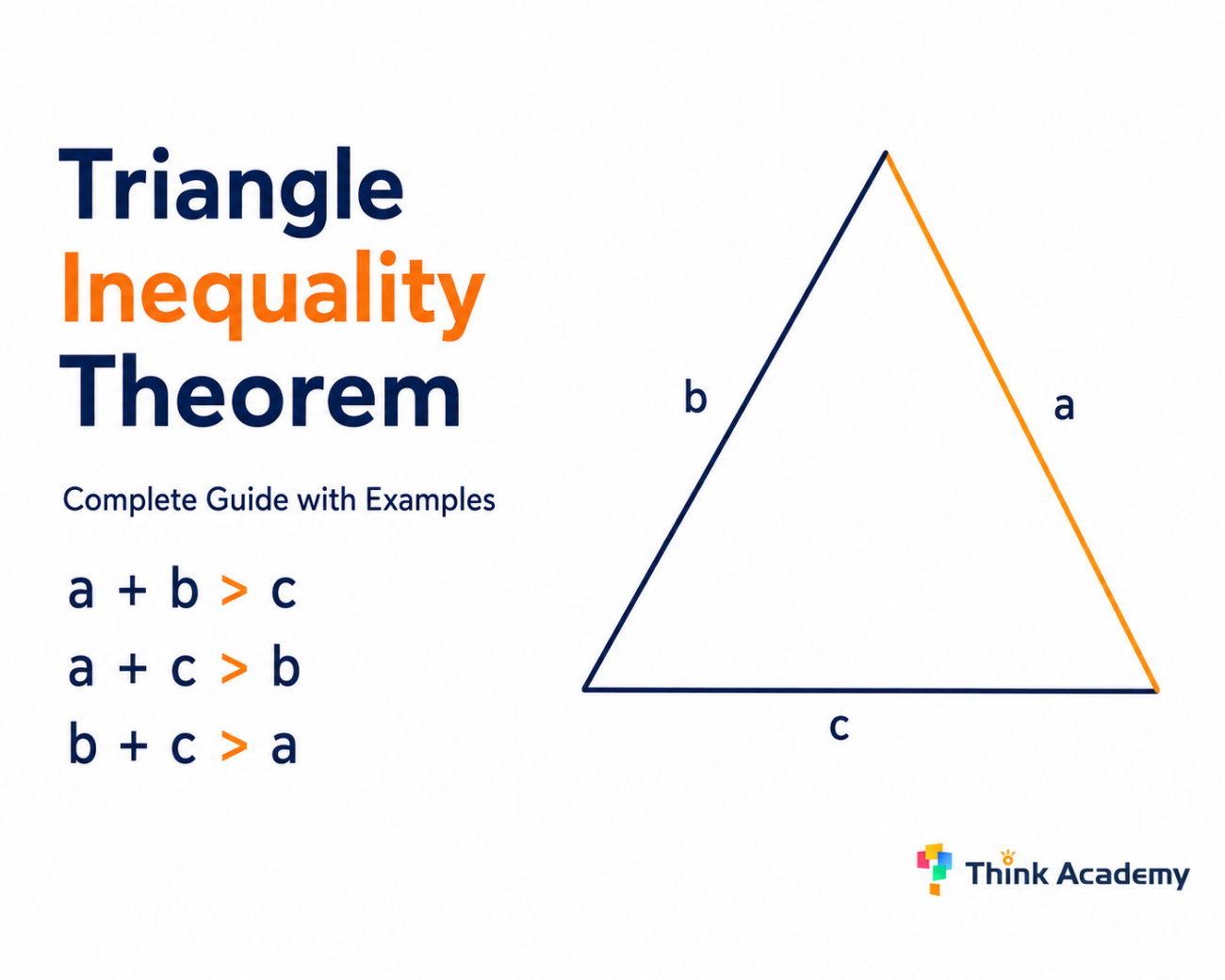
The triangle inequality theorem states that for any triangle with sides of length a, b, and c:a+b>c a+c>b b+c>a
In plain English: the sum of any two sides of a triangle must be greater than the third side.
Equivalently: any side of a triangle must be less than the sum of the other two sides.
This must hold for all three combinations simultaneously. If any one of the three inequalities fails, the three lengths cannot form a triangle.
The most useful form for problem-solving:
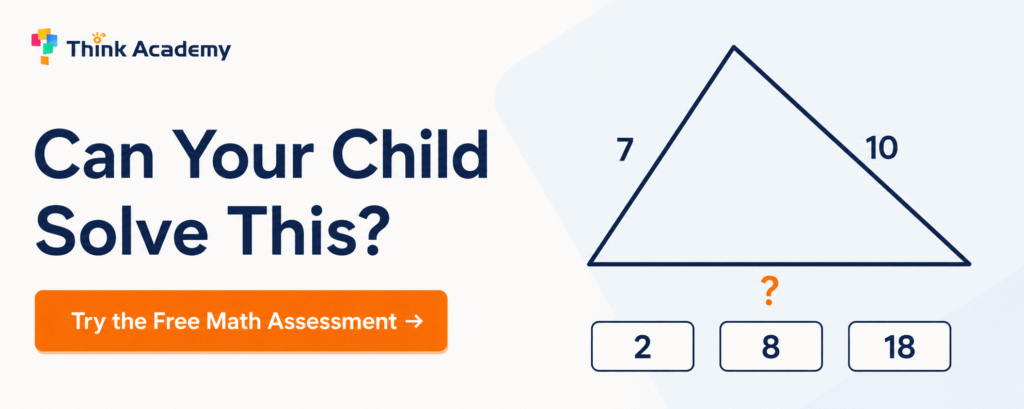
When you know two sides and need to find the range of possible values for the third side, the triangle inequality gives you:∣a−b∣<c<a+b
The third side must be strictly greater than the absolute difference of the other two, and strictly less than their sum.
Why the Triangle Inequality Is True
Geometric proof (most intuitive):
Imagine placing two sides of a triangle — lengths a and b — end to end in a straight line. Their total length is a + b. Now try to form a triangle by adding a third side c.
- If c = a + b: the three points are collinear — the “triangle” is a straight line, not a triangle
- If c > a + b: the third side is too long to reach — no triangle forms
- If c < a + b: the third vertex can be lifted off the line, forming a genuine triangle
For a triangle to exist, c must be strictly less than a + b. By the same reasoning applied to each side, all three inequalities must hold.
Formal proof sketch:
Given triangle ABC with sides a = BC, b = CA, c = AB:
By the straight-line path principle: the direct path from B to A (length c) is shorter than any indirect path through C (length a + b). Therefore c < a + b. ∎
The other two inequalities follow by relabelling.
How to Use the Triangle Inequality: Three Types of Problems
Type 1: Does a Triangle Exist?
Can three lengths form a triangle? Check all three inequalities. In practice, only the one involving the largest side needs to be checked — if the sum of the two smaller sides exceeds the largest, all three inequalities are satisfied.
Shortcut: If a ≤ b ≤ c, only check: a + b > c.
Example 1: Can 5, 7, and 10 form a triangle? Largest side = 10. Check: 5 + 7 = 12 > 10. ✓ Yes.
Example 2: Can 3, 4, and 8 form a triangle? Largest side = 8. Check: 3 + 4 = 7 < 8. ✗ No.
Example 3: Can 6, 6, and 12 form a triangle? Largest side = 12. Check: 6 + 6 = 12. Not strictly greater. ✗ No — this would be a degenerate triangle (a straight line).
Type 2: Finding the Range of a Third Side
Given two sides, find all possible integer (or real) values for the third side.
Example 4: Two sides of a triangle are 5 and 9. What are the possible integer values for the third side?
Using |a − b| < c < a + b: |9 − 5| < c < 9 + 5 4 < c < 14
So c can be any value strictly between 4 and 14. Integer values: 5, 6, 7, 8, 9, 10, 11, 12, 13.
Example 5: Two sides of a triangle are 7 and 7. What values can the third side take?
|7 − 7| < c < 7 + 7 0 < c < 14
Any value strictly between 0 and 14. This confirms that an isoceles triangle with equal sides 7 can have a base anywhere in the range (0, 14).
Type 3: Proving a Statement Using the Triangle Inequality
At competition level, the triangle inequality is used as a tool within longer proofs — not just checked directly.
Example 6: Prove that for any triangle with sides a, b, c: a+b+c>2c
Proof: By the triangle inequality, a + b > c. Adding c to both sides: a + b + c > 2c. ∎
Example 7: In triangle ABC, the perimeter is 30 and one side has length 12. What are the possible lengths of the other sides?
Let the three sides be 12, x, y where x + y = 18.
By the triangle inequality: 12 < x + y (automatically satisfied since x + y = 18 > 12) Also: x < 12 + y and y < 12 + x
Since x + y = 18: x < 12 + (18 − x) → x < 30 − x → 2x < 30 → x < 15. Similarly y < 15. And both x, y > 0.
So each of the two unknown sides must be in the range (0, 15), with x + y = 18.
The Triangle Inequality and the Degenerate Case
A degenerate triangle occurs when a + b = c — the three vertices are collinear and the “triangle” is a straight line with zero area.
Most problems specify that a triangle must be non-degenerate, which requires strict inequalities. Watch for this in problem statements:
- “A triangle with sides a, b, c” — strict inequalities required
- “A non-degenerate triangle” — same
- “A triangle with positive area” — confirms strict inequalities
Some problems at competition level deliberately test whether students include or exclude the degenerate case. Read carefully.
Triangle Inequality in Coordinate Geometry
The triangle inequality has a direct analogue for distances: for any three points A, B, C:d(A,C)≤d(A,B)+d(B,C)
with equality only when B lies on the segment AC (the degenerate case).
Example 8: Three points have coordinates A(0, 0), B(3, 4), C(8, 0). Do they form a triangle?
AB = √(9 + 16) = 5 AC = 8 BC = √(25 + 16) = √41 ≈ 6.4
Check: 5 + 6.4 > 8 ✓, 5 + 8 > 6.4 ✓, 6.4 + 8 > 5 ✓. Yes, they form a triangle.
Where the Triangle Inequality Appears in Contests
The triangle inequality theorem appears at every level of the competition mathematics ladder.
AMC 8 and Gauss Contest (Grades 7–8): The most common format: given three side lengths, determine which can or cannot form a triangle. Occasionally: given two sides, find the range of integer values for the third. These problems are designed to be solvable in under 90 seconds — which requires knowing the theorem and the shortcut (only check the largest side), not deriving it from scratch. See our AMC 8 guide and Gauss math contest guide.
AMC 10 and Cayley Contest (Grades 9–10): Triangle inequality problems at this level often involve algebraic side lengths — sides expressed as expressions in x — requiring students to set up and solve an inequality system rather than simply checking integers.
Example (AMC 10 style): A triangle has sides x, x + 2, and 2x − 1. Find all integer values of x for which a valid triangle exists.
From the triangle inequality (checking each side as the potential “largest”):
- x + (x + 2) > 2x − 1 → 2x + 2 > 2x − 1 → 2 > −1 ✓ (always)
- x + (2x − 1) > x + 2 → 3x − 1 > x + 2 → 2x > 3 → x > 3/2
- (x + 2) + (2x − 1) > x → 3x + 1 > x → 2x > −1 ✓ (always for positive x)
Also sides must be positive: x > 0, x + 2 > 0 (always), 2x − 1 > 0 → x > 1/2.
Combined: x > 3/2, so x ≥ 2 for integers. Integer values: x = 2, 3, 4, …
Euclid Contest (Grade 12): The triangle inequality appears as a component within larger geometry problems, or used to establish bounds in an inequality proof. Students are expected to cite it and apply it without lengthy re-derivation.
For students working toward competition mathematics, understanding the triangle inequality theorem — and being able to apply it quickly in algebraic form — is foundational. Our math competitions in Canada guide covers the full contest landscape.

Common Mistakes with the Triangle Inequality
Mistake 1: Only checking one inequality. Students who check only “the two shorter sides must sum to more than the longest side” are correct — but only if they correctly identify the longest side. In problems where the longest side depends on a variable (e.g., x, x+2, 2x−1), all three inequalities must be checked because the relative sizes of the sides change with x.
Mistake 2: Using ≥ instead of >. The triangle inequality is strict. A triangle with sides 3, 4, 7 where 3 + 4 = 7 does not exist — the three points are collinear. Students who write ≥ instead of > will include degenerate cases and lose marks on problems that specifically ask about valid triangles.
Mistake 3: Forgetting that sides must be positive. In algebraic problems (sides expressed as x − 1, 2x + 3, etc.), students sometimes find the inequality range but forget to also require that each side length is positive. A side length of 0 or negative is not a valid triangle side.
Mistake 4: Confusion about which form to use.
- “Does this triangle exist?” → check a + b > c for all three combinations (or just the largest)
- “What is the range of the third side?” → use |a − b| < c < a + b
Students who mix these up waste time or apply the wrong test.
Practice Problems
Set A — Does a triangle exist?
Determine whether each set of lengths can form a triangle:
- 4, 6, 9
- 2, 5, 8
- 7, 7, 7
- 1, 4, 4
- 5, 5, 10
- 3, 11, 12
- 6, 8, 15
- 10, 10, 1
Set B — Range of the third side
- Two sides are 6 and 10. Find all possible integer values for the third side.
- Two sides are 4 and 4. What is the range of the third side?
- Two sides are 8 and 15. What integer values can the third side take?
- A triangle has perimeter 24 and two sides of length 9 and 9. Find the third side.
Set C — Algebraic problems
- A triangle has sides 3, x, and 8. Find all integer values of x.
- A triangle has sides x, x + 1, and x + 2. Find all positive integer values of x.
- A triangle has sides x, 2x, and x + 6. Find the range of x.
Answers:
Set A:
- 4 + 6 = 10 > 9 ✓ Yes
- 2 + 5 = 7 < 8 ✗ No
- 7 + 7 = 14 > 7 ✓ Yes
- 1 + 4 = 5 > 4 ✓ Yes
- 5 + 5 = 10, not strictly greater ✗ No (degenerate)
- 3 + 11 = 14 > 12 ✓ Yes
- 6 + 8 = 14 < 15 ✗ No
- 10 + 1 = 11 > 10 ✓ Yes
Set B: 9) |10 − 6| < c < 10 + 6 → 4 < c < 16. Integer values: 5, 6, 7, 8, 9, 10, 11, 12, 13, 14, 15 10) 0 < c < 8. Any value in (0, 8) 11) |15 − 8| < c < 15 + 8 → 7 < c < 23. Integer values: 8, 9, …, 22 12) Third side = 24 − 9 − 9 = 6. Check: 9 + 9 = 18 > 6 ✓, 9 + 6 = 15 > 9 ✓. Third side = 6
Set C: 13) |8 − 3| < x < 8 + 3 → 5 < x < 11. Integer values: 6, 7, 8, 9, 10 14) Check largest side (x + 2): x + (x + 1) > x + 2 → x > 1. All three sides positive: x > 0. So x ≥ 2. Any positive integer x ≥ 2 15) Three inequalities: x + (x+6) > 2x → 6 > 0 ✓ always; x + 2x > x+6 → 3x > x+6 → x > 3; 2x + (x+6) > x → 3x+6 > x → x > −3 ✓. Also all sides positive: x > 0, x+6 > 0 (always), 2x > 0 → x > 0. Combined: x > 3
Frequently Asked Questions
What does the triangle inequality theorem state? For any triangle with sides a, b, and c, the sum of any two sides must be strictly greater than the third side: a + b > c, a + c > b, and b + c > a. All three conditions must hold simultaneously.
How do you check if three lengths form a triangle? Only one check is needed: verify that the sum of the two shorter sides is greater than the longest side. If the sides are a ≤ b ≤ c, check a + b > c. If this holds, all three inequalities are satisfied.
What is the range of the third side of a triangle? Given two sides of length a and b, the third side c must satisfy: |a − b| < c < a + b. The third side must be strictly greater than the absolute difference and strictly less than the sum of the other two sides.
What is a degenerate triangle? A degenerate triangle occurs when a + b = c for some labelling — the three points are collinear, the triangle has zero area, and the three inequalities are not all strictly satisfied. Most problems exclude degenerate triangles by requiring a valid (non-degenerate) triangle.
Does the triangle inequality apply to non-integer sides? Yes. The theorem holds for any positive real number side lengths — not just integers. The integer restriction only appears when a problem asks specifically for integer side lengths.
Where does the triangle inequality appear on the AMC 8? It appears in geometry problems where three lengths are given and you must determine which can or cannot form a triangle, or where two sides are given and you must find integer values for the third. It is one of the most directly applicable theorems in the AMC 8 geometry section.
See our related guides: AMC 8 guide · AMC 10 guide · Gauss math contest guide · Cayley math contest guide · Euclid math contest guide · math competitions in Canada · Pythagorean triples guide · special triangles in trigonometry · math enrichment guide
The triangle inequality is a short theorem with a long reach. Build the geometry foundations that make competition problems like this feel routine.