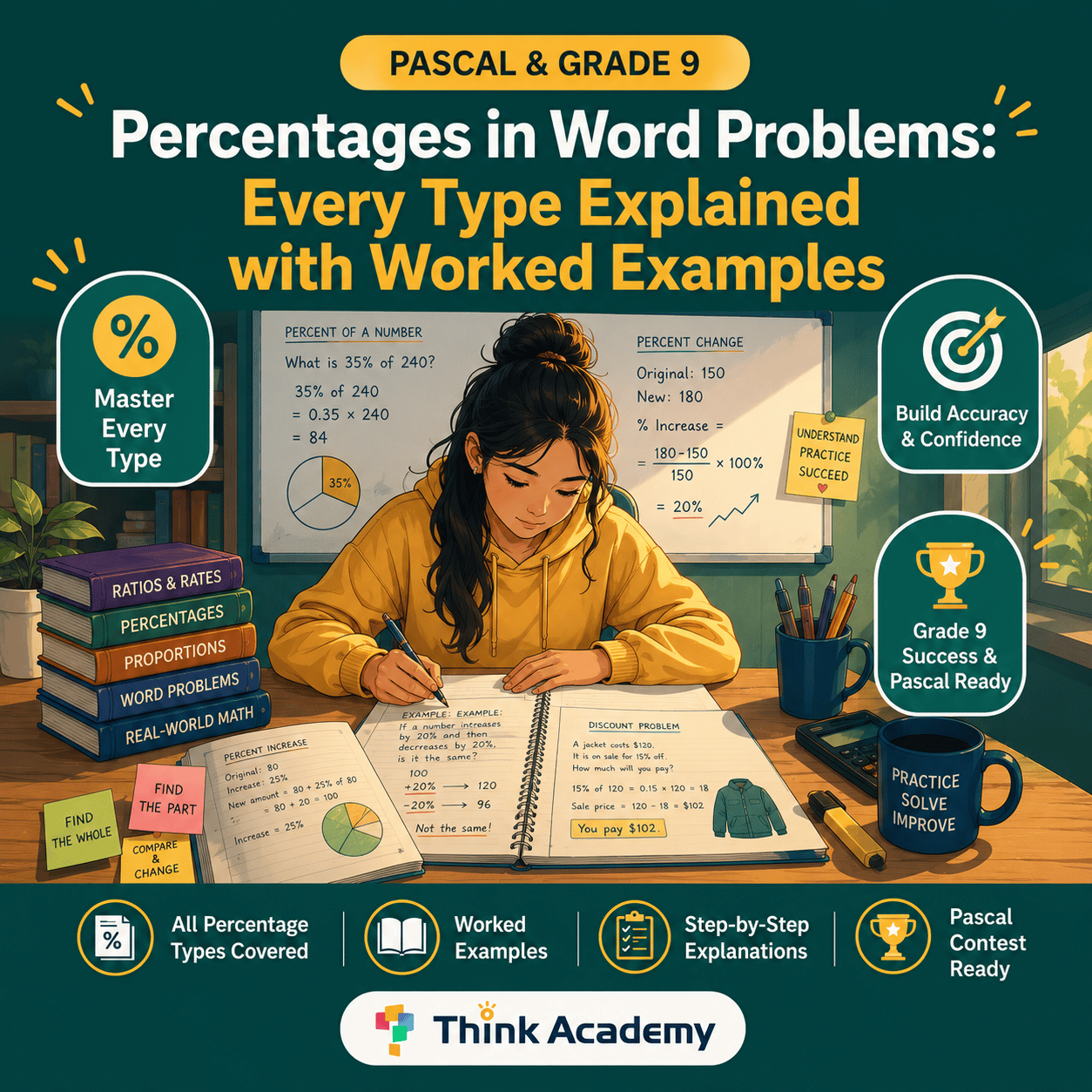
Percentages appear in almost every real-world context — discounts, taxes, interest, test scores, population changes. They also appear in almost every Ontario math assessment from Grade 6 onward. Yet percentages in word problems are where students consistently lose marks, not because they can’t calculate a percentage, but because they can’t identify what the problem is actually asking. This guide covers every type of percentage word problem that appears in Ontario Grade 9 math and the Pascal Contest, with a clear method for each and fully worked examples throughout.

The six types of percentages in word problems
Every percentage word problem in Grade 9 Ontario math falls into one of six categories. Identifying the type before calculating is the single most important habit to build.
| Type | What you are finding | Key phrase |
|---|---|---|
| Percent of a number | A portion of a given total | ‘find 35% of 240’ |
| Finding the percent | What percentage one number is of another | ‘what percent of 80 is 12’ |
| Finding the original value | The whole, given a percentage and a part | ‘after a 20% discount the price is $48 — what was the original?’ |
| Percent increase and decrease | How much something has grown or shrunk, as a percentage | ‘increased by’, ‘decreased by’, ‘percentage change’ |
| Tax, tip, and discount | Real-world applications of percent increase and decrease | ‘HST’, ‘gratuity’, ‘sale price’, ‘markdown’ |
| Simple interest | Interest earned or paid on a principal over time | ‘interest rate’, ‘principal’, ‘per year’, ‘annually’ |
How to approach percentages in word problems: a general method
Step 1: Identify the type. What is the problem asking for — a part, a percent, a whole, a change, or an interest amount?
Step 2: Identify the three quantities. Most percentage problems involve three quantities: the whole (the original or total amount), the part (the portion being considered), and the percent (the rate). Two are given; one is unknown.
Step 3: Set up the equation. The core relationship is:
Part = Percent × Whole
or rearranged: Percent = Part ÷ Whole and Whole = Part ÷ Percent
Step 4: Convert the percent to a decimal. Divide by 100 before calculating. 35% = 0.35.
Step 5: Solve and interpret. Check that the answer makes sense in context. A discount should reduce the price. An increase should produce a larger number.
Type 1: Finding a percent of a number
This is the most straightforward type. Multiply the whole by the decimal form of the percent.
Formula: Part = Percent × Whole
Worked example 1
A student scores 78% on a test worth 150 marks. How many marks did they receive?
Part = 0.78 × 150 = 117 marks
Worked example 2
A jacket costs $120. It is on sale for 35% off. How much is the discount?
Discount = 0.35 × 120 = $42
Sale price = 120 − 42 = $78
Type 2: Finding what percent one number is of another
Divide the part by the whole and multiply by 100.
Formula: Percent = (Part ÷ Whole) × 100
Worked example 3
18 students in a class of 24 passed the test. What percentage passed?
Percent = (18 ÷ 24) × 100 = 0.75 × 100 = 75%
Worked example 4
A hockey player scored 14 goals in 40 games. What percentage of games did they score in?
Percent = (14 ÷ 40) × 100 = 0.35 × 100 = 35%
Type 3: Finding the original value
This is the type students most often get wrong. The percent and the part are given; the whole is unknown. The key mistake is taking the percent of the wrong number.
Formula: Whole = Part ÷ Percent (as a decimal)
Worked example 5
After a 25% discount, a pair of shoes costs $60. What was the original price?
The $60 represents 75% of the original price (100% − 25% = 75%).
Whole = 60 ÷ 0.75 = $80
Common mistake: multiplying $60 by 1.25 to get $75. This is wrong because 25% of $75 is $18.75, and $75 − $18.75 ≠ $60. Always identify what percentage the given value represents before dividing.
Worked example 6
A school’s enrolment increased by 12% to reach 896 students. What was the enrolment before the increase?
896 represents 112% of the original (100% + 12%).
Whole = 896 ÷ 1.12 = 800 students
Type 4: Percent increase and decrease
These problems ask you to calculate how much a quantity has changed as a percentage of its original value.
Percent change formula:
Percent change = (New value − Original value) ÷ Original value × 100
A positive result is a percent increase; a negative result is a percent decrease.
Worked example 7
A store’s weekly sales went from $4,200 to $4,830. What is the percent increase?
Percent change = (4830 − 4200) ÷ 4200 × 100 = 630 ÷ 4200 × 100 = 0.15 × 100 = 15% increase
Worked example 8
A population of 6,400 decreased to 5,440. What is the percent decrease?
Percent change = (5440 − 6400) ÷ 6400 × 100 = −960 ÷ 6400 × 100 = −0.15 × 100 = 15% decrease
Note: percent change is always calculated relative to the original value, not the new one. This is a frequent source of error.
Type 5: Tax, tip, and discount problems
These are percent increase and decrease applied to real-world financial contexts. They appear consistently in the Ontario MTH1W Financial Literacy strand and in EQAO Grade 9.
Tax (HST in Ontario)
Ontario’s Harmonised Sales Tax (HST) is 13%. To find the price after tax:
Price after tax = Original price × 1.13
Worked example 9
A meal costs $45.00 before tax. What is the total cost with 13% HST?
Total = 45 × 1.13 = $50.85
Tip calculations
A tip is a percentage added to the pre-tax or post-tax amount (the problem will specify which).
Worked example 10
A restaurant bill is $62.00 before tax. A customer leaves an 18% tip on the pre-tax amount. What is the total paid?
Tip = 0.18 × 62 = $11.16 Tax = 0.13 × 62 = $8.06 Total = 62 + 11.16 + 8.06 = $81.22
Discount then tax
A common multi-step problem: apply the discount first, then calculate tax on the discounted price.
Worked example 11
A laptop is listed at $850. It is on sale for 20% off. What is the final price after 13% HST?
Discounted price = 850 × 0.80 = $680 Price after tax = 680 × 1.13 = $768.40
Do not calculate tax on the original price and then apply the discount — always discount first, then tax.
Type 6: Simple interest
Simple interest problems appear in the MTH1W Financial Literacy strand and are a common source of multi-step percentage problems in Grade 9.
Simple interest formula:
I = P × r × t
Where:
- I = interest earned or paid
- P = principal (the original amount)
- r = annual interest rate as a decimal
- t = time in years
Total amount = P + I
Worked example 12
$2,500 is invested at a simple interest rate of 4% per year for 3 years. How much interest is earned? What is the total value of the investment?
I = 2500 × 0.04 × 3 = $300 Total = 2500 + 300 = $2,800
Worked example 13
How long does it take for $1,200 invested at 5% simple interest to earn $180 in interest?
180 = 1200 × 0.05 × t 180 = 60t t = 3 years
Worked example 14 — finding the rate
$3,000 grows to $3,450 in 2 years with simple interest. What is the annual interest rate?
I = 3450 − 3000 = $450 450 = 3000 × r × 2 450 = 6000r r = 0.075 = 7.5% per year

Percentage word problems and the Pascal Contest
The Pascal Contest is written by Grade 9 and 10 students and tests mathematical reasoning across all areas of the curriculum. Percentage problems appear regularly, typically in two forms:
Direct percentage calculations: Part A and Part B problems (worth 5 and 6 marks) often include straightforward percentage applications — percent change, tax and discount, or simple interest — where the key skill is setting up the calculation correctly and efficiently.
Multi-step percentage reasoning: Part C problems (worth 8 marks) sometimes embed percentage reasoning inside a larger problem. A student who recognises that a problem involves finding an original value from a percentage, or calculating compound percentage changes, and can set it up cleanly, has a time advantage over students who work through it numerically by trial.
The most common Pascal percentage traps:
- Confusing percent increase with percent of the new value
- Applying a percentage to the wrong base
- Forgetting to convert a percentage to a decimal before multiplying
- Misreading ‘what percent of A is B’ versus ‘what percent of B is A’
Students who practise identifying the type of percentage problem before calculating — rather than reaching for a formula immediately — handle Pascal percentage problems significantly more reliably.
Percentage problems in EQAO Grade 9
The MTH1W EQAO assessment tests percentage reasoning across multiple strands. In the Number strand, percent increase and decrease and finding original values appear as standalone questions. In the Financial Literacy strand, tax, discount, tip, and simple interest appear in multi-step real-world contexts.
The EQAO Grade 9 assessment window for Semester 2 runs until 24 June 2026. For students currently preparing, percentage word problems are one of the highest-yield areas to focus on — they are consistently tested, they are not covered by the formula sheet, and they respond well to structured practice.
Practice problems
Try these before checking the solutions below.
Q1. A coat costs $195. It is on sale for 30% off. What is the sale price?
Q2. A student scored 84 marks on a test. This was 70% of the total marks. What was the test worth?
Q3. A town’s population grew from 12,500 to 13,875. What was the percent increase?
Q4. After a 15% tip and 13% HST on a $55 restaurant bill, what is the total amount paid? (Tip calculated on pre-tax amount.)
Q5. $4,000 is invested at a simple interest rate of 3.5% per year. How many years does it take to earn $700 in interest?
Solutions
Q1. Discount = 0.30 × 195 = $58.50. Sale price = 195 − 58.50 = $136.50
Q2. Whole = 84 ÷ 0.70 = 120 marks
Q3. Percent change = (13875 − 12500) ÷ 12500 × 100 = 1375 ÷ 12500 × 100 = 11%
Q4. Tip = 0.15 × 55 = $8.25. Tax = 0.13 × 55 = $7.15. Total = 55 + 8.25 + 7.15 = $70.40
Q5. 700 = 4000 × 0.035 × t → 700 = 140t → t = 5 years
Common mistakes in percentage word problems
| Mistake | How to avoid it |
|---|---|
| Taking the percent of the new value instead of the original | Percent change is always relative to the original value |
| Forgetting to subtract the discount before applying tax | Discount first, then tax — always in that order |
| Not converting percent to decimal | Divide by 100 before multiplying: 35% = 0.35 |
| Confusing ‘what percent of A is B’ with ‘what percent of B is A’ | Re-read carefully — the number after ‘of’ is the whole |
| Using the discounted price as the whole when finding the original | The discounted price represents (100% − discount%), not 100% |
How Think Academy Canada supports Grade 9 math and Pascal preparation
Think Academy Canada works with high-performing Ontario students from Grade 1 through Grade 12. For Grade 9 students, our programme covers all five strands of the MTH1W curriculum — including the Number and Financial Literacy strands where percentage word problems appear most heavily.
Our approach starts with a diagnostic. Every new student completes a free assessment and receives a personalised feedback report identifying where their skills stand. For Grade 9 students, the report typically shows whether the difficulty is in setting up the problem, in the arithmetic, or in understanding which type of percentage problem they are facing — three different problems with three different solutions.
The EQAO Grade 9 window closes 24 June. For students currently in Semester 2, there is still time to sharpen percentage reasoning before the assessment. For students preparing for the Pascal Contest in February, percentage fluency is one of the most transferable skills to build.

FAQs
What are the main types of percentages in word problems?
The six main types are: finding a percent of a number, finding what percentage one number is of another, finding the original value from a percentage and a part, percent increase and decrease, tax/tip/discount problems, and simple interest problems.
How do you solve percentages in word problems step by step?
Identify the type. Identify the whole, the part, and the percent — two are given and one is unknown. Use the core relationship Part = Percent × Whole (rearranged as needed). Convert the percent to a decimal. Solve and check that the answer makes sense in context.
What is the formula for percent change?
Percent change = (New value − Original value) ÷ Original value × 100. A positive result is an increase; a negative result is a decrease. The denominator is always the original value, not the new one.
How do you find the original price after a discount?
Identify what percentage of the original price the discounted price represents. For a 20% discount, the discounted price is 80% of the original. Divide the discounted price by 0.80 (or whatever the remaining percentage is as a decimal) to find the original.
What is the simple interest formula?
I = P × r × t, where I is the interest, P is the principal, r is the annual rate as a decimal, and t is the time in years. Total amount = P + I.
What is Ontario HST and how do you calculate it?
Ontario’s Harmonised Sales Tax (HST) is 13%. To find the price after HST, multiply the pre-tax price by 1.13. To find the pre-tax price from the total, divide the total by 1.13.
Do percentages in word problems appear on EQAO Grade 9?
Yes. Percentage problems appear across multiple strands of the MTH1W EQAO assessment — in the Number strand (percent change, finding original values) and in the Financial Literacy strand (tax, discount, tip, simple interest). They are not covered by the formula sheet, so fluency is essential.
Do percentages in word problems appear on the Pascal Contest?
Yes. The Pascal Contest regularly includes percentage problems in applied contexts. Multi-step problems combining percent change, discount, or interest with other reasoning appear in Part B and Part C.
Why do students lose marks on percentages in word problems?
The most common reasons are: applying the percent to the wrong base (especially in finding-the-original problems), confusing percent increase with percent of the new value, forgetting to convert percent to decimal, and misidentifying which quantity is the whole in the problem.
What is the difference between percent and percentage point?
A percent change measures change relative to the original value. A percentage point measures an absolute difference between two percentages. If interest rates go from 3% to 5%, that is a 2 percentage point increase but a 66.7% increase relative to the original rate.
How does percentage reasoning connect to the Pascal Contest?
The Pascal Contest tests mathematical reasoning across the Grade 9–10 curriculum. Percentage problems appear regularly as direct applications and embedded within multi-step problems. Students who can identify the problem type and set up the equation cleanly handle these problems more efficiently under time pressure.
How can Think Academy Canada help with percentages in word problems?
Think Academy Canada offers a free diagnostic assessment for students in Grades 1 to 12. The assessment identifies where a student’s percentage and proportional reasoning skills stand, including their ability to solve applied word problems across all six types. A personalised feedback report is provided after the assessment as well as free resources to practice with.
About Think Academy Canada Think Academy Canada is a K-12 mathematics tutoring programme, part of TAL Education Group. We work with motivated students across Canada from Grade 1 through Grade 12, with a focus on Ontario curriculum, EQAO preparation, and competition mathematics including CEMC contests (Pascal, Cayley, Fermat, Euclid) and AMC. All lessons are delivered online. Follow us on Instagram at @thinkacademyca.