


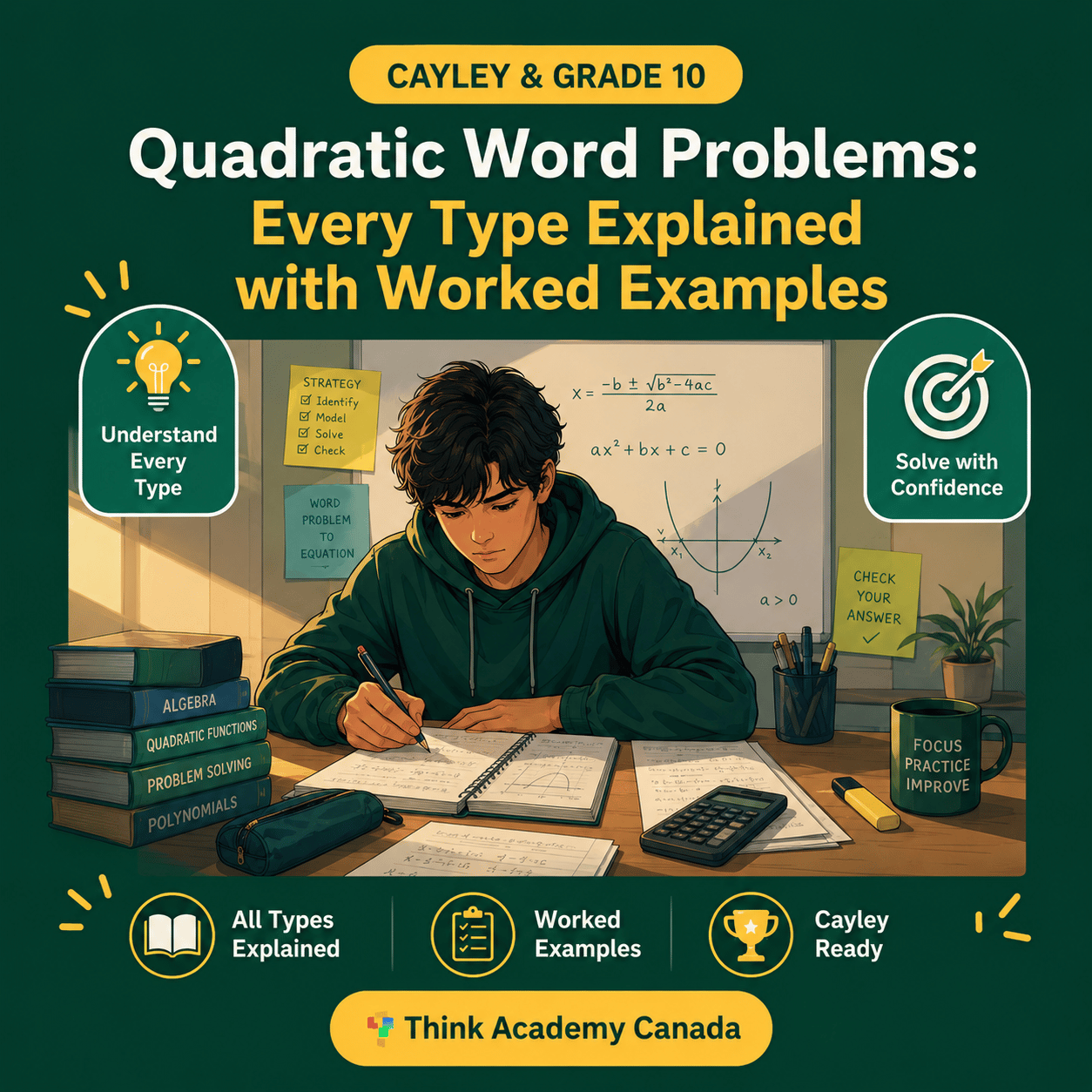
Quadratic word problems are where the algebra becomes real. Students who can expand and factor a quadratic expression often struggle when the same mathematics is wrapped in a context — a projectile, a revenue model, a rectangle with given area. The problem looks unfamiliar. The equation is not obvious. This guide covers every type of quadratic word problem that appears in Ontario Grade 10 math and the Cayley Contest, with a clear method for each and fully worked examples throughout.

The four types of quadratic word problems
Every quadratic word problem in Grade 10 Ontario math and the Cayley Contest falls into one of four categories. Identifying the type before setting up the equation is the most important step.
| Type | What you are finding | Key phrase in the problem |
|---|---|---|
| Projectile / motion | Maximum height, time in air, when object hits ground | ‘thrown’, ‘launched’, ‘ball’, ‘height’, ‘falls’ |
| Area and geometry | Dimensions of a shape given area or perimeter | ‘rectangle’, ‘area’, ‘width’, ‘length’, ‘border’ |
| Revenue and optimisation | Maximum profit, optimal price, number sold | ‘revenue’, ‘profit’, ‘price’, ‘sales’, ‘maximise’ |
| Number problems | Two unknowns with a quadratic relationship | ‘product’, ‘sum’, ‘consecutive integers’, ‘differ by’ |
Once you have identified the type, the setup process is the same in every case: define a variable, write the quadratic equation, and solve using the appropriate method.
A general method for any quadratic word problem
Step 1: Read carefully and identify the type. What is the problem actually asking you to find? A time? A dimension? A price? A pair of numbers?
Step 2: Define your variable. Let x = (whatever the unknown quantity is). Be specific — ‘let x = the width of the rectangle in centimetres’, not just ‘let x = width’.
Step 3: Write the equation. Express the relationship described in the problem as a quadratic equation. This is the hardest step and the one most worth practising.
Step 4: Solve the equation. Use factoring, the quadratic formula, or completing the square depending on what the problem requires and what form the equation takes.
Step 5: Interpret the solution. A quadratic equation usually produces two solutions. Check both against the context. Negative dimensions, negative prices, and times before t = 0 are typically inadmissible — eliminate them and state why.
Step 6: Write a conclusion. Answer the question asked. Include units.
Type 1: Projectile and motion problems
Projectile problems use the relationship between height and time. In Ontario Grade 10 math, the standard model is:
h = −4.9t² + v₀t + h₀
Where:
- h = height in metres
- t = time in seconds
- v₀ = initial vertical velocity in m/s
- h₀ = initial height in metres
The −4.9 coefficient comes from gravitational acceleration (−9.8 m/s² ÷ 2).
Worked example 1: When does the ball hit the ground?
A ball is thrown upward from a height of 1.5 m with an initial velocity of 14 m/s. Its height in metres after t seconds is given by h = −4.9t² + 14t + 1.5. When does the ball hit the ground?
Step 1: The ball hits the ground when h = 0. 0 = −4.9t² + 14t + 1.5
Step 2: Use the quadratic formula. a = −4.9, b = 14, c = 1.5.
t = (−14 ± √(196 + 29.4)) / (−9.8) t = (−14 ± √225.4) / (−9.8) t = (−14 ± 15.01) / (−9.8)
t = (−14 + 15.01) / (−9.8) = 1.01 / (−9.8) ≈ −0.10 (inadmissible — negative time) t = (−14 − 15.01) / (−9.8) = −29.01 / (−9.8) ≈ 2.96 seconds
Conclusion: The ball hits the ground approximately 2.96 seconds after being thrown.
Worked example 2: Maximum height
Using the same equation h = −4.9t² + 14t + 1.5, find the maximum height reached by the ball.
The maximum occurs at the vertex. The t-coordinate of the vertex is t = −b / (2a) = −14 / (2 × −4.9) = −14 / −9.8 ≈ 1.43 seconds.
Maximum height: h = −4.9(1.43)² + 14(1.43) + 1.5 h = −4.9(2.04) + 20.02 + 1.5 h = −10.00 + 20.02 + 1.5 h ≈ 11.52 metres
Type 2: Area and geometry problems
These problems give you a relationship between the dimensions of a shape and its area (or perimeter), then ask you to find the dimensions.
Worked example 3: Rectangle with given area
A rectangle has a length that is 5 cm more than its width. The area of the rectangle is 84 cm². Find the dimensions.
Step 1: Let x = width (cm). Then length = x + 5.
Step 2: Area = length × width x(x + 5) = 84 x² + 5x − 84 = 0
Step 3: Factor. (x + 12)(x − 7) = 0 x = −12 or x = 7
x = −12 is inadmissible (negative width).
Conclusion: Width = 7 cm, length = 12 cm.
Worked example 4: Border problem
A 10 m × 8 m garden is surrounded by a uniform border of grass. The total area of the garden plus border is 143 m². Find the width of the border.
Step 1: Let x = width of border (m). Total length = 10 + 2x, total width = 8 + 2x.
Step 2: Total area = (10 + 2x)(8 + 2x) = 143 80 + 20x + 16x + 4x² = 143 4x² + 36x + 80 = 143 4x² + 36x − 63 = 0
Step 3: Quadratic formula. a = 4, b = 36, c = −63. x = (−36 ± √(1296 + 1008)) / 8 x = (−36 ± √2304) / 8 x = (−36 ± 48) / 8
x = (−36 + 48) / 8 = 12/8 = 1.5 or x = (−36 − 48) / 8 = −10.5 (inadmissible)
Conclusion: The border is 1.5 m wide.
Type 3: Revenue and optimisation problems
Revenue problems ask you to find the price or quantity that maximises (or sometimes achieves a target) revenue or profit.
The standard setup uses the relationship:
Revenue = price per unit × number of units sold
When price increases, quantity sold decreases (and vice versa) — this is what creates the quadratic relationship.
Worked example 5: Maximum revenue
A theatre sells 500 tickets at $20 each. Market research shows that for every $1 increase in ticket price, 10 fewer tickets are sold. What ticket price maximises revenue?
Step 1: Let x = number of $1 increases in price. Price per ticket = 20 + x Number of tickets sold = 500 − 10x
Step 2: Revenue = (20 + x)(500 − 10x) R = 10000 − 200x + 500x − 10x² R = −10x² + 300x + 10000
Step 3: Maximum at vertex. t = −b / (2a) = −300 / (2 × −10) = −300 / −20 = 15
Optimal price = 20 + 15 = $35 per ticket Tickets sold = 500 − 10(15) = 350 tickets Maximum revenue = 35 × 350 = $12,250
Worked example 6: Revenue target
Using the same setup, at what price does the theatre earn exactly $11,250?
−10x² + 300x + 10000 = 11250 −10x² + 300x − 1250 = 0 x² − 30x + 125 = 0 (x − 5)(x − 25) = 0 x = 5 or x = 25
Two valid solutions: price = $25 (selling 450 tickets) or price = $45 (selling 250 tickets). Both are admissible — the problem has two solutions and both should be stated.
Type 4: Number problems
These involve finding two numbers that satisfy both a sum (or difference) condition and a product (or other quadratic) condition.
Worked example 7: Two consecutive integers
The product of two consecutive positive integers is 182. Find the integers.
Step 1: Let x = smaller integer. Then the larger = x + 1.
Step 2: x(x + 1) = 182 x² + x − 182 = 0 (x + 14)(x − 13) = 0 x = −14 (inadmissible — must be positive) or x = 13
Conclusion: The integers are 13 and 14.
Worked example 8: Sum and product
Two numbers have a sum of 20 and a product of 91. Find the numbers.
Step 1: Let x = one number. Then the other = 20 − x.
Step 2: x(20 − x) = 91 20x − x² = 91 x² − 20x + 91 = 0 (x − 7)(x − 13) = 0 x = 7 or x = 13
Conclusion: The two numbers are 7 and 13.
Quadratic word problems and the Cayley Contest
The Cayley Contest, written by Grade 10 students, tests mathematical reasoning and problem-solving. Quadratic word problems appear in Cayley in two main forms.
Direct application problems: A context is given and students must set up and solve a quadratic equation. These tend to appear in Part A and Part B of the contest (questions worth 5 and 6 marks respectively). The setup matches the types above — area, revenue, or motion — but the numbers are chosen to make clean factoring possible. Students who can identify the type and set up the equation quickly have a significant time advantage.
Embedded quadratic reasoning: Part C problems (worth 8 marks) sometimes require quadratic thinking without explicitly announcing it. A student who recognises that a problem about maximising an area or a product is fundamentally a quadratic optimisation problem is more likely to reach the correct approach than one who tries to solve it numerically.
The key Cayley skill that quadratic word problems build: the ability to translate a verbal description into an equation. This translation step is where most marks are lost in contest problems — not in the algebra itself.
Choosing the right solving method
Once the equation is set up, students need to choose an appropriate solving method.
| Method | When to use | Example |
|---|---|---|
| Factoring | When the quadratic factors cleanly with integers | x² + 5x − 84 = 0 → (x + 12)(x − 7) = 0 |
| Quadratic formula | When factoring is not obvious or when the discriminant is needed | 4x² + 36x − 63 = 0 |
| Completing the square | When vertex form is needed (e.g. for maximum/minimum) | h = −4.9t² + 14t + 1.5 |
| Vertex formula t = −b/2a | Shortcut for maximum/minimum without full completing the square | Revenue and projectile maximum problems |
For Cayley Contest problems, factoring is almost always the intended method — the numbers are chosen to make it work. If factoring does not produce integer roots quickly, try the quadratic formula before spending time on completing the square.
Common mistakes in quadratic word problems
| Mistake | How to avoid it |
|---|---|
| Accepting a negative solution without checking | Always check both solutions against the problem context |
| Setting up the equation for the wrong quantity | Re-read the question — are you maximising revenue or finding when revenue equals a target? |
| Forgetting to add h₀ in projectile problems | The initial height is a constant term, not part of the velocity calculation |
| Finding the x-value of the vertex but not the y-value | For maximum height or maximum revenue, the answer is the y-value (k), not the t-value |
| Not writing a conclusion | In word problems, the answer is a real-world quantity — state it with units |
Practice problems
Try these before checking the solutions below.
Q1. A ball is kicked from ground level with an initial velocity of 20 m/s. Its height is modelled by h = −4.9t² + 20t. Find the maximum height and the time when the ball lands.
Q2. A rectangle has a perimeter of 44 cm. Its area is 117 cm². Find the dimensions of the rectangle.
Q3. A store sells 300 items per week at $15 each. For every $2 increase in price, 20 fewer items are sold. What price maximises revenue?
Q4. Two numbers differ by 7. Their product is 120. Find both numbers.
Solutions
Q1. h = −4.9t² + 20t. Vertex at t = −20 / (2 × −4.9) = 20/9.8 ≈ 2.04 s. Max height = −4.9(2.04)² + 20(2.04) = −20.40 + 40.80 ≈ 20.4 m Ball lands when h = 0: t(−4.9t + 20) = 0 → t = 0 or t = 20/4.9 ≈ 4.08 s
Q2. Perimeter = 44 → 2(l + w) = 44 → l + w = 22 → l = 22 − w. Area: w(22 − w) = 117 → 22w − w² = 117 → w² − 22w + 117 = 0 (w − 9)(w − 13) = 0 → w = 9 or w = 13. Dimensions: 9 cm × 13 cm
Q3. Let x = number of $2 increases. Price = 15 + 2x, quantity = 300 − 20x. R = (15 + 2x)(300 − 20x) = 4500 − 300x + 600x − 40x² = −40x² + 300x + 4500 Vertex: x = −300 / (2 × −40) = 300/80 = 3.75 → round to x = 4 (must be whole number). Price = 15 + 2(4) = $23 (check x = 3: price $21, R = −40(9) + 300(3) + 4500 = $5040; x = 4: price $23, R = −40(16) + 300(4) + 4500 = $5060). Optimal price: $23
Q4. Let x = smaller number, x + 7 = larger. x(x + 7) = 120 → x² + 7x − 120 = 0 → (x + 15)(x − 8) = 0 x = 8 (taking positive solution). The numbers are 8 and 15.
How Think Academy Canada supports Grade 10 math and Cayley preparation
Think Academy Canada works with high-performing Ontario students from Grade 1 through Grade 12. For Grade 10 students, our programme covers the full MPM2D curriculum — quadratic relations, analytic geometry, and trigonometry — with particular focus on the applied problem-solving skills that both the course and the Cayley Contest reward.
Our approach starts with a free diagnostic. Every new student completes a short assessment and receives a personalised feedback report identifying where their skills stand. For Grade 10 students, the report typically surfaces whether the difficulty is in setting up equations from context, in algebraic manipulation, or in selecting the right solving method — three distinct problems with three distinct solutions.
The Cayley Contest is written in February each year. Students who begin structured preparation in autumn — building fluency with quadratics, analytic geometry, and problem-solving strategy — have the most time to develop the contest-specific skills that differentiate good scores from exceptional ones.

FAQs
What are quadratic word problems?
Quadratic word problems are real-world problems that require setting up and solving a quadratic equation. Common types include projectile and motion problems, area and geometry problems, revenue and optimisation problems, and number problems involving products or sums.
How do you solve a quadratic word problem step by step?
Read the problem and identify the type. Define your variable clearly. Write the quadratic equation from the context. Solve using factoring, the quadratic formula, or completing the square. Check both solutions against the problem context. State a conclusion with units.
What is the quadratic formula?
The quadratic formula is x = (−b ± √(b² − 4ac)) / (2a), used to solve any quadratic equation of the form ax² + bx + c = 0. It is particularly useful when the quadratic does not factor cleanly with integers.
How do you set up a revenue quadratic word problem?
Define x as the number of price increases (or decreases). Write expressions for price per unit and number of units sold in terms of x. Multiply them to get the revenue function R = (price)(quantity). This produces a quadratic. Find the vertex to maximise, or set R equal to a target value and solve.
What is the projectile motion formula in Grade 10 Ontario math?
The standard model is h = −4.9t² + v₀t + h₀, where h is height in metres, t is time in seconds, v₀ is initial velocity, and h₀ is initial height. The −4.9 coefficient comes from gravitational acceleration. Maximum height is found at the vertex; the ball hits the ground when h = 0.
Why do quadratic equations sometimes have two solutions in word problems?
A quadratic equation always has at most two solutions mathematically. In word problems, both may be valid (for example, two prices that produce the same revenue), or one may be inadmissible because it is negative or does not fit the context. Always check both solutions and explain which apply.
Do quadratic word problems appear on the Cayley Contest?
Yes. The Cayley Contest regularly includes problems involving quadratic functions in applied contexts — area, revenue, and optimisation. Students who can identify the problem type and set up the equation quickly have a significant advantage on the time-limited contest.
What is the vertex of a quadratic and why does it matter for word problems?
The vertex is the highest or lowest point of the parabola. For a quadratic in the form y = ax² + bx + c, the x-coordinate of the vertex is x = −b / (2a). In word problems, the vertex gives the maximum height in projectile problems and the maximum revenue or profit in optimisation problems.
How do you know which solving method to use for a quadratic word problem?
Try factoring first — if the quadratic factors cleanly with integers, it is usually the fastest method. If factoring does not work quickly, use the quadratic formula. Use completing the square (or the vertex formula t = −b/2a) when the problem asks for a maximum or minimum value.
What is the difference between standard form and vertex form of a quadratic?
Standard form is y = ax² + bx + c. Vertex form is y = a(x − h)² + k, where (h, k) is the vertex. Vertex form is useful for reading off the maximum or minimum directly; standard form is more common in word problems. Converting between them requires completing the square.
Is quadratic functions a major part of the Ontario Grade 10 math curriculum?
Yes. Quadratic relations is one of the three main units in MPM2D (Grade 10 Academic Mathematics), alongside analytic geometry and trigonometry. It covers graphing quadratics, factoring, the quadratic formula, vertex form, and applications — including word problems.
How can Think Academy Canada help with quadratic word problems?
Think Academy Canada offers a free diagnostic assessment for students in Grades 1 to 12. The assessment identifies where a student’s algebra skills stand, including their ability to set up and solve applied quadratic problems. For Grade 10 students preparing for MPM2D assessments or the Cayley Contest, the report gives a precise starting point for targeted preparation.
About Think Academy Canada Think Academy Canada is a K-12 mathematics tutoring programme, part of TAL Education Group. We work with motivated students across Canada from Grade 1 through Grade 12, with a focus on Ontario curriculum, EQAO, and competition mathematics including CEMC contests (Pascal, Cayley, Fermat, Euclid) and AMC. All lessons are delivered online. Follow us on Instagram at @thinkacademyca.

