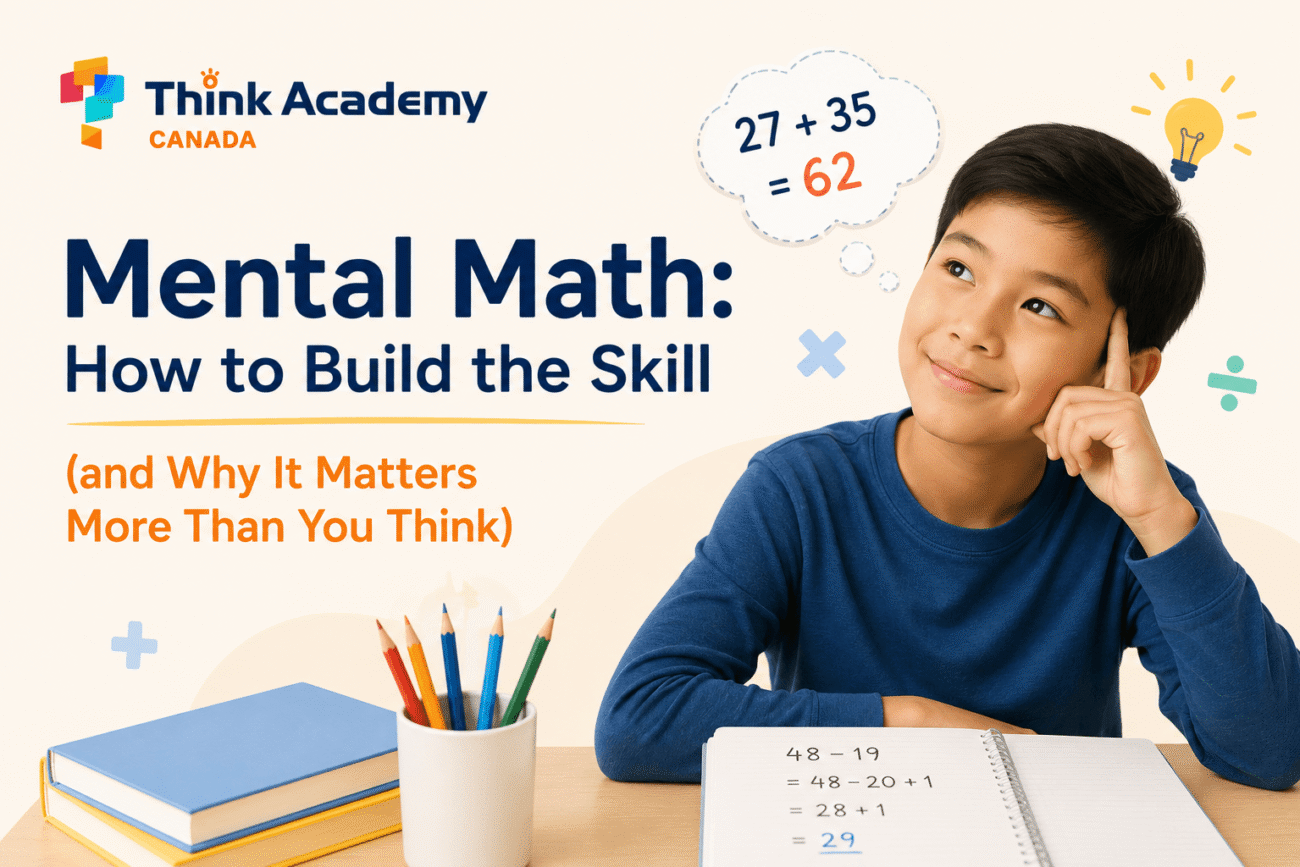
Mental math is one of the most undervalued skills in mathematics education — and one of the most consequential. It is not just about calculating quickly in your head. Strong mental math reflects genuine number sense: the flexible, intuitive understanding of how numbers work that underpins problem-solving, algebraic reasoning, and mathematical confidence at every level. A student who is fluent in mental math spends less cognitive effort on calculation — freeing up working memory for the harder parts of every problem.
This guide covers what mental math actually is, why it matters beyond party tricks, the core strategies that build it, and how to practise effectively at every age.
What Is Mental Math?
Mental math is the ability to perform mathematical calculations accurately and efficiently without paper, a calculator, or any external aid. But more than speed, genuine mental math fluency reflects a deep familiarity with number relationships — knowing not just that 7 × 8 = 56, but understanding why, and being able to use that knowledge flexibly in new contexts.
There are two distinct components:
Retrieval fluency — knowing number facts automatically. 6 × 7, 15 − 8, 12 × 12 — these should be retrieved from memory without calculation, the way a fluent reader recognises words rather than sounding them out letter by letter.
Computational reasoning — the ability to break down unfamiliar calculations into manageable steps using number sense. 47 + 38 might be computed as (47 + 40) − 2 = 85. 15 × 12 might be computed as 15 × 10 + 15 × 2 = 180. These are strategies, not algorithms — they require understanding the structure of the numbers.
Both components are built through deliberate practice. Neither develops automatically through general mathematics exposure alone.
Why Mental Math Matters More Than Most Parents Realise
Strong mental math is about more than speed—it reflects genuine number sense that supports every area of mathematics.
Our free assessment identifies whether your child’s calculation fluency is keeping up with their mathematical reasoning, and provides a personalised feedback report with clear next steps.
→ Get your free personalised feedback report
It frees up working memory for harder thinking.
Working memory — the mental space available for active thought — is limited. A student who has to calculate 8 × 7 every time it appears uses working memory on that calculation that should be available for the actual mathematical challenge. A student who retrieves 56 instantly has more cognitive capacity for the problem-solving, pattern recognition, and reasoning the question is actually testing.
This effect compounds. In algebra, a student who is slow at arithmetic is slow at every algebraic manipulation. In geometry, a student who is slow at multiplication is slow at every area and volume calculation. Mental math fluency does not just help on arithmetic questions — it makes every subsequent mathematics topic easier.
It is the best predictor of later mathematical achievement.
Research consistently shows that arithmetic fluency in Grades 1–4 is one of the strongest predictors of mathematical achievement in Grades 7–12. Students who build strong mental math foundations in the early years do not just do better at arithmetic — they do better at algebra, geometry, and calculus. The foundation predicts the ceiling.
It is explicitly tested in mathematics competitions.
The Gauss Contest, AMC 8, AMC 10, and every CEMC contest are timed, no-calculator assessments. A student who must calculate 7 × 8 or 13² by hand on every problem loses time that a mentally fluent student retains. At the highest contest levels — Euclid, COMC — the ability to evaluate expressions quickly and accurately is a significant practical advantage.
It builds mathematical confidence.
A student who can calculate 48 + 37 in their head in three seconds experiences mathematics as something they are capable of. A student who reaches for a calculator for every calculation — or who consistently gets wrong answers when calculating mentally — does not. Mathematical confidence, built through genuine competence, is self-reinforcing: confident students practise more, which builds more competence, which builds more confidence.
Core Mental Math Strategies
Mental math is not magic — it is a set of learnable strategies that make calculations faster and more reliable. The following are the most useful, organised by operation.
Addition Strategies
Make-10 (or make-100, make-1000) Find the nearest round number and adjust.
- 47 + 38: think 47 + 40 − 2 = 85
- 67 + 95: think 67 + 100 − 5 = 162
- 348 + 97: think 348 + 100 − 3 = 445
Left-to-right addition Add the largest place value first, then smaller ones.
- 53 + 28: 50 + 20 = 70, then 3 + 8 = 11, total = 81
- 246 + 137: 200 + 100 = 300, 40 + 30 = 70, 6 + 7 = 13, total = 383
Bridging through tens Add to the next ten first, then add the remainder.
- 36 + 17: 36 + 4 = 40, then + 13 = 53
- 58 + 25: 58 + 2 = 60, then + 23 = 83
Subtraction Strategies
Count up (shopkeeper’s method) Instead of subtracting, count from the smaller number to the larger.
- 83 − 47: count from 47 to 83. 47 + 3 = 50, 50 + 33 = 83. Answer: 36.
- 200 − 137: from 137 to 200. 137 + 3 = 140, + 60 = 200. Answer: 63.
Round and adjust
- 84 − 29: think 84 − 30 + 1 = 55
- 152 − 48: think 152 − 50 + 2 = 104
Same-change rule Add the same amount to both numbers to make one of them a round number.
- 73 − 38: add 2 to both → 75 − 40 = 35
- 91 − 57: add 3 to both → 94 − 60 = 34
Multiplication Strategies
Break apart (distributive property)
- 14 × 6: (10 × 6) + (4 × 6) = 60 + 24 = 84
- 23 × 7: (20 × 7) + (3 × 7) = 140 + 21 = 161
- 15 × 8: 15 × 4 × 2 = 60 × 2 = 120 (or 8 × 10 + 8 × 5 = 80 + 40 = 120)
Multiply by 9 trick Multiply by 10 and subtract one group.
- 7 × 9: (7 × 10) − 7 = 63
- 13 × 9: (13 × 10) − 13 = 117
Doubling and halving If one factor is even, halve it and double the other.
- 14 × 15: 7 × 30 = 210
- 16 × 25: 8 × 50 = 400
Multiply by 5 Multiply by 10 and halve.
- 36 × 5: 36 × 10 ÷ 2 = 360 ÷ 2 = 180
- 48 × 5: 480 ÷ 2 = 240
Squares near known values
- 19² = (20 − 1)² = 400 − 40 + 1 = 361
- 21² = (20 + 1)² = 400 + 40 + 1 = 441
- 13² = (10 + 3)² = 100 + 60 + 9 = 169
Division Strategies
Halving
- 96 ÷ 4: halve twice. 96 ÷ 2 = 48, 48 ÷ 2 = 24
- 200 ÷ 8: halve three times. 200 → 100 → 50 → 25
Factor division
- 72 ÷ 6: think 72 ÷ 2 = 36, then 36 ÷ 3 = 12 (since 6 = 2 × 3)
- 84 ÷ 12: 84 ÷ 4 = 21, then 21 ÷ 3 = 7 (since 12 = 4 × 3)
Use multiplication facts in reverse Division is most efficient when multiplication facts are known fluently. 63 ÷ 9 is answered by retrieving “9 × 7 = 63” — not by performing a division algorithm.
Percentage and Fraction Tricks
10% method Find 10% (move decimal one place) then scale.
- 35% of 80: 10% = 8, so 30% = 24, 5% = 4, total = 28
- 15% of 120: 10% = 12, 5% = 6, total = 18
Fraction of a number
- 3/4 of 48: 48 ÷ 4 = 12, then × 3 = 36
- 2/3 of 90: 90 ÷ 3 = 30, then × 2 = 60
Knowing the strategies is one thing. Using them automatically is another.
A free assessment shows which mental math strategies your child naturally applies—and which they still need to develop.
How Mental Math Connects to Number Sense
Mental math and number sense are closely related but not identical. Number sense is the broader skill — the intuitive understanding of how numbers relate to each other. Mental math is the practical expression of number sense in calculation.
A student with strong number sense knows that:
- 49 is close to 50, so adding 49 is almost like adding 50
- 7 × 8 = 56 can be derived from 7 × 7 = 49 by adding 7
- Doubling and halving preserves a product
These intuitions — not procedures — are what make mental math fast and flexible. Building number sense is the foundation; mental math strategies are the application.
For more on what number sense is and how to develop it at each grade level, see our number sense parent guide.
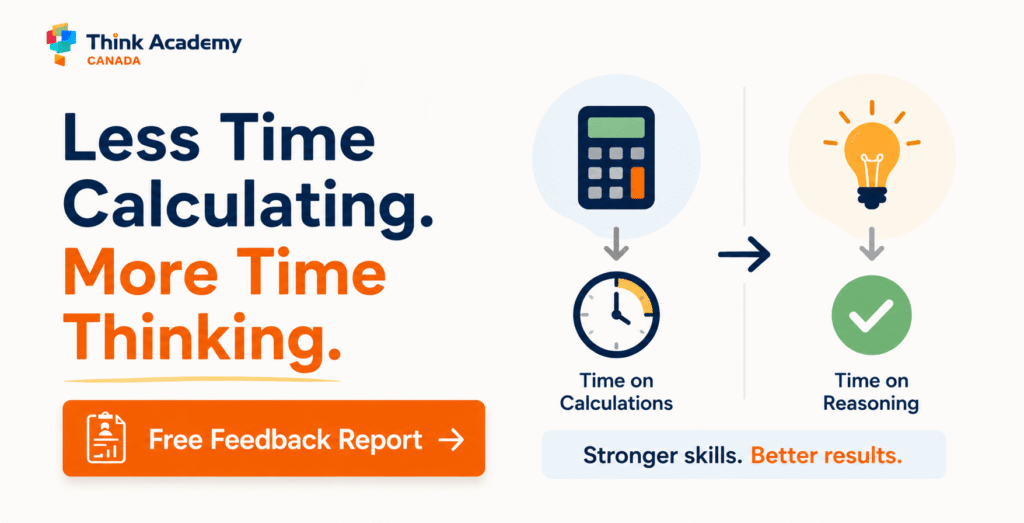
When basic calculations become automatic, students have more mental capacity for algebra, geometry, and problem-solving.
Our assessment identifies the calculation skills that are slowing your child down so they can focus on understanding—not just arithmetic.
→ Get your free feedback report
How to Practise Mental Math: A Structured Approach
Mental math is built through regular, deliberate practice — not through occasional intense sessions. The following approach is research-informed and practically effective.
Daily Warm-Up (5 minutes)
Every mathematics session — whether for school, tutoring, or self-study — should begin with 5 minutes of mental math warm-up. This is the single most effective habit for building mental math fluency because it makes the skill daily rather than occasional.
Format: 20 problems, timed. The problems should be at the edge of the student’s current fluency — not so easy they are automatic, not so hard they are guesses. Record the time. Track improvement over weeks.
Suggested progression by age:
- Grades 1–2: Addition and subtraction facts to 20
- Grades 3–4: Multiplication and division facts to 10×10, adding/subtracting two-digit numbers mentally
- Grades 5–6: Multiplication to 12×12, multiplying two-digit numbers by one-digit, percentages of simple numbers
- Grades 7–8: Multi-step mental arithmetic, squaring numbers to 20, fraction and percentage calculations
- Grades 9–12: Mental algebra simplification, quick estimation, competition-style rapid calculation
Spaced Retrieval Practice
Fact fluency — knowing that 8 × 7 = 56 — is built through spaced retrieval: being tested on a fact, recalling it, and being tested again after a delay. The spacing is what moves the fact from short-term to long-term memory.
Flashcards (physical or digital) are effective when used correctly:
- Review each fact until you can recall it in under 2 seconds
- Rotate facts you know out of the daily review; keep weaker facts in daily rotation
- Add new facts gradually — adding too many at once prevents any from becoming automatic
Our active recall guide explains how to structure spaced retrieval practice effectively.
Strategy Practice (Not Just Fact Drill)
Fact fluency alone is not sufficient for strong mental math. Strategy practice — explicitly practising the make-10 method, doubling and halving, the 9s trick — develops the computational reasoning that makes unfamiliar calculations manageable.
For each strategy:
- Learn the strategy with an example
- Practise 10 problems using only that strategy
- Practise 10 problems mixing that strategy with previously learned ones
- Practise 10 mixed problems without knowing which strategy is needed in advance (this is the most important step)
The final step — not knowing which strategy applies — develops the flexibility that makes mental math work in real contexts.
Real-Life Mental Math
The gap between practised mental math and applied mental math is real. Students who are fluent on flashcards but never use mental math outside the practice session do not build the habit of calculating mentally in daily life.
Build in real-life contexts deliberately:
- In the supermarket: estimate the total before reaching the checkout
- When cooking: double or halve a recipe mentally
- When travelling: calculate journey times or distances
- Playing games: keep score mentally
These contexts are low-stakes and build the habit of reaching for mental calculation rather than a calculator.
Mental Math by Grade Level: What to Target
| Grade | Primary Focus | Target Fluency |
|---|---|---|
| Grade 1–2 | Addition/subtraction facts to 20 | Recall in under 3 seconds |
| Grade 3–4 | Multiplication/division facts to 10×10 | Recall in under 3 seconds |
| Grade 5–6 | Two-digit × one-digit mental multiplication, percentages | Under 5 seconds |
| Grade 7–8 | Multi-step mental calculations, squares to 20 | Under 8 seconds per problem |
| Grade 9–12 | Rapid estimation, algebraic mental simplification | Appropriate for contest speed |
Mental Math in Mathematics Competitions
For students preparing for CEMC and AMC contests, mental math is a direct performance lever. Contest mathematics is timed, no-calculator, and rewards students who can calculate quickly and accurately.
Specific competition contexts where mental math matters most:
Part A of the Gauss / Cayley / Fermat: 10 multiple choice questions worth 5 marks each. Students who can calculate cleanly without writing every intermediate step complete Part A faster and with more accuracy. See our Gauss math contest guide.
AMC 8 and AMC 10: 40 minutes, 25 questions, no calculator. Mental computation speed is a significant advantage. Students who verify answers mentally rather than re-working every step save substantial time. See our AMC 8 guide and AMC 10 guide.
Euclid Part A and B: numerical response and short answer questions where clean mental calculation prevents errors that would otherwise occur in multi-step written work. See our Euclid contest guide.
For students specifically building contest readiness, mental math practice should be integrated into contest preparation from the start — not treated as separate from problem-solving practice. See our math competitions in Canada guide for the full competition landscape.
Practice Problems: Mental Math Challenges
Work through these without writing anything down. Time yourself.
Set A — Grade 4–6 level (target: under 15 seconds each)
- 47 + 36 = ___
- 83 − 47 = ___
- 14 × 6 = ___
- 96 ÷ 8 = ___
- 25 × 4 = ___
- 35% of 60 = ___
- 19 × 5 = ___
- 132 − 57 = ___
Set B — Grade 7–8 level (target: under 20 seconds each)
- 47 × 8 = ___
- 15² = ___
- 3/4 of 96 = ___
- 17 × 12 = ___
- 20% of 145 = ___
- 125 × 8 = ___
- 19² = ___
- 648 ÷ 8 = ___
Set C — Contest level (target: under 25 seconds each)
- 23 × 17 = ___
- 12.5% of 320 = ___
- 37 × 13 = ___
- 99 × 99 = ___
Answers: Set A: 1) 83 2) 36 3) 84 4) 12 5) 100 6) 21 7) 95 8) 75
Set B: 9) 376 10) 225 11) 72 12) 204 13) 29 14) 1,000 15) 361 16) 81
Set C: 17) 391 (23 × 17 = 23 × 20 − 23 × 3 = 460 − 69) 18) 40 (12.5% = 1/8; 320 ÷ 8) 19) 481 (37 × 13 = 37 × 10 + 37 × 3 = 370 + 111) 20) 9,801 ((100−1)² = 10,000 − 200 + 1)
How Think Academy Builds Mental Math
Think Academy Canada works with students from Grade 1 through Grade 12. Mental math fluency — both fact retrieval and computational strategy — is built into our programme at every level, not treated as a separate add-on.
At the early elementary level (Grades 1–4), every Think Academy session begins with structured fact fluency practice. At the intermediate level (Grades 5–8), mental math warm-ups include multi-step strategy problems. At the senior and competition level (Grades 9–12), rapid mental calculation is integrated into contest preparation.
The free diagnostic assessment identifies specifically where a student’s mental math fluency currently sits — which facts are automatic, which require calculation, and which strategies are available to them. That information drives a targeted improvement plan, rather than generic fact-drill that may be too easy in some areas and too hard in others.
Frequently Asked Questions
What is mental math? Mental math is the ability to perform mathematical calculations accurately and efficiently without paper, calculator, or external aids. It combines fact retrieval fluency (knowing 8 × 7 = 56 automatically) and computational reasoning (calculating 47 × 8 using decomposition strategies). Both are learnable and both need deliberate practice.
At what age should children start building mental math skills? From the earliest years of school. Counting, comparing quantities, and simple addition and subtraction — practised mentally from Grade 1 — are the foundations of mental math fluency. The skill builds cumulatively: a child who builds strong addition fluency in Grade 1 finds multiplication fluency easier in Grade 3.
Is mental math still important if my child uses a calculator? Yes. Calculators are not permitted in EQAO assessments, CEMC contests, AMC contests, or the Alberta Diploma Examination. Beyond assessments, mental math fluency improves general mathematical performance by freeing working memory for higher-order thinking. A student who understands whether an answer is in the right ballpark (estimation) will also catch calculator errors that a student without number sense misses.
How long does it take to build mental math fluency? For fact fluency (multiplication tables to 10×10), consistent practice of 5–10 minutes daily over 6–8 weeks produces reliable improvement. Strategy fluency — being able to compute 47 × 8 mentally — takes longer: 3–6 months of structured strategy practice to become reliable. The key is consistency over time, not intensity in short bursts.
What is the best way to practise mental math at home? Daily timed fact practice (5 minutes), explicit strategy teaching and practice (10 minutes, 3 times per week), and integration into real-life contexts. See the structured practice section above for a detailed approach.
Does mental math help with mathematics competitions? Significantly. All major Canadian and US mathematics competitions — CEMC contests, AMC series — are timed and no-calculator. Mental math fluency reduces calculation time and errors, leaving more cognitive resources for the actual problem-solving. For students targeting competition mathematics, mental math practice is not optional preparation — it is table stakes.
See our related guides: number sense parent guide · active recall guide · math enrichment guide · Gauss math contest guide · AMC 8 guide · AMC 10 guide · Euclid math contest guide · math competitions in Canada · skip counting worksheets · Ontario math curriculum overview
Mental math fluency is the foundation of mathematical speed and confidence. Build it deliberately.
Mental math improves with the right habits and strategies—not endless repetition.
In a free online trial lesson, our teachers identify your child’s current fluency, introduce practical mental math techniques, and create a personalised plan to build speed, confidence, and number sense.