Math Kangaroo Canada — also called the Canadian Math Kangaroo Contest (CMKC) — is one of the most accessible entry points into competitive mathematics for Canadian students. As part of the International Kangaroo Mathematics Contest (IKMC), it draws students from over 90 countries each year and is particularly popular with Grades 1-5 in Canada, making it the ideal first math contest for ambitious younger students. This guide covers everything Canadian parents need to know: how the contest works at each grade level, when registration opens, where to find past papers, how to prepare, and how Math Kangaroo fits into a broader contest pathway alongside Gauss, AMC 8, and Pascal. If your child has already participated in the 2026 contest (held March 19, 2026), this guide also helps you plan for next year and choose what comes next.
What is Math Kangaroo?
Math Kangaroo is the world’s largest mathematics competition by participation, with over six million students competing annually across more than 90 countries. It was founded in France in 1991 and has since become the most accessible international math contest available — open to students from Grade 1 all the way through Grade 12.
In Canada, the contest is run by the Canadian Math Kangaroo Contest (CMKC), a volunteer-led, non-profit organisation that coordinates registration, test administration, and scoring across Canadian test centres.
Why Math Kangaroo is different from other math contests
Math Kangaroo is deliberately designed to be accessible and fun rather than purely competitive. Unlike contests like Gauss, AMC 8, or Pascal, Math Kangaroo emphasises problem-solving creativity and mathematical intuition over advanced curriculum content. Most questions can be solved with elementary-level math but require clever thinking.
This makes it the ideal first contest for younger students. A Grade 3 child can attempt Math Kangaroo without needing extensive contest preparation, while still being meaningfully challenged. Compare this to Gauss (Grade 7-8), AMC 8 (typically Grade 6-8), or Pascal (Grade 9) — all of which require more advanced curriculum knowledge.
Why Math Kangaroo matters for ambitious students
For families thinking long-term about competitive mathematics:
- Math Kangaroo is the best entry point into contest math for Grade 1-5 students
- Strong Math Kangaroo performance correlates with later success in Gauss, AMC 8, and beyond
- It teaches the kind of problem-solving thinking that school math often misses
- The certificates are internationally recognised and valued for academic portfolios
- Students who do well at Math Kangaroo are typically the same students ready for Think Academy-level enrichment programs
For a broader look at the contest pipeline for Canadian students, see our Waterloo Math Competitions guide and our AMC 8 complete guide.
Math Kangaroo Canada: format and structure
Grade levels and test structure
Math Kangaroo offers separate contests for each grade level from Grade 1 to Grade 12, with questions calibrated to age-appropriate difficulty:
| Grade level | Questions | Time | Maximum score |
|---|---|---|---|
| Grades 1-2 | 24 questions | 75 minutes | 96 points |
| Grades 3-4 | 24 questions | 75 minutes | 96 points |
| Grades 5-6 | 30 questions | 75 minutes | 120 points |
| Grades 7-8 | 30 questions | 75 minutes | 120 points |
| Grades 9-10 | 30 questions | 75 minutes | 120 points |
| Grades 11-12 | 30 questions | 75 minutes | 120 points |
Students take the test for their current grade level. They can “challenge up” by taking the contest at a higher grade level if they want a harder test, but they cannot take a lower level.
Scoring system
Math Kangaroo uses a unique scoring system designed to encourage attempts:
- Every student starts with a base score (18, 24, or 30 points depending on the contest level). This ensures students cannot go below 0.
- One-third of questions are worth 3 points, one-third are worth 4 points, and one-third are worth 5 points.
- No penalty for incorrect answers. Unlike SSAT or AMC, students should attempt every question even if they’re guessing.
- No calculators allowed during the contest.
- Top 20 students per grade level per region are recognised as winners and receive awards.
The “no penalty” rule is important to understand strategically. Because guessing has no downside, students should never leave questions blank. Even random guessing on a hard 5-point question has a 25% expected value (assuming 4 answer choices), which is positive.
Question difficulty distribution
Questions are sorted in roughly increasing difficulty:
- First third (3-point questions): Approachable, often solvable with quick reasoning
- Middle third (4-point questions): Require more careful problem-solving
- Final third (5-point questions): Genuinely challenging, often requiring creative insight
For most students, the 3-point questions are easy marks and should be completed quickly. The 4-point questions reward careful work. The 5-point questions are where contest winners distinguish themselves — these often require thinking that’s not taught in school.
When is Math Kangaroo Canada in 2027?
Math Kangaroo runs annually in March, typically on the third Thursday. The 2026 contest took place on March 19, 2026. Based on this pattern, the 2027 contest is expected to be in mid-to-late March 2027, with the official date announced by the CMKC in late 2026.
Key dates and deadlines
For the 2027 contest cycle (expected):
| Milestone | Approximate timing |
|---|---|
| Registration opens | September 2026 |
| Standard registration deadline | December 2026 |
| Late registration | January-February 2027 (higher fee) |
| Contest date | Mid-to-late March 2027 |
| Results released | May 2027 |
Registration typically closes in February, so parents planning for 2027 should mark September 2026 as the time to start watching for registration opening.
Where to register
Registration is managed entirely through the official Math Kangaroo Canada website at mathkangaroo.ca. Students can:
- Register at a physical test centre (University of Toronto St. George Campus, UBC, and many other locations across Canada)
- Take the contest online (a remote option is typically available)
- Participate through their school if the school is registered
Slots at popular test centres fill up quickly, so early registration is strongly recommended. Late registration (January-February) usually incurs a higher fee.
Registration fees
Standard registration fees are typically around $20-25 CAD, with late registration adding a fee. Some test centres charge additional administrative fees. Fees are subject to change each year — check mathkangaroo.ca for current rates.
Math Kangaroo past papers and practice resources
The best preparation for Math Kangaroo is genuine problem-solving practice with the contest’s specific style of questions.
Where to find official past papers
The Canadian Math Kangaroo organisation publishes past contest papers on its website. International Math Kangaroo organisations also share past papers, and many of these problems overlap. Useful sources:
- Math Kangaroo Canada (mathkangaroo.ca) — official Canadian past papers
- Math Kangaroo USA — large archive of past papers in English
- International Math Kangaroo organisations — official problems from other participating countries, useful since Math Kangaroo problems are translated and reused internationally
Past papers from 2018 onwards are typically the most relevant, as the contest has remained structurally consistent.
How to use past papers effectively
Past papers are valuable, but how you use them matters more than how many you do:
Time them properly. Math Kangaroo is a 75-minute test. Practice papers should be done in 75 minutes from start to finish, not casually across an afternoon. Time pressure is part of what the contest tests.
Review every wrong answer. A practice paper with a score of 80/120 isn’t actually useful — what’s useful is understanding why the 40 missed points were missed. Was it careless arithmetic? Misreading? Unfamiliar problem type? Time pressure?
Categorise the mistakes by question type. Different students struggle with different categories: spatial reasoning, sequences, counting problems, geometry. Identifying the pattern is the entire point of practice.
Practice in increasing difficulty. Start with a level below your child’s grade level to build confidence and contest familiarity. Then move to grade-level papers. Save challenge papers (one grade above) for late preparation.
Beyond past papers
Past papers are excellent, but they’re a limited resource — students go through them quickly. Other useful preparation:
- Math Olympiad style problem books (e.g., MOEMS, Art of Problem Solving’s introductory books)
- NRICH problems (a free UK-based resource with high-quality contest-style problems)
- Structured contest preparation programs that teach the specific problem-solving techniques contest questions reward
How to prepare your child for Math Kangaroo
A few principles based on what works for successful Canadian Math Kangaroo competitors.
Preparation timeline by goal
The right preparation timeline depends on your child’s goal:
| Goal | Recommended preparation |
|---|---|
| First-time participant, low pressure | 4-6 weeks of light practice |
| Aiming to score well, no contest experience | 3-4 months of structured practice |
| Aiming for top 20 (winner) | 6-12 months of contest-focused prep |
| Building toward future contest pathway | Year-round consistent enrichment |
For most families, 3-4 months of structured preparation is the right amount. Less than 6 weeks rarely produces meaningful improvement; more than 6 months can lead to burnout in younger children.
A realistic 12-week prep plan
Weeks 1-2: Diagnose
Have your child complete one past paper from one year below their grade level. Time it at 75 minutes. Mark together. Don’t worry about score — the point is information.
Identify two patterns:
- Which question types are hardest (e.g., spatial reasoning, sequences, counting)?
- Where in the test do mistakes cluster (3-point, 4-point, or 5-point sections)?
Weeks 3-8: Targeted work
Spend 20-30 minutes a day, 4-5 days a week, on the weak areas identified.
For most students, the highest-leverage focus areas are:
- Mental arithmetic fluency — without a calculator, speed matters
- Spatial reasoning — visualising shapes, rotations, patterns
- Logical thinking — counting, ordering, sequence problems
- Reading the question carefully — many “wrong answers” are misreads
Weeks 9-11: Full practice papers
One full timed paper per week at grade level, with detailed review after each. By the third paper, your child should be hitting close to their target score.
Week 12: Light review and rest
The last week should focus on confidence, not new content. Sleep, calm routine, and one final lighter practice session.
What works and what doesn’t
What works:
- Consistent short sessions beat sporadic long ones
- Variety of problem types rather than drilling one type repeatedly
- Discussing solutions with a parent or tutor — verbalising the reasoning strengthens it
- Calm, low-pressure framing especially for younger children
- Practicing under realistic time pressure
What doesn’t:
- Cramming the week before the contest
- Pushing past frustration — if your child is genuinely stuck, take a break
- Treating each wrong answer as a failure — they’re diagnostic information, nothing more
- Comparing your child to other students — every child develops at their own pace
Math Kangaroo vs other math contests
A common question: should my child do Math Kangaroo, Gauss, AMC 8, or all of them?
How the major Canadian contests compare
| Contest | Grade range | Difficulty | Best for |
|---|---|---|---|
| Math Kangaroo | 1-12 | Accessible, fun | First-time competitors, Grades 1-5 |
| Gauss | 7-8 | Moderate | Strong students transitioning to senior contests |
| AMC 8 | 8 and below | Challenging | Students aiming for AMC 10/12 pathway |
| Pascal | 9 | Moderate-challenging | Grade 9 students starting CEMC pathway |
| Cayley | 10 | Challenging | Strong Grade 10 students continuing CEMC |
For ambitious Canadian students, the natural progression is:
- Math Kangaroo (Grades 1-5) — entry point
- Gauss (Grades 7-8) — first CEMC contest
- AMC 8 (Grades 6-8) — alternative or parallel American pathway
- Pascal/Cayley/Fermat (Grades 9-11) — senior CEMC contests
- AMC 10/12 (Grades 9-12) — senior American contests
- Euclid (Grade 12) — university admission contest
For deeper coverage of each of these, see our AMC 8, Gauss, Pascal, Cayley, Fermat, and Euclid guides.
Should my child do multiple contests?
For students serious about competitive mathematics, yes. Math Kangaroo and AMC 8 in particular complement each other well — Math Kangaroo emphasises creativity and accessibility, while AMC 8 emphasises curriculum depth. Together they build different problem-solving skills.
For younger students (Grades 1-5), Math Kangaroo alone is usually plenty. Layering AMC 8 prep onto a Grade 3 student is typically counterproductive — let them build foundational contest skills first.
Common questions about Math Kangaroo Canada
How hard is Math Kangaroo?
Math Kangaroo is designed to be accessible at the entry level but genuinely challenging at higher difficulties. The 3-point questions can typically be solved by most students at grade level. The 4-point questions require careful thinking. The 5-point questions are intentionally difficult — even strong students often only attempt half of them confidently.
A typical strong student might score 70-85 points out of 96 (Grades 1-4) or 85-100 points out of 120 (Grades 5+). Winners (top 20) usually score above 90 out of 120 at the higher levels.
What’s a good Math Kangaroo score?
It depends on the goal:
- Just participating: any positive score is fine for first-time competitors
- Good performance: scoring above the median for the grade level (varies by year)
- Top 50%: competitive performance suggesting your child is ready for harder contests
- Top 20 (winner): typically scores in the top 10-15% of all participants nationally
The CMKC website publishes score distributions each year, so parents can see exactly how their child compared.
Are calculators allowed?
No. Calculators are strictly prohibited at all Math Kangaroo grade levels. Students must do all calculations mentally or on scratch paper. This is one of the key contest skills students need to build during preparation.
Does Math Kangaroo affect university applications?
Directly, no — Math Kangaroo is for younger students primarily and isn’t part of university applications. However, consistent strong performance across multiple years does build a math portfolio that can be referenced in:
- Applications to selective private schools (which sometimes ask about extracurricular math)
- Applications to gifted programs and enrichment opportunities
- Eventually, in university applications as part of a broader mathematical portfolio (Olympiad participation, Waterloo CEMC contests, AMC, etc.)
The real value is the trajectory — students who do well in Math Kangaroo at Grade 3 are often the same students who excel at Gauss, AMC 8, Pascal, and beyond. The contest itself doesn’t determine future success, but it’s a strong early indicator.
How Think Academy Canada prepares students for Math Kangaroo
Think Academy is the international arm of TAL Education Group, one of the largest education companies in the world. Our Canadian programs are deliberately designed for high-performing students — those ready to engage with material that runs ahead of the school curriculum and prepares them for contests like Math Kangaroo, Gauss, and AMC 8.
Math Kangaroo-specific preparation. Our curriculum includes contest-style problem solving from Grade 1 onwards, building the kind of creative thinking Math Kangaroo rewards.
Curriculum that runs ahead of the Ontario standard. Our students consistently meet next-grade math content before their classmates do — which means contest topics feel like review, not new material.
Mental math fluency. Our practice problems are deliberately calculator-free, building the mental arithmetic that contest math requires.
Teachers who mark every homework set personally. Real feedback on the types of mistakes your child is making — which is exactly the diagnostic approach that produces strong contest performance over time.
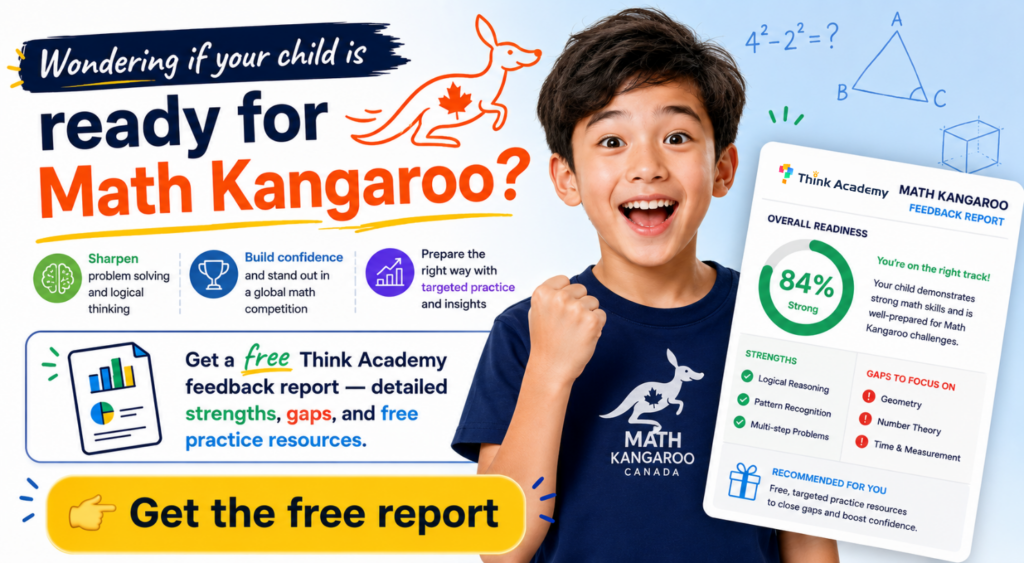
Free math assessment. Find out exactly where your child stands on the contest-readiness spectrum. Our free assessment takes about 20 minutes, gives you a detailed feedback report on strengths and gaps by topic, and includes free practice resources tailored to your child’s level.
Frequently asked questions
What is Math Kangaroo?
Math Kangaroo is the world’s largest international math competition by participation, with over six million students competing annually across 90+ countries. In Canada, it’s run by the Canadian Math Kangaroo Contest (CMKC). It’s open to students from Grade 1 to Grade 12 and is particularly popular with younger students (Grades 1-5).
When is Math Kangaroo Canada?
Math Kangaroo Canada is held annually in March, typically on the third Thursday. The 2026 contest was on March 19, 2026. The 2027 contest is expected in mid-to-late March 2027, with the official date confirmed by CMKC in late 2026.
How long is the Math Kangaroo test?
75 minutes for all grade levels. Grades 1-4 have 24 multiple-choice questions; Grades 5 and above have 30 questions.
How is Math Kangaroo scored?
Students start with a base score (18, 24, or 30 points depending on level). One-third of questions are worth 3 points, one-third are worth 4 points, and one-third are worth 5 points. There’s no penalty for wrong answers, so students should attempt every question.
H3: Can students use calculators on Math Kangaroo?
No. Calculators are strictly prohibited at all grade levels.
How do I register for Math Kangaroo Canada?
Registration is through the official Math Kangaroo Canada website (mathkangaroo.ca). Standard registration opens in September and closes in December, with late registration extending through January-February at a higher fee. Slots fill up quickly at popular test centres.
How much does Math Kangaroo cost?
Standard registration is typically around $20-25 CAD. Late registration adds a fee. Fees are subject to change each year — check mathkangaroo.ca for current rates.
Where can I find Math Kangaroo past papers?
Past papers are available on the official Math Kangaroo Canada website (mathkangaroo.ca) and on international Math Kangaroo sites. Many past problems are also available in published books and through Think Academy’s prep resources.
How should my child prepare for Math Kangaroo?
A realistic prep plan is 3-4 months of structured practice. Start with a diagnostic past paper to identify weak areas, spend 6-8 weeks on targeted work in those areas, then move to full timed practice papers in the final 3-4 weeks. Consistent short sessions (20-30 minutes daily) beat sporadic long ones.
What’s the difference between Math Kangaroo and AMC 8?
Math Kangaroo is more accessible and creativity-focused, with grade levels from 1-12 and a fun, multiple-choice format. AMC 8 is more advanced, primarily for Grades 6-8, and focuses on curriculum depth and competitive problem-solving. Math Kangaroo is the ideal first contest; AMC 8 is the next step for ambitious students.
Can my child participate online or only in person?
Both options are typically available. Students can register at a physical test centre (like the University of Toronto or UBC) or take the test online. The in-person experience often provides full scoring and participation gifts, while online participation is more flexible.
Is Math Kangaroo worth it for younger students?
For high-performing students, yes. Math Kangaroo is the best entry point to competitive mathematics for Grades 1-5 and builds the problem-solving skills that prepare students for later contests like Gauss and AMC 8. Even a single year of participation gives parents and teachers a clear sense of where the child stands relative to their peers.
What award levels exist?
The top 20 students per grade level per region are recognised as winners. Within that, students typically receive Gold, Silver, or Bronze awards based on relative ranking, and certificates are awarded to all participants.
My child missed Math Kangaroo 2026. What should we do?
Plan for 2027. The contest is annual, so missing one year doesn’t preclude future participation. Use the time before registration opens (September 2026) to build contest math skills. A free Think Academy assessment can identify exactly where your child stands and what to work on this year.
About Think Academy Canada
Think Academy Canada, part of TAL Education Group, supports K–12 students with structured math programs built around an online interactive platform, gamified learning, and teachers who personally mark every homework set. Our curriculum runs ahead of the provincial standards and is designed to prepare students for both school excellence and competitive math contests including Math Kangaroo, Gauss, AMC 8, Pascal, Cayley, Fermat, and Euclid.
🟦 Follow us on Instagram @thinkacademyca for daily Ontario math tips, worked examples, and free resources.