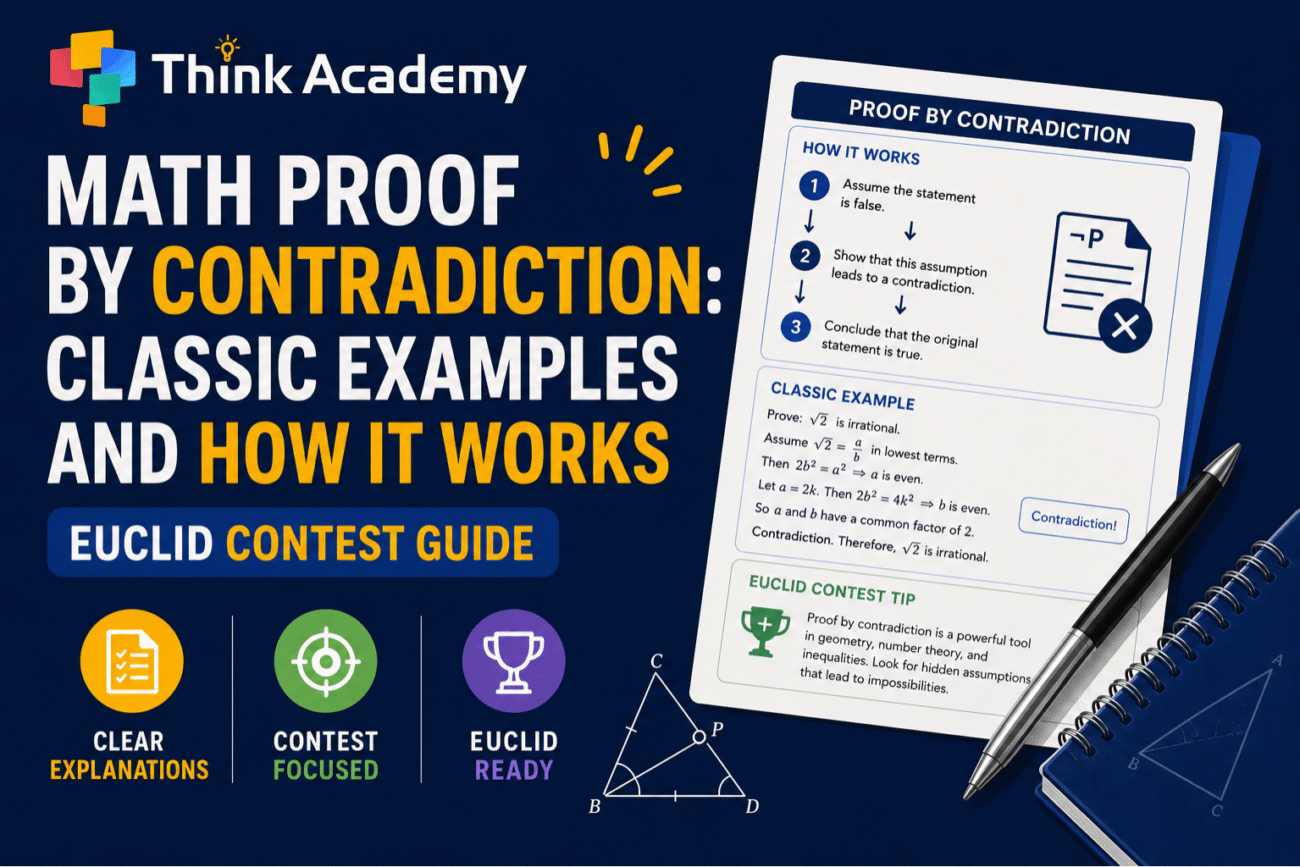
Proof by contradiction is one of the most powerful tools in a mathematician’s toolkit, and one of the least intuitive when students first encounter it. The idea — assume the opposite of what you want to prove, then show that assumption leads to something impossible — feels backwards at first. But it is the standard technique behind some of the most famous results in mathematics, and it appears regularly in Euclid Contest problems that ask students to prove something cannot be true. This guide explains the method clearly, works through the classic examples, and shows how the technique applies to Ontario Grade 11–12 math and Euclid Contest preparation.
What is proof by contradiction?
Proof by contradiction (also called indirect proof, or reductio ad absurdum) is a method of proving a statement by assuming it is false and showing that this assumption leads to a logical impossibility.
The structure is always the same:
- Assume the opposite of what you want to prove
- Reason logically from that assumption
- Reach a contradiction — something that is impossible, or that contradicts the original assumption itself
- Conclude that the assumption must be false, which means the original statement must be true
If a statement takes the form “If P, then Q,” proof by contradiction works by assuming P is true and Q is false, then deriving a contradiction. If a statement is simply “X is true,” the method assumes “X is false” and works from there.
Why proof by contradiction works
This method relies on a basic principle of logic: a statement and its negation cannot both be true. If assuming a statement is false leads to something impossible, the only way to resolve the contradiction is to conclude the original statement must be true after all.
Proof by contradiction is particularly useful for proving:
- That something does not exist (no largest prime, no rational solution)
- That something cannot happen (a line cannot be both tangent and secant to the same circle at the same point)
- Statements where a direct proof is difficult because there isn’t much to work with directly
As one well-known guide on proof technique notes, it is considered good style to use proof by contradiction specifically when a direct proof is difficult to construct — using it when a direct proof is readily available is often seen as unnecessarily roundabout.
The classic example: the square root of 2 is irrational
This is the most famous proof by contradiction in mathematics and the one nearly every student encounters first.
Claim: √2 is irrational.
Step 1 — Assume the opposite: Suppose √2 is rational. Then it can be written as a fraction a/b, where a and b are integers with no common factors (the fraction is fully reduced).
Step 2 — Reason from the assumption: √2 = a/b 2 = a²/b² 2b² = a²
This means a² is even (since it equals 2 times an integer). If a² is even, then a itself must be even (the square of an odd number is always odd). So we can write a = 2k for some integer k.
Step 3 — Continue the reasoning: Substituting a = 2k: 2b² = (2k)² = 4k² b² = 2k²
This means b² is even, so b must also be even.
Step 4 — Reach the contradiction: But we assumed a and b had no common factors. If both a and b are even, they share a factor of 2 — directly contradicting our original assumption.
Conclusion: The assumption that √2 is rational leads to a contradiction. Therefore, √2 must be irrational.
The classic example: there are infinitely many primes
This proof is attributed to Euclid himself and is one of the oldest known examples of the technique — making it especially relevant for students preparing for a contest that bears his name.
Claim: There are infinitely many prime numbers.
Step 1 — Assume the opposite: Suppose there are only finitely many primes. List them all: p₁, p₂, p₃, …, pₙ, where pₙ is the largest prime.
Step 2 — Construct a new number: Let N = (p₁ × p₂ × p₃ × … × pₙ) + 1
Step 3 — Reason about N: N is either prime or composite (made of smaller prime factors).
If N is prime, it is a prime number larger than pₙ — but we assumed pₙ was the largest prime. Contradiction.
If N is composite, it must be divisible by one of the primes in our list (since those are supposedly all the primes that exist). But dividing N by any pᵢ in the list always leaves a remainder of 1 (because N was constructed as a product of all the primes, plus 1). So no prime in the list divides N evenly.
Step 4 — Reach the contradiction: Either way, we reach an impossible situation: N must have a prime factor, but no prime in our supposedly complete list can be that factor.
Conclusion: The assumption that there are finitely many primes is false. There must be infinitely many primes.
A geometric example: tangent lines and contradiction
Proof by contradiction also appears in geometry, including topics directly relevant to Cayley and Euclid Contest preparation.
Claim: A tangent to a circle is perpendicular to the radius at the point of tangency.
Step 1 — Assume the opposite: Suppose the tangent line at point A is not perpendicular to radius OA.
Step 2 — Reason from the assumption: If OA is not perpendicular to the tangent, then there exists some other point B on the tangent line where OB is shorter than OA (since the perpendicular distance from a point to a line is always the shortest distance).
Step 3 — Reach the contradiction: If OB < OA, then B is closer to the centre than the radius length — meaning B would lie inside the circle. But B was defined as a point on the tangent line, and a tangent line by definition does not enter the circle’s interior.
Conclusion: The assumption leads to a contradiction. Therefore, the tangent must be perpendicular to the radius at the point of tangency.
This is the formal justification behind the tangent-radius theorem used throughout circle geometry problems on the Cayley Contest.
For more on tangent lines and circles, see Tangent Line to a Circle: Theorems, Equations and Cayley Contest Problems.
How to write your own proof by contradiction: a method
Step 1: State what you want to prove clearly. Be precise about the exact claim — vague statements lead to vague (and incorrect) negations.
Step 2: Write the negation correctly. This is the step where most errors occur. If the claim is “all primes are odd,” the negation is “there exists at least one prime that is not odd” — not “all primes are even.” Negating a universal statement (“all X are Y”) produces an existential statement (“there exists an X that is not Y”).
Step 3: Assume the negation is true, and explore its consequences. Work through what must logically follow if your assumption holds.
Step 4: Look for an impossibility. This could be: a number that is both even and odd, a fraction that isn’t fully reduced when it should be, a value that is both inside and outside a region, or a direct violation of an axiom or previously proven fact.
Step 5: State the contradiction and conclude. Clearly identify what was contradicted, and state that the original claim must therefore be true.
Common mistakes in proof by contradiction
| Mistake | How to avoid it |
|---|---|
| Negating the statement incorrectly | “All X are Y” negates to “some X is not Y,” not “all X are not Y” |
| Not using the assumption anywhere in the proof | The assumption must be actively used to derive the contradiction — if it isn’t, the “proof” hasn’t actually shown anything |
| Reaching a true statement and calling it a contradiction | The result must be impossible or directly conflict with something established, not just unexpected |
| Writing a proof by contradiction when a direct proof is simpler | Contradiction is best reserved for non-existence claims or when a direct approach has no clear starting point |
| Losing track of what the original contradiction needs to be | Keep the goal in mind — know what “impossible” will look like before you start reasoning |
Proof by contradiction and the Euclid Contest
The Euclid Mathematics Contest requires full written solutions with complete logical reasoning, not just final answers. Proof-based questions appear regularly, and proof by contradiction is one of the standard techniques students need to recognise as available.
When Euclid problems call for contradiction:
- Problems asking to prove something is impossible (no integer solutions exist, a certain configuration cannot occur)
- Problems asking to prove a value is irrational or has a specific property that is easier to disprove the opposite of
- Problems involving uniqueness (showing there is only one such object, by assuming there are two and deriving a contradiction)
What examiners look for: A complete proof by contradiction needs a clearly stated assumption, valid logical steps, an explicitly identified contradiction, and a clear concluding statement. Students who arrive at a contradiction but do not clearly state what was contradicted, or do not conclude properly, lose marks even when their mathematical reasoning was correct.
Practice problems
Try proving these using contradiction before checking the approach below.
Q1. Prove that there is no smallest positive rational number.
Q2. Prove that if n² is even, then n is even.
Q3. Prove that √3 is irrational.
Approach — Q1
Assume there is a smallest positive rational number, call it r. Consider r/2. Since r is positive, r/2 is also positive and rational, and r/2 < r. This contradicts the assumption that r was the smallest. Therefore, no smallest positive rational number exists.
Approach — Q2
Assume n² is even, but n is odd (the negation). If n is odd, n = 2k + 1 for some integer k. Then n² = (2k+1)² = 4k² + 4k + 1 = 2(2k² + 2k) + 1, which is odd. This contradicts the assumption that n² is even. Therefore, if n² is even, n must be even.
Approach — Q3
Assume √3 is rational. Then √3 = a/b for integers a, b with no common factors. Squaring: 3 = a²/b², so 3b² = a². This means a² is divisible by 3, so a is divisible by 3 (write a = 3k). Substituting: 3b² = 9k², so b² = 3k², meaning b is also divisible by 3. This contradicts a and b having no common factors. Therefore √3 is irrational.
How Think Academy Canada supports Euclid preparation and proof-based reasoning
Think Academy Canada works with high-performing Ontario students from Grade 1 through Grade 12. For students preparing for the Euclid Contest, proof construction is one of the most important — and most underdeveloped — skills, since most school curricula focus heavily on computation and less on formal logical argument.
Our approach starts with a free diagnostic. Every new student completes a short assessment and receives a personalised feedback report identifying where their skills stand. For students in Grade 11 and 12, the report often distinguishes between strong computational ability and weaker proof construction — two different skills that require different preparation strategies.
The Euclid Contest is written in April each year and is the only CEMC contest requiring full written proofs. Students who practise constructing complete arguments — not just solving for an answer — well before the contest are significantly better prepared for the proof-based questions that distinguish strong scores from exceptional ones.
FAQ
What is proof by contradiction?
Proof by contradiction is a method of proving a mathematical statement by assuming it is false, reasoning logically from that assumption, and showing that it leads to an impossibility. Since the assumption cannot be true, the original statement must be true.
What is another name for proof by contradiction?
Proof by contradiction is also known as indirect proof or reductio ad absurdum (Latin for “reduction to absurdity”).
What is the most famous example of proof by contradiction?
The proof that √2 is irrational is the most commonly taught example. The proof that there are infinitely many prime numbers, attributed to Euclid, is another classic example often used in contest mathematics.
How do you negate a statement correctly for proof by contradiction?
The negation depends on the structure of the statement. “All X are Y” negates to “there exists an X that is not Y.” “If P then Q” is negated by assuming P is true and Q is false. Getting the negation right is the most critical and most commonly mistaken step.
When should you use proof by contradiction instead of a direct proof?
Proof by contradiction works particularly well for statements claiming something does not exist, cannot happen, or is unique. If a direct proof is straightforward, it is generally preferred — contradiction is best reserved for cases where a direct approach has no obvious starting point.
Does proof by contradiction appear on the Euclid Contest?
Yes. The Euclid Contest requires full written solutions, and proof by contradiction is a standard technique for problems asking students to show something is impossible, irrational, or unique. Students need to know when to recognise contradiction as the right approach.
What makes a proof by contradiction incomplete?
A proof is incomplete if the assumption is never actually used to derive the contradiction, if the “contradiction” reached is not actually impossible, or if the conclusion is not clearly stated. Euclid Contest markers look for all of these elements to award full marks.
Is proof by contradiction hard to learn?
The concept itself is straightforward once explained, but applying it correctly — especially negating statements precisely and identifying genuine contradictions — takes practice. Students who have only seen the classic examples (√2, infinite primes) often struggle to construct an original proof by contradiction independently.
What is the difference between proof by contradiction and proof by contrapositive?
Proof by contradiction assumes the statement is false and derives an impossibility. Proof by contrapositive proves “if P then Q” by instead proving the logically equivalent statement “if not Q then not P.” They are related but structurally different techniques.
How can Think Academy Canada help with proof-based math?
Think Academy Canada offers a free diagnostic assessment for students in Grades 1 to 12. The assessment identifies where a student’s mathematical skills stand, including the distinction between computational fluency and proof construction ability — a key area for students preparing for the Euclid Contest.
About Think Academy Canada Think Academy Canada is a K-12 mathematics tutoring programme, part of TAL Education Group. We work with motivated students across Canada from Grade 1 through Grade 12, with a focus on Ontario curriculum, EQAO preparation, and competition mathematics including CEMC contests (Pascal, Cayley, Fermat, Euclid) and AMC. All lessons are delivered online. Follow us on Instagram at @thinkacademyca.