


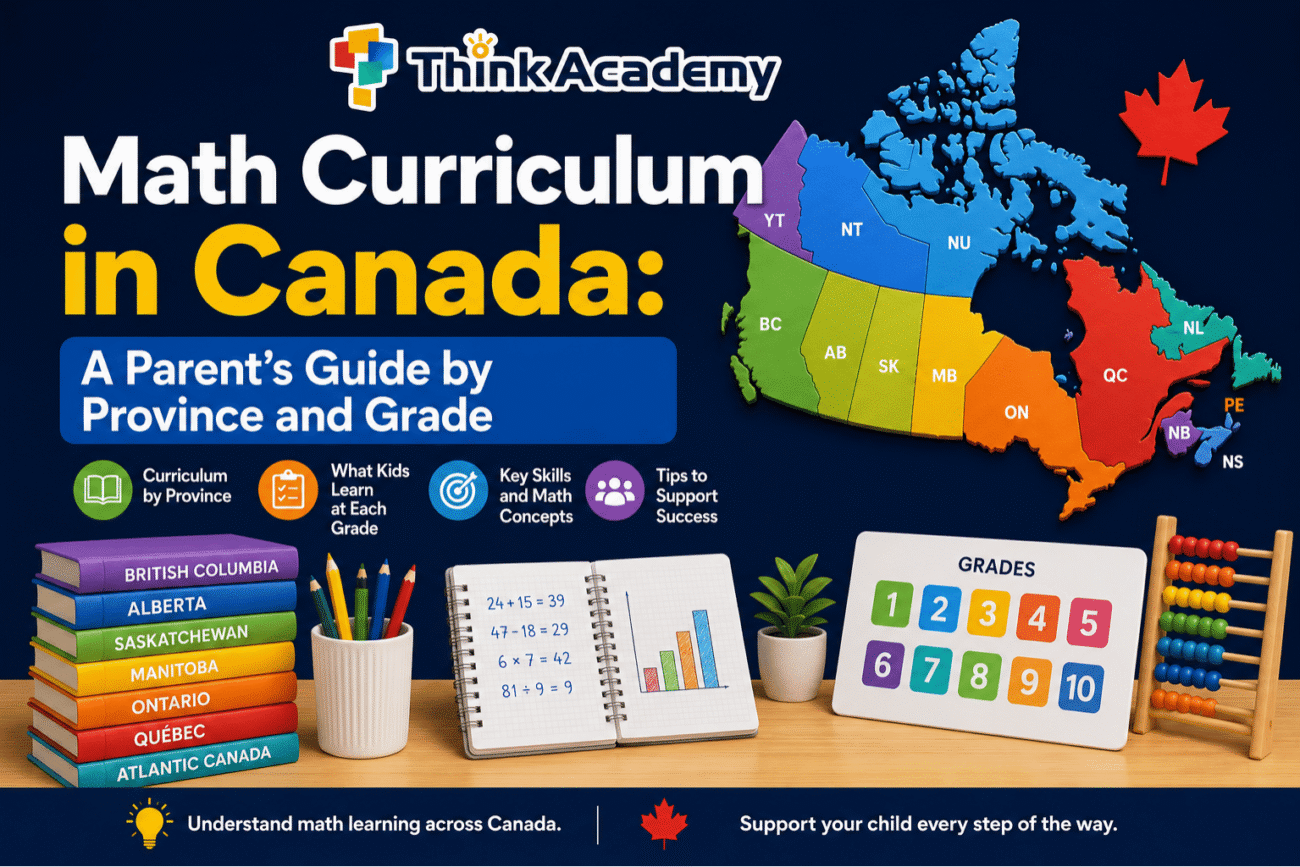
Every province and territory in Canada sets its own math curriculum, which means a Grade 5 student in Alberta and a Grade 5 student in Ontario are taught from different official documents. In practice, the core skills overlap heavily — but the framing, terminology, and pace can differ enough to confuse parents who are trying to understand what their child should know. This guide walks through how the Canadian math curriculum works at a national level, what’s taught at each grade band, and where the real differences between provinces show up.
How the math curriculum works in Canada
Education in Canada is a provincial and territorial responsibility, not a federal one. There is no single national math curriculum — each of the ten provinces and three territories writes and governs its own.
Despite this, there’s more consistency than the structure suggests. Most provinces and territories outside Ontario and Quebec follow some version of the Western and Northern Canadian Protocol (WNCP), a shared curriculum framework for Alberta, British Columbia, Saskatchewan, Manitoba, the Northwest Territories, Nunavut, and Yukon. This means a student moving between most Western provinces will find the math curriculum broadly aligned, even though each province publishes its own document.
Ontario and Quebec each maintain entirely separate curricula. Ontario’s 2020 mathematics curriculum is organised into six strands. Quebec’s curriculum places a stronger relative emphasis on mathematical reasoning and proof from an earlier age, reflecting the province’s broader educational philosophy.
| Framework | Provinces/territories | Notes |
|---|---|---|
| Ontario curriculum | Ontario | Six strands; own curriculum document |
| Quebec curriculum | Quebec | Distinct approach with strong emphasis on reasoning |
| WNCP (Western and Northern Canadian Protocol) | Alberta, BC, Saskatchewan, Manitoba, NWT, Nunavut, Yukon | Shared framework with provincial variations |
| Atlantic provinces | Nova Scotia, New Brunswick, PEI, Newfoundland and Labrador | Largely aligned with WNCP outcomes, with provincial adjustments |
For a complete guide to Ontario’s math curriculum, check out Ontario Math Curriculum: What Kids Learn in Grades 1–8.
What’s taught at each grade level: the common core of the math curriculum
Despite different curriculum documents, the math skills Canadian students are expected to learn follow a broadly similar progression nationally. This is the core sequence that holds across nearly every province.
Grades 1–3: foundational number sense
- Counting, place value, and number representation (typically to 20 in Grade 1, growing to the hundreds by Grade 3)
- Addition and subtraction strategies, building toward fluency with basic facts
- Introduction to fractions as equal parts of a whole
- Basic shape recognition and measurement using non-standard and then standard units
- Simple patterns and early algebraic thinking
Grades 4–6: building fluency and connecting concepts
- Multi-digit multiplication and division
- Fractions, decimals, and (by Grade 5–6) percentages, with an increasing focus on how they relate to each other
- Introduction to negative numbers and integers
- Area, perimeter, and (by Grade 6) volume
- Data collection, graphing, and basic probability
- More formal pattern rules and simple equations with variables
Grades 7–9: the shift toward abstraction
- Integer operations across all four operations
- Ratios, rates, and proportional reasoning
- Linear relations and introductory algebra — graphing, slope, solving equations
- More complex geometry (angle properties, the Pythagorean theorem, surface area and volume of 3D shapes)
- Financial literacy concepts (simple interest, budgeting, taxes)
By the end of Grade 9, most provinces converge on similar expectations even though the exact course names differ — Ontario’s MTH1W (de-streamed Grade 9 math), for example, covers content that aligns closely with Grade 9 outcomes in WNCP provinces, even though the curriculum documents are entirely separate.
Grades 10–12: branching into specific course pathways
This is where provincial differences become most visible, because high school math splits into multiple course pathways depending on a student’s intended direction (university, college, workplace, or apprenticeship).
- Quadratic functions, analytic geometry, and trigonometry (typically Grade 10)
- Advanced functions, exponential and logarithmic functions, and more advanced trigonometry (Grade 11)
- Calculus and vectors, or data management, as separate stream options (Grade 12)
Quebec’s system differs most significantly here: high school ends at Secondary V (equivalent to Grade 11), after which students who plan to attend university move into CEGEP — a two-year pre-university program — where the most advanced math content is completed.
How province math curriculums differ: the parts that actually matter
Pace and sequencing
The order topics are introduced varies. Some provinces introduce integers slightly earlier or later; some sequence fractions-to-decimals-to-percent connections differently. These differences rarely cause major gaps if a student changes schools within Canada, but they can cause a few weeks of unfamiliarity after a move.
Terminology
Ontario’s curriculum uses named strands (Number, Algebra, Data, Spatial Sense, Financial Literacy) that don’t have exact equivalents in WNCP language, which tends to group outcomes under headings like Number, Patterns and Relations, Shape and Space, and Statistics and Probability. The content overlaps substantially; the labels don’t always map one-to-one.
Coding and financial literacy
Ontario’s 2020 curriculum was notable for embedding coding and financial literacy as explicit, named content starting in Grade 1. Other provinces cover similar ground but with less prescriptive, less consistently sequenced expectations — meaning the depth of coverage can vary more by individual teacher and school than it does in Ontario.
Assessment
Standardized provincial assessment differs significantly. Ontario uses EQAO at Grades 3, 6, and 9. Other provinces run their own assessment programs on different schedules and at different grades, and some — like British Columbia — have moved toward more competency-based, less standardized-test-driven assessment models in recent years.
Performance differences
International and national comparisons (PISA, PCAP) consistently show some provincial variation in outcomes. Quebec has had the highest average math score among all provinces on both these assessments, with the result placing among the strongest in the world. Manitoba has shown weaker relative performance, a decline that one researcher attributed in part to curriculum changes that introduced multiple solving strategies for simple math without enough clarity for students and parents. These differences reflect a mix of curriculum design, teacher training, and broader systemic factors — they are not simply a measure of how “hard” a curriculum is on paper.
A practical guide to math curriculums: finding your province’s specific curriculum
Because the national picture is useful for context but not detail, parents generally need their specific provincial curriculum to understand exactly what their child is expected to know. For Ontario families, here is a complete breakdown by grade:
| Grade | Ontario curriculum guide |
|---|---|
| Grade 1 | Numbers to 50; addition/subtraction facts to 10; early patterns and equations |
| Grade 2 | Numbers to 200; regrouping; fractions of sets; coding |
| Grade 3 | Numbers to 1,000; multiplication/division facts; EQAO assessment year |
| Grade 4 | Numbers to 10,000; equivalent fractions; area formulas |
| Grade 5 | Numbers to 100,000; fraction-decimal-percent connections |
| Grade 6 | Integers introduced; ratios; EQAO assessment year |
| Grade 7 | Integer operations; linear patterns; circle geometry |
| Grade 8 | Multi-variable algebra; volume of cylinders and cones |
| Grade 9 (MTH1W) | De-streamed curriculum; linear relations; EQAO assessment year |
| Grade 10 (MPM2D) | Quadratics; analytic geometry; trigonometry |
| Grade 11 (MCR3U) | Functions; exponential and trigonometric functions |
If your family is in a different province, the grade-by-grade content above provides a close approximation, but exact terminology and sequencing will vary. Your provincial Ministry or Department of Education website is the authoritative source for the specific curriculum document.
Why math curriculum knowledge alone doesn’t tell you how your child is doing
Knowing what a curriculum covers answers the question “what should my child be learning?” It does not answer “is my child actually learning it well?” Those are different questions, and conflating them is one of the most common gaps in how parents assess their child’s progress.
A student can be sitting in a Grade 6 classroom covering exactly the right Grade 6 content and still have unresolved gaps from Grade 4 or 5 that the curriculum assumes are already solid. Curriculum documents describe intended content; they say nothing about an individual student’s actual mastery of material from previous years.
This is the gap a diagnostic assessment is designed to close — not “what should be taught” but “what does this specific child actually know right now.”
How Think Academy Canada supports students across Canada
Think Academy Canada works with high-performing students from Grade 1 through Grade 12, across Canada. Our programmes are built around what an individual student actually needs, not just what their grade level says they should know.
Our approach starts with a free diagnostic. Every new student completes a short assessment and receives a personalised feedback report showing exactly where their skills sit, along with free practice resources matched to their specific results. This matters more than knowing the curriculum in the abstract — it tells you precisely where your child’s gaps are, regardless of which province’s curriculum document they’re being taught from.
FAQ
Is there one national math curriculum in Canada?
No. Education is a provincial and territorial responsibility in Canada, so each of the ten provinces and three territories has its own curriculum. Ontario and Quebec maintain entirely separate curricula, while most other provinces and territories follow some version of the Western and Northern Canadian Protocol (WNCP), a shared framework with provincial adjustments.
How similar is math curriculum across Canadian provinces?
The core skills and general progression are broadly similar — number sense, operations, fractions, geometry, algebra, and data appear in roughly the same order at similar ages across the country. The differences are mainly in terminology, pacing, assessment methods, and how explicitly certain topics (like coding and financial literacy) are named and sequenced.
What is the Western and Northern Canadian Protocol (WNCP)?
The WNCP is a shared curriculum framework used by Alberta, British Columbia, Saskatchewan, Manitoba, the Northwest Territories, Nunavut, and Yukon. It provides a common base for math outcomes across these provinces and territories, though each still publishes and adapts its own curriculum documents.
Why does Quebec perform differently in math compared to other provinces?
Quebec has consistently scored highest among Canadian provinces on national and international math assessments. Researchers attribute this partly to significantly more required math education training for elementary teachers and a curriculum that balances basic skills with problem-solving approaches.
How do I find out exactly what my child should know in math?
The most accurate source is your provincial Ministry or Department of Education’s curriculum document for your child’s specific grade. For a general sense of progression, the grade-by-grade summary in this guide provides a useful approximation across most of Canada.
Does moving provinces affect a child’s math education?
Generally, the impact is moderate. Core skills are similar enough that most students adjust within a few weeks. The areas most likely to cause temporary confusion are differences in terminology, the exact sequencing of topics within a school year, and assessment format (for example, moving to or from Ontario, which uses EQAO).
What math topics are consistent across nearly all Canadian provinces by Grade 9?
By the end of Grade 9, most provinces cover integer operations, linear relations and introductory algebra, more advanced geometry (including the Pythagorean theorem), and financial literacy concepts — even though the specific course names and curriculum documents differ.
How is high school math different in Quebec compared to the rest of Canada?
Quebec’s high school ends at Secondary V, equivalent to Grade 11 elsewhere in Canada. Students intending to attend university then complete a two-year pre-university program called CEGEP, where the most advanced math content (including calculus, in many cases) is completed — rather than within high school itself as in most other provinces.
Is the math curriculum the same difficulty in every province?
Curriculum documents set similar content expectations, but actual student outcomes vary by province on national and international assessments. This reflects a combination of factors beyond the written curriculum itself, including teacher training requirements, instructional approaches, and broader educational system differences.
How can Think Academy Canada help if I’m not sure what my child should know?
Think Academy Canada offers a free diagnostic assessment for students in Grades 1 to 12 across Canada. Rather than relying solely on curriculum documents, the assessment shows exactly where your child’s actual skills stand and provides a personalised feedback report along with free practice resources matched to their specific results.
About Think Academy Canada Think Academy Canada is a K-12 mathematics tutoring programme, part of TAL Education Group. We work with motivated students across Canada from Grade 1 through Grade 12, with deep expertise in Ontario curriculum and EQAO preparation, alongside competition mathematics including CEMC and AMC. All lessons are delivered online. Follow us on Instagram at @thinkacademyca.


It’s really interesting how much variation there is across the provinces. I was just looking into the Ontario curriculum for my son’s grade 3 and it’s quite different from what we’ve seen in Quebec.